
The Role of Innovation Workshops in Team Growth
TL;DR:
- Innovation workshops are strategic tools that reframe problems, align teams, and drive execution beyond mere brainstorming. Proper design, diverse participation, and follow-through are essential to transform ideas into organizational growth and prevent innovation theater. Embedding regular workshops into long-term workflows sustains creative momentum and strategic impact across teams.
Most business leaders assume an innovation workshop is just a fancier brainstorming session. Get people in a room, throw ideas at a whiteboard, and call it creative thinking. That assumption is exactly why so many teams leave workshops with flipchart pages full of sticky notes and zero traction on anything. The real role of innovation workshops is far more strategic than raw ideation. When designed well, they restructure how teams think, identify the right problems to solve, and create the conditions where structured creativity actually converts into organizational growth. This article breaks down what that really looks like in practice.
Table of Contents
- Key Takeaways
- The role of innovation workshops defined
- How to run innovation workshops that deliver results
- Problem framing as the real strategic advantage
- Common pitfalls that kill workshop momentum
- Integrating workshops into long-term growth strategy
- My perspective: what most leaders get wrong about workshops
- Take your team’s innovation further with Nomadexcel
- FAQ
Key Takeaways
| Point | Details |
|---|---|
| Workshops are strategic tools | Innovation workshops go beyond brainstorming to reframe problems, align teams, and drive execution. |
| Design determines outcomes | Duration, participant diversity, and pre-work are critical design factors that directly affect results. |
| Problem framing is the real edge | Identifying and reframing the right problem is more valuable than generating large volumes of ideas. |
| Follow-through separates good from great | Assigning clear ownership and prioritization rubrics before the session ends prevents idea abandonment. |
| Regular use builds innovation culture | Embedding workshops into a recurring rhythm sustains creative momentum and team engagement over time. |
The role of innovation workshops defined
What are innovation workshops, exactly? They are structured, facilitated sessions designed to help teams generate, evaluate, and act on ideas within a defined time frame and a clear problem space. That last part matters. The word “structured” is doing a lot of work here. Unlike informal team conversations or casual ideation meetings, a well-designed workshop uses deliberate frameworks, cross-functional participation, and facilitation techniques to move a group from fuzzy challenge to concrete next step.
The importance of innovation workshops comes down to three things they do that everyday work cannot. They break down organizational silos by bringing together people who do not normally share a table. They create psychological safety so that unconventional ideas surface without fear. And they compress the kind of thinking that would otherwise take weeks of scattered email threads into one or two focused days.
Diversity of thought combined with psychological safety produces richer innovation outcomes than homogeneous, high-IQ groups working in familiar hierarchies. That finding matters for any leader who assumes putting the smartest people in a room is enough. It is not. The mix of perspectives, and the safety to voice them, is what generates breakthrough thinking.
Here is a quick reference for the core goals workshops are designed to serve:
| Workshop goal | Expected outcome |
|---|---|
| Problem identification | Teams surface the real challenge, not the assumed one |
| Cross-functional ideation | Solutions integrate perspectives from multiple disciplines |
| Alignment on priorities | Teams leave with shared understanding and agreed direction |
| Prototype and test thinking | Ideas get stress-tested against real constraints before investment |
| Ownership assignment | Each idea has a named person responsible for next steps |
The benefits of innovation sessions extend well beyond the day itself. Structured workshops have sustained impact measured over six months post-session, with participants reporting increased confidence and reduced barriers to creative engagement. That is not a soft benefit. That is a measurable shift in how teams approach problems.
How to run innovation workshops that deliver results
The difference between a workshop that sparks real change and one that produces a beautiful deck nobody acts on comes down to design choices made before anyone walks in the door.
Duration and format
Effective innovation workshops optimally last one to two full days. Shorter sessions tend to produce superficial results because they only allow for divergent thinking without the convergent phase where ideas get refined, challenged, and prioritized. Two days gives enough time for iteration and prototyping without pushing participants into burnout territory. Energy management is an active facilitation responsibility, not an afterthought.

Participant selection
Cross-functional teams consistently outperform siloed groups. Include people from different departments, levels, and functions. Even better, bring in customers, frontline employees, or outside experts. Pre-work interviews with frontline employees and customers uncover richer insights than executive opinions alone, and they focus the workshop on real problems rather than assumed ones.
Pre-work and preparation
Workshop pre-work enhances readiness and prevents participants from arriving cold. Simple reflection questions, short customer data summaries, or a relevant article can prime thinking and improve ideation quality from the first session. Do not skip this step.
Here are the core innovation workshop best practices worth building into every program:
- Define the problem space before the session begins, not during it.
- Assign a skilled facilitator who can read room energy and redirect when discussions stall.
- Send pre-work at least 48 hours in advance with a clear, low-effort ask.
- Mix participant seniority levels so that quieter voices get structured space to contribute.
- Build in convergent phases where ideas are evaluated against real criteria.
- Assign owners for the top three to five ideas before the session officially closes.
- Schedule a follow-up within two weeks to maintain accountability and momentum.
Pro Tip: Strong facilitation energy directly shapes participant engagement and output quality. Not every leader projects this naturally. If you are running your own workshop and know this is a gap, delegate facilitation to someone who does it well rather than struggling through it yourself.
Problem framing as the real strategic advantage
Here is where the conversation about the role of innovation workshops shifts from tactical to genuinely strategic. For years, the competitive advantage in innovation was assumed to lie in generating more ideas faster. That era is over. Generative AI can now produce hundreds of ideas on any topic within minutes. Raw ideation is no longer a scarce resource.
Innovation advantage has shifted from ideation quantity to quality of problem framing. Problem reframing is the new differentiator. The team that identifies the right problem, or reframes an obvious problem in a non-obvious way, will consistently out-innovate teams that are simply generating more output.
This is where workshops earn their highest value. A well-designed session does not just ask “what ideas do we have?” It asks “are we solving the right problem?” That distinction generates real competitive separation. Innovation workshops are best seen as problem framing and auditing sessions, not purely ideation events.
To use workshops for genuine problem framing, build these steps into the design:
- Start with a “how might we be wrong about this problem?” exercise to surface assumptions.
- Bring in behavioral data and customer usage patterns, not just stated preferences.
- Use the focusing question technique to narrow the group from ten problems to the one worth solving today.
- Map current problem frames visually and challenge each one with evidence.
- Explicitly separate problem definition from solution generation. Do not let the group jump to solutions before the problem is agreed upon.
When teams practice this consistently, workshops stop feeling like creative interruptions and start functioning as strategic decision-making tools. That is a meaningful shift for any organization serious about growth.
Common pitfalls that kill workshop momentum
The most frequent failure in innovation workshops is not a lack of creativity. It is the absence of execution infrastructure. Teams often produce many ideas but leave with no clear ownership or prioritization for follow-through. This is how “innovation theater” happens. The workshop feels productive, energy is high, and then three weeks later, nothing has moved.
Recognize the symptoms of innovation theater early:
- Ideas are celebrated equally with no filtering or prioritization process.
- No owner is assigned to any idea before the session closes.
- There is no defined next step, timeline, or decision checkpoint.
- Leadership is absent or disengaged during the session.
- The workshop is treated as a one-time event rather than part of a larger process.
The fix is structural, not motivational. Avoid innovation theater by defining decision rights and prioritization criteria before broad participation begins. Use a simple scoring rubric that evaluates ideas on feasibility, impact, and alignment with strategic goals. Assign a named owner for every idea that clears the bar. Set a two-week check-in before anyone leaves the room.
Leadership involvement signals priority and accelerates decision-making after the workshop. Executive presence alone boosts implementation rates because it communicates that these ideas have organizational backing, not just team enthusiasm.
Pro Tip: Measurable outcomes start with measurable inputs. Before the workshop, define what success looks like in concrete terms: number of ideas that enter a project pipeline, percentage of participants assigned ownership, follow-up completion rate at 30 days. If you cannot measure it, you cannot sustain it.
Integrating workshops into long-term growth strategy
A single workshop, however well-designed, is not a growth strategy. The sustained impact of collaboration workshops comes from making them a recurring part of how a team operates, not a one-off event triggered by a crisis or a quarterly offsite.
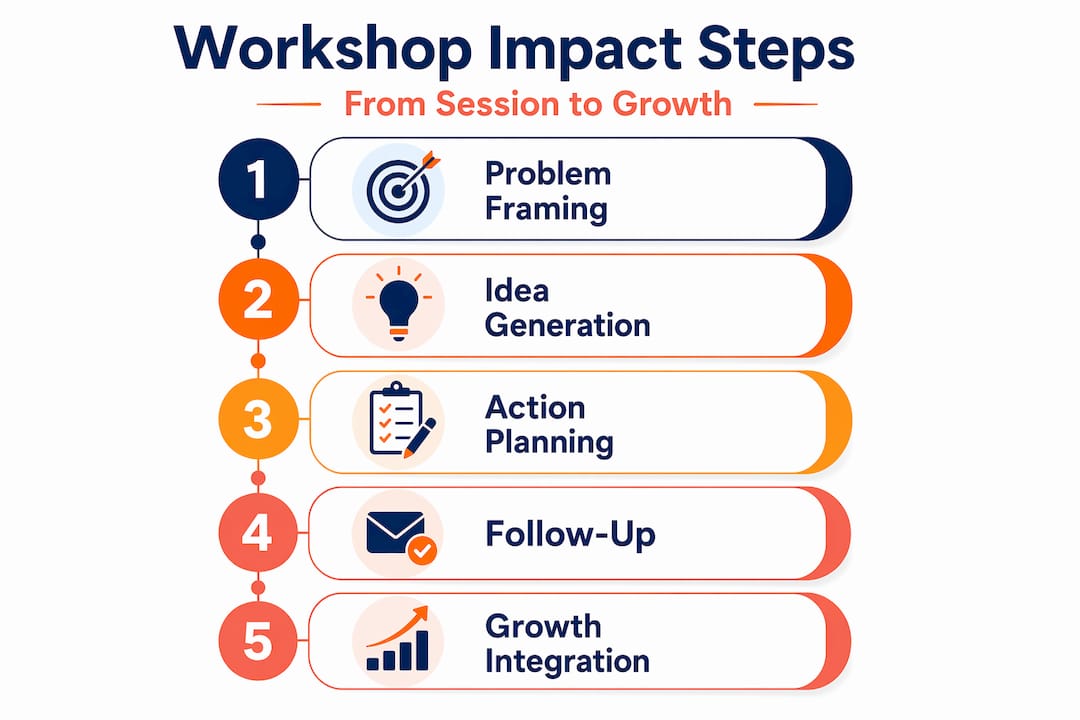
Embedding innovation into daily workflows sustains momentum and culture. Recurring workshops, visible action plans, and regular progress reviews create a rhythm that keeps creative thinking alive between sessions. Think of it as maintaining a muscle rather than attempting a sprint once a year.
Practical ways to integrate workshops into your team’s growth strategy include:
- Running a focused problem-framing session at the start of each major initiative.
- Using shorter, 90-minute “mini-workshop” formats monthly to revisit priorities and surface new signals.
- Building a library of team innovation exercises that can be deployed between full sessions to maintain engagement.
- Connecting workshop outputs to your broader innovation strategies so that ideas feed directly into team roadmaps.
- Using digital collaboration tools like virtual whiteboards to include remote and hybrid participants at full engagement, not as passive observers.
Resource allocation is a leadership signal. When teams see budget, time, and facilitation support dedicated to regular innovation sessions, they internalize that this is how the organization actually thinks, not just something that happens when things get slow. That cultural message matters more than any single workshop outcome.
My perspective: what most leaders get wrong about workshops
I’ve watched a lot of teams leave innovation workshops energized and return to their desks unchanged. The problem is almost never the ideas. It’s the framing that happened before the ideas were generated. In my experience, the leaders who get the most out of these sessions are the ones who arrive having already challenged their own assumptions about the problem. Everyone else arrives ready to solve something that may not be the actual constraint.
What I’ve learned is that the most valuable thing a workshop can do is force a team to sit with discomfort before moving toward solutions. That means resisting the pull toward the familiar idea that gets the room nodding. Balanced participation produces better results than letting the loudest voice define the direction, and I have seen that play out repeatedly. The quieter person who works directly with customers often holds the insight that reframes everything.
The hard truth about follow-through is that most leaders treat it as the team’s responsibility. It is not. It is a leadership responsibility. If the ideas from a workshop are not reflected in the next sprint, budget conversation, or strategic update, the signal sent to the team is that the workshop was theater. That perception is almost impossible to reverse. Workshops become growth engines when leaders treat the output as a genuine input to strategy, not a check-in-the-box exercise.
— Amichai
Take your team’s innovation further with Nomadexcel
The ideas in this article are a starting point. Putting them into practice consistently, at the pace that actually drives growth, is where most teams need structured support. Nomadexcel designs immersive experiences that take the principles of effective innovation workshops and build them into intensive, results-focused programs.
The Online Entrepreneurship Bootcamp gives individuals and early-stage teams the frameworks, mentorship, and execution focus to turn creative thinking into real business outcomes. For established teams, business retreats for remote teams combine facilitated workshop experiences with genuine team reconnection, giving groups the space and structure to align on strategy and return with renewed creative momentum. If you are ready to move beyond one-off sessions, Nomadexcel is where that next step happens.
FAQ
What is the role of innovation workshops in business?
Innovation workshops help teams identify the right problems, generate and evaluate ideas within a structured framework, and assign ownership for execution. Their role goes beyond ideation to include strategic alignment and creative problem framing.
How long should an effective innovation workshop last?
Research suggests one to two full days is the optimal duration. Shorter sessions tend to produce surface-level results because they do not allow for the convergent thinking phase where ideas are refined and prioritized.
What is innovation theater and how do you avoid it?
Innovation theater happens when workshops generate excitement but no follow-through. Avoiding it requires defining decision rights, using prioritization rubrics, and assigning named owners to ideas before the session ends.
Why does participant diversity matter in innovation workshops?
Diversity of thought combined with psychological safety produces richer outcomes than high-IQ homogeneous groups. Including cross-functional team members, customers, and frontline employees surfaces insights that purely executive-led sessions consistently miss.
How do you sustain innovation momentum after a workshop?
Embedding recurring workshops into your team’s workflow, connecting outputs to live project roadmaps, and scheduling a follow-up review within two weeks are the most reliable ways to sustain the impact of collaboration workshops over time.
Comments are closed.