
Harness creativity and innovation for startup growth
Many entrepreneurs believe creativity is a rare gift reserved for artists and visionaries. In reality, creativity is a learnable decision-making process that anyone can master. Innovation transforms these creative ideas into tangible business results. Research shows creativity improves SME performance significantly when paired with systematic innovation. This article explores how you can harness creativity and innovation to accelerate your startup’s growth, build competitive advantages, and create lasting value in 2026’s dynamic marketplace.
Table of Contents
- Understanding The Role Of Creativity In Entrepreneurial Success
- How Innovation Translates Creativity Into Business Growth
- Harnessing Design Thinking For Human-Centered Innovation
- Creating A Culture That Empowers Innovation And Creativity
- Explore Entrepreneurship Bootcamps To Unlock Your Creative Potential
Key takeaways
| Point | Details |
|---|---|
| Creativity drives measurable performance | Studies confirm that creative approaches directly boost small business outcomes and competitive positioning. |
| Innovation bridges ideas to revenue | Product innovation converts creative concepts into marketable solutions that generate real growth. |
| Design thinking centers on users | This methodology helps entrepreneurs uncover genuine customer needs through empathy and rapid prototyping. |
| Culture enables sustained innovation | Organizations that empower risk-taking and collaboration accelerate creative output and business results. |
| Constraints enhance creative output | Limited resources and defined boundaries often stimulate more original and practical solutions. |
Understanding the role of creativity in entrepreneurial success
Creativity isn’t about waiting for lightning strikes of inspiration. It’s a systematic process of making effective decisions that lead to original outcomes. Research demonstrates that creativity positively correlates with performance in small and medium enterprises. This means your ability to generate novel solutions directly impacts your bottom line.
Think of creativity as choice, not chance. Every time you solve a problem, you’re making decisions about which path to explore, which assumptions to challenge, and which solutions to test. These decisions accumulate into patterns that either foster or limit creative output. The good news? You can consciously improve these decision-making patterns through practice and awareness.
Interestingly, constraints often boost creativity rather than hinder it. Limited budgets force you to find resourceful solutions. Tight deadlines push you to prioritize ruthlessly. Even your current mood influences creative capacity. Understanding these factors helps you create conditions that maximize your creative potential.
Here’s what influences your creative output:
- Decision-making frameworks that encourage exploration over immediate judgment
- Environmental factors including physical space, time pressure, and resource availability
- Psychological states such as openness to experience and tolerance for ambiguity
- Social dynamics including team diversity and collaborative norms
Pro Tip: Schedule creative sessions when your energy peaks naturally. Morning people should brainstorm early, while night owls produce better ideas later. Align creative work with your biological rhythms for superior results.
The connection between creativity and innovation for entrepreneurial growth becomes clear when you view creativity as your ideation engine and innovation as your execution system. Both work together to transform market opportunities into competitive advantages.
How innovation translates creativity into business growth
Creativity generates possibilities, but innovation converts those possibilities into profits. Studies confirm that product innovation mediates the relationship between creativity and firm performance. Without innovation, creative ideas remain interesting concepts that never reach customers or generate revenue.
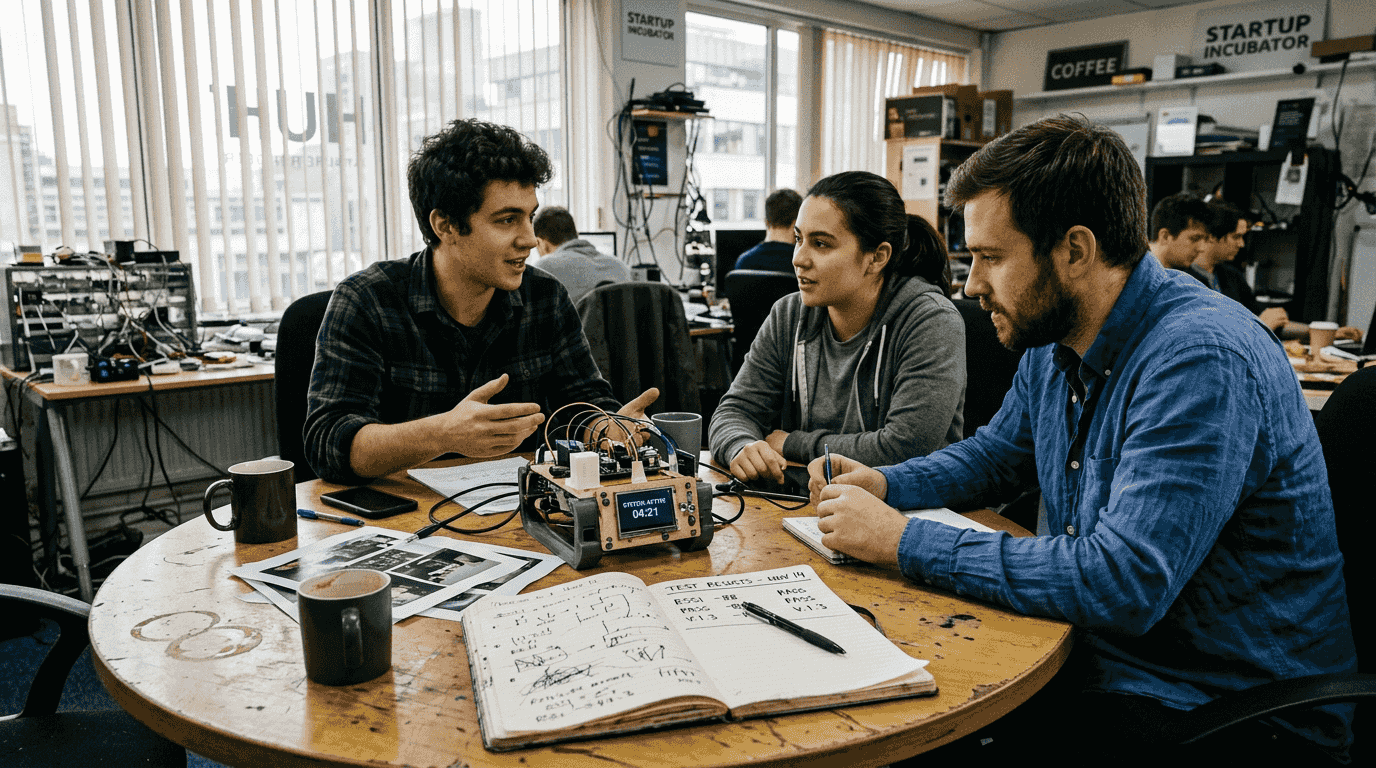
Innovation requires systematic approaches that move ideas through defined stages. The Corporate Innovation Playbook outlines a lifecycle framework that transforms innovation from random experimentation into repeatable capability. This structured approach helps startups avoid common pitfalls like pursuing ideas without market validation or scaling prematurely.
The innovation lifecycle includes these critical phases:
- Ideation: Generate and capture diverse ideas from multiple sources including customers, team members, and market observations.
- Evaluation: Filter ideas through lenses of desirability, feasibility, and viability to identify highest-potential opportunities.
- Incubation: Develop selected concepts through prototyping, testing, and iterative refinement based on real user feedback.
- Scaling: Expand validated solutions across markets, channels, or customer segments with proven business models.
- Partnership: Collaborate with external organizations to access complementary capabilities, distribution, or resources.
This systematic approach dramatically increases your success rate. Rather than betting everything on one untested idea, you create a portfolio of opportunities at different maturity stages. Some ideas move forward, others pivot, and many fail fast before consuming significant resources.
| Innovation Stage | Primary Goal | Key Activities | Success Metric |
|---|---|---|---|
| Ideation | Volume | Brainstorming, research, observation | Ideas generated |
| Evaluation | Quality | Scoring, filtering, prioritizing | Ideas advanced |
| Incubation | Learning | Prototyping, testing, iterating | Validated assumptions |
| Scaling | Growth | Expansion, optimization, automation | Revenue, users, impact |
Understanding innovation and higher growth helps you recognize which powerful innovation strategies fit your startup’s current stage and resources. Early-stage ventures benefit from rapid experimentation, while growing companies need systematic processes that maintain innovation velocity as teams expand.
Pro Tip: Track your innovation pipeline like a sales funnel. Monitor how many ideas enter each stage and what percentage advance. This reveals bottlenecks in your innovation process and helps you allocate resources effectively.
Harnessing design thinking for human-centered innovation
Design thinking offers entrepreneurs a proven methodology for creating solutions that customers actually want. This human-centered iterative approach fuses user needs with technical feasibility and business viability. Unlike traditional business planning that starts with solutions, design thinking begins with deep customer understanding.
The methodology cycles through five interconnected phases that you can repeat as you learn. Empathize involves immersing yourself in user experiences through interviews, observations, and contextual inquiry. Define synthesizes research into clear problem statements that guide solution development. Ideate generates diverse solution concepts without premature judgment. Prototype builds quick, low-fidelity versions to test assumptions. Test gathers user feedback to validate or invalidate hypotheses.
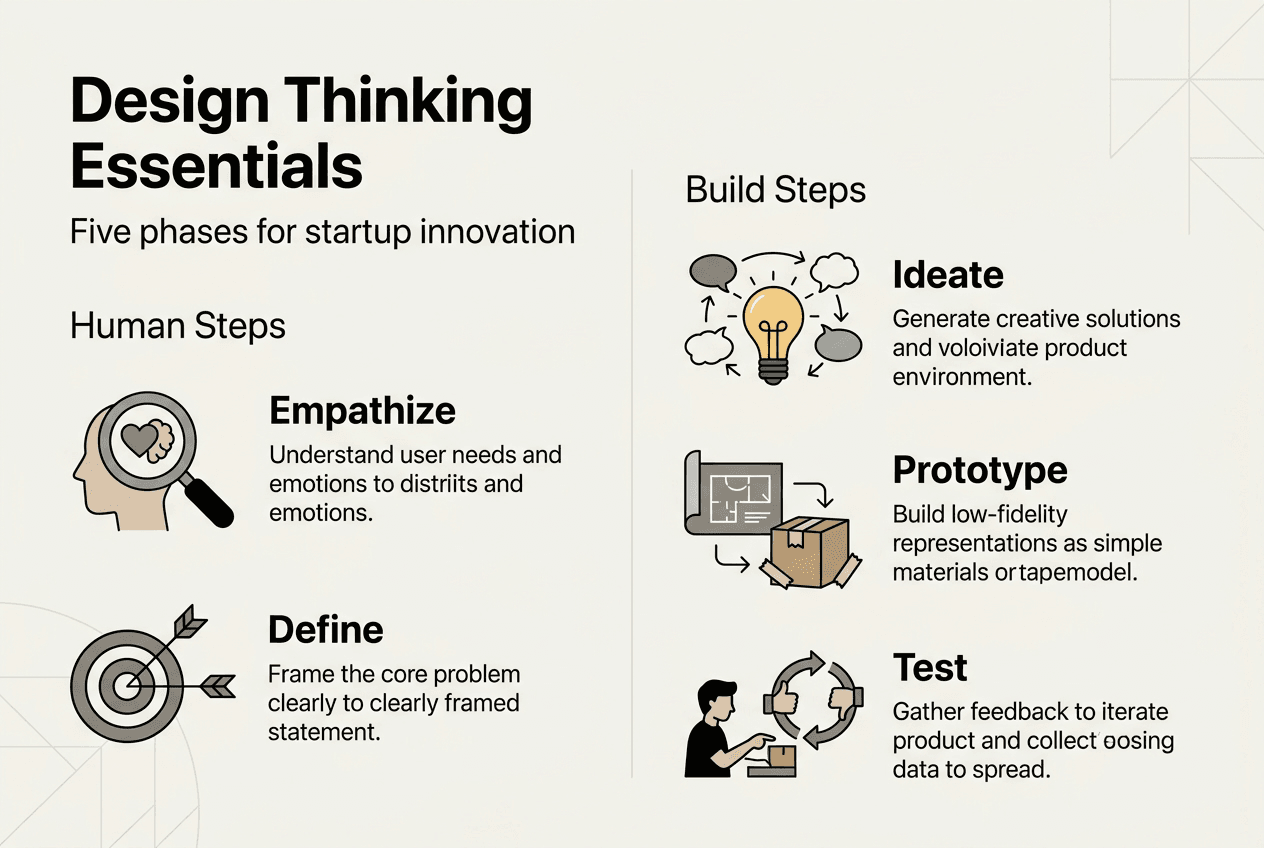
This non-linear process acknowledges that innovation rarely follows straight paths. You might prototype an idea, test it with users, gain new empathy insights, redefine your problem, and ideate fresh solutions. Each cycle builds knowledge that increases your probability of creating meaningful innovation.
Design thinking emphasizes understanding real user challenges before proposing solutions. This prevents the common entrepreneurial mistake of building products based on assumptions rather than evidence. When you truly understand customer struggles, frustrations, and unmet needs, you create offerings that resonate deeply and command premium prices.
Key benefits of design thinking for startups:
- Reduces development risk by validating concepts before major investment
- Uncovers latent needs that customers can’t articulate directly
- Accelerates learning cycles through rapid prototyping and testing
- Builds team alignment around shared customer understanding
- Creates differentiation through genuine user insight rather than feature competition
The methodology reframes wicked problems by breaking them into human-centered insights you can address systematically. Instead of feeling overwhelmed by complex market challenges, you develop concrete hypotheses to test and learn from quickly.
Pro Tip: Conduct empathy interviews with at least 10 potential customers before building anything. Ask about their current solutions, workarounds, and frustrations. Listen for emotional language that reveals pain intensity. These conversations often uncover opportunities you’d never discover through surveys or analytics alone.
Developing strong entrepreneurial thinking means embracing methodologies like design thinking that prioritize learning over being right. The faster you test assumptions and gather real-world feedback, the more efficiently you allocate limited startup resources.
Creating a culture that empowers innovation and creativity
Methodologies matter, but culture determines whether innovation becomes embedded in your organization’s DNA or remains an occasional activity. Fostering innovation culture requires empowering collaboration, encouraging calculated risk-taking, and viewing failures as learning opportunities rather than career-limiting mistakes.
Traditional organizational structures emphasize control, predictability, and risk avoidance. Innovation cultures flip these priorities. They value experimentation over certainty, learning over perfection, and speed over exhaustive analysis. This shift feels uncomfortable initially but becomes your competitive advantage as markets accelerate.
Building innovation culture starts with psychological safety. Team members must feel secure sharing unconventional ideas without fear of ridicule or punishment. When people self-censor to avoid looking foolish, you lose access to potentially breakthrough concepts. Leaders model this by sharing their own failed experiments and what they learned.
Cross-functional collaboration amplifies creative output by combining diverse perspectives. Engineers see problems differently than marketers, who think differently than operations specialists. These cognitive differences generate richer solution sets when channeled productively. Create regular forums where different functions collaborate on challenges outside their normal domains.
Essential elements of innovation culture:
- Dedicated time and resources for exploration beyond immediate deliverables
- Transparent sharing of experiments, results, and lessons across the organization
- Celebration of intelligent failures that generated valuable learning
- Flat communication structures that enable ideas to flow freely regardless of hierarchy
- Customer exposure for all team members, not just customer-facing roles
Compare traditional versus innovation-oriented cultures:
| Dimension | Traditional Culture | Innovation Culture |
|---|---|---|
| Decision-making | Top-down, hierarchical | Distributed, empowered |
| Failure response | Punish, avoid | Analyze, learn |
| Resource allocation | Predictable, controlled | Flexible, experimental |
| Success metrics | Efficiency, consistency | Learning, adaptation |
| Communication flow | Formal, filtered | Open, transparent |
Investing resources in innovation processes pays long-term dividends even when individual experiments fail. Each test generates data that informs future decisions. Over time, your organization develops pattern recognition that identifies promising opportunities faster and executes more efficiently.
Pro Tip: Institute a monthly innovation showcase where team members present experiments, regardless of outcomes. Focus discussions on insights gained rather than success or failure. This ritual reinforces that learning matters more than always being right.
Learn how to foster innovation for team growth and discover team building for startups strategies that create environments where creativity flourishes naturally rather than requiring forced ideation sessions.
Explore entrepreneurship bootcamps to unlock your creative potential
Understanding creativity and innovation intellectually differs dramatically from applying these concepts under real-world pressure. Structured learning environments accelerate your development by combining frameworks, mentorship, and peer collaboration that isolated study can’t replicate.
Entrepreneurship bootcamps immerse you in intensive learning experiences designed to shift mindsets and build practical skills rapidly. You work alongside other founders facing similar challenges, creating peer accountability and collaborative problem-solving opportunities. Expert mentors provide guidance based on their own entrepreneurial journeys, helping you avoid common pitfalls.
Nomad Excel offers programs specifically designed to help aspiring entrepreneurs transform creative ideas into viable businesses. Our online entrepreneurship bootcamp delivers structured frameworks for validating concepts, building minimum viable products, and acquiring early customers. Discover why joining an entrepreneurship bootcamp accelerates your journey and explore our program to find the right fit for your goals and schedule.
Frequently asked questions
What is the primary difference between creativity and innovation in entrepreneurship?
Creativity involves generating original ideas, concepts, or approaches to problems. Innovation takes those creative ideas and applies them successfully in business contexts to create value. You can be creative without innovating, but you cannot innovate without some form of creativity as the foundation.
How can aspiring entrepreneurs cultivate creativity if they don’t consider themselves naturally creative?
Creativity is a learnable skill developed through deliberate practice, not an innate talent. Start by making decisions that prioritize exploration over immediate judgment. Embrace constraints as creative catalysts rather than limitations. Experiment regularly with new approaches, even in small ways, to build your creative decision-making muscles over time.
Why is fostering an innovation culture important for small startups?
Innovation culture empowers team members to share ideas freely without fear of judgment or punishment. It encourages calculated risk-taking and frames failures as valuable learning opportunities. This environment accelerates growth by surfacing diverse perspectives, enabling rapid experimentation, and building organizational resilience through continuous adaptation.
What role does design thinking play in successful entrepreneurship?
Design thinking helps entrepreneurs understand customer needs deeply through empathy and observation before proposing solutions. It enables rapid iteration through prototyping and testing, reducing the risk of building products nobody wants. This human-centered approach uncovers latent needs and creates differentiated offerings that resonate authentically with target markets.
Comments are closed.