
Why business education is evolving for entrepreneurs
TL;DR:
- Business education is rapidly evolving due to shifting market demands, technology disruption, and changing learner needs. Programs now focus on practical outcomes, applied skills, flexible formats, and industry engagement to better prepare founders for real-world challenges. Genuine transformation requires restructuring institutional incentives and emphasizing measurable, actionable results over traditional academic prestige.
The assumption that traditional business education holds all the answers is starting to crack. As markets shift faster, technology rewires industries overnight, and startup culture demands real skills over theoretical frameworks, aspiring founders are asking a sharper question: is the education we are getting actually preparing us for the businesses we want to build? Understanding why business education is evolving is not just an academic exercise. It is one of the most practical things you can do before deciding where to invest your time, money, and energy as an early-stage entrepreneur.
Table of Contents
- Key forces driving change in business education
- How student demand and global trends shape evolving programs
- The rising impact of AI and digital technology on business education
- Curriculum innovation and operational changes in business schools
- Applying the evolving business education trends to your entrepreneurial journey
- A fresh perspective on business education evolution for entrepreneurs
- Explore Nomad Excel’s entrepreneurship bootcamps to stay ahead
- Frequently asked questions
Key Takeaways
| Point | Details |
|---|---|
| Business education transformation | Business education is evolving rapidly due to technology, industry needs, and global student shifts. |
| Impact of AI | Generative AI enhances learning only when combined with clear teaching principles and guidance. |
| Flexible learning formats | Online and modular programs grow as entrepreneurs seek practical and flexible education options. |
| Curriculum and incentives | Institutions must align faculty incentives, operational processes, and industry connections for effective change. |
| Entrepreneur needs | Aspiring founders should choose programs emphasizing measurable outcomes and applied skills for startup success. |
Key forces driving change in business education
Four forces are reshaping business education simultaneously: application exodus, human-capital transformation, operational excellence demands, and industry alignment. Each one signals that the old model, built on lecture halls, tenured faculty, and credential prestige, is losing ground to programs that prove their worth in real outcomes.
Application declines in traditional programs are not just a post-pandemic blip. Students are consciously choosing faster, more targeted skill-building routes because they can see the gap between what a two-year MBA teaches and what a founder actually needs in year one of a startup. That shift is forcing schools to rethink everything from course structure to faculty incentives.
What does this look like in practice? Consider the pressure on faculty. Institutions historically rewarded publishing research, not teaching entrepreneurs to solve real problems. That model is now a liability. Business schools facing enrollment pressure have to attract faculty who engage with industry, mentor students through applied projects, and bring current market knowledge into the classroom.
The forces reshaping programs right now include:
- Declining enrollments in traditional full-time MBA programs pushing institutions toward innovation
- Faculty incentive restructuring to reward teaching quality and industry engagement alongside research
- Outcomes measurement becoming a core operational priority as students demand proof of ROI
- Applied problem-solving replacing case studies with live client projects and startup challenges
If you are serious about investing in business education, understanding these forces helps you separate institutions that are genuinely evolving from those that are merely rebranding the same curriculum with a new coat of paint.
How student demand and global trends shape evolving programs
The learner has changed. Today’s aspiring founder is balancing freelance income, a side project, maybe a family, and a startup idea, all at once. A rigid two-year, on-campus program is not just inconvenient. For many, it is simply not viable. This is exactly why the evolution of business training is happening at the format level, not just the content level.
MBA online enrollment grew from 30% in 2020-21 to 38% in 2024-25, while international student recruitment has been hit hard by visa barriers, particularly across the Americas. Schools are adjusting by building more geographically flexible programs and rethinking how they attract global talent.
Here is a snapshot of how enrollment trends are reshaping program design:
| Trend | What it signals | Impact on program design |
|---|---|---|
| Rising online MBA enrollment | Demand for flexibility | More async and hybrid formats |
| Visa-related enrollment drops | Global access barriers | Increased investment in remote learning |
| Applications outpacing enrollments | More selective students | Programs must prove differentiated value |
| Growth in specialized programs | Niche skill demand | Shorter, modular credentials gaining traction |
The key takeaway for you as a founder is this: the market is validating what you already intuitively know. A rigid, general-purpose business degree is a harder sell when you can access a targeted, flexible program that addresses exactly the skills your startup needs right now.
Shifts you will see across global business trends include:
- Specialized programs in entrepreneurship, digital marketing, and AI growing faster than general MBAs
- Blended and online cohort formats becoming the norm rather than the exception
- Schools building regional and industry-specific partnerships to strengthen applied learning
The rising impact of AI and digital technology on business education
Here is where things get genuinely interesting, and also where the risks are highest. The impact of technology on business education is not just about adding an AI elective to the course catalog. It requires a fundamental rethink of how knowledge is assessed, taught, and transferred.

Generative AI produces real learning gains only when integrated with clear teaching principles. Without that structure, students produce polished outputs without developing the underlying reasoning. For entrepreneurs, that distinction matters enormously. You need to actually know how to think through a pricing model, not just prompt an AI into generating one for you.
Business schools are beginning to treat AI as three distinct roles in the learning environment:
- AI as tutor: Personalized feedback loops, adaptive learning paths, and concept reinforcement outside of class hours
- AI as thought partner: Collaborative problem-solving where students critically evaluate AI-generated ideas rather than passively accept them
- AI as assistant: Automating administrative or research tasks so students focus time on higher-order analysis and application
This framing matters for your own learning, too. If a program just hands you AI tools without teaching you when and why to trust them, you are being shortchanged. The importance of business skills today is not just technical fluency. It is judgment, and that still has to be earned through practice.
Pro Tip: When evaluating any business program, ask directly how they teach students to work with AI, not just through it. If the answer is vague, the curriculum has not caught up yet.
Strengthening technology literacy alongside AI strategy is now table stakes for founders. Resources like AI technology advances show how these tools are reshaping content and business operations from the ground up. And programs like the AI bootcamp at Nomad Excel are built specifically to develop that practical judgment, not just tool familiarity.
Curriculum innovation and operational changes in business schools
Business curriculum innovations are happening on two fronts: what is taught and how institutions operate to deliver it. Both matter if you want to identify programs that are genuinely built for today’s market.
The “publish or perish” model of faculty evaluation, where professors were rewarded almost entirely for academic research output, is giving way to a more balanced faculty reward structure that values teaching quality, industry involvement, and cross-disciplinary collaboration. This shift directly affects the relevance of what gets taught in the classroom.
Here is how the old model compares to what is emerging:
| Dimension | Traditional model | Evolving model |
|---|---|---|
| Faculty incentives | Research output | Teaching + industry engagement |
| Curriculum design | Discipline-specific silos | Cross-disciplinary applied projects |
| Credential format | Full degree programs | Micro-credentials and modular learning |
| Learning assessment | Exams and papers | Demonstrated real-world outcomes |
| Program flexibility | Fixed schedules | Online, blended, and self-paced options |
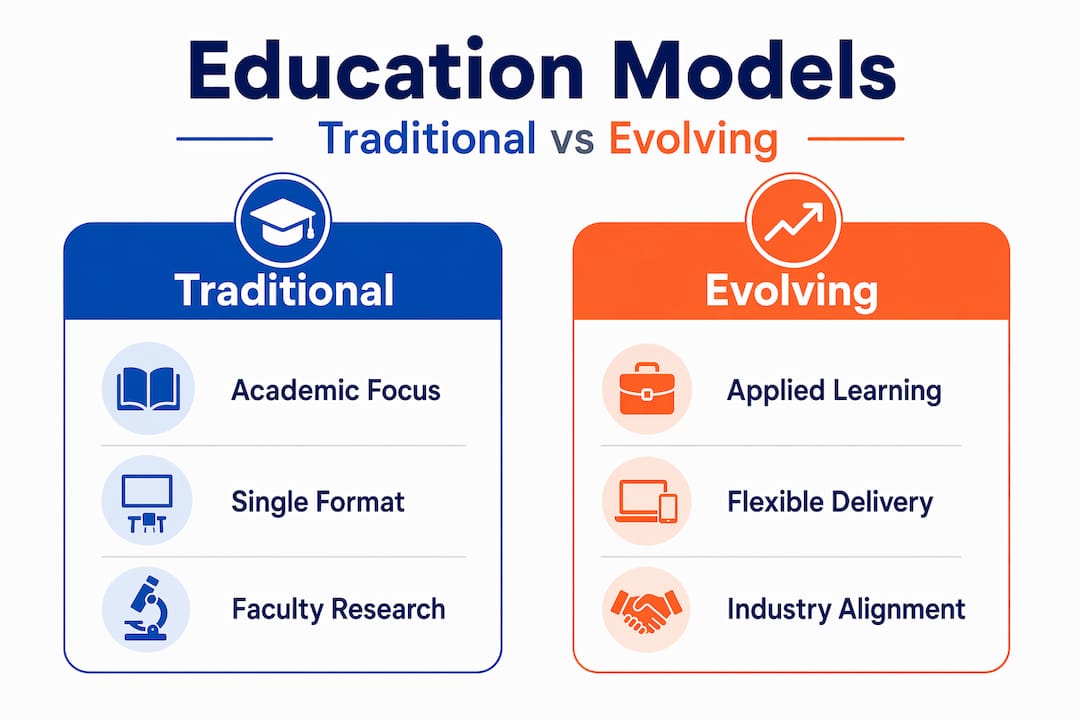
Operationally, schools are also investing in outcomes measurement, tracking what graduates actually achieve after the program rather than just what grades they earned inside it. This pressure is healthy. It forces programs to ask whether their education translates into real capability.
Key curriculum shifts you should look for include:
- Applied problem-solving with real clients or live business challenges
- Integration of entrepreneurship thinking across disciplines, not just in a standalone course
- Stackable micro-credentials that let you build expertise progressively
- Clear pathways from learning to application without unnecessary academic detours
Pro Tip: A program that measures its success by graduate employment rates alone is still thinking in old-economy terms. Look for programs that track revenue generated, businesses launched, or specific skill milestones achieved.
For founders seeking industry-aligned learning, these structural changes are the real signal that a program is worth your investment.
Applying the evolving business education trends to your entrepreneurial journey
Knowing why education in business is changing is only useful if it helps you make better decisions about your own development. Here is how to translate these emerging trends in business education into a practical filter for every program you consider.
Entrepreneurs should prioritize measurable outcomes, applied learning, and flexible formats that match their startup goals and lifestyle. With that principle as your guide, here are four concrete steps:
Demand applied digital and AI skills. Look for programs where you practice using AI tools in real business contexts, not just learn about them conceptually. The skill gap in the workforce is not knowledge of AI’s existence. It is judgment in applying it.
Prioritize flexible delivery. Your startup does not pause while you study. Online, blended, or cohort-based programs that accommodate startup pace are not a compromise. They are the right format for where you are.
Evaluate faculty and industry connections. Ask who is teaching and what they are doing outside the classroom. A faculty member actively running a business or advising startups brings a fundamentally different quality of insight than one whose last real-world experience was a decade ago.
Consider micro-credentials before committing to a full degree. If you need fundraising strategy or customer acquisition skills right now, a targeted micro-credential can deliver that faster and cheaper than a full program. Build the skill, apply it, then decide if you need more.
An entrepreneurship bootcamp model sits precisely at this intersection: flexible, applied, outcome-focused, and designed around the pace of actual startup life.
A fresh perspective on business education evolution for entrepreneurs
Here is the uncomfortable truth that most articles on this topic skip: adding AI content to a syllabus is not transformation. It is decoration. Real change in business education requires restructuring the incentives of the people who design and deliver it, and that is far harder than launching a new elective on ChatGPT.
Institutional incentives and governance structures often slow curriculum change, making genuine agility rarer than the marketing materials suggest. A school that announces an “AI-integrated curriculum” while still rewarding faculty exclusively for research publications has not changed anything that matters. The culture has not moved. Only the brochure has.
For you as a founder, this means you need to be a more demanding consumer of education. Ask hard questions. If a program cannot tell you what its graduates built, launched, or earned in the twelve months after completing it, that is a gap worth taking seriously.
The rise of micro-credentials and modular learning formats is genuinely exciting, but not for the reasons most people celebrate. It is exciting because it puts pressure back on every program to prove its value in shorter cycles. When a learner can complete a focused 8-week credential and immediately test what they learned in the market, the feedback loop tightens for everyone. Schools that cannot survive that scrutiny will shrink. Those that thrive will become the new standard.
We believe the future of business education belongs to programs built around execution, not just instruction. That is a fundamentally different philosophy. It means learning is not complete when you finish a course. It is complete when you apply what you learned and see real results. If you want to explore what that approach looks like in practice, our entrepreneurship education insights page breaks it down in concrete terms.
Founders who understand this shift will not just choose better programs. They will get more from every learning experience they pursue.
Explore Nomad Excel’s entrepreneurship bootcamps to stay ahead
If the evolution of business education described in this article resonates with you, then the logical next step is finding a program that actually embodies it. Nomad Excel’s online entrepreneurship bootcamp is built around the principles that matter most to early-stage founders: applied learning, digital and AI skill development, flexible delivery, and real-world outcomes you can measure. Every session is designed to move you forward in your business, not just your understanding of business. If you are weighing your options, explore why joining entrepreneurship bootcamps accelerates growth in ways self-study rarely does, and take a closer look at our program to see exactly how it is structured.
Frequently asked questions
Why is business education changing rapidly now?
Business education is evolving because four critical forces, including application declines and AI disruption, are simultaneously pressuring institutions to prove faster, more practical value to learners. Shifting market demands and learner expectations for immediate, applicable skills are making the traditional model increasingly difficult to justify.
How does generative AI impact learning in business schools?
Generative AI enhances learning only when integrated with sound teaching methods; without that structure, students risk producing polished work without genuine understanding. For entrepreneurs, this means seeking programs that teach critical AI judgment, not just tool access.
What should entrepreneurs look for in new business education programs?
Entrepreneurs should prioritize applied learning, flexible delivery formats, measurable outcomes, and faculty with active industry connections. Programs that can demonstrate real results from graduates, such as businesses launched or revenue earned, are the clearest signal of genuine value.
Are online MBA programs becoming more popular?
Yes, online MBA enrollment grew from 30% to 38% between 2020 and 2025, driven by student demand for formats that fit the pace of modern life and work. This trend confirms that flexibility is no longer a nice-to-have but a core program requirement.
How do visa barriers affect international business education?
Visa challenges significantly hinder international student recruitment, particularly across the Americas, prompting schools to invest more heavily in remote and hybrid delivery models. For globally minded founders, this shift is actually expanding access to programs that were previously geography-dependent.
Recommended
- Why Invest in Business Education for Entrepreneurs
- The Essential Guide to the Future of Entrepreneurship Education – Nomad Excel – Your Entrepreneurial Adventure Starts Here
- Online Entrepreneurship Bootcamp – Nomad Excel – Your Entrepreneurial Adventure Starts Here
- About Our Program – Nomad Excel – Your Entrepreneurial Adventure Starts Here