
NFTE entrepreneurship programs: Launch your business in 2026
Young entrepreneurs today face an exciting paradox. While starting a business has never been more accessible, navigating the path from idea to execution without structured support remains overwhelming. NFTE’s Next-Level Startup course offers a 90-day program for teens to launch businesses using AI-powered tools and expert mentorship. This guide explores how NFTE’s immersive programs combine hands-on learning, global competitions, and community support to help you build real businesses in 2026, not just theoretical knowledge.
Table of Contents
- Overview Of NFTE’s Entrepreneurial Education Programs
- Mentorship And Community Support As Growth Accelerators
- Global Competitions And Real-World Business Experiences
- The Future Of Entrepreneurship Education With NFTE And AI Integration
- Accelerate Your Entrepreneurial Journey With Nomad Excel
Key takeaways
| Point | Details |
|---|---|
| 90-day AI-powered course | NFTE’s Next Level Startup teaches teens 13-17 to launch businesses with generative AI tools and flexible learning. |
| Mentorship and community | Students access expert coaches, peer networks, and professional guidance to accelerate growth and refine ideas. |
| Global competition exposure | Pitch challenges from local to international levels offer cash prizes, networking, and real-world validation. |
| Future-ready skills | Curriculum integrates AI ethics, prompt engineering, digital infrastructure, and strategic innovation for modern ventures. |
| Practical business building | Project-based learning covers customer acquisition, brand development, and pitching to prepare for entrepreneurial challenges. |
Overview of NFTE’s entrepreneurial education programs
NFTE has reimagined entrepreneurship education for the digital age. Their flagship Next Level Startup course delivers a 90-day program teaching teens to launch businesses with AI integration at its core. This isn’t passive learning. You build an actual business while mastering tools that professional entrepreneurs use daily.
The program serves independent learners including homeschoolers, blending flexibility with concierge-style support. You work at your own pace while accessing structured guidance when needed. This approach removes traditional classroom constraints without sacrificing accountability or mentorship quality.
Curriculum depth separates NFTE from generic business courses. You’ll master AI ethics and understand responsible technology use in commercial contexts. Prompt engineering becomes a practical skill for automating tasks and generating business insights. Business pitching transforms from theory to practiced competency through repeated real-world scenarios.
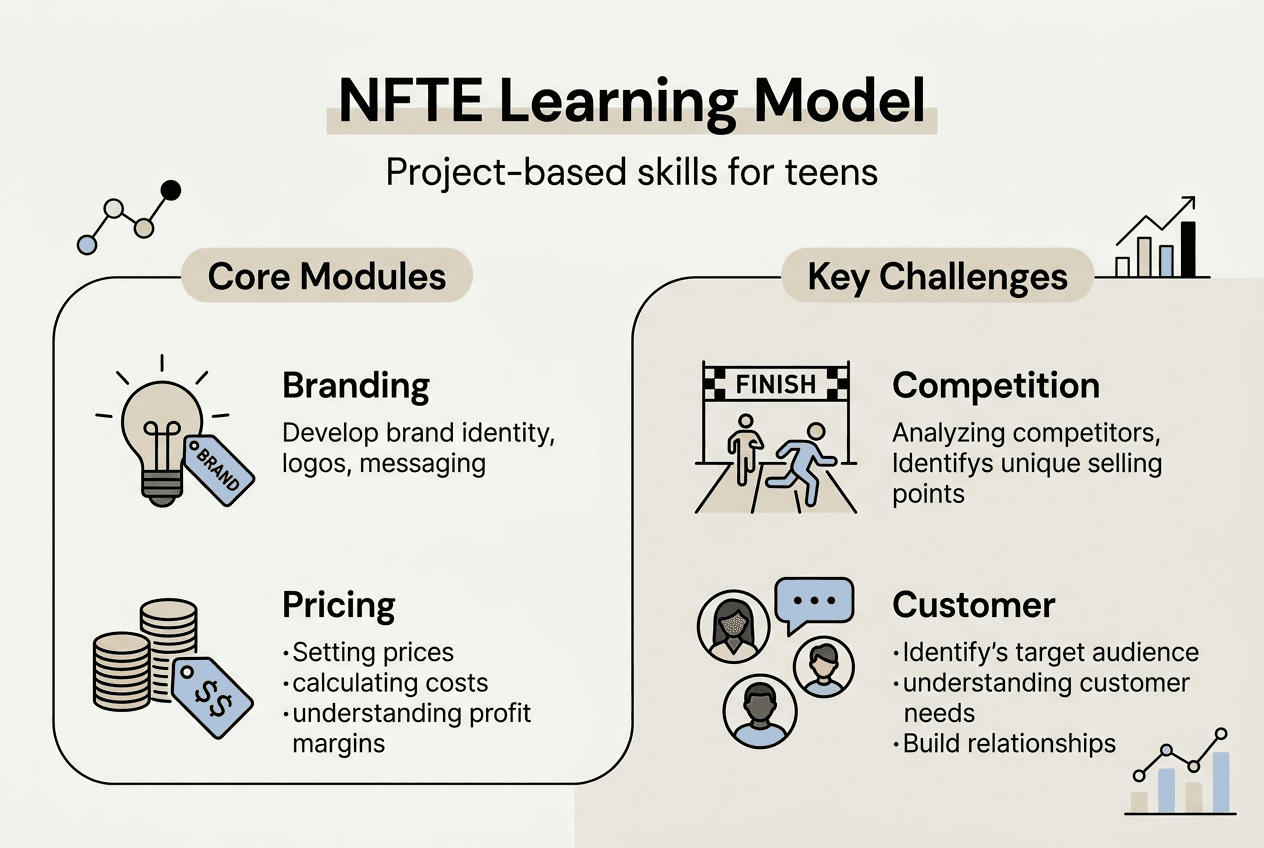
Customer acquisition strategies you learn apply immediately. Brand development modules guide you through creating authentic market positioning. Each lesson connects to tangible business outcomes, not abstract concepts. Students develop entrepreneurship skills that translate directly into revenue-generating activities.
Project-based learning ensures you face real entrepreneurship challenges. You’ll navigate pricing decisions, competitive analysis, and market validation. These experiences build problem-solving capabilities that textbooks can’t replicate. Mistakes become learning opportunities within a supportive framework.
Future of work skills like strategic innovation and effective communication get embedded throughout the curriculum. You learn to adapt quickly, communicate value clearly, and innovate systematically. These competencies matter whether you launch a startup at 16 or join a corporation at 26.
Pro Tip: Track your progress weekly by documenting one specific business decision and its outcome. This practice builds decision-making confidence and creates a portfolio of real entrepreneurial experiences to reference later.
Core curriculum components:
- AI-powered business model development and validation
- Ethical technology integration and responsible AI use
- Customer discovery and acquisition strategy execution
- Brand positioning and authentic market differentiation
- Financial modeling and pricing strategy fundamentals
- Pitch preparation and stakeholder communication skills
Mentorship and community support as growth accelerators
Mentorship at NFTE operates on multiple levels simultaneously. You gain access to expert coaches who have built and scaled real businesses. These aren’t theoretical advisors. They’ve navigated the exact challenges you’re facing and bring tactical solutions, not generic encouragement.

The 2025 NYC NFTE Youth Entrepreneurship Challenge emphasizes mentorship and support for young entrepreneurs, connecting students with diverse professionals from finance, corporate responsibility, and entrepreneurial backgrounds. This diversity matters because different mentors offer complementary perspectives on your business challenges.
Peer networks accelerate learning in unexpected ways. When you collaborate with other young founders, you encounter different problem-solving approaches and business models. These interactions spark innovation and prevent tunnel vision. Your cohort becomes a testing ground for ideas before you pitch to customers or investors.
Community engagement extends beyond casual networking. You participate in structured collaboration sessions where peers critique business models, refine value propositions, and challenge assumptions. This process sharpens your thinking and exposes blind spots early when pivoting costs little.
The supportive environment creates psychological safety for experimentation. You can test bold ideas, fail quickly, and iterate without judgment. This freedom accelerates growth because you’re not paralyzed by perfectionism. Real progress happens through action and adjustment, not endless planning.
Mentorship includes pitch preparation that goes deeper than presentation skills. You learn to articulate value clearly, handle tough questions gracefully, and adapt messaging for different audiences. These capabilities prove essential whether you’re pitching investors, customers, or potential partners. Exploring various types of mentorship programs helps you understand which support structures accelerate your specific growth stage.
Pro Tip: Schedule monthly check-ins with mentors focusing on one specific business metric. This targeted approach yields actionable feedback rather than vague encouragement and keeps you accountable to measurable progress.
Mentorship framework benefits:
- Expert guidance from entrepreneurs who’ve built successful ventures
- Peer collaboration for idea validation and creative problem-solving
- Professional network access spanning finance, marketing, and operations
- Structured feedback loops that accelerate business model refinement
- Emotional support during inevitable entrepreneurial setbacks and pivots
Global competitions and real-world business experiences
NFTE’s competition structure provides progressive challenges that match your development stage. Local contests let you test your pitch in lower-stakes environments. Regional events introduce broader competition and higher-caliber judging. Global showcases put you on international stages against the world’s best young entrepreneurs.
The NFTE World Youth Entrepreneurship Challenge runs as a three-day event where students pitch to judges in Shark Tank-style formats. This isn’t simulation. Real money, real feedback, and real business opportunities emerge from these competitions. Cash prizes ranging $250 to $1,500 provide seed funding to scale your validated ideas.
The new Youth Entrepreneurship Showcase launched for 2026-2027 unifies challenges worldwide, creating broader impact and connection opportunities. This integration means your local performance can lead directly to international recognition and networking with entrepreneurs across continents.
Competitions culminate in public showcases where top teams compete for advancement to international finals. These events attract media attention, potential investors, and partnership opportunities. The exposure alone often generates customer leads and business development conversations that accelerate growth beyond prize money.
Engagement in contests builds confidence through repeated high-pressure presentations. You learn to stay composed when judges challenge your assumptions. Business models get sharper because you must defend every claim with data and logic. Networks expand naturally as you connect with fellow competitors, judges, and event sponsors. Understanding startup mentorship principles helps you leverage these competition connections into lasting advisory relationships.
Competition tier comparison:
| Level | Scope | Prize Range | Key Benefit |
|---|---|---|---|
| Local | City/region | $250-$500 | Low-stakes pitch practice and initial feedback |
| Regional | Multi-state | $500-$1,000 | Broader competition and refined judging standards |
| National | Country-wide | $1,000-$1,500 | Media exposure and investor attention |
| Global | International | $1,500+ | Worldwide networking and partnership opportunities |
Competition preparation essentials:
- Develop a compelling three-minute pitch covering problem, solution, and traction
- Prepare data-backed responses to common investor questions about market size and unit economics
- Practice pitch delivery until it feels conversational, not memorized or robotic
- Research judges’ backgrounds to anticipate their perspectives and concerns
- Build a one-page visual aid that reinforces your verbal pitch without overwhelming viewers
The future of entrepreneurship education with NFTE and AI integration
NFTE integrates generative and agentic AI tools throughout its curriculum, giving you competitive advantages that traditional programs can’t match. AI-powered entrepreneurship programs handle tasks requiring entire teams just five years ago. You learn to leverage these tools for market research, content creation, and operational automation from day one.
AI supports idea generation by analyzing market gaps and customer pain points at scale. You can test dozens of business concepts quickly, validating demand before investing significant time or money. Business model building becomes iterative and data-driven rather than based on hunches or limited personal experience.
Automation capabilities you master include customer service chatbots, email marketing sequences, and social media content scheduling. These skills let you operate lean while maintaining professional customer experiences. You compete with larger, better-funded competitors by working smarter, not just harder.
AI ethics education ensures you understand responsible technology use. You learn to identify bias in AI outputs, protect customer data appropriately, and maintain transparency about AI involvement in your business. These principles build trust with customers and prevent costly mistakes as regulations evolve.
Prompt engineering becomes a practical skill for extracting maximum value from AI tools. You master techniques for framing questions, providing context, and refining outputs iteratively. This capability multiplies your productivity across research, writing, analysis, and creative tasks.
Digital infrastructure knowledge prepares you for modern business operations. You understand cloud platforms, API integrations, and no-code tools that let you build sophisticated systems without programming expertise. These skills reduce dependency on expensive technical co-founders or contractors. Exploring the future of entrepreneurship education reveals how AI integration is reshaping learning pathways for the next generation of founders.
AI skill development progression:
- Master prompt engineering fundamentals for accurate, useful AI outputs
- Implement AI tools for market research and competitive analysis automation
- Build customer-facing AI applications like chatbots and recommendation engines
- Develop AI-powered content creation workflows for marketing and communications
- Integrate AI analytics for business intelligence and decision-making support
- Apply AI ethics frameworks to ensure responsible, transparent technology use
AI integration advantages:
| Application Area | AI Capability | Business Impact |
|---|---|---|
| Market Research | Analyze thousands of customer reviews and competitor data in minutes | Faster validation and pivot decisions |
| Content Creation | Generate blog posts, social media content, and email campaigns at scale | Consistent marketing without large teams |
| Customer Service | Deploy 24/7 chatbots handling common questions and routing complex issues | Improved response times and satisfaction |
| Financial Modeling | Build dynamic projections adjusting for various scenarios automatically | Better planning and investor readiness |
| Product Development | Test concepts through AI-generated prototypes and user feedback analysis | Reduced development costs and risks |
Accelerate your entrepreneurial journey with Nomad Excel
While NFTE provides exceptional foundational training, Nomad Excel offers the next level of immersive entrepreneurship education for those ready to scale. Our bootcamps combine intensive mentorship, peer collaboration, and execution-focused frameworks that transform early-stage ideas into revenue-generating businesses.
You’ll work alongside driven founders in curated cohorts designed for maximum learning and accountability. Expert entrepreneurs guide you through validating offers, building scalable systems, and developing growth strategies that work in real markets. The community you build extends far beyond program completion, providing ongoing support as your business evolves.
Our online entrepreneurship bootcamp delivers structured learning without location constraints. You gain access to proven frameworks, direct mentorship, and a network of peers who challenge and support your growth. This combination accelerates progress beyond what solo learning or generic courses can achieve in 2026.
FAQ
What ages are eligible for NFTE entrepreneurship programs?
NFTE’s Next Level Startup course serves teens aged 13-17, providing age-appropriate curriculum and support structures. Competition opportunities extend to ages 15-22, allowing older students to participate in pitch challenges and showcases. Programs adapt to diverse youth needs including homeschoolers, traditional students, and independent learners seeking flexible entrepreneurial education.
How does NFTE incorporate AI into entrepreneurial training?
The program uses generative and agentic AI tools, teaching AI ethics and business applications throughout the curriculum. Students learn prompt engineering for effective tool use, automation strategies for operational efficiency, and responsible AI integration that respects customer privacy. This approach prepares you for the evolving digital business landscape where AI literacy separates successful entrepreneurs from those struggling to compete.
What mentorship opportunities does NFTE provide?
NFTE emphasizes mentorship from professionals, educators, and experienced entrepreneurs across industries. You access coaching on business strategy, pitch preparation, and growth challenges through structured programs and informal networking. Mentors include finance experts, corporate responsibility leaders, and successful founders who provide diverse perspectives. This mentorship approach accelerates learning by connecting theoretical knowledge with practical, battle-tested insights from those who’ve built real businesses.
How do NFTE competitions prepare you for real business challenges?
Competitions simulate high-pressure scenarios you’ll face when pitching investors, customers, or partners in actual business contexts. You receive direct feedback from experienced judges who identify weaknesses in your business model, financial projections, or market assumptions. This critique sharpens your thinking and forces you to defend every aspect of your venture with data and logic, building the resilience and adaptability essential for entrepreneurial success.
Can NFTE programs help if you’re unsure about your business idea?
Absolutely. The curriculum includes structured ideation frameworks that help you identify market gaps, validate customer pain points, and test concepts quickly. You’re not expected to arrive with a fully formed business plan. Mentors and peers help you explore possibilities, assess feasibility, and pivot toward opportunities that match your skills and market demand. Many successful NFTE alumni started with vague interests and developed focused, viable businesses through the program’s systematic approach.
What happens after completing an NFTE program?
You join an alumni network providing ongoing support, resources, and connection opportunities. Many graduates continue refining their businesses using skills and frameworks learned during the program. Others leverage their NFTE experience for college applications, internships, or early career opportunities that value entrepreneurial thinking. The competition connections, mentor relationships, and peer networks often generate business partnerships, customer leads, and advisory support that extend well beyond program completion.
Comments are closed.