7 Steps to Better Design Brainstorming for Designers
Brainstorming in design is a timeboxed, judgment-free ideation activity where the goal is quantity over quality, because more raw ideas raise your odds of finding a genuinely innovative one. The immediate move: write a sharp How Might We prompt, timebox the session to a short, focused duration, pick two or three techniques suited to your group, and appoint a facilitator and a scribe before anyone opens their mouth. Keep generating separate from judging. The techniques come next.
TL;DR:
- Rapid ideation is essential for quickly generating a large volume of ideas without evaluation, ideally in five to ten-minute bursts with no discussion.
- Using structured techniques like brainwriting, brainwalking, and silent braindumping helps include quieter participants and energize sessions, especially in remote settings.
- Effective brainstorming hinges on well-crafted How Might We prompts that are bounded but not overly narrow, clearly addressing real user needs.
- After a session, grouping ideas through affinity mapping and applying voting methods or decision matrices ensures actionable outcomes rather than unorganized piles of concepts.
- Preparation, clear rules, regular activity changes, and explicit roles are crucial to avoiding common pitfalls such as fatigue, dominance, or vague prompts.
Table of Contents
- Core Design Brainstorming Techniques and When to Use Each
- How to Run an Effective Design Brainstorming Session
- Solo vs Team Brainstorming: Adapting Methods and Pacing
- Brainwriting, Brainwalking, and Braindumping: The Siblings to Brainstorming
- Writing Effective How Might We Prompts
- Organizing and Evaluating Ideas After a Session
- Tools, Templates, and Checklists for Design Brainstorming
- Common Pitfalls in Design Brainstorming (and How to Fix Them)
- How Nomad Excel Teaches Brainstorming Inside Its Programs
- What Actually Separates a Good Brainstorm From a Great One
- Learning Facilitation by Actually Running Sessions
- Sources
Core Design Brainstorming Techniques and When to Use Each
Every design team needs more than one tool in the kit. The right technique depends on your group size, whether you’re remote, and how much visual thinking the problem demands.
Rapid ideation is the workhorse: everyone writes as many ideas as possible in a short burst, usually five to ten minutes, with no discussion allowed until time’s up. It’s the fastest way to flood a board with raw material before anyone starts second-guessing.
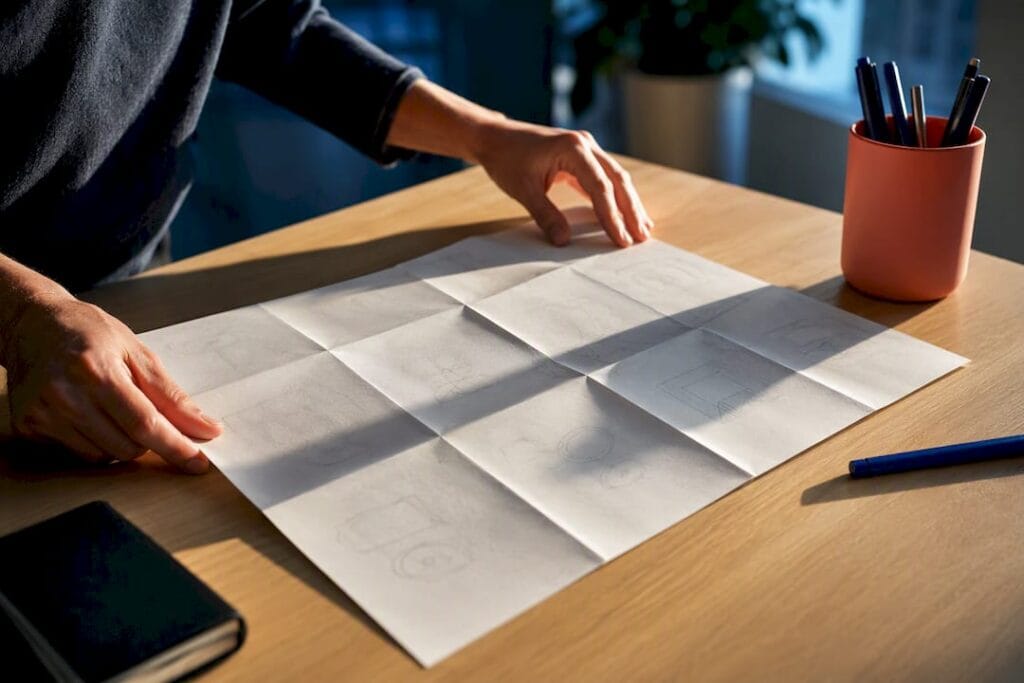
Crazy 8s swaps words for sketches. Fold a sheet into eight panels and give participants a minute per panel to sketch one distinct idea. Visual designers get more out of this than a verbal round because the constraint forces variation instead of eight versions of the same idea.
Mind mapping starts with a central concept and branches outward, which suits problems where relationships between ideas matter more than volume. It’s slower than rapid ideation but better for surfacing structure.
Starbursting flips the format into pure questions, mapping who, what, how, when, where, and why onto a topic before anyone proposes a solution. It’s useful early, when the team risks jumping to answers before understanding the actual problem.
Cubing and word association push lateral thinking by forcing a concept through six unrelated angles (cubing) or free-associating outward from a seed word. Both work well when a team feels stuck in the same three ideas.
For group settings where one or two voices tend to dominate, structured formats level the field:
- Round-robin: each person shares one idea per turn, in order, no skipping.
- 6-3-5 Brainwriting: six people write three ideas each, then pass their sheet five times, building on what’s already there.
- Silent circuit: participants rotate between stations or sticky-note clusters, adding ideas without speaking.
Pro Tip: Crazy 8s, mind mapping, and starbursting translate well to remote whiteboards. Round-robin and silent circuit lose almost nothing over video, since they were built around turn-taking rather than a shared physical room.
How to Run an Effective Design Brainstorming Session
A brainstorm succeeds or fails on structure, not enthusiasm. Here’s the run book.
- Prepare before anyone arrives. Write the desired outcome in one sentence. Draft your How Might We prompt. Decide who’s in the room (aim for cognitively diverse participants rather than five people who think alike). Gather materials: timer, shared board, sticky notes or a digital equivalent, and a printed or projected HMW prompt.
- Open with context, not the prompt. Spend two or three minutes grounding the group in the user problem before revealing the HMW question. Skipping this step is why half the ideas in a rushed brainstorm miss the actual need.
- State the rules out loud. Defer judgment, encourage wild ideas, go for quantity, build on others’ contributions. Say it every time, even with a team that’s done this before.
- Run divergent bursts with a visible timer. Five to fifteen minutes per round works well, based on how facilitators structure rapid ideation intervals. Alternate a silent solo round with a vocal group round to catch slower thinkers who need a beat before speaking.
- Appoint a scribe. One person captures everything, verbatim, without editorializing. Nobody else should be writing and talking at the same time.
- Refresh mid-session. If energy drops around minute twenty, switch techniques rather than pushing through. A five-minute walk or a change from mind mapping to crazy 8s resets the room.
- **Close with affinity mapping and a vote. Then document decisions and who owns the next step.
Solo vs Team Brainstorming: Adapting Methods and Pacing
Solo ideation and group ideation solve different problems, and using the wrong one wastes time.
Working alone, a designer’s biggest risk isn’t lack of ideas. It’s editing them before they’re fully written down. Braindumping, where you write everything without pausing to judge, followed by solo sketching and a timed review afterward, keeps the inner critic quiet long enough to get real volume on the page.
Team settings introduce a different risk: dominant voices crowding out quieter ones. That’s where brainwriting, round-robin turns, and breakout groups earn their keep, because combining silent written rounds with group discussion produces more diverse output than open talking alone.
Remote teams need extra scaffolding:
- Run an async ideation window before the live call, so people arrive with material already generated.
- Use a shared canvas everyone can edit simultaneously, not a slide deck one person controls.
- Assign a scribe and a moderator explicitly, and keep the synchronous portion short.
Brainwriting, Brainwalking, and Braindumping: The Siblings to Brainstorming
Straight group brainstorming has known weak spots. Its siblings exist to patch them.
- Brainwriting replaces talking with writing. Everyone silently writes ideas on paper or cards, then passes them around for others to build on. Silent written passing levels participation and is especially effective for introverted contributors who freeze up in open verbal rounds.
- Brainwalking adds movement. Groups physically rotate between stations or wall-mounted boards, adding to ideas left by the previous group. The change of scenery re-energizes a session that’s gone flat.
- Braindumping is the quick solo warmup: five minutes of unfiltered writing before the group even convenes, which primes people to arrive with something instead of a blank mind.
Sequencing matters more than picking a favorite. A braindump before the session, brainwriting to open it, and a brainwalk halfway through covers three different energy states in one meeting.
Writing Effective How Might We Prompts
A weak brainstorm almost always traces back to a weak prompt. How Might We questions convert a rigid problem statement into an open invitation to explore multiple solution paths, and prompt quality is arguably the single biggest predictor of how well a session goes.
A strong HMW prompt is bounded but not narrow. “How might we make checkout faster for mobile users who abandon carts after adding a shipping address?” gives the room enough context to move without dictating the answer. “How might we improve the app?” is too broad to generate anything usable; “How might we add a discount code field?” is already a solution disguised as a question.
Before the session, check your prompt against three things: does it name a real user and a real moment, does it leave more than one plausible solution path open, and can a stranger read it and immediately understand the stakes?

Organizing and Evaluating Ideas After a Session
Generating fifty ideas means nothing if they die on a sticky-note wall. The evaluative phase deserves its own structure.
Affinity mapping groups similar ideas into clusters so patterns emerge from the noise. On a board with sixty or more notes, don’t try to categorize live. Have two people silently move notes into rough clusters first, then name the clusters as a group afterward.
For narrowing down the field:
- Dot voting gives each participant three to five dots to place on favorites, fast and low-friction.
- Weighted criteria voting scores ideas against factors like feasibility, cost, and user impact when the stakes are higher than a quick pick.
- Decision matrices plot ideas on two axes (often effort versus impact) to make trade-offs visible instead of argued about.
Whichever method wins the vote, turn the top three or four ideas into something testable, a rough prototype or a scoped research question, rather than a paragraph in a deck no one revisits.
Tools, Templates, and Checklists for Design Brainstorming
You don’t need much to run a good session. You need the right few things, prepared in advance.
The essential kit: a visible timer, a shared board (a Miro-style canvas or a physical wall), sticky notes or their digital equivalent, a designated scribe, and a written HMW prompt everyone can see.
Templates worth building once and reusing:
- A 15-minute rapid ideation script with time markers for each phase.
- An HMW prompt sheet with the question plus two or three example answers.
- An affinity map layout with cluster zones pre-labeled.
- A voting matrix with your chosen criteria already listed.
Choose digital tools when your team is remote or the board needs to survive past the meeting. Choose analog sticky notes and whiteboards when everyone’s in the same room and speed of writing matters more than a permanent record.
Common Pitfalls in Design Brainstorming (and How to Fix Them)
Most failed brainstorms fall into the same five traps: satisficing (settling for the first workable idea instead of pushing past it), early critique that shuts down quieter contributors, one or two dominant voices, a vague prompt nobody can actually work with, and plain fatigue after twenty minutes of talking.
The fixes are specific, not aspirational:
- Open with a silent round before anyone speaks, so ideas exist before opinions do.
- Use a brainwriting primer to force written contribution from everyone.
- State norms out loud every single time, not just at the first session.
- Alternate activities every fifteen to twenty minutes to fight fatigue.
- Separate the generate phase from the evaluate phase explicitly, and say when you’re switching between them.
Pro Tip: Split every divergent burst with a short solo moment. Even ninety seconds of silent writing between vocal rounds catches ideas that would otherwise get lost to whoever talks fastest. Track who suggested what as you go. It makes follow-up ownership and credit far easier once the session ends.
How Nomad Excel Teaches Brainstorming Inside Its Programs
Nomad Excel builds HMW framing, timed ideation sprints, and mentor-led facilitation directly into its entrepreneurship bootcamps, because founders who can run a tight ideation session make faster decisions under real deadlines. Participants practice writing bounded prompts, running rapid-fire divergent rounds against a clock, and synthesizing the output into a prioritized next step, not a pile of unsorted notes.
The same structure carries into company retreats, where teams practice facilitation roles (scribe, moderator, timekeeper) on real business problems instead of hypothetical ones, with mentors coaching the process live.
What Actually Separates a Good Brainstorm From a Great One
My habit is boring but it works: run a silent ten-minute brainwrite before anyone talks. It kills the instinct to chase the first decent idea, which is the trap that quietly ends more sessions than bad prompts do. Wild ideas and feasible ones can coexist. Just don’t let feasibility show up before generation is done.
— Amichai
Learning Facilitation by Actually Running Sessions
Reading a playbook gets you halfway. The rest comes from running sessions with real stakes and someone experienced watching your timing, your prompt, and how you handle the person who won’t stop talking. Nomad Excel’s online entrepreneurship bootcamp builds facilitation practice into hands-on sprints with mentor feedback, so you leave running sessions on instinct rather than checking a script. For teams, the same skill gets built through company retreats designed around real alignment problems, not icebreakers. If you want to practice HMW framing and timeboxed ideation with actual accountability behind it, the bootcamp is the place to start.
Sources
- Learn How to Use the Best Ideation Methods — IxDF
- How Might We questions — d.school (Stanford)
- What is Brainstorming? 10 Effective Techniques You Can Use — IxDF
For deeper technique theory beyond this guide, the Interaction Design Foundation, NN/g, and Stanford’s d.school remain the standard references design teams return to.
Comments are closed.