
Entrepreneur Leadership Network: Cost, Benefits and Options
The Entrepreneur Leadership Network® is a paid contributor program run by Entrepreneur Media. Approved members publish advice articles on Entrepreneur.com, and new annual memberships cost $3,000. It is a publishing and personal-brand program, not a peer community or a mentorship group. If what you want is a circle of founders who challenge and support you, you will want a different kind of network, and this guide covers both.
Below you will find what the program includes, what it costs, how applying works, what editors expect, and how to decide whether it fits your stage. We also explain how founders build a leadership network through shared work with other founders.
TL;DR
- The Entrepreneur Leadership Network is an application-based program for experts who want to publish bylined articles on Entrepreneur.com.
- New annual memberships cost $3,000 (as of November 1, 2022), payable only after you are accepted.
- Membership does not guarantee that an article is published or promoted. Editors can ask for changes.
- Articles run 800 to 1,000 words and must be advice-driven, with clear takeaways.
- For peer support, accountability and real working relationships, pair any publishing program with an in-person community of founders.
Table of Contents
- What the Entrepreneur Leadership Network is
- What membership includes
- What the Entrepreneur Leadership Network costs
- How to apply, step by step
- What editors expect from your articles
- Does paying guarantee publication?
- Is it the right fit for you?
- Building an entrepreneurial leadership network that works
- Our perspective
- Start with the room, then write the article
- FAQ
- Sources
What the Entrepreneur Leadership Network is
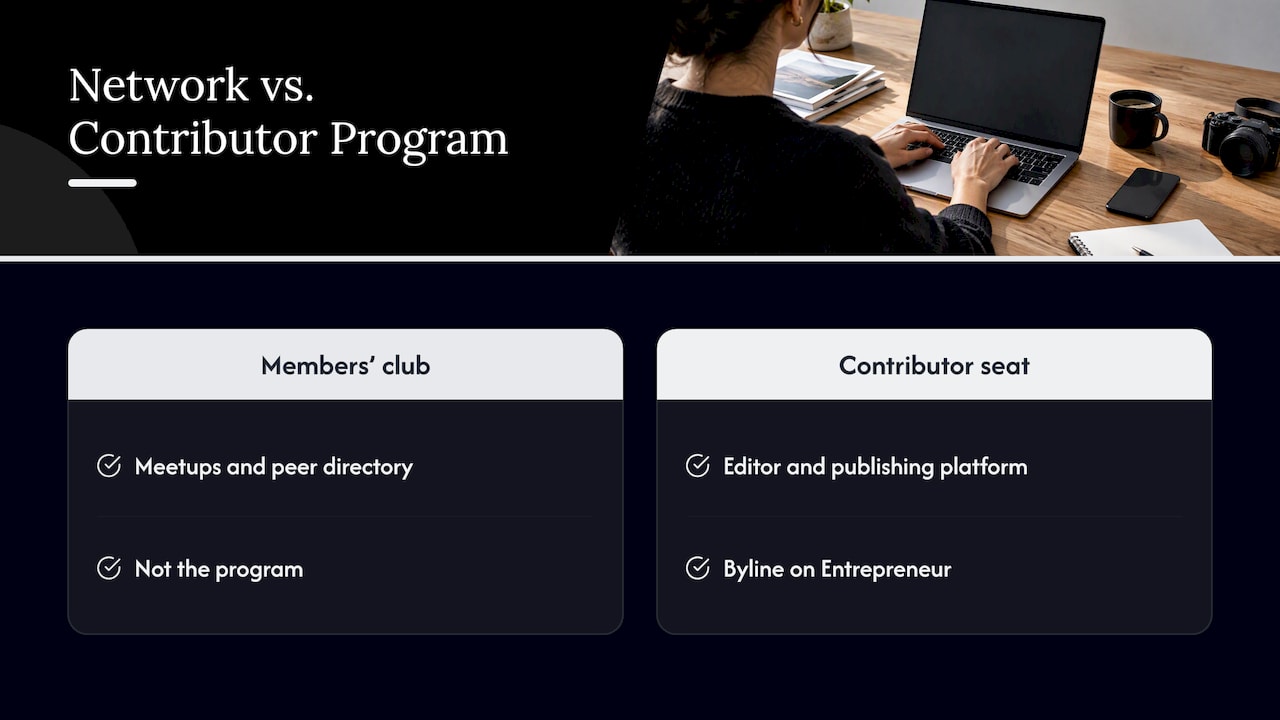
Entrepreneur describes the network as an exclusive program where selected industry experts can reach its engaged readers. The word “network” can mislead. You are not joining a members’ club with meetups and a directory of peers. You are applying for a seat as a contributor, with an editor and a publishing platform behind you.
Entrepreneur also says it does not accept ordinary guest posts and points prospective contributors to this program instead. That is why so many founders, consultants and executives search for it: it is the stated route to a byline on that site.
The program suits people who already have something to teach: a consultant with a repeatable method, a founder who has scaled a team, an operator with hard lessons about hiring or pricing. It is less suited to someone still validating a first idea, who usually gets more from building and testing than from writing about it.
What membership includes
Entrepreneur’s own help pages list the benefits. According to its product help page, membership includes:
- The ability to contribute to Entrepreneur.com
- A dedicated one-on-one editor
- Promotion of your personal brand and voice
- An Entrepreneur+ subscription
- Up to four submissions per month
The same page says your content may be included in daily and weekly newsletters, subject to editorial decisions. Notice the wording: the benefits are tools and access, not promised reach. Entrepreneur says members can submit up to four articles a month and that the standard review time is two to four weeks.
In practice, you get a platform, an editor and a brand-building asset. The work of making each article worth reading stays with you.
What the Entrepreneur Leadership Network costs
As of November 1, 2022, new annual memberships cost $3,000, paid in full once you are approved. Entrepreneur adds that people who enrolled before that date may have different annual costs. Independent write-ups by PR professionals, such as this account of guest posting on Entrepreneur.com, report the same $3,000 annual fee.
Two details help you budget:
- There is no application fee and no upfront credit card charge. Entrepreneur says payment is requested only after acceptance.
- The fee is annual. Spread across up to four submissions a month, the price per published piece can look low, but only if the pieces are actually accepted and you use the slots.
Before applying, check the current fee on Entrepreneur’s help page, since pricing can change.
A simple way to judge the return
Think of the $3,000 as a marketing budget line, not a course fee. Ask what you would otherwise spend to earn the same credibility: a podcast tour, a conference talk, a paid placement. Then ask what you can realistically deliver over twelve months. A founder who will write six strong articles a year is buying a different product than one who will write forty.
For reference, a seat in one of our programs is priced differently: our Online Business Bootcamp is €500, and our 5-Day Online AI Bootcamp is €300. They solve a different problem, which is building the business rather than promoting an existing one.
How to apply, step by step
Entrepreneur outlines the process on its page about how to contribute. It runs like this:
- Complete the online application. Be specific about your expertise, your background and the topics you would cover.
- Prepare pitches. A selection-committee member reviews your application and may ask you to rework pitches or give more detail about your background and goals.
- Wait for the review. Entrepreneur says applications normally take three to five business days to process.
- Finalize payment if approved. Only then does the fee come due.
- Start submitting through the editorial platform. Your editor guides the first pieces.
Treat the pitches as the real test. A pitch that names a clear reader, a problem and a takeaway is far easier to approve than a broad topic like “leadership lessons.”
What editors expect from your articles
Entrepreneur requires submissions to be advice-driven articles that share your thoughts, experiences and hard-earned problem-solving techniques with other entrepreneurs. The stated length is 800 to 1,000 words, with clear takeaways and references to reputable, trustworthy sources.
That translates into a few habits worth building:
- Lead with the lesson. Readers should know the point in the first two sentences.
- Use your own numbers and mistakes. Specifics from your business set you apart from generic advice.
- Cite real sources. When you quote a statistic, link the page that states it.
- Write for one reader. A first-time founder and a 50-person CEO need different advice.
An author page is part of the package, so your public profile matters. A current, well-lit photo is a small detail that affects how professional you look, and a LinkedIn headshot checklist is a quick way to get yours right before you apply.
Does paying guarantee publication?
No. The independent account cited above states that paying the annual fee does not guarantee publication and that editors may ask for constructive changes before accepting a submission. Entrepreneur’s own language about newsletter inclusion, “subject to editorial decisions,” points the same way.
That is a reasonable standard for a publication that wants to protect its readers. It also means you should plan around effort, not entitlement. Budget time for revisions, expect some pitches to be turned down, and treat each accepted article as an asset you can reuse on your site, your LinkedIn profile and your sales conversations.
Is it the right fit for you?
Use these criteria to decide.
| Question | A good sign | A sign to wait |
|---|---|---|
| Do you have expertise to teach? | Years of results in one niche | Still testing your first offer |
| Can you write 800 to 1,000 words regularly? | You already publish or have a ghostwriter | You have never written for an audience |
| Will credibility help you sell? | Clients vet you online before they call | Your sales come from referrals only |
| Can you absorb a $3,000 annual fee? | It fits your marketing budget | It would come from your runway |
If most of your answers land in the right column, a different investment will likely move your business faster: building a product, signing first customers and meeting founders who are a step or two ahead of you.
Building an entrepreneurial leadership network that works
A publishing byline builds visibility. A leadership network, in the sense most founders mean it, is the group of people who answer your messages at 9 p.m., tell you your pricing is off, and introduce you to your next customer. Those relationships tend to form through shared work, not through reading each other’s articles.
Here is what we have seen make the difference:
- Proximity and time. Spending days together, not minutes at a mixer, is when trust forms. Our guide to effective networking for entrepreneurs shows how to turn short contacts into lasting ones.
- A shared task. Founders who build, test and present side by side learn each other’s strengths quickly. That is the idea behind learning from real-world business projects.
- Accountability. Daily check-ins and structured sprints turn good intentions into shipped work.
- A leadership model to practice. If you are working out how you lead, our entrepreneurial leadership guide breaks down the skills, and the guide to accelerated growth shows how they apply as a company scales.
If you are weighing formats, our explainer on business networking retreats for entrepreneurs covers what to expect, and why join an entrepreneurship bootcamp lays out when a cohort format beats going alone.
The two approaches work well together. A founder who spends a week building an offer alongside peers comes home with something worth writing about, and with people who will read, share and challenge the article.
If you lead a team
Leadership networks matter inside companies too. When a team needs alignment, trust and a shared direction, a facilitated company retreat gives managers a place to practice leadership together, away from the inbox. For distributed teams, our ideas for business retreats for remote teams are a good starting point.
Our perspective
We read the questions founders ask about the Entrepreneur Leadership Network, and the pattern is clear: people want credibility and people want company. A byline can give you the first. It rarely gives you the second.
In our experience running bootcamps and retreats, the founders who grow fastest are the ones who pair a clear plan with a group that holds them to it. When you spend one to four weeks working next to other builders, with mentors who have operated businesses themselves, you stop guessing which advice applies to you. You test it that week, in front of people who care how it turns out.
That is why we design our programs around execution: structured sprints, daily accountability, and a community that stays active after the event ends. The relationships are the leadership network, and the work you ship together is the credibility.
If you are considering paid thought-leadership programs, we think the strongest order is to build first, then publish what you learned. Your articles will be better, your story will be real, and you will not be writing alone.
Amichai
Start with the room, then write the article
If you are an aspiring or early-stage founder, freelancer or digital nomad looking for a network you can lean on, our bootcamps are built for that. Online options start with the 5-Day Online AI Bootcamp at €300, and our in-person programs run in destinations such as Lisbon, Panama, Brazil and the Canary Islands, with registration fees of €400 for the multi-day destination formats. See what is coming next on our upcoming bootcamps page, or read what past cohorts did on the previous bootcamps page. Not sure which format fits? The Online Entrepreneurship Bootcamp is the easiest place to begin.
FAQ
How much does the Entrepreneur Leadership Network cost?
As of November 1, 2022, new annual memberships cost $3,000, paid in full after your application is approved. Members who enrolled earlier may pay a different amount. Check Entrepreneur’s help page for the current figure before you apply.
What is a leadership network?
In general, it is a group of people who support each other’s growth as leaders through advice, introductions and shared experience. Entrepreneur’s program uses the name for a contributor program, which is publishing-focused. Peer-based groups, alumni circles and cohort programs are the other common meaning.
What do you mean by entrepreneurial leadership?
It is leading with an owner’s mindset: spotting opportunities, making decisions with incomplete information, and bringing a team along while the business is still taking shape. It applies to founders and to employees who act like owners. Our entrepreneurial leadership explained guide goes deeper.
How do I contribute to Entrepreneur?
Entrepreneur does not take ordinary guest posts. You apply to the Entrepreneur Leadership Network online, a selection-committee member reviews your application, and you may be asked to revise your pitches. If you are approved, you pay and begin submitting articles.
Does membership guarantee my article gets published?
No. Editors review every submission and may request changes, and newsletter placement is subject to editorial decisions. Plan for revisions and treat acceptance as something you earn with each piece.
Sources
- Entrepreneur Leadership Network® | Help Center
- Do you accept guest posts? | Entrepreneur Help Center
- Product Help | Entrepreneur Help Center
- Promote your personal brand and voice | Entrepreneur Help Center
- How much does it cost to be in the Entrepreneur Leadership Network?
- How to Guest Post on Entrepreneur.com | McDougall Interactive
- How do I contribute to Entrepreneur? | Help Center
- How long does it take to process my Entrepreneur Leadership Network application?
- What type of content can members of the Entrepreneur Leadership Network submit?
- 10-Step LinkedIn Headshot Checklist for Professionals