
Looking for New Career Opportunities: A Practical Plan
If you are looking for new career opportunities, the fastest route is rarely a job board. Start by getting clear on your interests, values and transferable skills. Then research two or three fields, talk to people who work in them, tailor your application materials, and test the direction with a small, low-risk step. This guide walks you through each stage and shows where flexible paths such as freelancing and entrepreneurship fit in.
The search can feel heavy when you are doing it alongside a full-time job or after a layoff. It helps to remember that it is a learnable skill. The International Labour Organization (ILO) points out that looking for work is something people face several times in life, so knowing how to do it well pays off for decades.
TL;DR
- Begin with self-assessment (interests, values, personality, skills), then treat the results as a starting point, not a verdict.
- Research fields through industry publications and informational interviews before you change anything on your resume.
- Many openings are never advertised, so networking is part of the search, not an extra.
- Tailor your resume to each role and show the skills the employer asks for, including soft skills.
- Self-employment and entrepreneurship are legitimate career paths if you want flexibility, and you can test them before you leap.
Table of Contents
- Signs it may be time to look for something new
- Step 1: Map what you actually have to offer
- Step 2: Research two or three fields, not twenty
- Step 3: Close the skills gap with intent
- Step 4: Use people, not just postings
- Step 5: Rewrite your application materials for the new direction
- Flexible paths: remote work, freelancing and entrepreneurship
- Our perspective
- A 30-day plan you can start this week
- Where a bootcamp can speed things up
- Making the decision stick
- FAQ
- Sources
Signs it may be time to look for something new
Nobody gets a flashing signal. Most people notice a pattern first: the work no longer stretches you, your values and your employer’s have drifted apart, or your industry is shrinking while your curiosity grows somewhere else. Here are questions worth answering honestly:
- Do you dread Sunday evenings more often than not, and has that lasted months rather than days?
- Are you learning anything, or repeating what you already know?
- Can you picture the senior people in your company’s roles as your own in five years?
- Is there a subject you read about, or a side project you work on, that you would rather be paid for?
- Do you want more control over where, when or how you work?
If several answers point the same way, you are not being impatient. You are collecting data. The ILO notes that in a constantly changing world of work, it matters to watch how professions evolve, keep training throughout life and be ready to move toward new labor-market opportunities. Wanting a change is often part of that adaptation, not a failure of the old path.
Step 1: Map what you actually have to offer
The first job is an inventory, and it has two halves: what you care about and what you can do.
Interests, values and personality
Yale’s Office of Career Strategy describes career decision-making as a process of assessing your interests, values, personality, and technical and transferable skills, then researching and evaluating options against what you want. The same page is careful to say that self-assessment tools are starting points for exploration rather than definitive answers about your career. Use them the way you would use a compass: helpful for direction, useless if you refuse to look up at the terrain.
A simple way to start is a one-page list with three columns:
- What energizes me: tasks that make time disappear.
- What I will not compromise on: schedule, location, income floor, team culture, mission.
- What drains me: the parts of your current job you would happily hand off.
Transferable skills
Transferable skills are the ones that travel: writing, project coordination, negotiating, teaching, analyzing data, managing people or budgets. Grow with Google suggests a practical exercise: list your hobbies, interests and experiences, then note the skills you used or learned in each. Careers New Zealand makes a similar point: transferable skills develop through study, work, hobbies and community service. That means the volunteer treasurer role and the weekend market stall count.
A career also is not only a job history. The New Zealand government’s career guidance describes it as bringing together experiences across a lifetime, including family life, friendships, community activities, leisure, work and learning. Include all of it in your inventory.
Step 2: Research two or three fields, not twenty
A long list feels productive and rarely is. Narrow to two or three candidate directions, then test each one against reality.
Yale’s guidance on researching a career is to learn about employers and industry trends through professional publications, websites and other resources. If you are still unsure after that, the same source recommends informational interviews. For each field, try to answer:
- What does a typical week look like, hour by hour?
- Which skills are required on day one, and which are learned on the job?
- What does entry look like for someone coming from outside: a junior role, a lateral move, a contract?
- Who hires, and are they concentrated in certain cities, or is remote work common?
- What do people in the role complain about?
The last question is the one most guides skip, and it is often the most revealing.
Try before you commit
You do not have to resign to explore. The UK’s Milton Keynes City Council notes that volunteering counts as work experience and can help you explore jobs, practice skills, learn new ones and build confidence. A short volunteer project, a freelance gig on evenings, or a small paid pilot for a friend’s business can tell you more in a month than a year of reading.
Step 3: Close the skills gap with intent
Once you know a target, ask what separates you from it. Careers New Zealand lists the usual routes: relevant qualifications or certificates, on-the-job training, courses or an apprenticeship. Which one applies depends on the field. Some regulated professions require specific credentials. Many others care more about what you can show.
The ILO’s 2023 guidance for people who support jobseekers observes that, as labor markets accelerate, diploma-based qualifications are increasingly supplemented or replaced in value by acquired and practiced skills. The same publication cites ILO research in France indicating that 57% of recruiters prioritize behavioral skills over technical skills in the initial selection phase. That figure comes from one country, so treat it as a signal rather than a universal rule. Still, it supports a sensible plan: pair one targeted technical upgrade with visible evidence of communication, reliability and problem-solving.
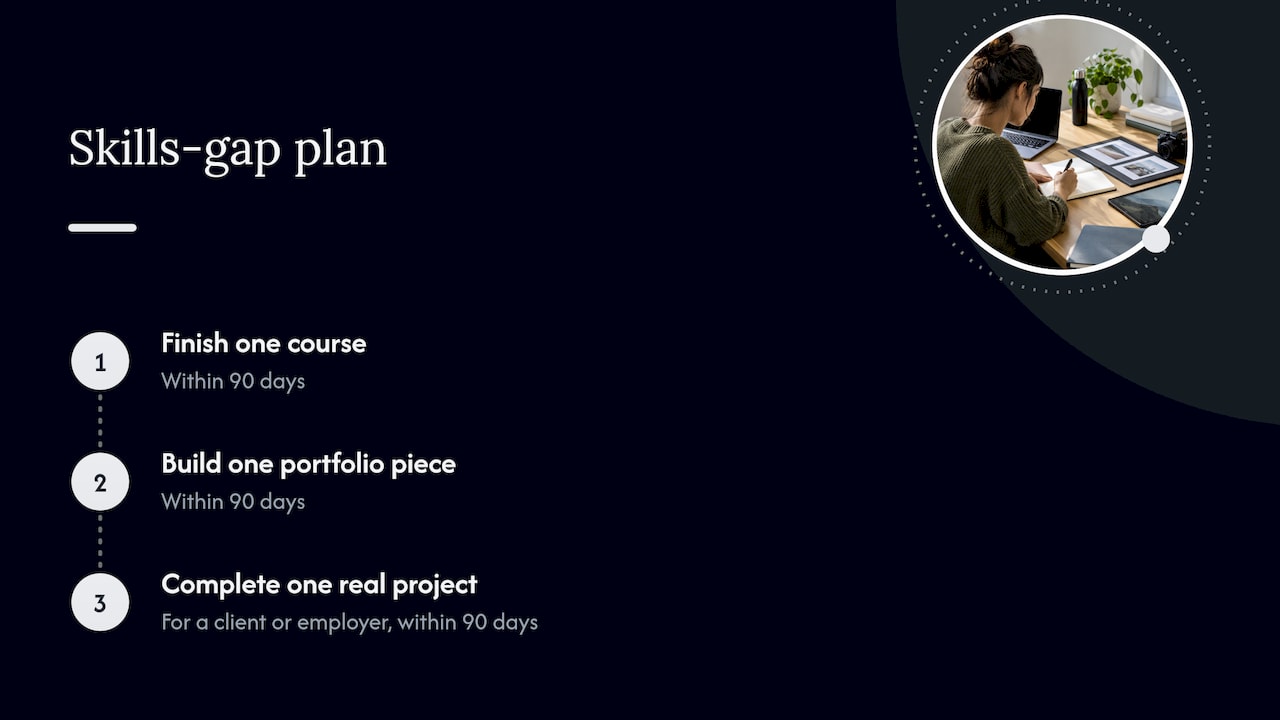
A good skills-gap plan is small and dated. For example: finish one course, build one portfolio piece, and complete one real project for a real client or employer, all within 90 days.
Step 4: Use people, not just postings
Networking is the part many career changers postpone, and it is where the best leads often hide. Careers New Zealand’s guidance says networking can help you find the hidden job market: talk with someone in the field you are interested in, join a professional organization and attend industry meet-ups. It also states that in Aotearoa New Zealand, about 70% of job vacancies may never be advertised and are filled through employers’ networks. That number applies to New Zealand, but the logic travels: people hire people they have heard of.

The same dynamic shows up well beyond employment. Buyers and sellers of small companies, for instance, often connect before anything is publicly listed, as explained in this piece on finding off-market businesses. If you are thinking about buying or building something of your own, those quiet channels matter as much as the public ones.
How to run an informational interview
- Ask for 20 minutes, not a job. Say that you are exploring the field and value their perspective.
- Prepare five questions. Include what surprised them, what they would do differently, and what skills matter most.
- Ask who else you should talk to. One conversation should produce two more.
- Follow up within a day. Thank them and mention one thing you will act on.
- Report back later. Tell them what you did. That turns a favor into a relationship.
If networking feels awkward, our freelance networking guide and networking strategies explained break it into small, repeatable habits.
Step 5: Rewrite your application materials for the new direction
Your resume should not be a history of your last job. It should be an argument for your next one. The ILO’s job-search guide frames the process in six steps: identifying what you offer an employer, preparing tools like a CV, understanding the labor market, using digital search tools, putting a clear strategy in place, and settling into the new role. Careers New Zealand adds a simple rule: tailor your CV to the job and show the employer the skills they are looking for.
For a career changer, tailoring means:
- A headline that names your target, not your old title.
- A short summary that connects your background to the new role in two sentences.
- Skills-first bullets, rewritten in the language of the new field, each with a result.
- Projects and volunteer work listed beside paid roles when they are relevant.
- A cover letter that explains the move as a deliberate decision, in a sentence or two, then moves on to what you will deliver.
And if you have been asking how to phrase it, “seeking new opportunities” is vague. “Moving from operations into customer success, building on five years of client-facing problem-solving” tells a recruiter exactly where to put you.
Flexible paths: remote work, freelancing and entrepreneurship
For a growing number of people, a new career opportunity does not mean a new employer. It means a different way of working. The UK’s independent self-employment review found that 87% of respondents gave positive reasons for becoming self-employed, with freedom, flexibility and independence the most frequently mentioned. Milton Keynes City Council likewise notes that working for yourself can offer flexibility in pace, pattern and place.
Those findings come from UK research, so check how tax, benefits and licensing work where you live. The review’s practical advice travels well: people considering self-employment can seek advice from business and trade associations, local authorities and accountants. In the UK, the government also describes a 12-month start-up period for some Universal Credit claimants who are self-employed. That is a UK scheme, and it shows why local rules matter.
A sensible way to test the water:
- Pick one skill from your inventory that someone would pay for.
- Find one paying client or pilot project while you still have your income.
- Track hours, income and how the work feels for 60 to 90 days.
- Decide whether to scale up, keep it as a side income, or go back to employment with a sharper idea of what you want.
Our guides on how to launch a freelance business, how to start a freelancing business and cultivating entrepreneurial independence cover the practical setup. If you want a map of the abilities a venture demands, the entrepreneurship skills guide is a good place to begin.
Our perspective
We meet a lot of people at the exact moment they realize the career they have is not the one they want. Almost none of them lack talent. What they lack is a structured stretch of time to try something, with people who have done it before.
That is why we believe in learning by doing. A good program puts you in a room, physically or online, with other driven people, gives you a framework for validating an idea, and holds you to daily execution. Our bootcamps are designed around exactly that: business-building frameworks, direct mentorship from experienced entrepreneurs, marketers and operators, structured sprints, and a community that stays in your corner after the final day.
A career change is easier to carry when you are not doing it alone. A business mentor shortens your learning curve, peers keep you honest, and a change of scene can break old habits of thinking. Whether your next step is a job, a freelance practice or your own company, clarity and momentum come from action, not from another month of browsing.
Amichai
A 30-day plan you can start this week
The table below turns the steps into a month. Adjust the pace to your schedule, but keep the order.
| Week | Focus | Concrete output |
|---|---|---|
| 1 | Self-assessment | One-page inventory of interests, values, drains and transferable skills |
| 2 | Research | Shortlist of two or three fields, with notes from industry publications |
| 3 | Conversations | Three informational interviews booked, at least one completed |
| 4 | Materials and test | Tailored resume and one small project, volunteer role or freelance pilot started |
At the end of the month, review what energized you and what did not. That review is more valuable than any quiz result, because it comes from your own behavior.
Where a bootcamp can speed things up
If your shortlist includes starting something of your own, structured time can help you move from thinking to doing. Our Online Entrepreneurship Bootcamp is priced at 500 EUR, and our 5-Day Online AI Bootcamp is 300 EUR, for those who want to build practical AI skills fast. For an in-person experience, the Entrepreneurship Sprint Bootcamp at Idea Space in Lisbon is 1350 EUR, and the one at Second Home in Lisbon is 1500 EUR. We also run longer bootcamps in Panama, Brazil and the Canary Islands, each with a 400 EUR registration fee. See the upcoming bootcamps page for the current schedule.
If you manage a team that is going through its own transition, we also design custom company retreats, and our overview of business retreats vs. bootcamps explains which format fits which goal.
Making the decision stick
A few habits keep a career change moving when motivation dips:
- Set a weekly minimum. Two networking messages and one hour of skill-building beat a heroic weekend followed by silence.
- Keep a win log. Write down every conversation, small project and piece of feedback. It helps in interviews and on discouraging days.
- Protect your runway. Know how many months of expenses you can cover before you make a bigger move.
- Join a community. Our piece on entrepreneurial collaboration shows how peers make the work more sustainable, and our self-development tips for freelancers cover routines that last.
- Revisit your values. If an opportunity pays well but breaks one of your non-negotiables, you have learned something useful. Better to learn it in a pilot than in a contract.
FAQ
How do you say “seeking new opportunities” on a resume or profile?
Be specific about the direction. Name the role or field you are targeting and one or two strengths that carry over, for example “Project manager moving into product operations, with experience coordinating cross-functional launches.” Specific wording helps recruiters place you, and it signals that the move is deliberate.
Is a career switch worth it?
It depends on what you are moving toward and what you can afford to test. Treat it as an experiment: run a small project, volunteer role or informational interview first, and see whether the work energizes you. If it does, you have evidence to make a larger move with less risk.
Do I need a new degree to change careers?
Not always. Routes include certificates, on-the-job training, courses or apprenticeships, and the ILO notes that practiced skills are increasingly valued alongside diplomas. Some regulated professions do require specific credentials, so check the entry requirements for your target role first.
How do I find jobs that are not advertised?
Talk to people in your target field, join professional organizations and attend industry meet-ups. Careers New Zealand states that a large share of vacancies there are filled through employers’ networks, and the same habits help in any market. Ask for advice rather than a job, and follow up.
Can freelancing or starting a business be a career move?
Yes, many people choose it for freedom, flexibility and independence. Start by selling one skill to one client while you still have an income, and talk to an accountant or a local business association about taxes and registration where you live.
Sources
- How to organize my job search? (ILO, 2021)
- How to support a jobseeker? (ILO, 2023)
- The Five-Step Career Decision Making Process (Yale Office of Career Strategy)
- How to Choose a Career Path (Grow with Google, 2025)
- Work and training (Milton Keynes City Council)
- Self-employment review (UK Government, 2016)
- Starting or running your own business (GOV.UK)