
Outcomes of Bootcamp Learning: What Founders Actually Gain
The outcomes of bootcamp learning fall into four groups: practical skills, confidence to act, a higher chance of launching a business, and a network that keeps working after the program ends. The research behind each group is encouraging, and it also shows why some participants get far more from the same program than others. This guide walks through what the evidence says, what it means for aspiring and early-stage founders, and how to judge any bootcamp’s promises, including ours.
TL;DR
- A randomized trial of an entrepreneurship training program found a 16 percentage point rise in the business owner rate, a 30% increase in the likelihood of creating a business two years later.
- Skills are the most consistent gain: business planning, prototyping and pitching are the ones participants name most often.
- Confidence is a real outcome too. Training participants report a stronger sense that they can control the result of their own efforts.
- Results depend on mentor quality, follow-up and what you do in the weeks after the program, so choose and use a bootcamp with that in mind.
Table of Contents
- What “outcomes” means for an entrepreneurship bootcamp
- The outcomes at a glance
- Skills: the most reliable result
- Confidence and mindset: the quiet outcome
- Launching and growing: what the trials show
- Mentorship and community: why they change results
- What decides how much you keep
- How to evaluate any bootcamp’s reported results
- Matching outcomes to the right format
- Start with the format that fits your goal
- FAQ
- Sources
What “outcomes” means for an entrepreneurship bootcamp
In technical bootcamps, outcomes usually means one number: how many graduates land a job. Entrepreneurship is different. Nobody hands you a role at the end, so the results show up in other places: a validated idea, a sharper offer, a first paying customer, a clearer decision about what to stop doing.
It helps to sort outcomes into two kinds:
- Capability outcomes: what you can do on the last day that you could not do on the first. Examples are testing demand, pricing an offer, building a simple sales process or pitching in two minutes.
- Business outcomes: what changes in the world afterward. Examples are a launched product, revenue, a hire, or a decision to pivot before you spend a year on the wrong thing.
Capability outcomes show up quickly and are easy to observe. Business outcomes take months, and they depend on you as much as on the program. Research tends to measure each on a different timeline, so it is worth keeping them apart when you read any claim.
If you want the basics of the format first, our complete overview of what an entrepreneurship bootcamp is covers structure and typical schedules.
The outcomes at a glance
| Outcome | What the evidence points to | What it means in practice |
|---|---|---|
| Entrepreneurial skills | Gains in skills are the most commonly reported effect in a systematic review of entrepreneurship education | You leave able to plan, prototype and pitch |
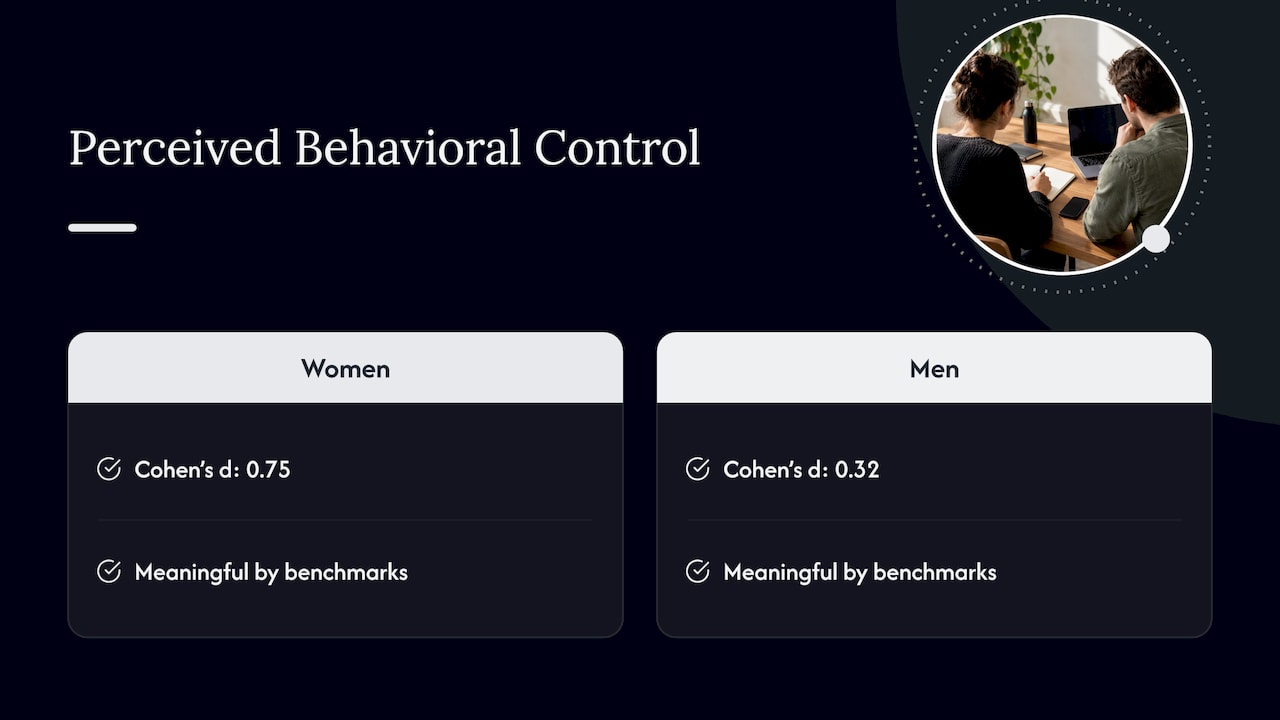
| Confidence and self-efficacy | Higher perceived behavioral control after training, with a larger effect for women | You act sooner instead of waiting to feel ready |
| Venture creation | A 30% higher likelihood of creating a business in a randomized trial | An idea becomes a registered, selling business more often |
| Job creation | Trained founders employed more people on average than a control group | Growth beyond a one-person operation |
| Network and support | Mentorship linked with stronger capabilities in young entrepreneurs | Advice and accountability that outlast the program |
Skills: the most reliable result
If you take one thing from the research, take this: skills are the outcome most studies agree on. A systematic review of entrepreneurship education found that 32.2% of the analyzed studies reported gains in entrepreneurial skills, while 6.4% reported gains in management knowledge. Skills are simply what programs measure and move most often.
A survey of students who attended startup bootcamps in Kenya points the same way. 85% of respondents said they acquired critical skills, including business planning, prototyping and pitching. The list is useful because it describes the work of a founder, not a classroom subject.
In our own programs, the skill areas we build around are the ones a founder uses every week:
- Validation: testing whether anyone wants what you plan to sell before you build it.
- Offer design: turning a loose idea into a clear promise, a price and a buyer.
- Systems: setting up repeatable ways to find customers, deliver and follow up.
- Communication: explaining what you do clearly enough that a stranger can repeat it.
These are our program’s design goals, not guarantees. What you take from them depends on how much you apply during the sprint itself, which is why we run daily accountability and structured sprints rather than lectures alone. You can read more about the approach on the About Our Program page.
Confidence and mindset: the quiet outcome
Skills matter little if you never start. This is where confidence enters the picture. A study of a formal entrepreneurship training program in the United States found that participants reported significantly higher perceived behavioral control after the program. In plain terms, they felt more able to carry out the steps of starting a business. The effect was a Cohen’s d of 0.75 for women and 0.32 for men, and by common benchmarks both count as meaningful.
The finding is worth remembering if you are a freelancer or remote professional who has quietly thought about building something of your own for years. The barrier is often a belief, not a missing technique. Being in a room, or a cohort, with others doing the same thing makes the next step look ordinary. That is one reason we put so much weight on community in the bootcamp design.
Launching and growing: what the trials show
The strongest evidence for business outcomes comes from randomized controlled trials, where trained participants are compared with similar people who did not get the training.
In a trial of the STEP training program run by Leuphana University, the business owner rate rose by 16 percentage points, which is a 30% increase in the likelihood of creating a business two years after the program. The same page reports that trained participants employed an average of 1.38 people against 0.92 in the control group, about 50% more job creation.
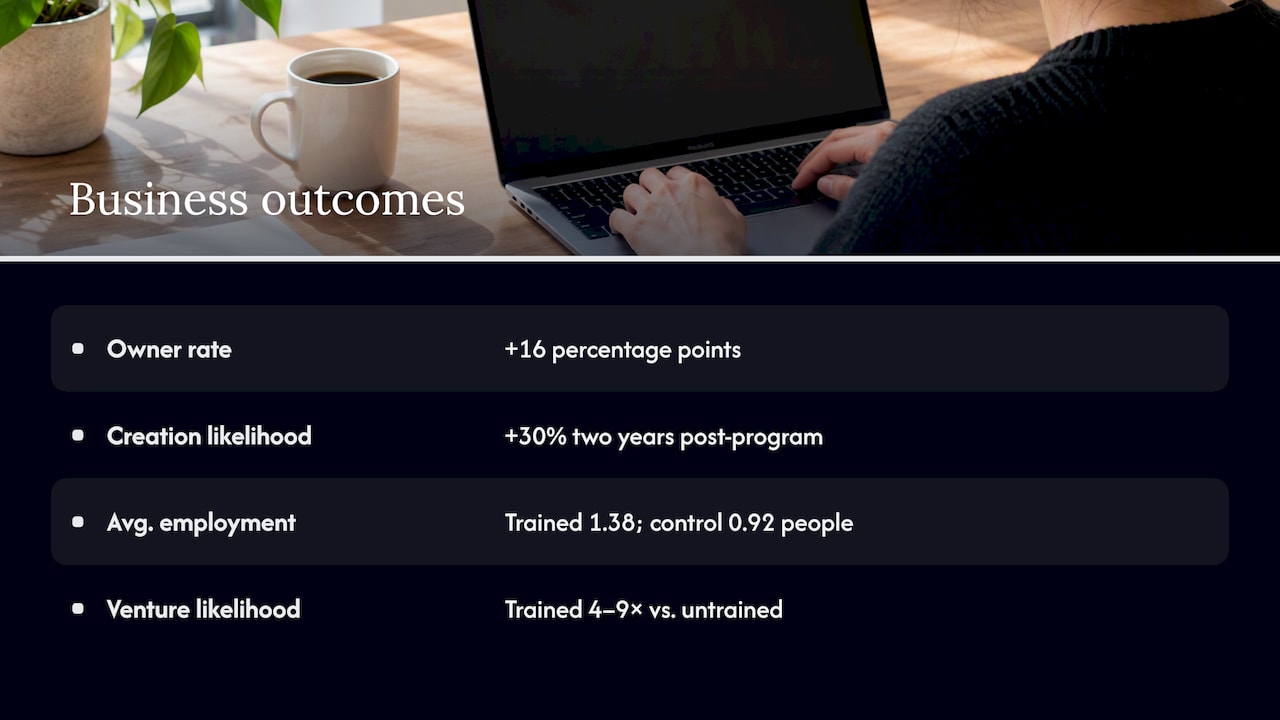
Older work points in the same direction. A 2011 study by Klinger and Schündeln, as cited in a systematic review, found that participants with entrepreneurship training were four to nine times more likely to start new ventures than those without such guidance.
Two cautions keep these numbers honest. First, they describe specific programs in specific settings, so a different bootcamp will not automatically produce the same figures. Second, a launch is a starting line. Researchers describing effective training argue that founders need a package of competencies across the whole business development process, from ideation to scaling, not a single burst of inspiration. That is the reason a bootcamp that only teaches idea generation tends to disappoint, and one that walks you from validation to a working system tends to stick.
If you already run a business
Most outcome research focuses on starting. If you already have customers, the realistic gains look different: a sharper offer, a pricing change, a process that removes you from daily delivery, or a decision to drop a product line. These are smaller than “launching a company” on paper, and they often move revenue faster.
Mentorship and community: why they change results
Hands-on work and feedback are what separate a bootcamp from a course of videos. Research on the mentoring side of entrepreneurship programs is consistent in direction: guided, structured engagement with an experienced person helps. The authors of a recent review on how to train entrepreneurs note that the benefits of hands-on formats depend on structured engagements and quality mentorship. In other words, the mentor matters as much as the schedule.
Peers matter too, and in a different way. A mentor tells you what has worked for them. A peer shows you what is possible with your own constraints, a similar budget and the same week of the calendar. Peers also notice when you have gone quiet. For people who work alone most of the year, that accountability is often the first thing they say they miss after a program ends.
The network effect extends beyond the cohort. Founders who build a habit of meeting other business owners tend to find clients, collaborators and honest feedback faster. If you want to keep that habit going locally after a bootcamp, business owner networking events such as supper clubs, guest speaker sessions and skill-building workshops are a practical way to turn new contacts into a regular rhythm, even if the examples there are in the UK.
Our own take on why the format works is in Why Experiential Bootcamps Matter for Entrepreneurs.
Our perspective: what a bootcamp is really for
When people ask us what the outcome of a bootcamp is, we say it is momentum with a structure around it. Most of the founders we meet do not lack ideas or intelligence. They lack a deadline, a few people who will tell them the truth, and a week in which nothing else competes for their attention.
That is why we build Nomad Excel programs around execution. Each day has a task you finish, not a topic you hear about. Mentors who have built and run businesses look at your real offer, your real numbers and your real plan. The community around you is made of people in the same position, so advice comes with context.
We also choose our destinations on purpose. Working from places like Lisbon, Panama, Brazil or the Canary Islands takes you out of your usual routine, and many of our participants are digital nomads or remote professionals who value that mix of work and place. The setting is not decoration. It makes it easier to commit fully for the length of the program, and the people you share it with often stay in your corner afterward.
If you take only one thing from us: pick a program, arrive with a specific question about your business, and plan what you will do in the first two weeks after you return. The bootcamp gives you the push, and the plan gives you the result.
Amichai
What decides how much you keep
Two people can sit through the same program and leave with very different results. The research points to a handful of factors that explain the gap, and each one is something you can influence.
Quality of mentorship
Mentor quality varies, and the research says so plainly. Reviews of out-of-class training methods identify information overload, lack of peer interaction, difficulty measuring progress and variability in mentor quality as recurring weak points. When you compare programs, ask who the mentors are, what they have built themselves and how much time each participant gets with them.
Continuity after the event
In the Kenyan bootcamp survey, participants named technical difficulties, time constraints and a lack of sustained mentorship as the obstacles that interrupted project continuity. The lesson is simple: look for a program with a community or follow-up that continues beyond the last day, and block time in your calendar for the project afterward.
Personalization
Systematic reviews suggest that personalized learning and formal preparation of mentors are among the best ways to improve the impact of entrepreneurship education. Small cohorts and tailored feedback are not a luxury. They are how general frameworks turn into decisions about your business.
What you bring
The most overlooked factor is preparation. Participants who arrive with a draft offer, a list of ten people to talk to and a clear question get more out of every session than those who hope the program will supply a direction. Our guide to joining entrepreneurship bootcamps lists what to prepare.
How to evaluate any bootcamp’s reported results
Search results for bootcamp outcomes are dominated by coding programs, with placement rates quoted in the 70s and 80s. Those numbers measure employment, which is the wrong yardstick for founders. Here is how to read outcome claims when you are building a business.
- Check what is measured. Placement and graduation rates say little about whether a founder launched or grew. Look for figures on businesses started, revenue or customers.
- Look for a comparison group. Trials like the one above compare trained people with similar untrained people. A program’s own average, with no comparison, cannot separate the effect of the program from the effect of motivated people signing up.
- Ask about timing. A result measured two years later tells you something different from a satisfaction survey on the final day.
- Be aware of the research gap. A review in the Journal of Small Business Management argued that few studies met robust methodological standards, which is why careful readers favor trials and long follow-ups over single testimonials.
- Ask what a typical participant did next. Concrete stories from past cohorts, with details you can check, are worth more than a headline percentage.
On our side, you can see what past cohorts worked on on the previous bootcamps page, and our 7 key benefits of entrepreneurship bootcamps article explains the outcomes we design for.
Matching outcomes to the right format
Different goals call for different formats. A rough guide:
- You want to test whether AI tools can speed up your work: a short online format is enough. Our 5-Day Online AI Bootcamp costs €300.
- You want structure but must stay at your desk: the Online Business Bootcamp costs €500 and fits around work.
- You want a focused sprint with a fixed deliverable: the in-person Entrepreneurship Sprint Bootcamp in Lisbon is €1,350 at Idea Space or €1,500 at Second Home.
- You want to step away for one to two weeks: our destination bootcamps in Playa Venao (Panama, two weeks), Pipa (Brazil, ten days) and Agaete (Canary Islands, one week) each carry a €400 registration fee.
The what is a business sprint guide explains why shorter, sharper formats work well for founders with a clear question.
Start with the format that fits your goal
If you are ready to turn an idea or a side project into something with customers, you can browse the upcoming bootcamps for current locations and schedules, or start with the online entrepreneurship bootcamp if you prefer to learn from home. Teams that want a shared reset can look at our company retreats, which are designed end to end, from workshops to logistics.
FAQ
What are the main outcomes of bootcamp learning for entrepreneurs?
The most consistent outcomes are practical skills such as business planning, prototyping and pitching, along with higher confidence in your ability to act. Controlled studies of entrepreneurship training also show a higher likelihood of starting a business. How far you go after that depends on the quality of mentorship and your follow-through.
How long does it take to see results from a bootcamp?
Skills and clarity often show up by the final day. Business results such as launches, revenue or hires take longer, and the trial cited above measured them two years after the program. A good rule is to set a 30, 60 and 90 day plan before the bootcamp ends.
Will a bootcamp guarantee that my business succeeds?
No program can promise that, and you should be wary of any that does. What a good bootcamp does is compress months of trial and error into days, put experienced mentors in front of your real plan and surround you with peers. The result still depends on the work you do afterward.
Is an online bootcamp as effective as an in-person one?
Both can deliver skills, and the deciding factors are mentor access, structure and accountability rather than location. In-person formats add immersion and a stronger peer bond, while online programs are cheaper and easier to fit around work. Pick the one you will actually finish.
Who gets the most out of an entrepreneurship bootcamp?
People with a specific question and the time to act on the answer: aspiring founders with an idea to test, freelancers turning services into a business, and small business owners ready to refine their offer. Arriving prepared matters more than your starting experience.
Sources
- CEED: STEP Entrepreneurship Training, Leuphana University
- Entrepreneurship Program Evaluation: Examining the Impact of a Training Program on Women and Underrepresented Groups, Small Business Institute Journal
- Characteristics and Effects of Entrepreneurship Education, PMC
- Assessing the impact of startup bootcamps, Journal of Social Innovation Education and Research
- Does how to train matter? Journal of Innovation and Entrepreneurship
- Does Entrepreneurship Education Really Work? Journal of Small Business Management