
Why join a founder bootcamp for startup growth
TL;DR:
- Most first-time founders fail because they build alone without structure or honest feedback, not because their ideas are bad.
- Founder bootcamps provide immersive, cohort-based environments that accelerate growth through mentorship, community, and structured phases.
Most first-time founders don’t fail because their ideas are bad. They fail because they build alone, without structure, without honest feedback, and without the discipline that turning an idea into a real business actually demands. You don’t need a business school degree or a seed check to get started. What you do need is an environment that forces you to think clearly, act consistently, and connect with people who are solving the same hard problems you are. That’s exactly what founder bootcamps are designed to deliver.
Table of Contents
- What is a founder bootcamp and who should join?
- Key benefits: Structure, mentorship, and community support
- How leading bootcamps differ: Founder Institute vs. others
- Is a founder bootcamp right for your startup journey?
- Our perspective: What most new founders misunderstand about bootcamps
- Ready to level up? Explore top entrepreneurship bootcamps for growth
- Frequently asked questions
Key Takeaways
| Point | Details |
|---|---|
| Structure and discipline | Founder bootcamps deliver a proven system and support network for turning startup ideas into reality. |
| Mentorship matters | Access to mentors accelerates learning, but it’s up to each founder to engage and extract value. |
| Low equity requirements | Leading programs like Founder Institute require less equity than most accelerators, reducing founder risk. |
| Not a shortcut | Bootcamps are most effective for resourceful, proactive founders—not those seeking easy funding or done-for-you results. |
What is a founder bootcamp and who should join?
A founder bootcamp is an immersive, cohort-based learning experience built specifically to accelerate your growth as an entrepreneur. Unlike a weekend workshop or an online course you half-finish, bootcamps place you inside a structured program with real deadlines, mentor check-ins, peer pressure (the good kind), and a clear progression from idea to validated business concept.
Understanding the startup bootcamp structure helps you see why this format works so well. Programs are typically divided into phases: research and validation, offer development, go-to-market strategy, and a culminating pitch or demo. Each phase builds on the last, which means you’re not jumping between random topics but following a learning path designed around how businesses actually get built.
Who should join? The honest answer is broader than most people expect:
- Aspiring entrepreneurs who have an idea but haven’t taken the first concrete step toward building a business
- Early-stage founders who have launched something but feel stuck, unfocused, or unsure how to grow
- Career changers who want to transition into entrepreneurship with real tools and a supportive network, not just motivation
- Side-project builders ready to evaluate whether their idea has genuine market viability
One excellent example of the range bootcamps can serve is the Future Founders Startup Bootcamp, a free four-month program specifically for early-stage founders between the ages of 18 and 30. It includes structured phases, pitch days, mentorship, and community access with no equity requirement. Programs like this show that the barrier to entry for quality bootcamp experiences is lower than most founders assume.
“The best bootcamps don’t just teach you what to do. They put you in an environment where not doing it becomes uncomfortable.” — A common reflection from founders who’ve completed immersive programs.
The benefits of joining a structured cohort go well beyond the curriculum. The peer cohort alone often becomes one of the most valuable long-term assets a founder walks away with.
Key benefits: Structure, mentorship, and community support
After defining founder bootcamps, let’s examine the real benefits that set them apart from solo learning or traditional education.

The single biggest challenge most early-stage founders face isn’t knowledge. It’s execution. You can watch a hundred hours of startup content and still not validate your first customer. Bootcamps solve this by creating external accountability structures that make execution the default, not the exception. Daily check-ins, weekly sprints, and cohort-wide progress reviews turn abstract goals into concrete actions.
The bootcamp growth benefits that founders consistently report include:
- Faster decision-making because mentors give direct, experienced feedback instead of generic advice
- Stronger business clarity through repeated iteration on your core offer and target customer
- Peer learning that surfaces blind spots you’d never identify working in isolation
- Network building that produces real collaborative relationships, not just LinkedIn connections
- Confidence through doing, since bootcamps prioritize real-world testing over theoretical frameworks
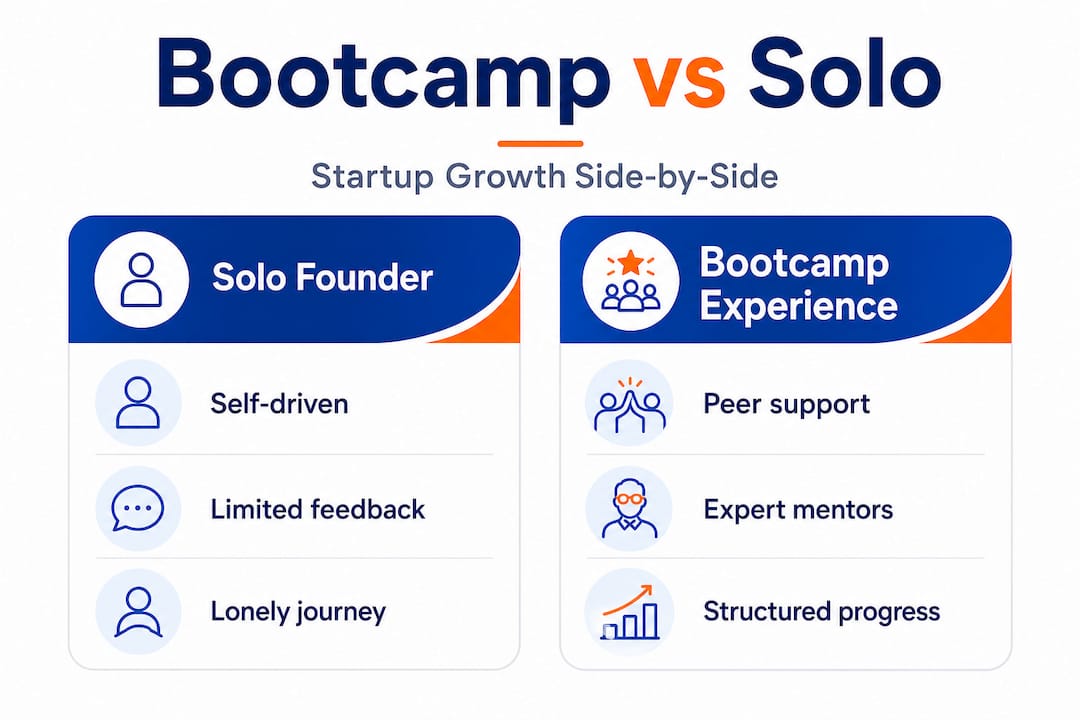
| Factor | Solo founder experience | Bootcamp experience |
|---|---|---|
| Accountability | Self-imposed, easy to skip | Structured, cohort-driven |
| Mentor access | Occasional, hard to find | Regular, program-facilitated |
| Peer community | Limited or ad-hoc | Curated cohort of peers |
| Learning path | Fragmented, self-directed | Sequential, guided phases |
| Feedback quality | Rare and inconsistent | Frequent and specific |
| Progress pace | Slow without external pressure | Accelerated through structure |
It’s worth being honest about variability in quality. Trustpilot reviews for FI average 4.4 out of 5, with founders consistently praising the structure, mentorship approach, and the discipline the program creates. However, critical feedback points to inconsistent mentor quality across chapters and limited post-program support in some cases. This is a realistic reflection of almost any cohort-based program at scale.
Pro Tip: Don’t rely on your assigned mentor alone. From day one, identify two or three additional mentors or advisors you can engage proactively. Bootcamps create the access; it’s your job to maximize it by coming to every session with specific, prepared questions rather than waiting for guidance to appear.
The Future Founders program also reinforces this point. Even in a well-designed program that includes mentorship and pitch days, the founders who get the most out of it are those who treat every touchpoint as an opportunity to pressure-test their thinking rather than simply receive information.
How leading bootcamps differ: Founder Institute vs. others
Understanding the benefits, it’s crucial to pick the right founder bootcamp for your specific situation. Not all programs are designed for the same stage, founder profile, or goal.
The Founder Institute pre-accelerator is widely recognized as one of the best entry points for first-time, idea-stage founders who need structure but aren’t yet at the point of seeking institutional investment. The equity requirement is intentionally low, at a 2.5% warrant, making it far less dilutive than most accelerator programs. By contrast, programs like Y Combinator and Techstars are designed for teams that already have traction and want to accelerate toward raising a seed or Series A round.
| Program | Entry bar | Equity taken | Mentorship style | Duration | Funding access |
|---|---|---|---|---|---|
| Founder Institute | Low (idea stage) | 2.5% warrant | Cohort mentors, structured | 3-4 months | Limited, network-based |
| Y Combinator | High (traction required) | 7% equity | Partner office hours | 3 months | Direct investment |
| Techstars | High (team + traction) | 6% equity | Intensive mentor meetings | 3 months | Direct investment |
| Future Founders | Low (18-30, early stage) | None | Peer and guest mentors | 4 months | None direct |
The Trustpilot feedback on FI highlights an important nuance: the program’s value is directly correlated with the quality of the local chapter and the mentor pool available. A founder in a major startup hub will likely have a very different experience than one in a smaller market where the mentor network is less developed.
How should you evaluate which program is right for you? Follow these steps before committing:
- Assess your current stage honestly. Are you pre-idea, idea-stage, or post-launch? Match the program to where you actually are, not where you want to be.
- Clarify your primary goal. Is it validation, funding, community, or skill-building? Different programs optimize for different outcomes.
- Research the mentor network. Check LinkedIn to see who’s actually involved in your city or cohort, not just the names on the website.
- Understand the equity and cost structure. Know exactly what you’re giving up and what you’re getting in return before signing anything.
- Talk to alumni. Recent graduates will give you the most honest picture of day-to-day reality in the program.
“The founders who thrive in bootcamps aren’t the ones with the best ideas. They’re the ones who show up fully prepared to be challenged, changed, and occasionally proven wrong.” — Observed pattern across multiple cohort programs.
Explore a thorough mentorship programs comparison and business mentorship program reviews to dig deeper into how different programs stack up before you decide.
Is a founder bootcamp right for your startup journey?
Having seen the landscape, it’s time for honest reflection. A bootcamp is not a guaranteed path to funding, and it’s not designed to do the work for you. Knowing whether the format fits your personality and your current stage is essential to getting real value from the experience.
You’re likely to thrive in a founder bootcamp if you recognize yourself in most of these characteristics:
- You learn best when you have structure and deadlines, not open-ended self-direction
- You actively want peer feedback, even when it challenges your assumptions
- You’re ready to prioritize execution over extended planning and research
- You’re open to pivoting your idea based on real market signals
- You value community and collaborative learning as much as individual achievement
- You can commit meaningfully to the program’s time requirements without burning out
On the flip side, Trustpilot reviews for FI reveal a clear pattern: founders who enter expecting guaranteed introductions to investors or a step-by-step roadmap to product-market fit often leave disappointed. Bootcamps build your capacity to find those things. They don’t hand them to you. This is a distinction that matters enormously when setting expectations before you apply.
What bootcamps genuinely cannot provide includes guaranteed funding at any stage, a substitute for actually doing customer discovery yourself, and consistent mentor quality in every chapter or cohort. These are real limitations worth factoring into your decision.
Pro Tip: Before you apply, write down three specific, measurable outcomes you want to achieve by the end of the program. Not vague goals like “grow my business,” but real deliverables: a validated customer segment, a working landing page with a defined conversion rate, or five paying beta customers. Planning your startup path with clear milestones in mind will help you stay focused and measure your actual progress throughout.
The founders who consistently get the most out of bootcamps are those who treat it like a sprint, not a class. They show up every day ready to act, not just to learn.
Our perspective: What most new founders misunderstand about bootcamps
With the facts laid out, here’s our hard-won perspective on the single biggest mistake founders make when approaching bootcamp programs.
Most people come in thinking a bootcamp is about getting something: a network, a mentor, a shortcut to investment, a framework that finally makes everything click. That mindset, while understandable, tends to produce passive participation and real disappointment.
The founders who walk away transformed are those who come in focused on building something, not receiving something. The curriculum, the mentors, the cohort — these are tools. They only work if you bring genuine urgency, real problems to solve, and the willingness to be uncomfortable.
“A bootcamp doesn’t give you a business. It gives you an environment where building one becomes unavoidable if you show up with intention.”
The why behind joining a bootcamp matters more than which bootcamp you choose. Founders who are clear on why they need structure and community tend to perform far better than those who apply simply because it sounds like the right next move.
There’s also a long-term ROI question that rarely gets discussed. The immediate outcomes of a bootcamp — a refined pitch, a validated idea, a clearer go-to-market strategy — are valuable. But the compounding value comes from the peer network you maintain over years, the habits of execution and iteration you build into your daily practice, and the mentor relationships you continue to invest in after the program ends.
Pro Tip: Treat the last two weeks of any bootcamp as an investment in the next two years. Focus on deepening two or three peer relationships that you genuinely plan to maintain, and follow up with every mentor who gave you meaningful feedback within 48 hours of the program ending. Most long-term value from bootcamps is unlocked in the follow-through, not the program itself.
Ready to level up? Explore top entrepreneurship bootcamps for growth
If you’re ready to take your next step, here are resources and programs designed for founders like you.
At Nomad Excel, we’ve built our online entrepreneurship bootcamp specifically around the principles that make immersive programs work: structured phases, hands-on execution, direct mentorship, and a curated peer community that doesn’t disappear when the program ends. Whether you’re validating your first idea or scaling an early-stage venture, our programs meet you where you are and push you toward where you need to go.
Explore the full picture of why joining entrepreneurship bootcamps accelerates your progress in ways that solo learning simply cannot replicate. Or review our Nomad Excel program details to understand exactly what the experience looks like and how it’s designed to produce real, measurable outcomes for founders at every stage.
The right bootcamp won’t hand you success. It will build the environment where your success becomes far more likely.
Frequently asked questions
Are founder bootcamps only for new entrepreneurs?
Founder bootcamps are ideal for new and early-stage entrepreneurs, but those at any point of building or scaling a startup can benefit from the structure and peer support. Programs like the Future Founders Startup Bootcamp serve founders from the very beginning of their journey, but the frameworks and community apply well beyond that starting point.
Do all bootcamps require giving up equity?
Many founder bootcamps require no equity at all, while others take a minimal stake compared to full accelerator programs. The Founder Institute, for example, requires only a 2.5% warrant, which is significantly lower than the equity stakes typical of programs that require existing traction.
What happens if I don’t find a compatible mentor?
Mentor quality can vary, but proactive founders can still build substantial value through peer learning and by seeking mentors outside the formal program. Trustpilot reviews consistently show that founders who engage the community broadly, rather than relying on a single mentor relationship, have stronger overall experiences.
Can I join a bootcamp while working full-time?
Some founder bootcamps require a near full-time commitment, but many programs now offer part-time formats, remote participation options, and flexible scheduling specifically designed for working professionals who are building their ventures on the side.
Comments are closed.