
What Is Entrepreneurial Co-Living for Founders
TL;DR:
- Entrepreneurial co-living is a managed housing model that combines private bedrooms, communal workspaces, and curated programming to foster startup growth. The success of this model relies on operator-managed activities like events and mentorship, which create a vibrant entrepreneurial community. This approach offers flexible leases, cost efficiency, and instant peer networks, effectively reducing relocation and isolation challenges for founders.
Entrepreneurial co-living is defined as a managed housing model where founders, remote professionals, and early-stage startup teams share a property that combines private bedrooms with communal workspaces, social areas, and operator-curated programming designed to accelerate business growth. Unlike a standard apartment share, this model bundles utilities, high-speed Wi-Fi, cleaning, and community events into a single monthly payment. Platforms like Coliving.com and operators like The Assembly Place have built entire ecosystems around this concept, treating the social infrastructure as seriously as the physical space. For anyone exploring entrepreneurial living concepts, the defining feature is not the shared kitchen. It is the intentional community built around it.
What is entrepreneurial co-living and how does it work?
Entrepreneurial co-living adapts the baseline coliving model by adding bundled services and community programming specifically tailored for entrepreneurs and remote professionals. Residents get a private bedroom within a shared property, but the monthly fee covers far more than rent. Utilities, internet, cleaning, and access to co-working areas are all included, removing the administrative friction that typically consumes a founder’s first weeks in a new city.

The model is operator-managed, which is the critical distinction. A property manager or community team actively designs and runs the resident experience, from onboarding to weekly events. This is not a passive arrangement where you hope your housemates turn out to be interesting. The operator builds the conditions for collaboration deliberately, using programming schedules, resident matching, and shared space design to create regular interaction. Coliving.com, for example, curates entrepreneurial hubs that connect residents with mentors, investors, and fellow builders through structured events.
The result is a living arrangement that functions more like a startup accelerator with bedrooms than a traditional apartment. Residents arrive with a peer network already forming around them, workspaces ready to use, and a calendar of events designed to move their businesses forward.
How does it differ from traditional coliving and other shared living models?
The word “coliving” covers a wide range of arrangements, so the differences matter. Here is how entrepreneurial co-living compares to the most common alternatives:
| Model | Management | Services bundled | Entrepreneur focus | Lease flexibility |
|---|---|---|---|---|
| Entrepreneurial co-living | Operator-managed | Yes, full bundle | High, curated programming | Short to medium term |
| Standard coliving | Operator-managed | Partial | Low to moderate | Short to medium term |
| Co-housing | Resident-led | Minimal | None by design | Long term |
| Traditional rental | Self-managed | No | None | 12-month standard |
| Roommate share | Self-managed | No | None | Varies |
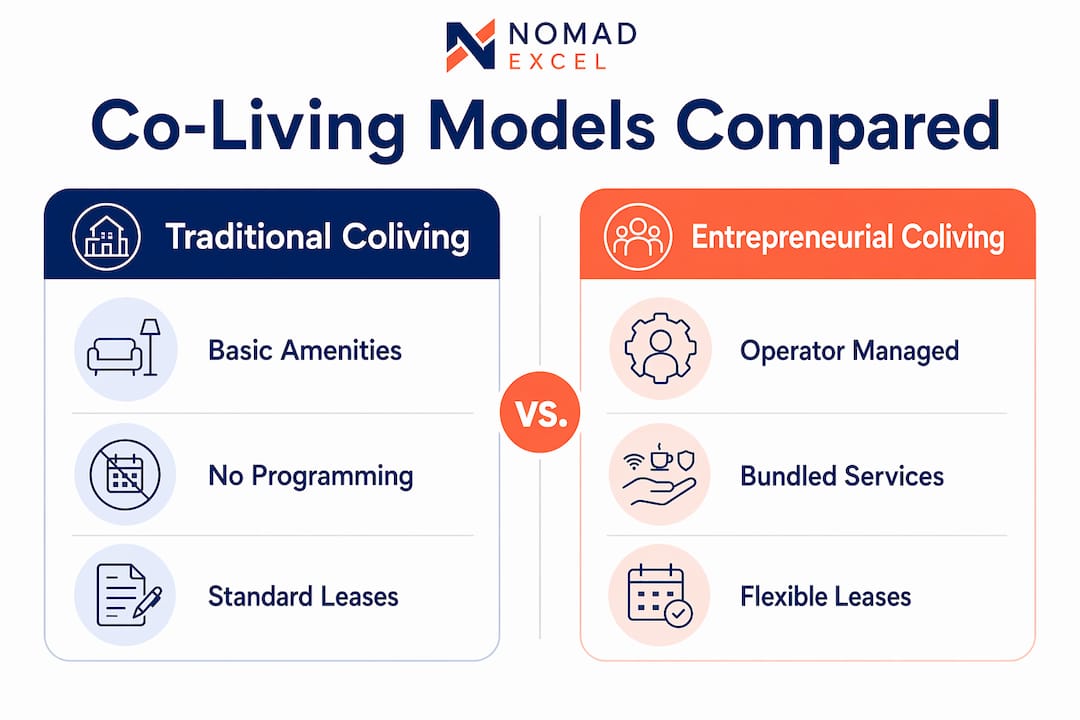
Operator-managed coliving differs from co-housing in one fundamental way: residents in co-housing collectively govern the space and make decisions together, which builds deep community but requires significant time investment. Entrepreneurial co-living removes that governance burden so residents can focus on their work.
The programming gap between standard coliving and entrepreneurial co-living is equally significant. A standard coliving property might host a monthly social dinner. An entrepreneurial co-living space runs pitch nights, workshops, mentorship pairings, and demo days on a recurring schedule. These are not optional extras. They are the core product. The physical space is the hardware. The programming is the software, and the software is what drives outcomes.
Traditional rentals and roommate setups offer neither the bundled convenience nor the community infrastructure. For a founder relocating to a new city for three months to test a market, signing a 12-month lease and buying furniture is a significant distraction from the actual work.
What are the key benefits of co-living for startup founders?
The practical advantages of entrepreneurial co-living stack up quickly for anyone building a business while managing a mobile or flexible lifestyle. Here are the benefits that matter most:
- Turnkey setup. You arrive and everything works. Internet, desk, kitchen, and community are ready from day one. There is no two-week gap while you wait for a router or negotiate a utility account.
- Instant peer network. Reducing isolation through community is one of the most underrated benefits. Loneliness is a real productivity killer for solo founders, and co-living addresses it structurally rather than leaving it to chance.
- Access to mentorship and events. Pitch nights, workshops, and guest speaker sessions are built into the calendar. These are the kinds of connections that take months to build through cold outreach, compressed into a living environment.
- Flexible lease terms. Short-term commitments suit founders who are testing cities, attending accelerator programs, or simply not ready to commit to a year-long lease. The plug-and-play lifestyle is a genuine competitive advantage for people whose work location is not fixed.
- Dedicated workspaces. High-speed internet and conference rooms are standard in well-run spaces. Improved access to workspaces removes one of the most common friction points for remote founders who cannot work productively from a bedroom or a noisy café.
- Cost efficiency. Bundling rent, utilities, internet, and cleaning into one payment often costs less than assembling those services separately in major cities, particularly when you factor in the time saved.
Pro Tip: When evaluating a co-living space, ask the operator for a three-month programming calendar before you commit. A space with a full, varied schedule of events signals an operator who treats community as a product. A space with vague promises about “regular events” is likely to disappoint.
What community programming and activities are common in these spaces?
The programming calendar is where entrepreneurial co-living earns its distinction from every other shared living model. Recurring interaction loops like weekly build nights and monthly demo days create a rhythm of accountability and feedback that mirrors what the best accelerators provide.
Common event types and their purposes include:
- Pitch nights. Residents practice presenting their businesses to peers and invited guests, building confidence and refining their messaging in a low-stakes environment.
- Build nights. Structured working sessions where residents work on their projects in the same room, creating shared momentum and spontaneous collaboration.
- Demo days. Monthly or quarterly showcases where residents present progress, attracting external mentors, investors, and potential partners.
- Workshops. Skills-focused sessions covering topics like marketing, fundraising, product development, or legal basics, often led by experienced operators or guest experts.
- Mentorship pairings. Operators match residents with mentors based on business stage and industry, creating structured relationships rather than hoping for organic connection.
- Guest speaker sessions. Founders, investors, and operators share their experience with the resident community, providing access that would otherwise require expensive conference tickets or strong existing networks.
The Assembly Place’s AI Lab initiative in Singapore demonstrates what this looks like at an advanced level. The operator runs weekly build nights and demo days as part of a technology-integrated community model, treating the programming schedule as a product that evolves with resident needs. This approach reflects a broader truth: community events for entrepreneurs like pitch nights and workshops provide networking and mentorship that accelerates growth in ways that passive shared space simply cannot replicate.
The most effective spaces design programming to serve residents at different entrepreneurial stages. A builder in the early validation phase needs different support than a founder who is hiring their first team or a veteran who can mentor others. Spaces that recognize these stages and program accordingly create communities with genuine depth and longevity.
How does co-living solve the challenges of relocating as a founder?
Relocating to a new city as a founder carries a specific set of problems that entrepreneurial co-living is built to solve. The standard relocation checklist includes finding an apartment, setting up utilities, buying furniture, sourcing a reliable workspace, and building a social network from scratch. Each item on that list takes time and energy that would be better spent on the business.
Young professionals and remote workers seeking flexibility and instant peer networks when relocating represent the core demographic for entrepreneurial co-living, and the model addresses their needs directly. You arrive with a furnished room, working internet, and a community of people who understand what it means to build something from nothing. The social infrastructure is already in place.
Flexible lease terms are particularly valuable for digital nomads and freelancers who move between cities based on opportunity, project timelines, or personal preference. A three-month stay in a co-living space in Lisbon, Bali, or Austin gives a founder access to a local network, a productive workspace, and a community of peers without the commitment of a long-term lease or the isolation of a hotel.
Technology is also changing what relocation looks like inside these spaces. The Assembly Place’s AI-powered model uses smart community management to match residents, surface relevant events, and track community health metrics. This kind of data-driven approach to community building is still emerging, but it points toward a future where co-living operators can personalize the resident experience at scale.
Pro Tip: Before relocating to a co-living space in a new city, research the resident community composition, not just the amenities. A space filled with founders at a similar stage to yours will generate more useful conversations than a beautiful property with a mixed or undefined resident profile.
Key takeaways
Entrepreneurial co-living works because operator-managed programming, bundled services, and curated peer communities create conditions for startup growth that no traditional housing model can replicate.
| Point | Details |
|---|---|
| Definition is operator-driven | Entrepreneurial co-living is defined by managed programming and bundled services, not just shared space. |
| Programming is the core product | Pitch nights, build nights, and mentorship pairings drive the real value beyond physical amenities. |
| Flexibility suits founders | Short-term leases and turnkey setup remove relocation friction for mobile entrepreneurs and remote professionals. |
| Community combats isolation | Structured social infrastructure reduces the loneliness that undermines solo founder productivity. |
| Technology is advancing the model | AI-powered operators like The Assembly Place are using smart community management to personalize resident experiences. |
Why the “software” of co-living matters more than the building
The most common mistake people make when evaluating entrepreneurial co-living is focusing on the physical space. Beautiful common areas and fast internet are table stakes. What actually determines whether a space produces meaningful outcomes for residents is the quality of the operator’s community programming, or what The Assembly Place CEO Eugene Lim calls the “non-physical software” of co-living.
I have seen this play out repeatedly. A well-designed space with passive shared areas produces polite neighbors. A space with a disciplined programming calendar, resident matching, and recurring interaction loops produces collaborators, co-founders, and clients. The difference is not the building. It is the intentionality of the operator.
What concerns me about the broader co-living market is the number of operators who treat programming as a marketing feature rather than a core operational commitment. A pitch night held once and never repeated is not community infrastructure. It is a photo opportunity. Operators must actively deliver lightweight, repeatable programming and resident matching to produce environments where startups actually thrive.
The blend of private space and shared social infrastructure is also more delicate than it appears. Founders need solitude to do deep work, and they need community to stay motivated and connected. Spaces that get this balance right, giving residents genuine privacy alongside structured opportunities for interaction, tend to retain residents far longer and generate the kind of word-of-mouth that fills waiting lists. The cultural impact of a well-run entrepreneurial co-living space extends well beyond housing. It shapes how founders think about collaboration, accountability, and what it means to build alongside other people.
— Amichai
How Nomadexcel supports the entrepreneurial co-living mindset
The values that make entrepreneurial co-living work, peer learning, structured accountability, mentorship, and community, are exactly what Nomadexcel builds into every program. If you are drawn to the co-living model because you want to grow faster alongside other driven founders, Nomadexcel’s online entrepreneurship bootcamp delivers that same curated community experience in a flexible, location-independent format. You get direct mentorship, a cohort of peers at your stage, and a structured program designed for real execution rather than theory. Explore the bootcamp program and find out how Nomadexcel can accelerate your growth, wherever you are building from.
FAQ
What is entrepreneurial co-living in simple terms?
Entrepreneurial co-living is a managed housing model where founders and remote professionals share a property with private bedrooms, communal workspaces, and operator-run programming like pitch nights and workshops, all bundled into one monthly payment.
How is entrepreneurial co-living different from standard coliving?
Standard coliving provides shared housing with basic amenities, while entrepreneurial co-living adds curated programming, mentorship pairings, and events specifically designed for startup founders and remote professionals.
Who is entrepreneurial co-living best suited for?
It is best suited for early-stage founders, digital nomads, freelancers, and remote professionals who want flexible leases, instant peer networks, and access to business-building resources without the overhead of a traditional rental.
What types of events happen in entrepreneurial co-living spaces?
Common events include pitch nights, build nights, demo days, skills workshops, guest speaker sessions, and mentorship pairings, all designed to accelerate resident business growth and reduce professional isolation.
Is entrepreneurial co-living cost-effective compared to renting an apartment?
For founders in major cities, bundling rent, utilities, internet, cleaning, and co-working access into one payment often competes favorably with assembling those services separately, particularly on short-term stays where traditional leases are impractical.
Recommended
- Entrepreneurship Sprint Bootcamp | Second Home, Lisbon – Nomad Excel – Your Entrepreneurial Adventure Starts Here
- Online Entrepreneurship Bootcamp – Nomad Excel – Your Entrepreneurial Adventure Starts Here
- Why should I Even Join an Entrepreneurship Bootcamp?
- What Is Entrepreneurial Facilitation? A Startup Guide
Comments are closed.