
Hands-On Business Training: What It Is and Why It Works
TL;DR:
- Hands-on business training involves learning through direct practice in real or simulated environments. It emphasizes active application, mentorship, and reflection to develop measurable skills and confidence. Effective programs include live projects, expert guidance, and teamwork over 1 to 4 weeks for lasting competency.
Hands-on business training is defined as a learning method where individuals develop business skills through direct practice in real or simulated environments, rather than passive study. The industry term for this approach is experiential learning, a framework built on the principle that competence comes from doing, not just knowing. Practical training boosts workplace confidence and competency in ways that theory alone cannot replicate. For entrepreneurs and teams who need results, not just credentials, understanding what hands-on business training delivers is the first step toward choosing the right program.
What is hands-on business training and how does it differ from traditional methods?
Hands-on business training places learners inside real decisions, real feedback loops, and real consequences. Traditional classroom methods transfer knowledge from instructor to student. Experiential business learning transfers ownership of problems from instructor to learner. That shift changes everything about how skills form.
Practical skills produce measurable results, not just knowledge. Employers consistently prioritize communication, problem-solving, and digital literacy over academic credentials alone. Hands-on formats build exactly those capabilities because learners practice them under pressure, not in theory.
The contrast with traditional training is sharp. A lecture on negotiation teaches vocabulary. A live negotiation simulation builds the muscle memory, judgment, and confidence that repetition in controlled environments creates over time. One produces notes. The other produces skill.
Pro Tip: When evaluating any training program, ask whether participants leave with a tangible output, such as a validated business idea, a completed project, or a measurable result. If the answer is no, the program leans too heavily on theory.
The benefits of practical training extend beyond skill acquisition. Individuals completing practical training adapt faster, show higher competency, and face less workplace anxiety than those with theory-only study. Less anxiety means faster onboarding, stronger performance, and greater resilience when conditions change.
Key benefits of hands-on business education include:
- Faster skill retention through active application and error correction in real time
- Greater confidence entering professional roles, reducing performance anxiety
- Critical thinking development through exposure to ambiguous, real-world problems
- Adaptability built by practicing skills across varied conditions and contexts
- Workforce resilience, which OECD research identifies as a priority skill for future careers
What are the core components of effective hands-on business training?
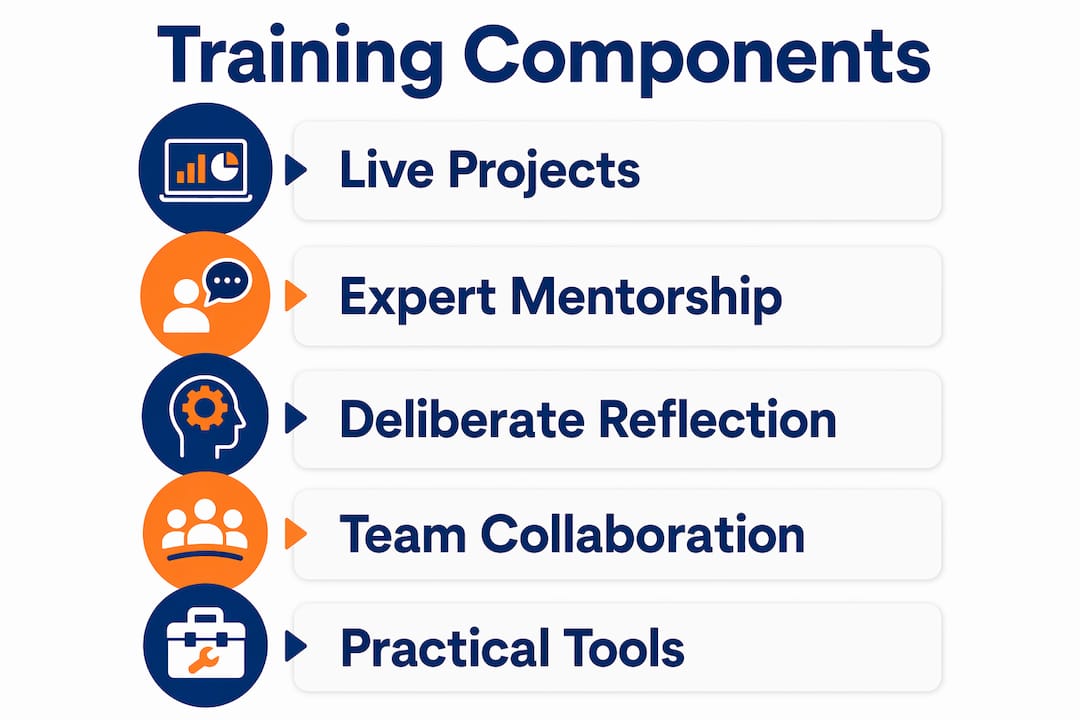
Not every program that calls itself “hands-on” delivers genuine experiential learning. The difference lies in structure. Effective programs share specific components that convert activity into competence.
Live projects and real tools
Learners work on actual business challenges, not hypothetical case studies. They use the same tools, platforms, and frameworks that practitioners use daily. This closes the gap between training and application from day one.

Structured mentorship and expert feedback
Effective hands-on training includes mentorship by practitioners, not just instructors. A practitioner mentor has made the mistakes, navigated the uncertainty, and built the judgment that a textbook cannot convey. Direct access to that experience accelerates learning significantly.
Deliberate reflection after every task
Immediate, structured reflection after practical tasks converts experience into competence. Without reflection, repetition creates habit, not skill. The best programs build reflection into the daily schedule, not as an afterthought.
Collaborative team activities
Working alongside peers who challenge your thinking replicates the actual business environment. Collaborative projects and teamwork are central to hands-on business education because most real business decisions happen in groups, not in isolation.
Pro Tip: Look for programs that run 1–4 weeks in duration. Short workshops rarely allow enough time for the full cycle of practice, feedback, reflection, and application that builds lasting competence.
The table below compares program types by their core structural features:
| Feature | Workshop format | Immersive bootcamp |
|---|---|---|
| Duration | 1–2 days | 1–4 weeks |
| Live project work | Rarely included | Central to program |
| Practitioner mentorship | Limited | Structured and ongoing |
| Peer collaboration | Minimal | Daily and deliberate |
| Reflection built in | Uncommon | Scheduled consistently |
How does hands-on training fit into broader business education?
Experiential business learning works best when it complements, not replaces, foundational knowledge. Theory gives learners a map. Hands-on practice teaches them to read the terrain. Both are necessary, but the sequence matters: theory first, application immediately after.
Effective training programs combine knowledge transfer with realistic scenarios, using structured learning for theory and hands-on practice for application. Virtual simulations and digital tools can support this blend, but they do not replace the judgment that comes from working through real uncertainty with real stakes.
Mentorship sits at the center of this integration. A strong mentorship program connects learners to practitioners who have navigated the exact challenges the learner faces. That connection shortens the feedback loop between mistake and correction, which is where most skill growth actually happens.
Entrepreneurship bootcamps and company retreats represent the most concentrated form of hands-on business education available today. These formats bring together live project work, expert mentorship, peer collaboration, and structured reflection inside a single program. For teams, business retreats add the dimension of shared experience, which builds trust and alignment alongside skill.
The role of community in this model is underestimated. Peers who share the same growth goals create accountability that no instructor can manufacture. They challenge assumptions, share resources, and sustain momentum long after the formal program ends.
What practical steps can you take to engage in hands-on training effectively?
Choosing the right program is the first decision, and it is the most consequential one. The wrong program wastes time and money. The right one compounds both.
Follow these steps to get the most from experiential business learning:
- Prioritize programs with real outputs. Choose training that ends with a deliverable: a business plan, a launched product, a completed client project. Outputs prove skill was built, not just discussed.
- Apply skills across varied conditions. Practice the same skill in different contexts to build genuine adaptability. A negotiation skill practiced only in one scenario is fragile. Practiced across three different contexts, it becomes reliable.
- Seek practitioner mentorship, not just instruction. A mentor who has built a business gives you pattern recognition that no curriculum can provide. Prioritize access to business mentor benefits when evaluating programs.
- Engage peer collaboration deliberately. Do not treat group work as a logistical necessity. Treat it as a core learning tool. The feedback you receive from peers who are solving the same problems is often more useful than formal instruction.
- Track progress through demonstrable results. Build a portfolio of outputs from your training. Concrete evidence of skill development is more persuasive to clients, employers, and investors than a certificate.
Pro Tip: Before enrolling in any program, ask to speak with a past participant. Their honest account of what they built, what they struggled with, and what they applied afterward tells you more than any program description.
Soft skills built through hands-on training such as adaptability, communication, and resilience are the ones employers and clients value most. These skills cannot be memorized. They must be practiced, tested, and refined through experience.
Key Takeaways
Hands-on business training builds competence through direct practice, structured mentorship, and deliberate reflection, making it the most effective method for developing real business skills.
| Point | Details |
|---|---|
| Definition is clear | Hands-on training means learning by doing in real or simulated business environments. |
| Retention beats theory | Active application with real-time feedback produces faster skill development than lectures. |
| Reflection is non-negotiable | Structured reflection after every task converts experience into lasting competence. |
| Mentorship accelerates growth | Practitioner mentors shorten the gap between mistake and correction more than any curriculum. |
| Outputs prove skill | Choose programs that end with a tangible deliverable, not just a certificate. |
Why hands-on training is harder than it looks, and why that matters
The biggest misconception I encounter is that hands-on training is the easier path. People assume that because it feels more engaging, it must demand less. The opposite is true. Hands-on training is more demanding than theory because it exposes learners to real-world uncertainty and requires them to own their decisions, not just observe them.
I have watched participants in immersive programs hit a wall around day three or four. The novelty wears off, the real complexity of their business challenge surfaces, and the temptation to retreat into passive learning becomes strong. The ones who push through that moment are the ones who leave with genuine skill. The ones who don’t leave with a good experience but limited growth.
The other pattern I see consistently is reflection being skipped. Participants complete a task, feel the satisfaction of finishing, and move immediately to the next one. Skipping reflection leads to habitual repetition rather than skill mastery. The task gets done faster each time, but the underlying judgment never deepens. Deliberate reflection, even five minutes after a task, changes that outcome entirely.
My honest view is that the best training programs are the ones that make you uncomfortable in productive ways. They put you in front of real problems before you feel ready. They give you feedback that stings a little. They ask you to apply what you learned in a context you did not expect. That discomfort is not a design flaw. It is the mechanism through which competence forms.
— Amichai
Nomadexcel’s approach to hands-on entrepreneurship training
Nomadexcel runs immersive entrepreneurship bootcamps built on the exact principles this article describes: live project work, practitioner mentorship, peer collaboration, and structured reflection. Programs run for 1–4 weeks and are designed for aspiring and early-stage entrepreneurs who want real results, not just classroom hours. Participants work on their own business challenges from day one, receiving direct feedback from experienced operators and a peer community that continues well beyond the program itself. For teams, Nomadexcel also designs custom company retreats that combine business alignment with hands-on skill development. If you are ready to build skills through practice rather than passive study, Nomadexcel’s programs are built for exactly that.
FAQ
What is hands-on business training?
Hands-on business training is an experiential learning method where individuals build business skills through direct practice in real or simulated environments. It prioritizes active application, real-time feedback, and deliberate reflection over passive instruction.
How does practical training improve skill retention?
Active application with error correction and real-time feedback produces stronger retention than theory-only study. Learners who practice skills under realistic conditions adapt faster and perform with greater competency.
What types of business training programs use hands-on methods?
Entrepreneurship bootcamps, company retreats, live project workshops, and mentorship programs are the most common formats. The most effective ones run for 1–4 weeks and include structured mentorship, peer collaboration, and tangible deliverables.
Is hands-on business training suitable for teams as well as individuals?
Hands-on training works for both. Team formats add the benefit of shared experience, which builds trust, alignment, and communication alongside individual skill development.
How do I know if a training program is genuinely hands-on?
Ask whether participants leave with a real output, such as a validated business idea or completed project. Programs that end with only a certificate and no tangible deliverable lean too heavily on theory.
Comments are closed.