
E-Commerce Business Models: Your PDF Guide and Framework
The three most useful e-commerce business model PDFs you can download right now are the OECD’s Unpacking E-Commerce policy report, the analytical framework paper on ResearchGate that applies transaction-cost theory to model evaluation, and the Chris C. Fox Consulting overview that maps B2B and B2C model types with practical examples. Pair any of those with Nomadexcel’s one-page business-model worksheet (described in Section 8) and you have everything you need to map, compare, and pitch your model before you spend a dollar on inventory.
Top PDFs to download now:
- OECD Unpacking E-Commerce (2019) — The most authoritative public-domain overview of platform, subscription, and omni-channel model types; the model taxonomy section alone is worth the download.
- Analytical Framework for E-Commerce Business Models (ResearchGate) — A structured evaluation tool grounded in transaction-cost and switching-cost theory; use it as a scoring rubric when comparing two candidate models.
- E-Commerce Business Models Overview (mediatum.ub.tum.de) — A concise practitioner-oriented overview with B2B marketplace evolution examples; useful for anyone moving into wholesale or platform selling.
Named anchors in these PDFs include Amazon’s marketplace architecture, Shopify’s merchant ecosystem, and Walmart’s omni-channel fulfillment model — three of the clearest U.S. case studies available in free public documents. Download the OECD PDF first, open the Nomadexcel one-page template alongside it, and fill in your own model’s fields as you read. That single exercise will surface more strategic clarity than most week-long planning sessions.
Key Takeaways
The most durable e-commerce businesses layer multiple revenue streams on top of a validated core model rather than optimizing a single stream in isolation.
| Point | Details |
|---|---|
| Start with the OECD PDF | Download the OECD Unpacking E-Commerce report first — its model taxonomy is the clearest free framework available. |
| Match model to your constraints | Choose DTC/subscription for brand control and LTV; choose marketplace for catalog breadth with low inventory risk. |
| Validate before you layer | Prove demand with direct sales and 100+ paying customers before adding subscription, membership, or advertising streams. |
| Track three KPIs from day one | CAC, conversion rate, and LTV:CAC ratio (target 3:1 or higher) are the minimum dashboard for any early-stage model. |
| Nomadexcel for guided execution | Nomadexcel’s bootcamp gives founders the one-page template, mentor feedback, and peer accountability to move from model to traction faster. |
Table of Contents
- How the main e-commerce business models compare at a glance
- How e-commerce businesses actually make money
- When to pick each model — and when to walk away
- Your implementation checklist and launch timeline
- Where to find the best e-commerce PDF guides and templates
- U.S. operational notes every e-commerce founder needs to know
- The Nomadexcel one-page PDF template: a practitioner walkthrough
- Sources
How the main e-commerce business models compare at a glance
The eight canonical online business model types each carry a distinct risk-reward profile. The table below maps them across the dimensions that matter most when you are choosing or stress-testing a model.
| Model | Best for | Revenue predictability | Startup complexity & capital | Fulfillment complexity | Margin potential | Scalability | Key risks |
|---|---|---|---|---|---|---|---|
| B2C (direct retail) | Branded consumer products | Moderate (one-time) | Medium | Owned inventory | Medium–high | High with paid channels | High CAC, returns |
| B2B | Wholesale, SaaS, services | High (contracts) | High (longer sales cycle) | Negotiated/drop | High | High via contracts | Long sales cycles, churn |
| C2C / Peer-to-peer | Resale, handmade, collectibles | Low | Low | Seller-managed | Low (platform fee) | Platform-dependent | Trust, fraud, disputes |
| Marketplace | Broad catalog, low inventory risk | High (commission) | Medium–high (platform build) | Seller-fulfilled | Medium (take rate) | Very high | Platform dependency, seller quality |
| DTC (direct-to-consumer) | Brand-building, LTV focus | Moderate–high | Medium | Owned or 3PL | High | High with retention | Brand awareness cost, logistics |
| Subscription | Replenishment, content, SaaS | Very high (recurring) | Medium | Recurring ship or digital | High over time | High with low churn | Churn, cadence mismatch |
| Dropshipping | Low-capital entry, trend testing | Low–moderate | Very low | Supplier-managed | Low | Moderate | Supplier reliability, thin margins |
| Freemium / Social commerce | Digital products, discovery-led | Low initially | Low–medium | Digital or light | Variable | High (viral potential) | Conversion rate, monetization lag |
The OECD’s analysis of e-commerce business models makes a point worth internalizing: modern e-commerce success depends less on product category and more on how well a business integrates its model layers — subscription on top of DTC, advertising on top of marketplace, membership on top of omni-channel retail.
Hybrid and omni-channel models are where the real competitive moats form. Walmart’s U.S. e-commerce operation is the clearest proof: its Q1 FY26 earnings presentation documents double-digit e-commerce growth driven by store-fulfilled pickup and delivery alongside marketplace and advertising expansion. That is a B2C retail model layered with marketplace, membership (Walmart+), and advertising revenue — four model types running simultaneously. Social commerce (TikTok Shop, Instagram Shopping) is the fastest-growing hybrid entry point for early-stage founders, particularly for fashion, beauty, and lifestyle products where discovery and purchase collapse into a single moment.
How e-commerce businesses actually make money
Most founders launch with one revenue stream and wonder why their unit economics never improve. The businesses that scale well almost always layer multiple streams deliberately, not accidentally.
The common revenue streams across online business model types:
- Direct sales — one-time product or service purchase; the baseline for B2C and DTC.
- Subscription / recurring billing — fixed cadence charges for replenishment, content, or software access; pairs naturally with DTC consumables and SaaS.
- Transaction / commission fees — a percentage of each sale taken by a marketplace or platform; Amazon’s third-party seller services and Shopify’s payment processing both operate this way.
- Advertising revenue — brands pay for placement or sponsored listings; attaches to marketplaces and high-traffic content platforms.
- Affiliate / referral fees — a commission paid when a referred customer converts; low-capital entry point for content-led businesses.
- Freemium / upsell — a free tier drives acquisition; paid tiers or one-time upgrades monetize engaged users.
- Membership fees — flat annual or monthly access fee that funds loyalty benefits, free shipping, or exclusive pricing; Walmart+ is the clearest U.S. retail example.
- Data and B2B services — selling aggregated insights, API access, or white-label fulfillment to third parties; a later-stage stream that requires scale first.
Two U.S. examples of layered revenue in practice:
Amazon’s model is the most studied case of deliberate layering. First-party retail, third-party seller commissions, AWS cloud services, advertising, and Prime membership each reinforce the others in a flywheel — Amazon’s revenue architecture shows how a company can generate durable margin from commerce infrastructure even when retail margins stay thin.
Walmart’s trajectory illustrates the same principle applied to a traditional retailer. e-commerce sales surge](https://www.pymnts.com/walmart/2025/grocery-helps-walmart-us-ecommerce-sales-surge-26percent/), but the higher-margin growth came from Walmart+ membership and its advertising network — streams that did not exist at scale five years ago.
Pro Tip: Stage your revenue streams. Prove demand with direct sales first, then introduce a subscription or membership tier once you have at least 200–300 repeat buyers. Adding a second stream before you have retention data usually dilutes focus without improving LTV/CAC.
When to pick each model — and when to walk away
The fastest rule of thumb: choose DTC or subscription when brand control and lifetime value are your primary levers. Choose a marketplace model when catalog breadth and low inventory risk matter more than margin. Choose B2B when your product justifies a longer sales cycle because contracts and volume make the economics work.
B2C direct retail
Best for: Founders with a defined product, some brand story, and the budget to acquire customers through paid social or SEO. The upside is full margin ownership. The downside is that customer acquisition cost (CAC) is entirely your problem — there is no platform sending you traffic. Warby Parker built its DTC eyewear brand by combining a strong value proposition (home try-on, $95 frames) with a clear content strategy, then layered physical retail only after proving the model online.
B2B
Best for: Operators who can tolerate a 30–90 day sales cycle in exchange for larger average order values and predictable contract revenue. B2B marketplaces have evolved from simple RFQ matchmakers into integrated transactional platforms that manage inventory, fulfillment, and payment — which means the operational bar is rising. Early-stage B2B founders should focus on two or three anchor clients before building platform infrastructure.
Marketplace (as a seller or builder)
Best for: Sellers who want access to existing demand without building an audience, and platform builders who can aggregate supply and demand in a fragmented category. The risk is platform dependency. Amazon and Shopify together account for roughly half of U.S. online spending, which means selling exclusively on either platform is a concentration risk, not a growth strategy.
DTC and subscription
Best for: Products with natural replenishment cycles (supplements, coffee, skincare) or strong brand affinity. Subscription economics reward retention: a subscriber who stays 12 months at $40/month generates $480 in revenue from a single acquisition event. The caveat is cadence mismatch — a product purchased every six months rarely succeeds on a monthly subscribe-and-save model without strong retention mechanics.

Dropshipping
Best for: Validating demand before committing to inventory. Use dropshipping as a testing vehicle, not a long-term business model, unless you can negotiate exclusivity or white-label terms with your supplier.
Freemium and social commerce
Best for: Digital products, creator-led brands, and discovery-driven categories where the cost of a free sample or free tier is negligible. Social commerce through TikTok Shop or Instagram Shopping collapses the awareness-to-purchase funnel, which is a structural advantage for visual products. The monetization lag is real, though — free users who never convert are a cost center, not a community.
How to combine decision criteria
Map four variables before committing: product fit (does the product need to be touched or explained before purchase?), time-to-market (can you launch in 8–12 weeks?), capital (do you have $5,000 or $50,000 to deploy?), and fulfillment capability (can you ship 50 orders a day from your garage, or do you need a 3PL from day one?). The intersection of those four answers usually points to one or two viable models.
Red flags that should steer you away from a model: Platform dependency with no owned audience (more than 80% of revenue from a single marketplace); gross margins below 30% after fulfillment costs; return rates above 25% in apparel or electronics without a clear mitigation plan; subscription churn above 8% monthly with no retention program in place.
Pro Tip: Before you commit to a model, run a “kill criteria” exercise. Write down the single metric that would tell you the model is not working — a CAC threshold, a conversion rate floor, a margin minimum. Founders who define this before launch pivot faster and waste less capital.
Your implementation checklist and launch timeline
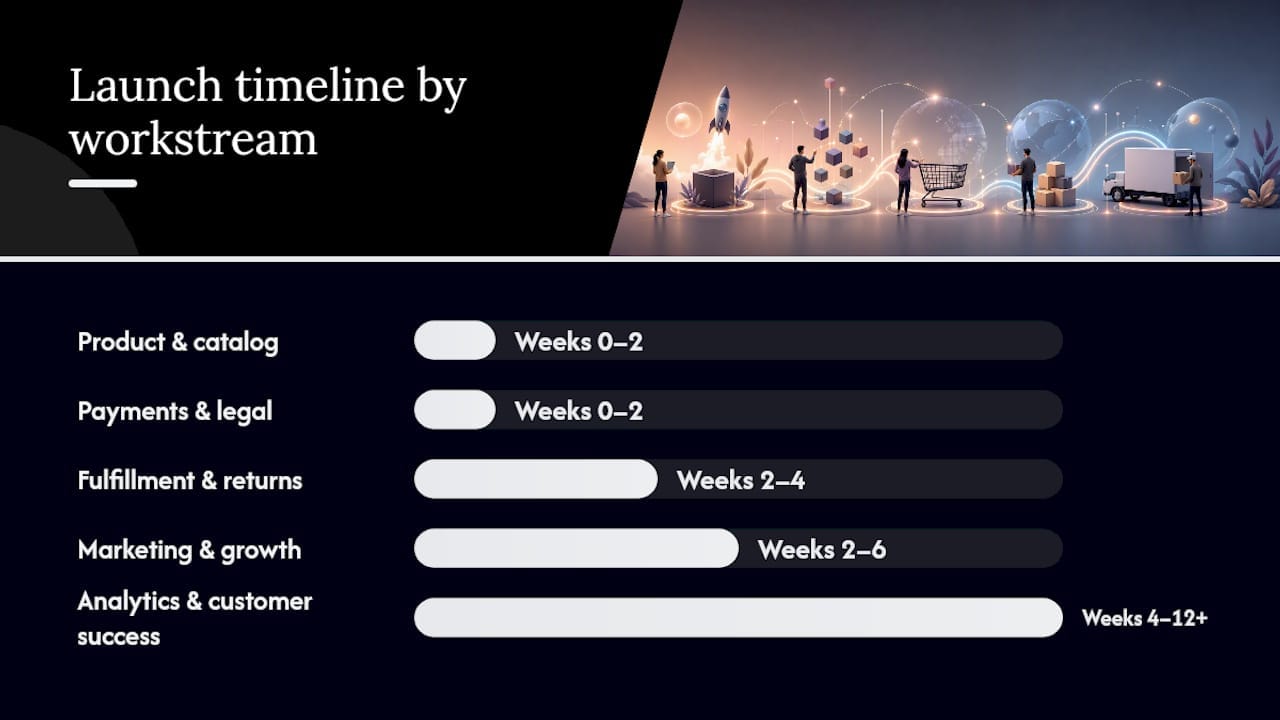
Most DTC and marketplace proofs can be validated in 8–12 weeks with an MVP product page, a payment processor, basic fulfillment, and a paid social test. Here is the sequence.
Launch sequence by workstream:
- Product and catalog (Weeks 0–2): Finalize SKU count (start with 1–3 products), write product descriptions, shoot photography. For product-heavy stores, consider 3D product visualization to reduce return rates and improve conversion on visual categories.
- Payments and legal (Weeks 0–2): Register your business entity (LLC is the most common U.S. starting point), open a business bank account, set up a payment processor (Stripe, Shopify Payments, or PayPal Commerce Platform), and confirm sales tax nexus obligations.
- Fulfillment and returns (Weeks 2–4): Decide between self-fulfillment, a 3PL (ShipBob, ShipMonk), or marketplace fulfillment (FBA for Amazon). Write a clear returns policy — U.S. consumers expect 30-day returns as a baseline.
- Marketing and growth (Weeks 2–6): Launch a paid social test (Meta or TikTok Ads) with a $500–$1,000 budget to validate CAC before scaling. Build an email capture from day one. For social commerce channels, review social media strategies for entrepreneurs to structure your content cadence.
- Analytics and customer success (Weeks 4–12+): Install Google Analytics 4, set up a post-purchase survey, and define your KPI dashboard before you hit 100 orders.
Key KPIs by model:
| KPI | Formula | Early-stage target |
|---|---|---|
| CAC (Customer Acquisition Cost) | Total marketing spend ÷ new customers acquired | Below 30% of first-order revenue |
| LTV (Lifetime Value) | Avg. order value × purchase frequency × avg. customer lifespan | LTV:CAC ratio of 3:1 or higher |
| Conversion rate | Orders ÷ sessions × 100 | 1–3% for DTC; 5% for warm email traffic |
| GMV (Gross Merchandise Value) | Total sales volume before fees/returns | Milestone: $3,000/month to validate demand |
| Gross margin | (Revenue minus COGS) ÷ Revenue × 100 | 40%+ for DTC; 40% for digital/subscription |
| Monthly churn (subscriptions) | Subscribers lost ÷ total subscribers × 100 | Below 5% monthly for healthy subscription |
Cost buckets to plan for:
- One-time setup: $500–$3,000 for platform setup, legal registration, and initial creative assets.
- Monthly operational: $200–$800 for platform fees, email tools, and basic analytics.
- Paid acquisition test: $500–$2,000 for the first 4–6 weeks of paid social to generate real CAC data.
Where to find the best e-commerce PDF guides and templates
The three public PDFs worth downloading, and exactly how to use each one:
- OECD Unpacking E-Commerce (2019) — A 100+ page policy report with the clearest taxonomy of online business model types available in a free public document. How to use it: Go directly to Chapter 2 for the model classification framework, then copy the model comparison structure into your one-page template. The policy implications section is less relevant for operators but useful for understanding regulatory trends.
- Analytical Framework for E-Commerce Business Models (ResearchGate) — An academic paper that applies transaction-cost and switching-cost theory to model evaluation. How to use it: Extract the evaluation criteria table and use it as a scoring rubric: rate your candidate model on each dimension (transaction cost, switching cost, network effects) to identify structural weaknesses before you launch.
- E-Commerce Business Models Overview (mediatum.ub.tum.de) — A practitioner-oriented overview with B2B marketplace evolution examples and revenue stream breakdowns. How to use it: Use the revenue stream checklist to audit whether your model relies on a single stream, then map two or three additional streams you could add in months 6–18.
Using the Nomadexcel one-page template:
The Nomadexcel business-model worksheet is a single-page PDF designed for fast validation and investor-ready clarity. It contains five fields: value proposition (one sentence), revenue streams (ranked by priority), fulfillment plan (model and key partners), KPIs (three metrics with targets), and a 12-week milestone timeline. Practitioners recommend keeping all five fields visible on one page — it forces the discipline of choosing what matters and makes investor conversations dramatically faster.
To adapt it: print the PDF and fill it in by hand first (the constraint of physical space is intentional), then transfer the completed fields into a Google Doc or slide deck for team sharing. When using it alongside the OECD PDF, fill in the “revenue streams” field using the OECD taxonomy as a reference, then cross-check your fulfillment plan against the analytical framework’s switching-cost criteria.
Pro Tip: Convert your completed one-page template into a Google Slide with one field per text box. Share it with your co-founder or a mentor and ask them to challenge every field in 15 minutes. The fields that survive that conversation are your real business model.
U.S. operational notes every e-commerce founder needs to know
The key U.S. operational priorities that PDF guides developed for general markets often understate: sales tax under marketplace facilitator laws, payment processor chargeback policies, and returns practices that meet U.S. consumer expectations.
Sales tax and marketplace facilitator rules:
- Most U.S. states have enacted marketplace facilitator laws, which require platforms like Amazon, Etsy, and eBay to collect and remit sales tax on behalf of third-party sellers. If you sell exclusively through one of these platforms, the platform handles collection in facilitator states — but you still need to understand your nexus obligations for states where you sell directly.
- Economic nexus thresholds vary by state but commonly trigger at $100,000 in sales or 200 transactions per year in a given state. Check each state’s revenue department directly; the IRS provides federal guidance but state rules differ.
- If you operate a Shopify store alongside a marketplace, you have two separate nexus profiles to manage. Tools like TaxJar or Avalara automate this, but the compliance decision is yours.
Payments and chargebacks:
- Stripe, Shopify Payments, and PayPal Commerce Platform are the dominant U.S. payment facilitators for early-stage stores. Each has different chargeback dispute processes and reserve policies — read the terms before you launch, not after your first dispute.
- A chargeback rate above 1% will trigger account reviews on most processors. Invest in clear product descriptions, delivery confirmation emails, and a visible returns policy to keep disputes low.
Shipping, fulfillment, and returns:
- U.S. consumers expect free or low-cost shipping and 30-day returns as a baseline. If your margins cannot support free shipping at launch, offer a free shipping threshold (e.g., orders over $50) rather than charging flat rates.
- For immersive product experiences like 3D/AR viewers, evidence suggests they reduce return rates on apparel and home goods — worth evaluating if returns are a structural risk in your category.
- Walmart’s store-fulfilled delivery model, documented in its Q1 FY26 earnings, shows that leveraging physical locations as fulfillment nodes can dramatically reduce last-mile costs — a model that franchise and multi-location brands can adapt.
Pro Tip: Record your compliance steps inside your PDF checklist as you complete them — state nexus confirmed, payment processor terms reviewed, returns policy published. That documentation protects you in a dispute and gives any future co-founder or investor a clean operational record from day one.
Authoritative U.S. sources to bookmark: IRS Small Business Center (irs.gov/businesses/small-businesses-self-employed), your state’s department of revenue for nexus rules, and the platform policy pages for any marketplace you sell on (Amazon Seller Central, Shopify Help Center, Etsy Seller Handbook).
The Nomadexcel one-page PDF template: a practitioner walkthrough
The Nomadexcel business-model PDF template is a one-page worksheet built for fast validation and investor-ready clarity. It is not a 40-slide deck or a 20-page business plan — it is a single constraint-driven page that forces the decisions most founders avoid.
Template sections and their purpose:
- Value proposition — one sentence that names the customer, the problem, and the specific outcome your product delivers. If you cannot write this in one sentence, your model is not ready to launch.
- Revenue streams — list your primary and secondary streams in priority order. The discipline of ranking them forces you to admit which stream you are actually betting on.
- Fulfillment plan — the model (self-fulfill, 3PL, marketplace, digital delivery) and the two or three key partners or tools that make it work.
- KPIs with targets — three metrics with specific numeric targets for the first 90 days. Leaving this blank is the most common mistake early-stage founders make.
- 12-week milestone timeline — four milestones with dates. This is the accountability layer that separates planning from execution.
The template reflects the experiential business education approach Nomadexcel uses across its bootcamp programs — frameworks that are immediately applicable, not theoretical. Nomadexcel’s bootcamp participants use this template in live sessions with mentors and peers, which means every field has been stress-tested against real founder questions.
The template is available to Nomadexcel bootcamp participants as part of the program materials. For founders who want to use it independently, the one-page format can be replicated in Google Docs or Notion using the five field structure described above.
What experienced operators actually prioritize
The single most important rule for any new e-commerce founder: run cash-generating experiments before you optimize anything else. A beautiful Shopify store with zero validated demand is a liability, not an asset.
Two tips that consistently separate founders who gain traction from those who stall:
First, prioritize cash-generating experiments in weeks 1–4. That means a product listing, a payment link, and a small paid test — not a logo, not a brand guide, not a custom domain. The goal is a real transaction from a real stranger. Everything else is preparation.
Second, stage your revenue streams after you prove demand. Adding a subscription tier, a membership program, or an affiliate channel before you have 100 paying customers usually creates operational complexity without improving economics. Prove the core transaction first, then layer.
Pro Tip: In weeks 1–4, measure three things only: conversion rate on your product page, CAC from your paid test, and the percentage of buyers who open your post-purchase email. Those three numbers tell you whether the model is viable before you invest in anything else.
The business innovation trends shaping 2025 and beyond reinforce this point: the founders gaining ground fastest are those who treat their business model as a hypothesis to test, not a plan to execute.
Nomadexcel bootcamps: guided execution for founders who want to move faster
Reading PDFs and filling in templates gets you to clarity. Acting on that clarity — with expert feedback, real accountability, and a community of founders doing the same work — is where traction actually happens. That gap between knowing and doing is exactly what Nomadexcel’s Online Entrepreneurship Bootcamp is built to close.
The bootcamp brings together early-stage founders for 1–4 weeks of hands-on business building, direct mentorship from experienced operators, and structured execution sprints. Participants work through the same one-page business-model template described in this article, but with a mentor challenging every field and a cohort of peers pressure-testing the assumptions. The outcome is not just a completed template — it is a validated model with real feedback and a network that stays active long after the program ends.
If you are at the stage where you have a model in mind but need structured momentum to launch it, explore the bootcamp program and see whether the next cohort fits your timeline.
Sources
- Unpacking E‑commerce: Business Models, Trends and Policies (OECD)
- Mediatum
- Q1 FY26 earnings presentation (Walmart corporate)
On citing OECD and academic PDFs: When you extract a table or framework from the OECD report or the ResearchGate paper into your own PDF or slide deck, add a source line beneath the element: “Adapted from [Author/Organization], [Title], [Year].” This is standard academic and professional practice and protects you if the document is shared externally.
Nomadexcel template license: The one-page business-model worksheet is original Nomadexcel material, available to bootcamp participants as part of program resources. Founders using the five-field structure independently should treat it as a working tool rather than a publishable document — the value is in the thinking it forces, not the format itself.
Comments are closed.