
Streamline your business model creation workflow
TL;DR:
- Using structured frameworks like Business Model Canvas or Lean Canvas reduces risk and accelerates decision-making.
- Continuous testing and iteration of assumptions ensure a viable and adaptable business model.
- Collaborating with mentors and communities enhances validation, feedback, and overall startup success.
Many entrepreneurs pour months into building a product before they ever stop to ask: does this business actually work? That gap between excitement and execution is where most early-stage ventures quietly fail. A structured business model creation workflow changes that equation entirely. It forces you to map out your assumptions, test what matters most, and build with clarity instead of guesswork. This guide walks you through a proven, step-by-step process for creating, validating, and iterating your business model using the right frameworks and tools, so you can move faster and waste far less.
Table of Contents
- Why a structured workflow matters
- Essential tools and frameworks for business model design
- Step-by-step business model creation workflow
- Testing, iteration, and real-world validation
- What most guides miss about business model creation
- Take your business model further with expert support
- Frequently asked questions
Key Takeaways
| Point | Details |
|---|---|
| Use proven frameworks | Effective business model creation starts with tools like Business Model Canvas or Lean Canvas for structure and insights. |
| Prioritize rapid validation | Test your assumptions early with real customers and treat your model as a living document. |
| Iterate based on feedback | Be ready to pivot or update your model whenever new evidence surfaces. |
| Community matters | Joining a supportive community provides faster learning, better feedback, and accountability. |
Why a structured workflow matters
Skipping a structured approach to business model design is one of the most common and costly mistakes new founders make. Without a clear framework, you end up making decisions based on gut feeling rather than tested logic. You build features nobody asked for, target customers who were never really your audience, and burn through your runway before you find a model that actually works.
A structured workflow solves this by giving you a visual map of how your business creates, delivers, and captures value. Two frameworks dominate this space: the Business Model Canvas (BMC) and the Lean Canvas. Both are one-page tools that force you to think through every critical dimension of your business before you spend a dollar on development.
The business model canvas overview breaks your business into nine building blocks, from customer segments to cost structure. The Lean Canvas adapts this for startups, swapping in blocks like Problem, Solution, and Unfair Advantage. As BMC and Lean Canvas provide guided, visual frameworks ideal for aspiring entrepreneurs, combining them with communities like Y Combinator or SCORE multiplies your results significantly.
Here is why structure matters so much in practice:
- Focus: A canvas limits your thinking to what is essential, cutting out distractions.
- Speed: Visual frameworks accelerate decisions that would otherwise take weeks of debate.
- Alignment: If you have co-founders or early team members, a shared canvas creates a single source of truth.
- Risk reduction: Mapping assumptions early means you catch fatal flaws before they become expensive mistakes.
One of the biggest traps founders fall into is treating their business model as a finished document. It is not. The moment you complete your first canvas, it is already out of date. Markets shift, customer needs evolve, and your understanding deepens. The goal is not perfection on paper. It is rapid learning in the real world.
“A business model is a hypothesis. Your job as a founder is to prove or disprove it as fast as possible.”
For a deeper look at how to analyze your business model with the canvas, there are practical guides that walk through coherence checks and iteration cycles. Pair that with the mastering entrepreneurship principles that experienced founders rely on, and you have a foundation that is genuinely hard to shake.
Essential tools and frameworks for business model design
A clear workflow starts with the right tools. Let’s spell out your options and what each is best for.
The two primary frameworks you will encounter are the Business Model Canvas and the Lean Canvas. They share DNA but serve different purposes. The BMC works best when you have some market clarity and want to map a broader strategic picture. The Lean Canvas, developed by Ash Maurya, is purpose-built for early-stage validation. Lean Canvas adapts BMC for startups by replacing some blocks with Problem, Solution, Key Metrics, and Unfair Advantage to sharpen the focus on what actually needs proving first.
| Framework | Main focus | Best use case |
|---|---|---|
| Business Model Canvas | Strategic overview, nine building blocks | Established or scaling businesses |
| Lean Canvas | Problem-solution fit, early validation | Pre-revenue or idea-stage startups |
| Value Proposition Canvas | Customer jobs, pains, and gains | Refining your core offer |
Beyond the canvases themselves, a few additional tools make the workflow smoother:
- Miro or Mural: Digital whiteboard apps that let you fill in canvases collaboratively in real time.
- Notion or Google Docs: Ideal for storing assumptions, tracking experiments, and logging iteration notes.
- Strategyzer: The official BMC platform, with templates, tutorials, and a testing library.
- Founder communities: Peer groups and mentorship networks are vital lifelines when you get stuck on a block.
For a thorough walkthrough of how to use these tools together, the business model canvas guide covers practical setup steps that complement any framework you choose.
Pro Tip: Write your first canvas in pencil, literally or digitally. Every block you fill in is a hypothesis, not a decision. Expect to revise it multiple times as you learn more. Founders who treat their first draft as sacred tend to defend bad assumptions far too long.
For those serious about lean startup validation, the Lean Canvas is almost always the better starting point. It keeps your attention on the riskiest unknowns rather than the comfortable parts of your plan.

Step-by-step business model creation workflow
With your framework in hand, it is time to roll up your sleeves and start building your business model, one step at a time.
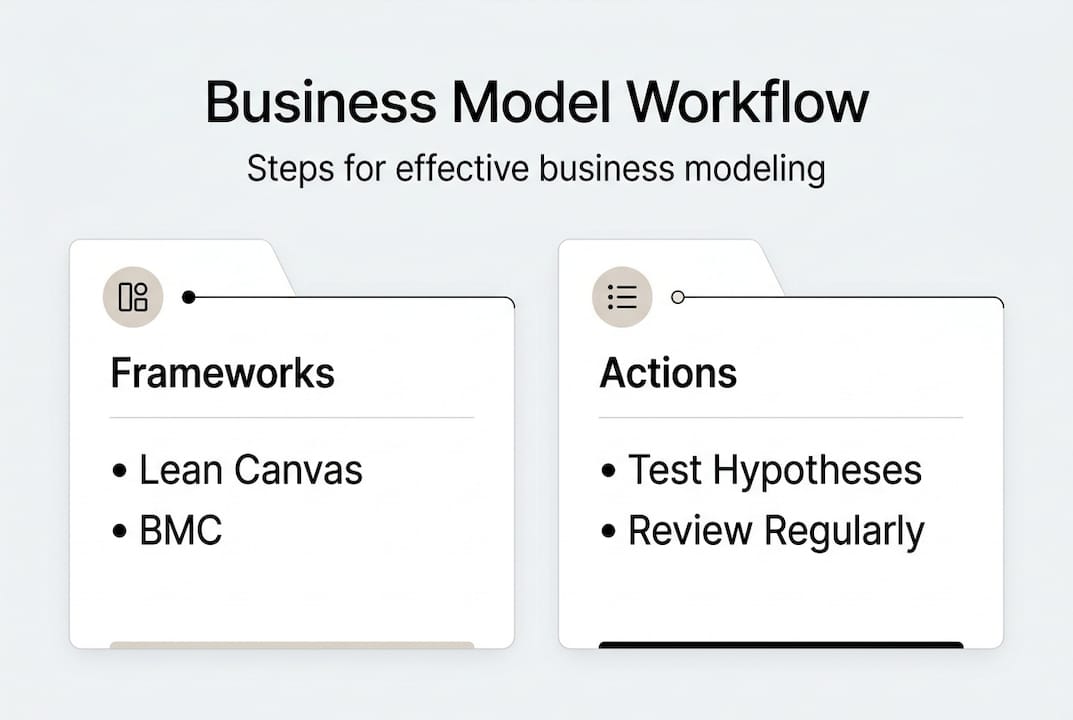
The sequence matters here. Most founders want to jump straight to revenue streams or product features. Resist that urge. The recommended workflow starts with Customer Segments and Value Propositions, then moves to Channels and Relationships, Revenue Streams, Key Resources, Activities and Partnerships, and finally Cost Structure, before analyzing coherence and iterating.
Here is that workflow broken into clear steps:
- Define your customer segments: Who exactly are you serving? Be specific. “Small business owners” is too broad. “Independent fitness coaches with under 200 clients” is a segment you can actually talk to.
- Articulate your value proposition: What problem do you solve, and why does your solution matter more than alternatives?
- Map your channels: How do customers find you, evaluate you, and buy from you?
- Design customer relationships: Will you offer self-service, personal support, or automated onboarding?
- Identify revenue streams: How do you get paid? One-time, subscription, usage-based?
- List key resources and activities: What do you need to deliver your value proposition consistently?
- Define key partnerships: Who do you rely on that you do not own or control?
- Calculate cost structure: What does it actually cost to run this model?
B2B and B2C businesses approach several of these steps differently:
| Step | B2B approach | B2C approach |
|---|---|---|
| Customer segments | Defined by industry, company size, role | Defined by demographics, behavior, lifestyle |
| Validation method | Letters of intent, pilot contracts | Landing page tests, pre-orders |
| Sales channel | Direct outreach, partnerships | Digital ads, content, community |
| Revenue model | Annual contracts, retainers | Subscriptions, one-time purchases |
Pro Tip: Once your canvas is filled in, circle the two or three assumptions that would kill your business if they were wrong. Test those first. A startup validation framework helps you design cheap, fast experiments around your riskiest bets before you invest heavily in building.
Save your canvas in a shared, accessible location and schedule a review every two to four weeks. This step by step business launch approach keeps you honest and moving forward.
Testing, iteration, and real-world validation
Creating a model is only the beginning. Now it is time to put it to the test and evolve it based on real feedback.
Every block on your canvas is an assumption until the market confirms it. The fastest founders are not the ones with the best ideas. They are the ones who test assumptions cheaply and quickly, treating failed experiments as data rather than defeats. Avoiding broad segments and static canvases is essential. Treat your model as a living document and be ready to pivot if validation fails.
Here are practical, affordable validation techniques you can start using this week:
- Customer discovery interviews: Talk to 10 to 20 people in your target segment. Ask about their problems, not your solution.
- Landing page tests: Build a simple page describing your offer and measure sign-up or click-through rates before building anything.
- Concierge MVP: Manually deliver your service to a small group of early customers to test the value proposition without automation.
- Smoke tests: Run low-budget ads pointing to a waitlist to gauge real demand.
- Letters of intent (LOI): For B2B models, ask potential customers to sign a non-binding letter expressing intent to buy. It is the closest thing to real commitment without a full contract.
The Dropbox story is a classic example of cheap validation done right. Before writing a single line of production code, the team released a video MVP that demonstrated the product concept. Overnight signups jumped from 5,000 to 75,000. That is the power of testing before building.
“Build the minimum amount necessary to learn the maximum amount possible.”
B2B and B2C validation differ in important ways. B2C validation often happens through digital experiments and pre-orders, where volume and speed matter. B2B validation relies more on direct conversations and LOIs, where depth and specificity are the signal. Knowing which approach fits your model saves weeks of misdirected effort.
For a practical guide to idea validation and the specific tactics that work at each stage, there are frameworks built specifically for early-stage founders. And if you are refining B2C marketing strategies alongside your model, aligning your validation approach with your go-to-market plan creates a tighter feedback loop.
What most guides miss about business model creation
Most articles about business model creation focus almost entirely on how to fill in the boxes. That is useful, but it misses the deeper truth: the quality of your canvas is determined by the quality of your thinking, not the completeness of your template.
The founders who struggle most are not the ones who chose the wrong framework. They are the ones who fell in love with their first draft. Emotional attachment to an early idea is one of the most powerful forces working against startup success. When you have spent three weeks crafting a beautiful canvas, it feels like progress. But progress is measured in validated assumptions, not filled-in boxes.
True innovation in business model design comes from relentless iteration, not from documentation. The best founders we have seen come through programs at Nomad Excel’s bootcamp share one habit: they seek feedback early, often, and from people who will challenge them honestly. They do not wait until the model feels ready. They share rough drafts and let reality sharpen their thinking.
The lesson is simple. Build with others, not in isolation. The community around your model is often as valuable as the model itself.
Take your business model further with expert support
Now that you have the workflow, consider how expert guidance can accelerate your success. Working through a business model alone is possible, but it is slower and riskier than building alongside experienced mentors and a community of driven peers.
At Nomad Excel, our immersive programs are designed specifically to help you move from idea to validated model with speed and confidence. Whether you are just starting out or refining an existing concept, joining an entrepreneurship bootcamp gives you structured frameworks, direct mentorship, and daily accountability that solo study simply cannot replicate. Explore our online entrepreneurship bootcamp or connect with the broader Nomad Excel community to find the right program for where you are right now.
Frequently asked questions
What’s the difference between the Business Model Canvas and Lean Canvas?
The Business Model Canvas focuses on strategic overview across nine building blocks, while Lean Canvas adapts BMC for startups by emphasizing early validation, key metrics, and unfair advantages. Use the Lean Canvas when you are still testing your core assumptions.
How often should I update my business model?
Update your business model whenever you validate or invalidate key assumptions, run new experiments, or receive meaningful market feedback. Treating your model as a living document and pivoting when validation fails is what separates adaptive founders from those who stay stuck.
What is the first step in creating a business model?
Begin by defining your customer segments and value propositions using your chosen framework. Starting with customer segments anchors every other decision you make in the canvas around real human needs.
How can I validate my business model quickly?
Run cheap, fast experiments like customer interviews, landing page tests, or a concierge MVP before investing further. Testing with cheap experiments before building is the fastest path to a model the market actually wants.
Comments are closed.