
Build 10 Team Leader Competencies: Research Backed 3/6/12 Plan
Ten competencies separate team leaders who deliver from those who stall out: communication, emotional intelligence, decision-making, delegation, coaching, change management, learning agility, conflict management, strategic thinking, and performance management. These matter because teams don’t underperform due to lack of strategy. They underperform when the person leading them can’t communicate direction, read a room, or hand off real ownership. What follows is a research-backed breakdown of each competency, how to build it, and how to prove you’re improving.
TL;DR:
- Improving communication skills requires confirming understanding and adjusting messages for different audiences, not just giving directions.
- Building emotional intelligence involves self-awareness, reading team signals, and giving feedback without triggering defensiveness.
- Developing decision-making competency means making calls with incomplete data, owning outcomes, and practicing quick, reversible choices.
- Effective delegation requires explaining the “why,” avoiding micromanagement, and giving full ownership to develop real responsibility.
- Tailoring growth plans to individual learning styles and personality traits accelerates skill acquisition more than a one-size-fits-all approach.
Table of Contents
- What Are the Core Team Leader Competencies?
- The Ten Competencies, Broken Down: What They Look Like in Practice
- Your 3, 6, and 12-Month Plan for Building These Skills
- How Do You Measure Whether You’re Actually Improving?
- How Nomad Excel Builds These Competencies Through Practice, Not Theory
- Leading Across Cultures Isn’t a Soft Add-On
- Digital Literacy Has Quietly Become a Core Leadership Skill
- Not Every Leader Learns the Same Way, and Development Plans Should Reflect That
- What Nobody Tells You About Building These Skills
- Ready to Build These Competencies Through Real Practice?
- Sources
What Are the Core Team Leader Competencies?
The Center for Creative Leadership organizes leadership competencies into three buckets: leading others, leading yourself, and leading the organization. That structure is useful because it stops people from treating leadership as one blob of “soft skills” and shows where a given weakness actually lives.
Leading others is where most first-line team leaders spend their energy, and it’s where the highest-impact competencies sit for anyone managing a team of five to fifteen people.
- Communication — translating goals into clear, specific direction people can act on without guessing.
- Delegation and empowerment — handing off real authority, not just tasks, so people grow instead of just staying busy.
- Coaching and developing others — asking questions that build capability rather than handing out answers that build dependency.
- Conflict management — addressing friction before it curdles into resentment or quiet quitting.
- Performance management — setting clear standards and giving feedback often enough that reviews contain no surprises.
Leading yourself covers the internal work that makes the external skills credible.
- Emotional intelligence — reading your own reactions and other people’s signals before they become problems.
- Learning agility — pulling lessons from unfamiliar situations instead of freezing or repeating old habits.
- Decision-making and critical thinking — weighing incomplete information and choosing anyway, on a deadline.
Leading the organization becomes more relevant as leaders move from first-line to mid-level roles.
- Strategic thinking — connecting daily team output to where the business is actually headed.
- Change management — helping a team absorb a shift in priorities without losing momentum or trust.
For a brand-new team leader, communication, delegation, and coaching carry the most weight. Strategic thinking and change management matter more once you’re managing other leaders, not just individual contributors.
The Ten Competencies, Broken Down: What They Look Like in Practice
Here’s where theory turns into behavior you can actually observe, in yourself or in someone you’re evaluating.
Communication. This is the ability to give direction that survives contact with a busy, distracted team. Watch for three behaviors: does the person confirm understanding instead of assuming it, do they adjust their message for different audiences (a peer versus a junior hire), and do they follow up in writing after verbal conversations? A team leader who tells her group “we need to move faster on the Meridian account” without naming what “faster” means or who owns what will watch the deadline slip anyway. The fix is a weekly habit: end every team meeting by having one person repeat back the three action items in their own words.
Emotional intelligence. IMD’s research on leadership skills places relationship building and self-awareness among the top modern leadership skills, and for good reason. Look for self-regulation under pressure, accurate reads on team morale before it shows up in metrics, and the ability to give hard feedback without triggering defensiveness. A leader who notices a normally vocal team member has gone quiet in standups, and checks in privately rather than calling it out publicly, is exercising this competency in real time. Practice this by keeping a one-line daily note on your own emotional state before big meetings to identify patterns.
Decision-making and critical thinking. IMD flags critical thinking as one of the leading skills for 2026, and it shows up as the willingness to make a call with incomplete information rather than waiting for complete certainty. Indicators include separating urgent decisions from important ones, asking “what would change my mind here” before committing, and owning the outcome publicly whether it works or not. A team leader facing a vendor deadline who delays a decision for three weeks “to get more data” is often avoiding the discomfort of being wrong, not genuinely gathering intelligence. Build this with a simple exercise: set a personal rule that decisions reversible within 48 hours get made within the hour.
Delegation and empowerment. This is handing over outcomes, not chores. The behavioral tells are clear: does the leader explain the “why” behind a task, do they resist the urge to redo work that’s “good enough but not how I’d do it,” and do they check in on progress rather than micromanaging steps? A leader who delegates a client presentation but insists on approving every slide hasn’t delegated anything. Try a stretch assignment: give a direct report full ownership of one recurring meeting, including the agenda and follow-up, to build real responsibility.
Coaching and developing others. HBR’s research on essential leadership skills ties this directly to long-term team performance, not just individual morale. Look for question-based feedback instead of directive answers, individualized development conversations rather than generic annual reviews, and visible investment in a report’s growth even when it doesn’t directly benefit the leader’s own numbers. One useful habit: replace “here’s what you should do” with “what have you already tried” in your next five feedback conversations.
Change management. IMD’s research links this to agility, one of the modern leadership skills most in demand. The signals: framing change in terms of what stays the same (not just what’s different), addressing resistance directly instead of pretending it doesn’t exist, and communicating change in stages rather than one large announcement. A leader rolling out a new CRM should walk the team through what specifically won’t change about their daily workflow, not just the shiny new features. Practice by running a “pre-mortem” before your next change initiative: ask the team what could make this fail before you launch it.
Learning agility. CCL identifies this as a meta-competency that prevents leaders from plateauing once they hit mid-career. It shows up as actively seeking unfamiliar assignments, extracting a specific lesson from failures rather than just moving past them, and applying insight from one context (a past job, a hobby, a crisis) to a completely different one. Seek what CCL calls “heat experiences,” projects with real stakes and no script, rather than passive classroom training.
Conflict management. IMD’s research also notes that a meaningful share of leaders never receive formal conflict-resolution training, which explains why so many avoid it entirely. Watch for whether a leader names tension directly (“I noticed some friction between you two on this project”) instead of hoping it resolves itself, mediates without picking a side prematurely, and follows up after a resolution to confirm it held. A team leader who lets two engineers’ rivalry simmer for months because “they’re both high performers” is quietly damaging the team’s trust in leadership. One micro-habit: address any visible tension within 48 hours rather than waiting for it to escalate.
Strategic thinking. This is connecting a team’s daily work to the organization’s direction, and it becomes more critical the further up you move. Indicators include reframing team tasks in terms of business impact, anticipating how a decision today affects resourcing six months out, and pushing back on requests that don’t serve the larger goal. Build this by requiring your team to answer “how does this connect to our quarterly priority” before starting any new project.
Performance management. Skills England’s occupational standard for team leaders lists this among the core knowledge, skills, and behaviors expected of the role, alongside coaching and stakeholder management. Look for regular, specific feedback rather than surprise-laden annual reviews, clear standards set in advance, and documentation that supports fair, defensible decisions. Set a recurring 15-minute check-in with each direct report focused solely on progress against agreed goals, separate from status updates.
Your 3, 6, and 12-Month Plan for Building These Skills
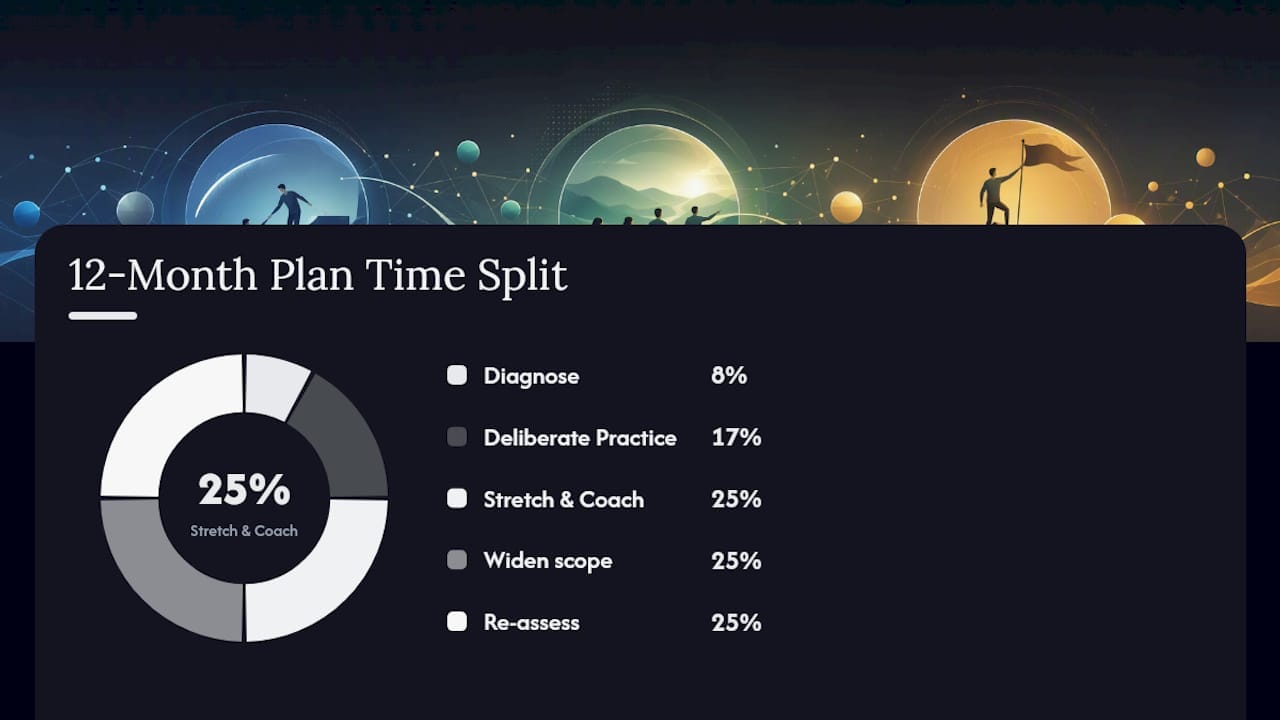
Trying to improve all ten competencies at once guarantees you improve none of them. Pick your focus using an impact times gap analysis: rate each competency on how much it would improve your team’s output if you got better at it, then rate your current gap honestly. The intersection of high impact and high gap is where you start.
- Month 1: Diagnose. Run a 360 feedback cycle or informal peer input to confirm which one or two competencies actually need work, since self-perception is often wrong here.
- Months 2 to 3: Practice deliberately. Pick one micro-habit per priority competency (the 48-hour decision rule, the weekly repeat-back, the pre-mortem) and run it daily until it’s automatic.
- Month 4: Take a stretch assignment. Volunteer for one project outside your comfort zone, ideally one that forces the exact competency you’re building.
- Months 5 to 6: Get coached feedback. Pair with a peer or mentor who observes you in the stretch assignment and gives specific, behavioral feedback, not just encouragement.
- Months 7 to 9: Widen the scope. Apply the competency in a higher-stakes setting, a bigger team, a tighter deadline, a more senior audience.
- Months 10 to 12: Re-assess and reset. Run another 360 or peer check, measure movement against your original rubric, and choose your next one or two priority competencies.
Pro Tip: Stretch assignments only build competency when the stakes are real but the downside is contained. Volunteer to lead a project that matters but has a safety net, a supportive sponsor, a reversible outcome, so failure teaches you something instead of just costing you credibility.
Deliberate practice combined with feedback cycles and real stretch assignments produces faster, more durable skill gains than classroom training alone. For a structured version of this plan built around entrepreneurial team leadership, the leadership development guide for building high-impact teams walks through the same milestones in more depth.
How Do You Measure Whether You’re Actually Improving?
Feeling more confident isn’t proof of growth. You need external signals and a few objective numbers.
- 360 feedback collects input from your manager, peers, and direct reports, which matters because self-ratings and manager ratings often diverge sharply on competencies like delegation and coaching.
- Pulse surveys run monthly or quarterly and catch shifts in team morale or trust before they show up in turnover data.
- Behavioral rubrics rate specific, observable actions (not vague traits) on a scale from developing to proficient to advanced.
- Objective team metrics worth tracking include voluntary turnover, project delivery timeliness, and internal promotion rate from your team.
A simple rubric for delegation might rate “developing” as assigning tasks with heavy oversight, “proficient” as assigning outcomes with periodic check-ins, and “advanced” as assigning ownership of entire workstreams with the leader stepping back almost entirely. Behaviorally-anchored rubrics like this make development plans concrete instead of aspirational.
Run a full 360 cycle every six months and lighter pulse checks monthly in between. When results show a stall, update your development plan rather than repeating the same habit that isn’t moving the needle. A self-assessment checklist can help structure this review before your next 360 cycle.
How Nomad Excel Builds These Competencies Through Practice, Not Theory
Reading about delegation and actually handing off a real project under a real deadline are different skills entirely. Bootcamps put founders and team leaders into structured sprints where they’re mentored by experienced operators and paired with peers who challenge their decisions in real time, not in a hypothetical case study.
The format mirrors what the research calls heat experiences: daily accountability, live feedback from mentors and peers, and stretch assignments with actual stakes attached. Participants typically walk away with a concrete leadership action plan, practice running peer coaching conversations, and direct experience facilitating discussions under time pressure, the exact behavioral indicators outlined earlier for coaching and communication. The retreat format applies the same structure to existing teams, building alignment and leadership capability through shared execution rather than a lecture series.
Leading Across Cultures Isn’t a Soft Add-On
Cultural and diversity awareness function as a competency multiplier rather than a separate skill sitting off to the side. A team leader with strong communication skills but no cultural awareness will still misfire, giving direct feedback to someone from a culture where indirect feedback is the norm, or scheduling a “quick sync” that ignores time zone realities for a distributed team.
This shows up concretely in how leaders run meetings, give recognition, and interpret silence. In some team cultures, silence in a meeting signals disagreement being processed respectfully. In others, it signals disengagement. A leader who reads it the same way every time will misjudge team sentiment constantly. Diversity awareness also shapes delegation: assuming everyone wants visible, individual recognition for stretch assignments ignores team members who come from more collectivist working norms and find public praise uncomfortable rather than motivating.
The practical fix isn’t a training module you complete once. It’s building the habit of asking rather than assuming, checking how someone prefers to receive feedback, confirming whether a norm you take for granted actually applies to this specific team member. Team leaders who treat inclusion as an ongoing behavioral practice, not a policy checkbox, tend to build higher-trust teams faster, particularly on distributed or multinational teams where the margin for miscommunication is thinner to begin with.
Digital Literacy Has Quietly Become a Core Leadership Skill
Ten years ago, technological literacy wasn’t on most leadership competency lists. Now it belongs there, not because leaders need to write code, but because the tools a team uses shape how well a leader can actually lead it.
A team leader managing a hybrid or remote team needs fluency in asynchronous communication tools, project management platforms, and increasingly, AI-assisted tools for drafting, analysis, and reporting. This isn’t about mastering every tool. It’s about knowing enough to make good decisions: which platform actually reduces meeting overhead versus which one just adds another inbox to check, when an AI tool speeds up a first draft versus when it introduces errors that cost more time to fix than they save.
Digital literacy also intersects directly with performance management and communication. A leader who can’t navigate a shared dashboard will struggle to give data-backed feedback. One who can’t run an effective virtual meeting will lose a distributed team’s engagement fast. The competency here isn’t technical mastery. It’s judgment: knowing which tools serve the team’s actual goals and which ones just create the appearance of productivity. Leaders who stay curious about new tools, without chasing every new platform that launches, tend to keep their teams both efficient and sane.
Not Every Leader Learns the Same Way, and Development Plans Should Reflect That
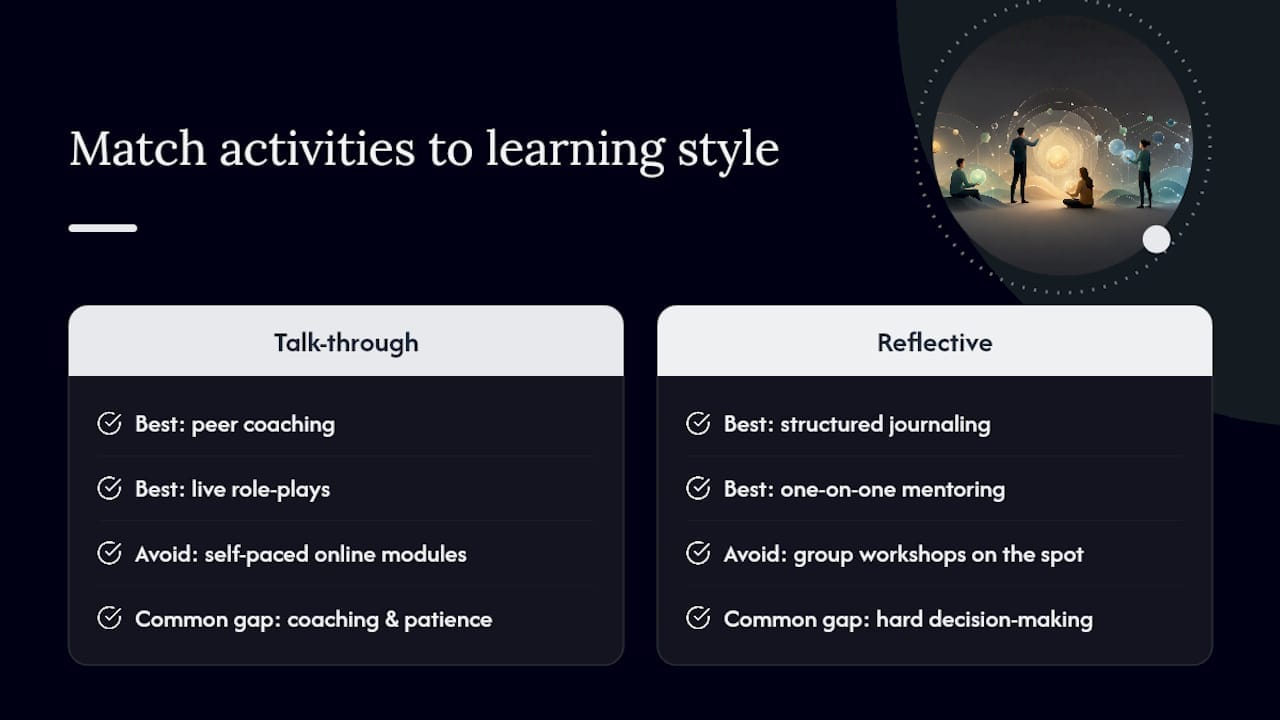
A rigid, one-size development plan is one of the fastest ways to waste a good leader’s growth window. Someone who processes information by talking through problems out loud will get far more from peer coaching sessions and live role-plays than from a self-paced online module. Someone who prefers to reflect privately before acting will do better with structured journaling and one-on-one mentor conversations than with a group workshop that puts them on the spot.
Personality also shapes which competencies feel natural versus effortful. A leader who’s naturally decisive and action-oriented may need more deliberate work on coaching and patience, since their instinct is to solve problems directly rather than let a direct report work through one. A leader who’s naturally empathetic and relationship-focused may need more structured practice on hard decision-making, since their instinct is to seek consensus even when a call needs to be made quickly.
The practical move is matching development activities to how someone actually absorbs feedback: some leaders need to see a skill modeled before attempting it, others need to attempt it first and get corrected afterward. Mentorship pairings work best when the mentor recognizes this difference instead of coaching everyone with the same script. A structured mentorship process that adjusts pacing and format to the individual tends to produce faster, stickier gains than a standardized curriculum applied uniformly across a cohort.
What Nobody Tells You About Building These Skills
Three blind spots trip up most developing leaders. First, they mistake busyness for delegation, handing off tasks while still making every decision. Second, they treat feedback as something to survive rather than mine for patterns, missing the same note three reviews in a row. Third, they wait for a formal training program instead of building daily habits.
A weekly ten-minute reflection, asking what decision you’d make differently, beats an annual workshop. The lesson worth repeating: competency grows in small, repeated reps, not in single breakthrough moments.
— Amichai
Ready to Build These Competencies Through Real Practice?
Reading about delegation, coaching, and decision-making only gets a leader so far. The competencies covered here compound fastest when they’re practiced under real pressure, with mentors watching and peers pushing back, not absorbed passively through another course. That’s the entire premise behind this approach: structured sprints, direct mentorship from working entrepreneurs and operators, and daily accountability that forces communication, delegation, and decision-making skills to develop through repetition, not repetition of theory.
If you’re an early-stage founder or team leader looking to build these competencies fastest, the Online Entrepreneurship Bootcamp puts you inside exactly that kind of hands-on, mentor-guided environment. If you’re leading an existing team and want the same growth applied at the group level, custom retreats build alignment and leadership skills through shared execution. Explore the bootcamp program to see which cohort fits your timeline.
Sources
The competency framework and behavioral indicators in this article draw on established leadership research and occupational standards.
- The 8 key leadership skills you need to know in 2026 | IMD
- Team leader occupational standard (KSBs) | Skills England
- 6 essential leadership skills — and how to develop them | HBR