
8 Business Model Innovation Types for Founders & Innovation Managers
Business model innovation means changing how a company creates, delivers, or captures value, not just tweaking its product. The main types you will actually use fall into eight buckets: incremental, modular, architectural, radical or disruptive, platform, revenue-model, servitization, and sustainable or circular innovation. The one that fits depends on your stage, your risk appetite, and what part of the model is actually broken.
TL;DR:
- Only a small, incremental change may be enough if margins are shrinking because the issue likely stems from outdated pricing rather than the entire business model.
- High-risk, high-reward transformations like creating new market categories through radical or platform innovation require significant patience and a long-term runway.
- Matching your leadership and governance structure to the type of business model change ensures better execution, with radical changes needing executive sponsorship and cross-functional teams.
- Testing and validation should focus on specific blocks of your existing model, using frameworks like Business Model Canvas or Lean Startup experiments, rather than trying to invent a completely new model from scratch.
- Most failures in business model innovation result from poor execution, such as organizational resistance and premature scaling, rather than flawed strategy or idea concept.
Table of Contents
- What Is Business Model Innovation, and What Are the Main Types?
- A Practical Taxonomy: The Common Types of Business Model Innovation
- When to Pursue Each Type: Decision Rules for Founders and Managers
- Processes, Governance, and Leadership for Successful BMI
- Frameworks and Patterns to Design and Validate BMI
- Short Examples Mapped to Types
- Common Challenges and Practical Mitigations
- What Founders Consistently Get Wrong About BMI
- Sources
What Is Business Model Innovation, and What Are the Main Types?
Business model innovation, often shortened to BMI, changes at least one of the fundamental elements of how a business operates: who it serves, what it offers, how it delivers value, or how it makes money. That is different from product innovation, which improves what you sell without touching the surrounding model. A new flavor is product innovation. Switching from selling that product outright to renting it by subscription is business model innovation.
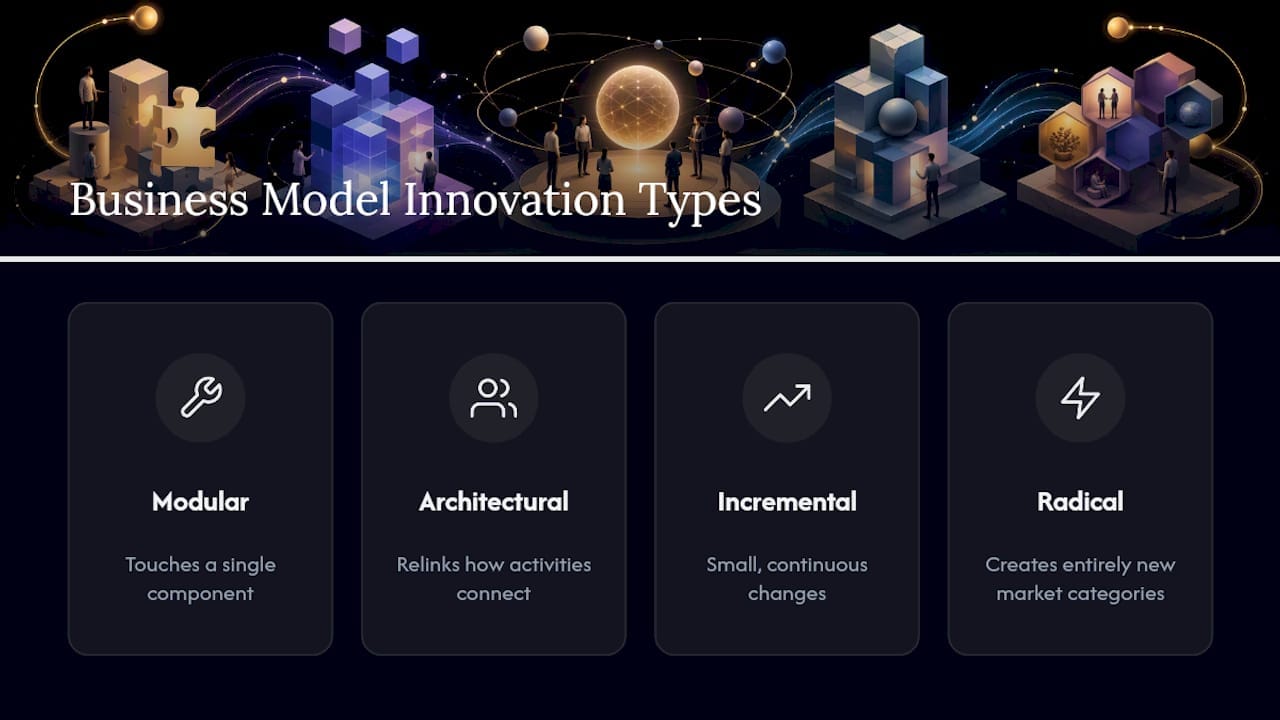
Academic literature on BMI classifies these shifts by degree and location of change. Modular changes touch a single component. Architectural changes relink how activities connect to each other. Incremental changes are small and continuous. Radical changes create entirely new market categories. That four-part framework, developed by researchers Foss and Saebi, gives founders a shared vocabulary instead of vague talk about “reinventing” a business.
The urgency behind this is not theoretical. BCG’s analysis of business model innovation finds that the average lifespan of a business model has shortened considerably over recent decades, which means the models that got you to your first $1 million in revenue may not carry you past $10 million. You need a working map of your options before that gap catches you off guard.
A Practical Taxonomy: The Common Types of Business Model Innovation
Here is how the eight types break down in practice, ordered roughly from lowest risk to highest:
- Incremental (evolutionary) BMI: Small, continuous adjustments to pricing, packaging, or delivery that improve the existing model without disrupting it. Think adding a loyalty tier to an existing subscription.
- Modular BMI: A focused change to one component, most often the revenue model or channel, while everything else stays intact. Swapping a one-time purchase for a payment plan is modular.
- Architectural BMI: Relinking how your activities or partners connect, sometimes changing governance itself. A retailer that shifts from owning inventory to a marketplace model has changed its architecture.
- Radical or disruptive BMI: Creating a new value proposition that opens a market that did not exist for your company before. This is the highest-risk, highest-reward category.
- Platform or ecosystem BMI: Building a multi-sided market where you orchestrate value between two or more distinct customer groups instead of selling directly.
- Revenue-model innovation: Changing how you capture value through subscription, freemium, or pay-per-use pricing, independent of what you actually sell.
- Servitization: Shifting from selling a product to selling the outcome that product delivers, often bundled as a service.
- Sustainable and circular BMI: Redesigning the model around triple-bottom-line goals, reuse, and closed-loop value chains rather than a single stakeholder’s profit.
That last category deserves a note: the same literature review that maps modular and architectural change also flags sustainable BMI as a distinct, growing category tied to stakeholder co-design, which tends to take longer to embed than a simple pricing tweak.
When to Pursue Each Type: Decision Rules for Founders and Managers
Matching the type to your actual goal saves you months of wasted testing. Use this rough guide:
- Chasing growth with low risk tolerance? Start with incremental or modular changes. Test a new pricing tier before overhauling your entire revenue structure.
- Margins under pressure from commoditization? That is a direct signal for revenue-model innovation. Competitors racing to the bottom on price is exactly when subscription or usage-based pricing can reset the conversation.
- Need resilience against a single point of failure? Architectural changes, like diversifying your supplier or channel structure, spread the risk.
- Trying to create a category rather than compete in one? That calls for radical or platform innovation, and it demands the longest runway and the most patience from investors.
Early-stage startups generally have more room to attempt radical or platform bets because they have less to protect. Incumbents usually get better returns from modular or architectural moves, since a misstep in a radical pivot can cannibalize existing revenue before the new model proves itself.
Pro Tip: If you are not sure which type fits, look at what is actually failing. A shrinking margin points to the revenue model. A churn problem points to the value proposition itself, which is architectural or radical territory.
Processes, Governance, and Leadership for Successful BMI
The management structure needs to match the type of change you are making, not the other way around. Research on leadership fit to BMI type shows that architectural or radical changes require different sponsorship and risk oversight than modular tweaks a single team can pilot alone.
- Executive sponsorship: Radical and architectural bets need a senior sponsor with authority to protect the pilot from being killed by short-term metrics.
- Cross-functional teams: Architectural changes cut across departments by definition, so the team designing the change needs representation from every function it touches.
- A pilot, evaluate, scale cadence: Run small before you run wide, and set a kill criterion in advance.
- Governance choice: Decide upfront whether you build internally, partner, or spin off a separate unit, since evolutionary learning across these processes is what actually links a good idea to a working model.
Frameworks and Patterns to Design and Validate BMI
You do not need to invent a new archetype from scratch. Most working business models are recombinations of patterns that already exist elsewhere.
- Business Model Canvas: Start by mapping your current model across its nine blocks, then pick one or two blocks to deliberately change rather than redesigning everything at once.
- Business Model Navigator: This pattern library lets you recombine existing dimensions, asking who you serve, what you offer, how you deliver it, and how you capture value, instead of inventing something wholly new.
- Lean Startup experiments: Test a new revenue model with a landing page or a pricing MVP before building the full infrastructure behind it.
- Blue Ocean and platform thinking: Useful complements when your goal is creating uncontested market space rather than optimizing an existing one.
Our entrepreneurial frameworks guide breaks down how Lean Startup principles apply specifically to model-level testing, not just product testing.
Short Examples Mapped to Types
Real cases make the taxonomy concrete.
- Service and revenue-model innovation: IKEA repurposed its Billie chatbot, originally built to handle customer service, into a paid remote interior-design channel that generated €1.3 billion in its first full year.
- Subscription hardware: Razor and blade economics, where a low-margin device unlocks a recurring consumable revenue stream, illustrate revenue-model innovation built around replenishment.
- Platform orchestration: A two-sided marketplace connecting independent service providers with customers demonstrates platform BMI, where the company’s value comes from matching, not from producing.
- Manufacturer-to-service shift: Mobility-as-a-service models, where a vehicle maker sells access instead of ownership, show architectural change across the entire value chain.
Billie handled millions of customer interactions over several years, resolving nearly half of inquiries on its own and saving IKEA significant support costs, before the company noticed the deeper opportunity sitting inside that data.
That last point matters more than the revenue figure itself. The company was optimizing for efficiency and stumbled onto an entirely new paying customer segment hiding inside the same technology investment. Our collection of startup business model examples walks through more cases like this one in depth.
Common Challenges and Practical Mitigations
Most BMI failures are not strategy failures. They are execution failures inside a good strategy.
- Organizational resistance: Teams protect the model that pays their bonus, and architectural or radical changes threaten that directly.
- Under-testing and premature scaling: Skipping the pilot phase to chase a board deadline is one of the most common ways a promising model dies.
- Misaligned incentives: A sales team compensated on one-time deals will quietly sabotage a subscription pivot, whether or not that is the intent.
- Mitigation: Run phased pilots with a named sponsor, set explicit learning metrics before launch, and align incentives across every business unit touched by the change.
Pro Tip: Write down what “failure” looks like before you start testing. Teams that skip this step almost always talk themselves into scaling a mediocre result because nobody defined the bar in advance.
What Founders Consistently Get Wrong About BMI
Most founders treat business model innovation as a single decision: pivot or don’t. That framing is backward. The eight types described here are not mutually exclusive choices; they are a toolkit, and the founders who make real progress usually run two or three of them in parallel, at different speeds, on different parts of the business.
The bigger mistake I see is founders reaching for radical innovation when a modular fix would have solved the actual problem. A shrinking margin is rarely a signal to reinvent your entire value proposition. It is far more often a signal that your pricing model has not kept pace with your cost structure, and that fix takes weeks, not years.
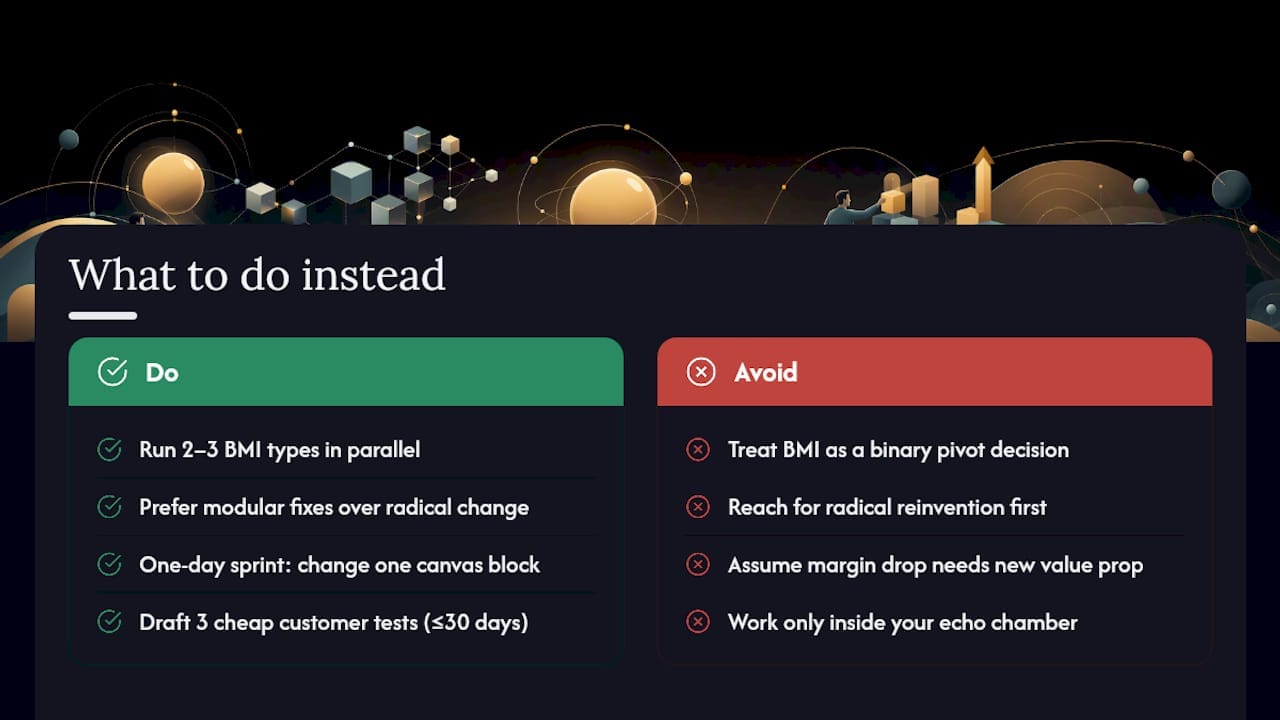
Two exercises worth running in a single day-long sprint: map your current model on a canvas and force yourself to change exactly one block, then draft three cheap customer tests you could launch within thirty days. If neither exercise produces a testable idea, the model probably is not your bottleneck. Something upstream, like positioning or team alignment, usually is.
If you want structured help running that sprint with people outside your own echo chamber, an online entrepreneurship bootcamp built around this kind of testing gets you there faster than working it out alone.
— Amichai
Sources
- BCG — business model innovation overview
- Business model innovation: a review of the process-based literature
- How IKEA turned a chatbot with 13 million users into a business worth €1.3 billion — CIO
- SI Labs — types and dimensions of BMI