
Founders: 10 Question Preflight Checklist to Scale Startups Safely
Scale only when three things are true at once: you have product-market fit, one acquisition channel with repeatable unit economics, and enough operational slack to absorb a demand spike. If any of those is missing, the right move isn’t to push harder. It’s to run a focused pre-flight checklist and a small, controlled pilot before you commit real capital to growth.
TL;DR:
- Scaling should only happen when product-market fit, a proven acquisition channel, and operational capacity are confirmed to avoid wasting resources.
- Key metrics such as LTV to CAC above 3:1, a burn multiple under 1, and a payback period under 12 months indicate capital-efficient growth readiness.
- Building on a single acquisition channel before diversifying prevents wasting budget on untested strategies, while focusing on retention and expansion yields better returns.
- Strengthening team decision rights, documenting systems, and maintaining cash discipline are critical to managing growth without compromising culture or infrastructure.
- Testing international markets requires starting small, understanding local quirks, and ensuring legal, compliance, and currency risks are proactively addressed before larger expansion.
Table of Contents
- How Do You Know When to Scale a Startup?
- What Metrics Actually Prove You’re Ready to Scale?
- In What Order Should You Build Growth Engines?
- How Should Your Team and Culture Change as You Scale?
- What Systems Do You Need Before You Scale Operations?
- How Should You Finance a Scaling Push?
- What’s the Pre-Flight Checklist Before You Scale?
- What Should You Know Before Expanding Internationally?
- What Legal and Compliance Issues Come With Scaling?
- How Do Partnerships Accelerate Startup Growth?
- How Should Data Guide Scaling Decisions?
- What Are the Biggest Risks When Scaling a Startup?
- Author Perspective: Lessons From Nomad Excel Bootcamps
- Ready to Pressure-Test Your Scaling Plan?
- Sources
- FAQ
How Do You Know When to Scale a Startup?
Readiness shows up as a pattern, not a single metric. You’re looking for retention curves that flatten instead of decay, customers who come back without a prompt, and qualitative feedback that says “I’d be upset if this disappeared” rather than “it’s fine.” That’s product-market fit in practice, and it’s the foundation every serious framework on how to scale a startup starts from.
Beyond product-market fit, four signals matter most:
- Repeatable acquisition: one channel proven end-to-end, with a customer acquisition cost (CAC) that holds steady as you add spend.
- Operational slack: your systems, suppliers, and support team could handle 30 to 50% more demand tomorrow without falling over.
- Team alignment: founders, early employees, and investors agree on the direction and pace of growth, not just the destination.
- Financial discipline: you know your burn rate and runway well enough to say, with confidence, how many months a scaling push buys you.
Miss one of these and scaling accelerates a problem instead of solving it. Founders who scale a broken acquisition channel just burn cash faster reaching the same ceiling.
What Metrics Actually Prove You’re Ready to Scale?
Four numbers separate founders who scale successfully from those who scale into a wall. The first is LTV to CAC, the ratio of a customer’s lifetime value to what it costs to acquire them. A ratio below 3:1 usually means your growth engine is running at a loss once you account for overhead. Payback period, how many months it takes to recoup CAC, should generally sit under 12 months for most business models, though capital-intensive categories can tolerate more.
Burn multiple, the amount of cash burned divided by net new revenue added, is one of the clearest signals of capital efficiency available to founders. A burn multiple under 1 suggests disciplined, efficient growth. Above 2 or 3, you’re buying revenue at a price that will catch up with you.
Two more quick checks: revenue per employee, which flags bloated headcount before payroll does, and contribution margin, which tells you whether each new customer actually adds profit or just adds volume. If retention is falling, CAC is climbing, or your engineering team is drowning in technical debt, that’s your signal to pause, not push through.
In What Order Should You Build Growth Engines?
Sequence matters more than most founders assume. Prove one acquisition channel completely, meaning you understand its CAC, its conversion path, and its ceiling, before you spread budget across three untested ones. VC guidance on scaling from traction to growth consistently flags diversifying spend too early as a top reason growth budgets get wasted.
Retention and expansion revenue, upselling or cross-selling existing customers, often deliver a better return than chasing new logos, especially once your acquisition costs start climbing. Test cheaply first:
- Run referral programs before paid channels; they reveal whether customers actually love the product.
- Pilot a new channel with a capped budget and a hard stop date, not an open-ended test.
- Automate a channel once its playbook is documented and repeatable.
- Hire a specialist only after a generalist has proven the channel works at small scale.
A partner-focused framework like this 30/90/180 roadmap for scaling acquisition operations offers a useful model for sequencing channel investment without overcommitting early.
How Should Your Team and Culture Change as You Scale?
Hiring bar goes up, not down, as you scale. McKinsey research cited by HBS Online shows high-performing employees can be multiple times more productive than average performers, and that gap widens as roles grow more complex. The generalist who ran three functions at ten employees usually can’t run all three well at fifty.
Clear decision rights matter just as much as talent. When nobody knows who owns a call, every decision becomes a meeting, and meetings don’t scale. Write down who decides what, then get out of the way.
Pro Tip: Document your company’s non-negotiable values before your tenth hire, not your fiftieth. Culture set by example works when everyone can watch the founder. It stops working the moment most employees have never met you.
Underperformers cost more during scaling than during the early days, because their mistakes now touch more customers and more teammates. Address gaps directly and early. For a deeper look at building the right team structure, team building for startups covers hiring sequencing and role design in more detail.
What Systems Do You Need Before You Scale Operations?
Turn repeated decisions into runbooks before you hire the next five people, not after. If your support lead answers the same question a dozen times a week, that answer belongs in a document, not in her head. Technical debt deserves the same treatment: budget time to pay it down deliberately rather than letting it accumulate until a launch grinds to a halt.
Standardized onboarding, ideally a 30/60/90 day plan, cuts the time it takes a new hire to become productive and protects your culture from dilution. Confirm your suppliers can handle a demand spike before you need them to. A scalable systems framework can help you map which processes need documentation first.
How Should You Finance a Scaling Push?
Match the capital to the growth pace, not the other way around. Equity funding suits ventures with long payback periods and big total addressable markets. Debt or revenue-based financing fits founders with predictable, near-term cash flow. Advance sales or pre-orders can fund a pilot without diluting equity at all.
Avoid locking in fixed overhead, long leases, large salaried teams, before your unit economics are proven at even modest scale. Hold enough runway to survive a pilot that takes longer than planned; six months of buffer beyond your test timeline is a reasonable starting point for most early-stage companies. Use your burn multiple and CAC payback period to size each incremental dollar of spend rather than guessing.
What’s the Pre-Flight Checklist Before You Scale?
Run through these ten questions before committing budget to growth:
- Do retention curves flatten after the first few months of use?
- Can you name one channel with proven, repeatable CAC?
- Is your LTV:CAC ratio above 3:1?
- Is your burn multiple at a reasonable level that indicates disciplined growth?
- Can operations absorb a 30% demand spike today?
- Do investors and the team agree on the growth plan?
- Is technical debt documented and budgeted for?
- Do you have a written onboarding plan for new hires?
- Do you have six or more months of runway beyond your pilot?
- Have you defined a clear rollback trigger if the pilot underperforms?
From there, follow a three-phase rollout: pilot one channel with a capped budget, scale it channel-by-channel once CAC and retention hold steady, then automate and optimize what’s proven. Set numeric go or no-go triggers at each phase, drawn from the same VC playbook on traction and growth, so a stalling pilot gets rolled back instead of quietly absorbed into next quarter’s budget.
What Should You Know Before Expanding Internationally?
International growth multiplies every advantage and every flaw in your business model simultaneously. A channel that works in your home market rarely transfers unchanged. Payment preferences, language, and buying behavior all shift, and CAC in a new market often runs higher than founders expect during the first two quarters.
Start with a single new market, not five. Pick the one where your product needs the least adaptation and where you already have some signal, an existing customer base, inbound interest, or a competitor’s gap you can exploit. Treat it as a pilot with the same discipline you’d apply domestically: cap the spend, set a review date, and define what “working” looks like in numbers before you launch.
Local hiring usually beats remote management for anything customer-facing. A support or sales lead who understands local norms, holidays, and communication style will outperform a headquarters team trying to run the market from a distance. Currency exposure also deserves early attention: hedge or at least monitor it if a significant share of revenue or cost sits in a currency your treasury doesn’t already manage.
Time zones quietly wreck coordination more often than founders admit. If your new market sits eight or more hours away from your core team, decide upfront how much overlap you actually need for support, engineering, and leadership syncs. Building that rhythm deliberately, rather than discovering the gaps live, saves months of friction later.
What Legal and Compliance Issues Come With Scaling?
Growth outpaces legal readiness more often than founders plan for. Contracts written for a five-person company rarely hold up once you’re processing thousands of transactions or hiring across state lines. Review your terms of service, privacy policy, and customer contracts before volume forces a rewrite under pressure.
Data privacy regulation tightens as you grow, and it varies sharply by jurisdiction. A company handling customer data across multiple regions needs to understand which rules apply where, rather than assuming a single compliance framework covers every market. This is one area where guessing is expensive: fines and forced product changes cost far more than an early legal review.
Employment law shifts the moment you cross certain headcount thresholds in many jurisdictions, triggering new obligations around benefits, reporting, or worker classification. If you’re using contractors to stay lean, confirm that classification actually holds up under local law before an audit forces the question.
Intellectual property protection also becomes more urgent as visibility grows. A trademark or patent that felt optional at five customers becomes a real vulnerability at five thousand, when competitors are watching what you build. None of this needs a large legal department early on, but it does need a standing relationship with counsel who understands your industry and reviews changes before they ship, not after a customer complaint or regulator flags them.
How Do Partnerships Accelerate Startup Growth?
The right partnership can hand you distribution, credibility, or capability you’d otherwise spend a year building from scratch. The wrong one drains founder time on integrations and negotiations that never pay off. The difference usually comes down to whether the partner’s customers actually need what you sell, not whether the logo looks impressive on a slide.
Start with partnerships that solve a real gap rather than ones that just sound strategic. A payments company partnering with an accounting platform makes sense because their customers overlap and the integration solves a genuine workflow problem. A partnership built purely for a press release rarely survives past the announcement.
Structure the relationship with clear, mutual incentives from day one. Revenue share, co-marketing commitments, or referral fees work better than vague promises of “exploring synergies,” because they force both sides to define what success actually looks like. Put it in writing early, even if the relationship starts informally, so expectations don’t drift as volume grows.
Channel partnerships, where another company resells or bundles your product, can scale distribution faster than direct sales in some categories. But they also require enablement: training, documentation, and support your partner’s team, or the relationship produces confused customers instead of new revenue. Treat a new partnership like a new acquisition channel: pilot it small, measure what it actually produces, and only expand the ones that show real, repeatable results.
How Should Data Guide Scaling Decisions?
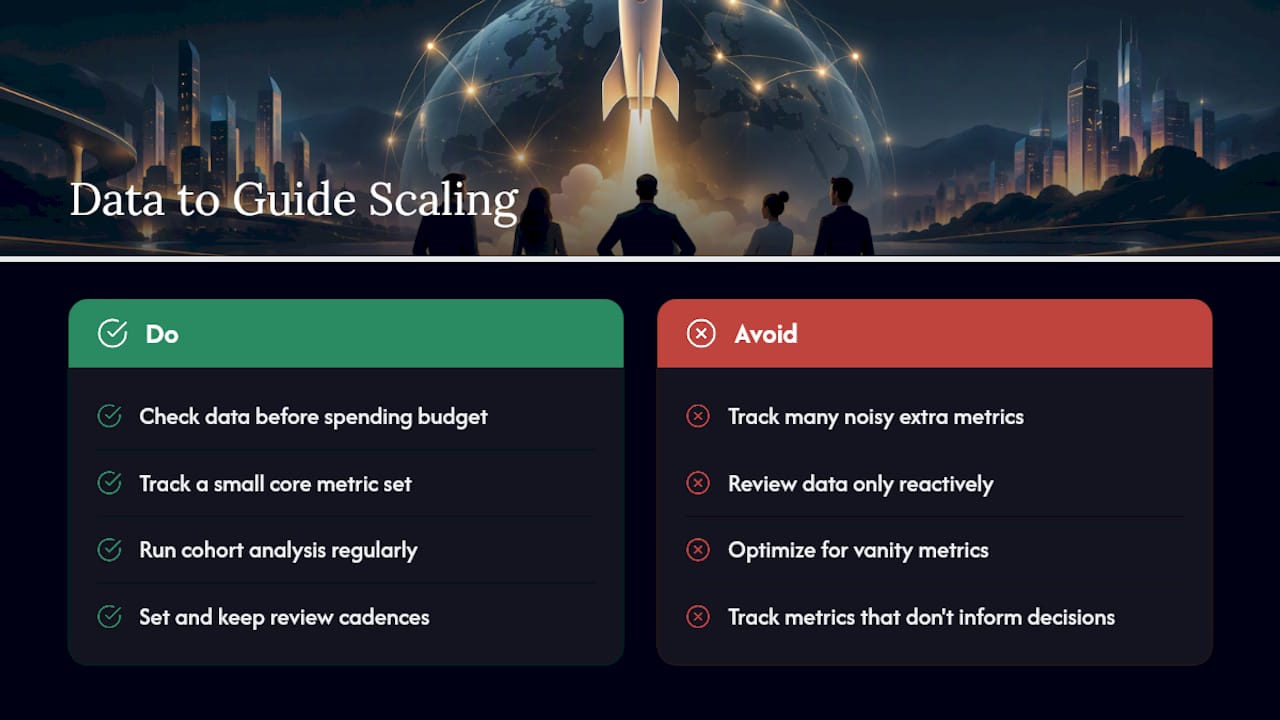
Founders who scale successfully tend to trust dashboards over instinct at the moments that matter most. That doesn’t mean ignoring intuition entirely. It means building the habit of checking whether the data supports a decision before committing real budget to it.
Start with a small set of metrics tracked consistently rather than a sprawling dashboard nobody actually reads. CAC, LTV:CAC, burn multiple, retention by cohort, and revenue per employee cover most of what matters for a scaling decision. Adding twenty more metrics rarely improves decisions; it just makes the important five harder to find.
Cohort analysis, tracking how each group of customers who joined in the same period behaves over time, catches problems that aggregate averages hide. A business can show flat overall retention while a recent cohort quietly churns twice as fast as older ones, a warning sign that something in the product or onboarding recently changed for the worse.
Set a review cadence and stick to it. Weekly for acquisition metrics, monthly for retention and unit economics, quarterly for the bigger financing and hiring decisions. Reviewing data reactively, only when something feels wrong, means you catch problems months after they started rather than weeks.
Resist the trap of optimizing for a metric that looks good but doesn’t reflect real business health. Vanity signups or app downloads with no activation attached can make a dashboard look great while revenue stays flat. Anchor every metric to a decision you’d actually make differently based on it. If a number wouldn’t change your next move, it’s not worth tracking closely.
What Are the Biggest Risks When Scaling a Startup?
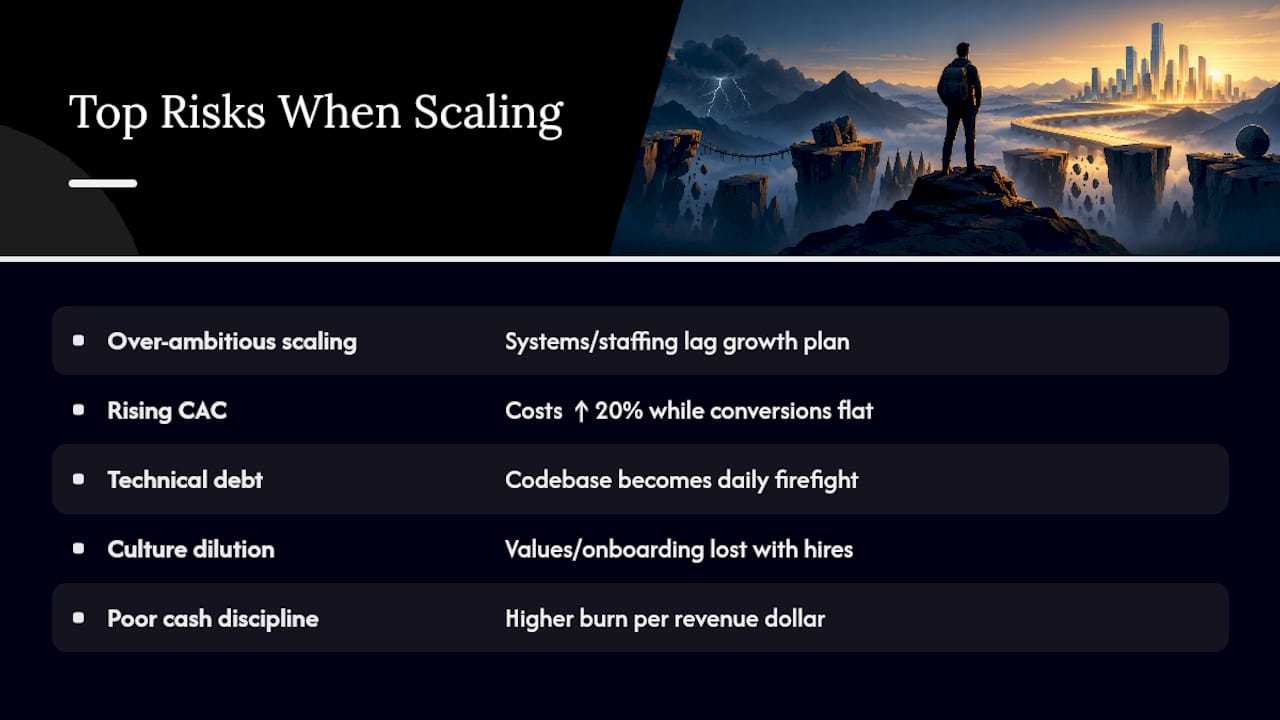
The single most common failure mode is scaling ambition past infrastructure. A team builds a growth plan for ten times its current revenue while running on systems, staffing, and processes designed for its current size. The VC playbook on scaling from traction to growth flags this mismatch as one of the most reliable predictors of a stalled scale-up.
Rising customer acquisition cost is the next warning sign, and it’s often ignored because revenue still looks healthy on the surface. If CAC climbs 20% while conversion rates stay flat, that channel is quietly getting more expensive, and pouring more budget into it just accelerates the burn.
Technical debt compounds silently until it doesn’t. A codebase that felt manageable at a thousand users can become a daily fire drill at fifty thousand, and the same operational research that tracks revenue per employee flags rising tech debt as an early scaling indicator worth watching closely, not a problem to defer indefinitely.
Culture dilution deserves equal attention. Hiring quickly without a clear onboarding process or documented values means new employees learn “how things work here” from whoever happens to train them, and that knowledge degrades with each new hire generation. The fix isn’t slowing hiring; it’s documenting what matters before headcount doubles.
Finally, watch cash discipline. A rising burn multiple, more cash spent for every dollar of new revenue, is a signal to tighten before the runway forces the decision for you.
Author Perspective: Lessons From Nomad Excel Bootcamps
The founders who benefit most from a structured sprint rarely arrive believing their bottleneck is what they think it is. They think it’s growth. It’s usually operations, hiring discipline, or a channel they never actually proved. The repeated mistake: chasing new tactics before fixing the leaky one already running. The fix is almost always slower and less exciting than founders want: document the process, fix the metric, then scale.
— Amichai
Ready to Pressure-Test Your Scaling Plan?
A checklist tells you what to measure. It doesn’t hand you the mentorship, structured sprints, or peer accountability that turn a plan into an actual pilot you run this month instead of next quarter. That’s the gap some specialized entrepreneurship programs fill. The Online Entrepreneurship Bootcamp puts founders through hands-on frameworks for validating growth assumptions, alongside mentors who’ve seen the same operational cracks you’re trying to catch early, and a community that keeps you honest about what’s actually working.
Consider enrolling once your internal pilot has stalled or once you’d rather test your scaling assumptions alongside experienced operators than alone. If you’re still validating your first channel, keep piloting internally and revisit the checklist. If you’ve hit a wall on execution, structure, or hiring, that’s exactly when a focused, guided sprint accelerates the answer. Check current dates and pricing on the Nomad Excel program page and book your seat.
Sources
- How to Scale a Business: 6 Tactics to Utilize | HBS Online
- How to Scale a Startup: A VC’s Playbook for Going from Traction to Growth
- Burn multiple: capital efficiency (CFI)
FAQ
How Do You Scale a Startup Successfully?
Successful scaling requires product-market fit, one proven acquisition channel with healthy unit economics, and operations that can absorb higher volume without breaking. Founders who skip straight to spending on growth before confirming these three usually burn cash without fixing the underlying bottleneck.
What Does It Mean to Scale a Startup?
Scaling means growing revenue faster than costs, using systems and processes that get more efficient at higher volume rather than more strained. It’s different from simple growth, where adding customers also means adding proportional headcount and expense.
How Do You Measure the Scalability of a Startup?
Track LTV:CAC ratio, burn multiple, revenue per employee, and contribution margin as your core scalability signals. A burn multiple under 1 and an LTV:CAC ratio above 3:1 generally indicate a business ready to absorb more growth spend responsibly.
What Is the Startup to Scale-Up Strategy?
The strategy moves in phases: validate with manual, hands-on tactics first, prove one acquisition channel completely, then scale that channel while building the systems and hiring standards needed to sustain higher volume. Programs like Nomad Excel’s entrepreneurship bootcamp walk founders through this sequence with structured, hands-on sprints rather than theory alone.
Comments are closed.