
EO Accelerator for Founders: Cohort or Bootcamp on the Road to $1M
EO Accelerator is a learning program built for owner-founders with between $250,000 and $999,999 in annual revenue who want practical tools to scale toward $1 million. The format pairs four full-day learning events per year with monthly accountability groups, and the baseline annual fee runs $1,750 before local chapter fees are added.
TL;DR:
- Applicants must own and run the business, which must earn $250,000 to $999,999 in trailing twelve month revenue; venture backed firms qualify only with raises in that band.
- The $1,750 annual fee covers July 1 through June 30; local chapter dues add to the total, and midyear entrants pay a prorated amount.
- Participants attend four full day events annually plus eight to twelve accountability meetings, each lasting two to four hours, alongside monthly peer group work.
- Reaching $1 million does not guarantee full EO membership: founders must apply separately, and their local chapter decides acceptance based on its standards and capacity.
- Because cohorts are local, chapter culture, fees, calendars, and programming vary by city; check your chapter before committing to the two year program.
Table of Contents
- Who should join and what the program aims to achieve
- Curriculum and program format: the four quarterly pillars and learning rhythm
- Eligibility and application steps: how to apply and what local chapters do
- Costs, timing, and what to budget
- Participant outcomes and the path after reaching $1 million
- When an immersive bootcamp beats a year-long accelerator cohort
- Detailed benefits and outcomes beyond scaling to $1 million
- Comparison between EO Accelerator and other entrepreneurial programs
- Community and peer support during and after the program
- Success patterns among past participants
- Timeline from application to graduation
- How coaching and mentorship sessions are structured
- What matters most when choosing a growth program
- How our bootcamps complement your path to $1 million
- FAQ
- Sources
Who should join and what the program aims to achieve
EO Accelerator is designed for owners and founders who are past the earliest startup scramble but have not yet crossed the seven-figure mark. The eligibility bar is specific, and knowing where you stand before you apply saves time for both you and the local chapter reviewing your application.
- You must be an owner or founder, not an employee or a passive investor, actively running day-to-day operations.
- Your business should fall within the $250,000 to $999,999 revenue band in the trailing twelve months.
- Venture-backed companies qualify only when their private capital raise falls within that same range, since the program is built around operating revenue, not funding rounds.
The core aim is straightforward: give founders a structured runway toward $1 million in revenue, with the option to apply for full EO membership once that milestone is within reach.
Curriculum and program format: the four quarterly pillars and learning rhythm
The Accelerator curriculum breaks the year into four pillars, each tackled one quarter at a time. This sequencing means you build financial discipline before you stress-test strategy, and you strengthen your team before pushing hard on execution.
- Cash (Q1): Founders work through cash flow management, financial literacy, and the numbers that actually predict survival.
- Strategy (Q2): The focus shifts to positioning, competitive differentiation, and long-term planning.
- People (Q3): This quarter covers hiring, delegation, and building a team that can operate without the founder in every decision.
- Execution (Q4): The final pillar ties everything together with goal-setting frameworks and systems for follow-through.
Delivery happens through four full-day learning events per year, each one led by a trained EO member facilitator. Between those sessions, participants meet in small peer Accountability Groups roughly once a month, with sessions typically lasting two to four hours. These groups provide a setting for founders to report progress, discuss challenges, and set the next round of targets together.
Pro Tip: Treat your monthly Accountability Group like a board meeting, not a social call. Show up with numbers, not just updates.
Eligibility and application steps: how to apply and what local chapters do
Getting into EO Accelerator involves a short, structured process rather than a single application form. Local chapters play an active role in vetting every applicant, which keeps each cohort consistent in stage and commitment.
- Submit the online application through your nearest EO chapter’s portal.
- Confirm your business meets the revenue criteria of $250,000 to $999,999, or that your venture-backed raise falls in that same range.
- Meet with your local EO liaison or Accelerator committee, who will confirm fit and answer questions specific to that chapter’s calendar and fees.
Once accepted, you join a local cohort rather than a generic global group, which means the experience can vary somewhat by city. Reaching $1 million in revenue does not automatically convert you into a full EO member. Graduation requires a separate application to the chapter, and acceptance remains at that chapter’s discretion based on its own membership standards and available capacity.
Costs, timing, and what to budget
Budgeting for EO Accelerator means accounting for two layers of fees rather than one flat number.
The baseline program fee is $1,750 annually, covering the fiscal year from July 1 through June 30. On top of that, local chapter fees vary by city and can meaningfully change your total cost, since chapters set their own dues to cover venue, facilitation, and local programming. If you join mid-fiscal-year, expect a prorated charge rather than the full annual amount.
Time-wise, the commitment includes four full-day learning events annually and eight to twelve accountability meetings per year, each running two to four hours. That adds up to a meaningful time investment, with full-day events and regular group sessions that founders should weigh against their business commitments.
Participant outcomes and the path after reaching $1 million
Founders who complete EO Accelerator typically walk away with more than a revenue bump. The structure is built to compound several kinds of support over time.
- Access to goal-setting tools and tracking systems introduced during the Execution quarter and reinforced in Accountability Groups.
- Regular peer accountability from founders facing similar stage-specific problems, not generic business advice.
- Mentorship from established EO members who have already scaled past $1 million themselves.
- Invitations to local and global EO events, which expand the network well beyond your home chapter.
Once your business approaches or crosses $1 million, the next step is notifying your local Accelerator leadership and formally applying to EO. Acceptance is not automatic and sits with the chapter’s own review process. EO Accelerator currently operates in many cities and countries, so in-person programming is available to founders well beyond major metro hubs, though the exact chapter experience will differ from one location to the next.
When an immersive bootcamp beats a year-long accelerator cohort
We built our bootcamps for founders who need concentrated execution now, not a two-year runway. A cohort program like EO Accelerator earns its value through sustained accountability and a local chapter network that can deepen over time. Our Entrepreneurship Sprint Bootcamps and Online Business Bootcamp compress that same discipline into days or weeks, with daily sprints, direct mentorship, and a curated peer group built for one intensive push.
If your business needs a long-term support structure tied to a local community, Accelerator’s pacing fits. If you need to validate an offer, fix a bottleneck, or relaunch a growth plan before your next funding or sales cycle, a short, immersive format moves faster.
Pro Tip: Use a bootcamp to break a specific bottleneck fast, then apply what you build to your next Accountability Group cycle if you’re already in a cohort program.
Detailed benefits and outcomes beyond scaling to $1 million
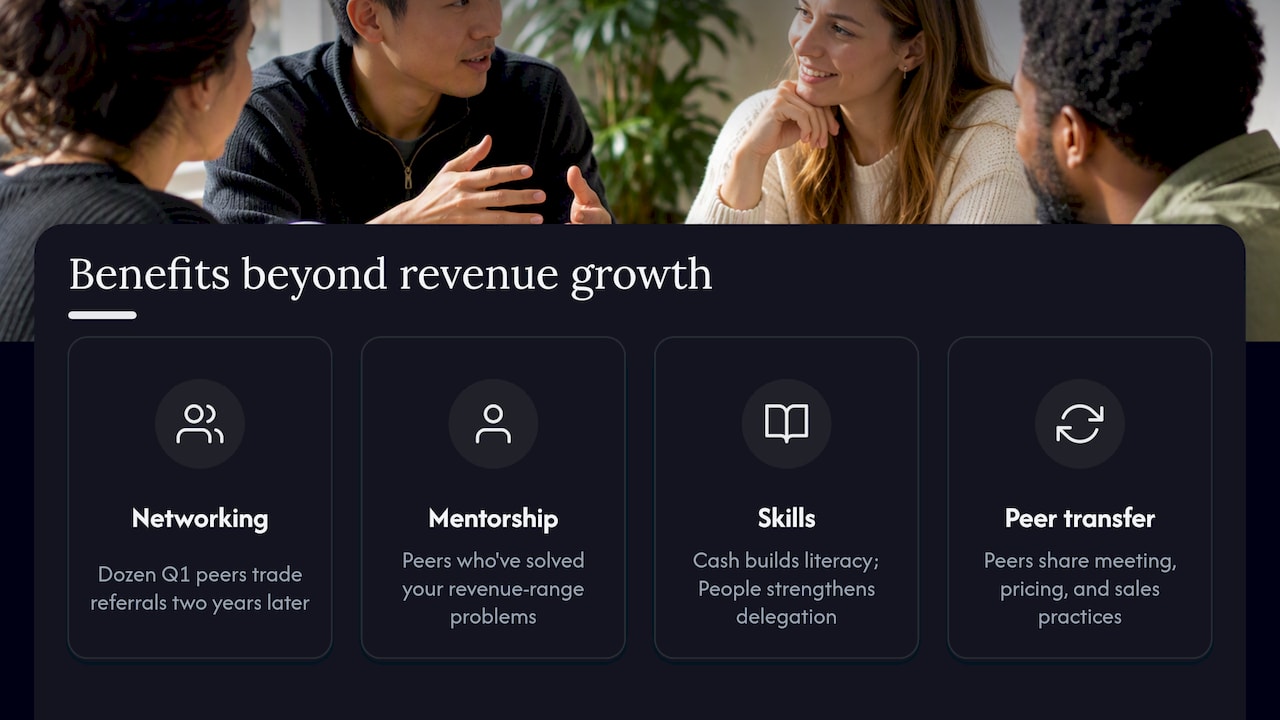
Revenue growth is the headline metric, but founders in structured programs tend to gain just as much from the surrounding infrastructure. Networking access compounds over time: a founder who meets a dozen peers at similar stages during Q1 may still be trading referrals and vendor recommendations with them two years later, long after the formal curriculum ends.
Mentorship access matters just as much as curriculum content. Having a facilitator or peer group member who has already pushed a business through the exact revenue range you’re in means fewer wasted months solving problems that someone else already solved. That kind of pattern recognition is hard to buy and easy to underestimate until you’ve experienced it firsthand.
Skill development tends to cluster around the specific pillar in focus that quarter. A founder weak on financial literacy gains the most during Cash; one who struggles to delegate sees the biggest shift during People. The sequencing matters because it forces founders to address weaknesses in a deliberate order rather than whichever fire is loudest that month.
Beyond the curriculum itself, exposure to other founders’ operating rhythms, how they run meetings, price their offers, or structure a sales process, often transfers more practical value than any single workshop. That peer-to-peer transfer is part of why cohort-based models persist across the industry, from EO Accelerator to structured bootcamp formats.
Comparison between EO Accelerator and other entrepreneurial programs
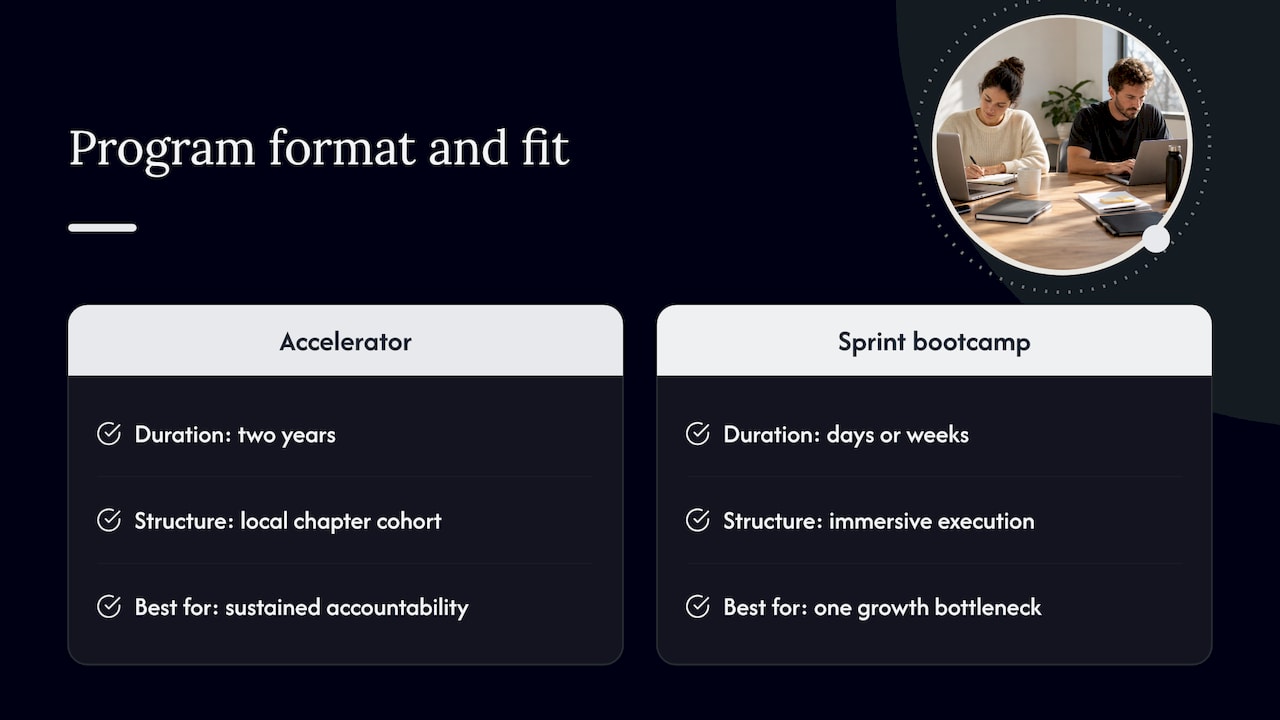
Accelerator competes for attention with a wide field of mentorship organizations, university-affiliated incubators, and short-form bootcamps, each solving a slightly different problem. Accelerator’s advantage is its two-year, chapter-based structure: founders get a long runway, a consistent peer group, and a defined path toward full EO membership once they cross $1 million.
Higher-tier networks aimed at more mature CEOs, such as YPO, generally target founders running larger, more complex organizations, which makes them a poor fit for someone still working through the $250,000 to $999,999 range Accelerator serves. Choosing between these options comes down to company stage and complexity rather than brand reputation alone.
Shorter, immersive formats sit at the other end of the spectrum. Programs like our Entrepreneurship Sprint Bootcamps compress hands-on execution into a matter of days or weeks, trading long-term chapter integration for speed. Neither approach is strictly better: a founder who needs ongoing local accountability over multiple years will get more from Accelerator’s rhythm, while one who needs to fix a specific growth bottleneck before a funding round or busy season will get more from a concentrated sprint.
Community and peer support during and after the program
The Accountability Group is the backbone of EO Accelerator’s community structure. These small, consistent peer groups meet monthly, which means founders build familiarity with each other’s businesses over time rather than starting from scratch at every session. That familiarity tends to produce sharper feedback, since a peer who has heard your numbers for a year notices patterns a stranger would miss.
Community support does not end at graduation. Founders who move into full EO membership can carry their Accelerator relationships forward into a larger chapter network, and their original Accountability Group may provide a foundation for business relationships that outlast the formal program.
The caveat worth naming honestly: chapter experience varies. Because EO is a global, community-led organization, the strength and culture of a local chapter can differ meaningfully from one city to the next, so founders evaluating the program should look into their specific chapter’s track record before committing two years to it.
Success patterns among past participants
EO Accelerator’s own positioning centers on founders who have used the program to move from early-stage revenue toward and past the $1 million mark, a trajectory the organization describes as a core part of its design. The pattern that tends to repeat across these stories is less about a single breakthrough moment and more about compounding discipline: a founder who tightens cash management in Q1 carries that financial clarity into the strategy work of Q2, and so on through the year.
What distinguishes founders who get the most out of the program is consistency in the Accountability Group rather than enthusiasm in the quarterly workshops. Showing up once a quarter for a full-day session is relatively easy; showing up every month with real numbers and real follow-through is where the actual transformation tends to happen.
Timeline from application to graduation
The Accelerator timeline runs from acceptance to the point where a founder either applies for full EO membership or completes the program independently. The first milestone is the application and local liaison meeting. The fiscal year runs from July 1 through June 30.
The program moves through all four pillars: Cash in Q1, Strategy in Q2, People in Q3, and Execution in Q4, each anchored by a full-day learning event. Monthly Accountability Group meetings run in parallel throughout, typically eight to twelve times across the year. The quarterly structure gives founders an opportunity to work through each pillar with new growth and data behind them.
The final milestone arrives when a founder’s revenue approaches or crosses $1 million. At that point, the founder notifies local Accelerator leadership and submits a separate application for full EO membership, with acceptance decided at the chapter’s discretion.
How coaching and mentorship sessions are structured
Mentorship inside EO Accelerator happens on two tracks. The first is formal: each quarterly learning event is led by a trained EO member facilitator who has direct experience in the pillar being taught that quarter, whether that’s cash management or team-building.
The second track is peer-driven and happens monthly through Accountability Groups. These smaller sessions, typically two to four hours, function less like a lecture and more like a working session where each founder reports progress against goals and receives direct feedback from peers facing similar stage-specific challenges. That adds up to eight to twelve structured accountability touchpoints per year, layered on top of the four annual full-day events, giving founders a regular mentorship rhythm without a weekly obligation.
What matters most when choosing a growth program
The conventional advice tells founders to chase the most prestigious network they can get into. That advice undersells how much fit matters more than prestige. A founder within EO Accelerator’s $250,000 to $999,999 revenue range may gain more from a program built around that stage than from a higher-tier network designed for CEOs running larger organizations.
What’s underrated in most of the content written about accelerator programs is the role of format fit. A cohort with monthly accountability suits a founder who wants sustained structure and a local community. It is a poor match for someone who needs to solve one specific problem fast, where a short, immersive bootcamp does more good in less time.
Our take: pick the format that matches your actual bottleneck, not the one with the most recognizable name. If your gap is sustained accountability and a local network, Accelerator’s structure may be a good fit. If your gap is a stalled launch or a broken sales process, a concentrated sprint will move you faster than waiting for next quarter’s learning event.
— Amichai
How our bootcamps complement your path to $1 million
We built our programs for founders who want the execution intensity that a two-year cohort can’t always deliver on its own. Our Online Entrepreneurship Bootcamp gives you structured sprints and direct mentorship without waiting for a quarterly learning event to roll around; current prices are on our site.
For founders exploring how AI fits into their growth plan, our 5-Day Online AI Bootcamp offers an intensive online format. For those who want an in-person, immersive push, our Entrepreneurship Sprint Bootcamps in Lisbon at Idea Space and Second Home pair hands-on frameworks with a curated group of founders working through the same stage you are.
What you get across every format:
- Daily structured sprints instead of theory-heavy lectures.
- Direct mentorship from experienced operators and marketers.
- A cohort built for ongoing accountability well after the program ends.
Browse our full lineup on the program overview page and find the format that matches your next growth bottleneck.
FAQ
What is the accelerator program for entrepreneurship?
EO Accelerator is a two-year learning program for owner-founders generating between $250,000 and $999,999 in annual revenue, built around four quarterly pillars: Cash, Strategy, People, and Execution. It combines four full-day learning events per year with monthly peer Accountability Groups to help founders scale toward $1 million.
How much does the EO Accelerator program cost?
The baseline annual fee is $1,750, covering the fiscal year from July 1 through June 30. Local chapter fees are added on top and vary by city, and founders who join mid-year typically see a prorated charge.
Which is better, EO or YPO?
Neither is universally better since they serve different company stages. EO Accelerator fits founders in the $250,000 to $999,999 revenue range, while networks like YPO generally target more mature CEOs running larger, more complex organizations.
Does reaching $1 million automatically make me an EO member?
No. Graduation requires a separate application to your local chapter, and acceptance into full EO membership is at that chapter’s discretion rather than an automatic step.