
The Role of Business Accelerators in Startup Growth
TL;DR:
- Business accelerators boost early-stage startups through mentorship, training, and investor exposure within a time-limited program. Their effectiveness depends on matching the right training type, founder experience, and growth stage, with strong networks being highly valuable. Founders should approach accelerators as focused execution phases, ensuring foundational stability before scaling to maximize long-term value.
A business accelerator is a structured, cohort-based program designed to fast-track early-stage startups through mentorship, targeted training, and access to funding. Programs like Y Combinator and Techstars have made this model famous, but the role of business accelerators extends well beyond brand recognition. These programs typically run for three to six months, immersing founders in a high-pressure environment that culminates in a Demo Day pitch to investors. Understanding what accelerators actually do, and for whom they work best, is the difference between choosing a program that transforms your company and one that simply consumes your time.
How do business accelerators help startups grow?
Business accelerators fast-track startups through a combination of mentorship, structured training, networking, and investor access, all compressed into a defined program window. The impact of business accelerators is not uniform. Research shows that the type of training a program delivers determines who benefits most and by how much.

Two distinct training models define most programs today. Managerial capital training focuses on operational skills: financial modeling, team management, and process building. Entrepreneurial capital training focuses on opportunity recognition, market positioning, and scaling strategy. According to research from Ingeniería UC, entrepreneurial capital training boosts growth by 43% for high-growth potential startups, while managerial capital training leads to 18% faster growth for average participants. That gap tells you something important: the right training type for your startup depends entirely on where you are in your growth curve.
Beyond training, the benefits of startup accelerators include three core mechanisms:
- Mentorship networks: Direct access to experienced operators who can refine your go-to-market strategy, challenge your assumptions, and open doors to their own networks. The role of mentorship in accelerators is often the most cited reason founders apply.
- Peer cohort learning: Working alongside other founders at a similar stage creates a feedback loop that no solo founder can replicate. Cohort peers become sounding boards, collaborators, and sometimes co-investors.
- Investor exposure: Demo Day presentations to investors are a defining feature of most programs. As Silicon Valley Bank notes, Demo Day preparation is a critical inflection point where structural business weaknesses surface if product-market fit has not been validated beforehand.
Accelerators also provide ecosystem connection and idea refinement that support founder development in ways that funding alone cannot replicate. These intangible benefits compound over time, especially through alumni networks that remain active long after the program ends.
Pro Tip: Before applying to any accelerator, map out which type of training your startup needs most. If you have a validated product but struggle with scaling operations, a managerial capital program is your best fit. If you are still refining your market position, seek entrepreneurial capital training.
What types of accelerator programs exist and how do they differ?
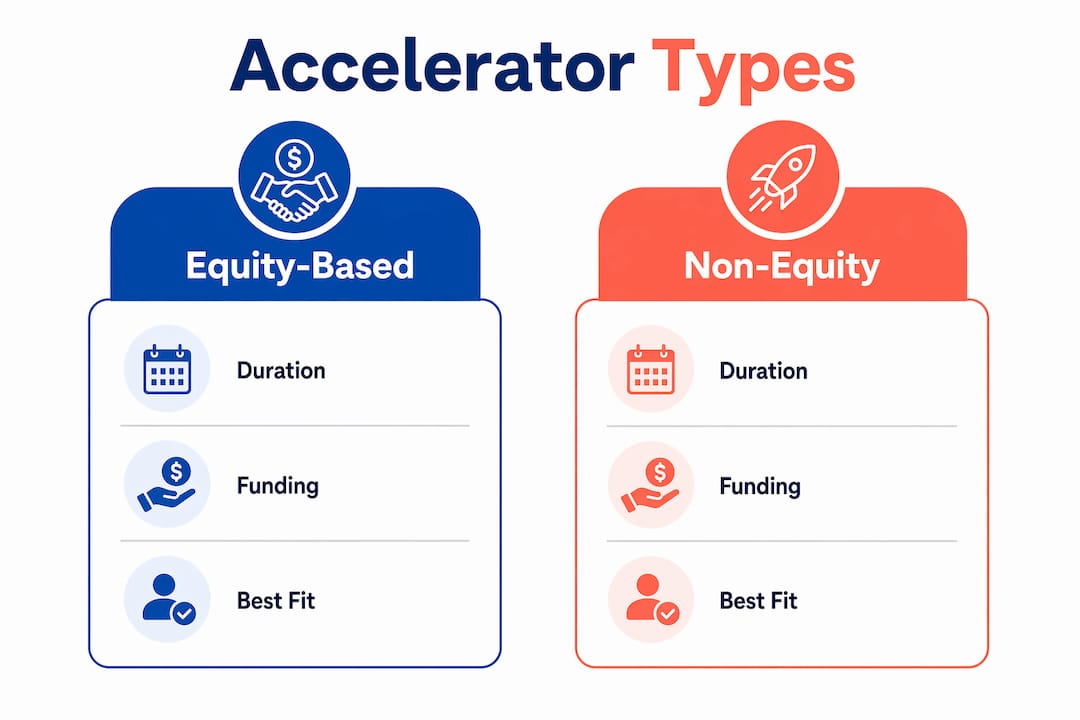
Accelerator programs vary significantly in structure, cost, specialization, and intensity. Understanding these differences is the first step toward choosing the right one for your startup.
| Program Type | Duration | Funding Model | Best For |
|---|---|---|---|
| Equity-based accelerator (e.g., Y Combinator) | 3 months | Equity exchange | Scalable tech startups seeking investor networks |
| Membership-based accelerator | 9 weeks to 6 months | Quarterly fees from $300 | Bootstrapped founders avoiding equity dilution |
| Industry-specific accelerator (e.g., AI, biotech) | 3 to 6 months | Equity or grant-based | Founders in regulated or specialized sectors |
| Corporate accelerator (e.g., Microsoft for Startups) | 3 to 6 months | Non-dilutive resources | Startups seeking enterprise partnerships |
| Hybrid/online accelerator | 9 to 12 weeks | Membership or equity | Founders with geographic or schedule constraints |
Standard accelerator programs last three to six months, with some hybrid formats as short as nine weeks. Funding models range from equity exchange to quarterly membership fees starting at $300. That range matters because equity dilution at the seed stage has long-term implications for your cap table.
The accelerator versus incubator distinction is worth clarifying. Incubators are typically longer-term, less structured, and focused on idea development rather than rapid scaling. Accelerators are time-bound and results-driven, with clear milestones and a defined endpoint. If your startup has a working prototype or minimum viable product, an accelerator is the more appropriate vehicle. If you are still developing your concept, an incubator may serve you better first.
Industry-specific programs have grown significantly. Accelerators focused on artificial intelligence, climate technology, and biotech now offer domain expertise that generalist programs cannot match. For founders in these sectors, the specialized mentor network alone can justify the equity cost.
Who benefits most from business accelerators?
Not every founder extracts equal value from an accelerator. The research on this is clear and somewhat counterintuitive: accelerators work best for founders who already have strong foundations.
Wharton research confirms that accelerators act as multipliers of existing human capital. They push up the ceiling for founders with prior knowledge rather than raising the floor for novices. This is a critical insight for anyone evaluating whether they are ready to apply.
The data on revenue outcomes reinforces this point. Founders with high pre-entry human capital experience up to 188% revenue growth one year post-accelerator, four times higher than firms with low human capital. That is not a marginal difference. It reflects a fundamental truth about how accelerators function: they amplify what you bring in, not what you lack.
“Accelerators act as powerful amplifiers for founders prepared to absorb advanced mentorship, rather than remedial education for novices.” — Wharton Knowledge
Several founder profiles benefit most from accelerator participation:
- Founders with domain expertise who need help with business model refinement and investor positioning
- Second-time founders who understand execution but want structured access to capital networks
- Founders with validated MVPs who are ready to scale but lack the operational frameworks to do so efficiently
- Founders with prior industry networks who can leverage accelerator connections to multiply existing relationships
There is also a risk dimension that deserves attention. Accelerators increase startup headcount growth by about 31%, but rapid scaling without financial discipline raises bankruptcy risk post-program. Business growth through acceleration is real, but it demands that founders build financial controls alongside headcount. The founders who struggle after Demo Day are often those who scaled spending before scaling revenue.
Understanding startup accelerators and human capital as interconnected variables is the most practical frame for evaluating your own readiness.
How to choose the right accelerator program for your startup
Choosing an accelerator is a strategic decision, not a prestige competition. The best program for your startup is the one aligned with your current stage, your learning gaps, and your growth objectives.
Follow these steps to evaluate your options with clarity:
- Audit your training needs. Decide whether you need managerial capital development (operations, finance, team building) or entrepreneurial capital development (market positioning, scaling strategy, fundraising). Research confirms that tailoring program choice to founder competencies improves outcomes significantly.
- Assess your product maturity. Accelerators deliver the most value when you have a working prototype or MVP. Applying before you have validated demand means you will spend program time on fundamentals that should have been resolved beforehand.
- Evaluate the mentor network. Research the mentors attached to the program. A mentor who has built and exited a company in your sector is worth more than a generalist advisor with impressive credentials. Ask alumni directly about mentor accessibility and quality.
- Understand the funding model. Equity-based programs like Y Combinator offer capital and credibility but dilute your ownership. Membership-based programs preserve your cap table but require upfront cash. Neither is universally better. Choose based on your funding runway and long-term equity strategy.
- Check cohort quality and alumni outcomes. The peer cohort is a core asset of any accelerator. Research the companies that have gone through the program and assess their post-accelerator trajectories. Strong alumni networks are a reliable signal of program quality.
- Match timing to your growth phase. Joining an accelerator too early wastes the opportunity. Joining too late means you are solving problems the program was designed to address months ago.
Pro Tip: Contact two or three alumni from any accelerator you are seriously considering. Ask them one specific question: “What did you wish you had known before joining?” Their answers will tell you more than any program brochure.
Nomadexcel’s mentorship process for entrepreneurs offers a useful framework for thinking about how structured guidance accelerates growth at each stage of the founder journey.
Key takeaways
Business accelerators deliver the greatest impact when founders arrive with validated products, relevant experience, and a clear understanding of what type of training they need.
| Point | Details |
|---|---|
| Training type determines outcomes | Entrepreneurial capital training drives 43% growth for high-potential startups; managerial training drives 18% for average participants. |
| Founder experience amplifies results | Founders with strong pre-entry human capital see up to 188% revenue growth post-accelerator, four times more than novices. |
| Program type must match your stage | Equity-based, membership-based, and industry-specific programs each serve different founder profiles and funding situations. |
| Rapid growth requires financial discipline | Accelerators boost headcount by 31% on average, but unmanaged scaling raises post-program bankruptcy risk. |
| Mentor and cohort quality matter most | Beyond funding, the mentor network and peer cohort are the most durable assets an accelerator provides. |
What I have learned about getting real value from accelerators
By Amichai
Most founders approach accelerators with the wrong mental model. They treat the program as a course to complete rather than an execution phase to survive. That distinction changes everything about how you show up.
The founders I have seen extract the most value from accelerator programs are not the ones with the most polished pitches. They are the ones who treat every mentor session as a working session, not a performance. They come with specific problems, not general questions. They use the cohort as a pressure-testing environment, not a networking event.
There is also a post-accelerator trap that does not get discussed enough. The momentum of Demo Day creates a false sense of security. Investor interest at Demo Day is not the same as committed capital, and headcount growth funded by that interest is not the same as sustainable revenue. I have watched promising companies burn through their post-accelerator runway in six months because they confused growth signals with growth foundations.
The other thing worth saying plainly: if you are a first-time founder with no domain experience and no validated product, an accelerator will not fix that. It will accelerate whatever you already have, which means it will accelerate your problems just as fast as your strengths. Build the foundation first. Then use an accelerator to multiply it.
The programs that consistently produce strong outcomes, whether at Alchemist Accelerator, Y Combinator, or community-driven bootcamp formats, share one trait. They treat founders as operators, not students. That is the environment worth seeking out.
— Amichai
Take your growth further with Nomadexcel
If you are an early-stage founder who wants the intensity of an accelerator experience without the equity trade-off, Nomadexcel’s programs are built for exactly that. The online entrepreneurship bootcamp combines structured mentorship, peer cohort accountability, and real-world execution frameworks across one to four weeks of immersive learning. You leave with a sharper strategy, a stronger network, and skills you can apply immediately. For founders who want to understand whether a structured program is the right next step, the guide to joining entrepreneurship bootcamps is a practical starting point. Nomadexcel is where founders come to grow faster, through action, mentorship, and community.
FAQ
What is the role of business accelerators for startups?
Business accelerators provide early-stage startups with structured mentorship, training, funding access, and investor exposure through a time-bound cohort program. Their primary role is to compress years of learning and network-building into a three to six month intensive period.
How do business accelerators work in practice?
Accelerators accept cohorts of startups, deliver training and mentorship over a defined program period, and culminate in a Demo Day where founders pitch to investors. Funding models include equity exchange or membership fees, depending on the program structure.
Who benefits most from startup accelerator programs?
Founders with prior domain expertise, validated MVPs, and strong pre-entry human capital benefit most. Research shows these founders achieve up to 188% revenue growth post-accelerator, compared to significantly lower outcomes for founders with limited prior experience.
What is the difference between an accelerator and an incubator?
Accelerators are time-bound, results-driven programs designed for startups with working products ready to scale. Incubators are longer-term, less structured environments suited for founders still developing their core concept or business model.
Are there risks to joining a business accelerator?
Yes. Accelerators can drive rapid headcount growth of around 31%, but without financial discipline, that growth raises post-program bankruptcy risk. Founders should build revenue controls alongside team expansion to avoid unsustainable cash burn after the program ends.
Comments are closed.