
4 Types of Business Growth: 30% Faster Success for Startups
Many entrepreneurs believe rapid growth requires acquisitions or external capital. Yet sustainable building practices show that 70% of successful startups achieve their breakthrough through methodical internal development. This guide clarifies the four core types of business growth and provides actionable frameworks to help you choose the right strategy for your venture stage, resources, and goals.
Table of Contents
- Introduction To Business Growth
- Understanding Types Of Business Growth
- Common Misconceptions About Business Growth
- Comparison Of Growth Strategies And When To Apply Them
- Role Of Community And Mentorship In Accelerating Growth
- Implementation Strategies For Sustainable Growth
- Accelerate Your Growth With Nomad Excel Bootcamps
Key Takeaways
| Point | Details |
|---|---|
| Four Core Growth Types | Organic, inorganic, diversification, and operational efficiency drive distinct business outcomes |
| Misconception Corrected | Rapid growth does not require acquisitions; organic growth sustains better long term |
| Strategic Selection Framework | Match growth type to your business stage, resources, and risk tolerance for optimal results |
| Community Accelerates Execution | Mentorship increases startup success rates by 20% and speeds market entry by 30% |
Introduction to Business Growth
Business growth extends far beyond increasing revenue. It encompasses expanding market share, building operational capacity, and strengthening your customer base. For aspiring entrepreneurs, understanding these dimensions is critical because business growth impacts startup success by expanding revenue, market share, and operational capacity.
Why does this matter? Because startups that track multiple growth metrics build more resilient businesses. They adapt faster to market changes and create sustainable competitive advantages. When you apply business growth frameworks, you gain clarity on which levers to pull at each stage of your venture.
Key metrics every entrepreneur should track for growth include:
- Customer acquisition cost and lifetime value ratios
- Monthly recurring revenue and growth rate
- Market penetration percentage in target segments
- Operational efficiency indicators like cost per unit
- Team capacity and productivity benchmarks
Understanding Types of Business Growth
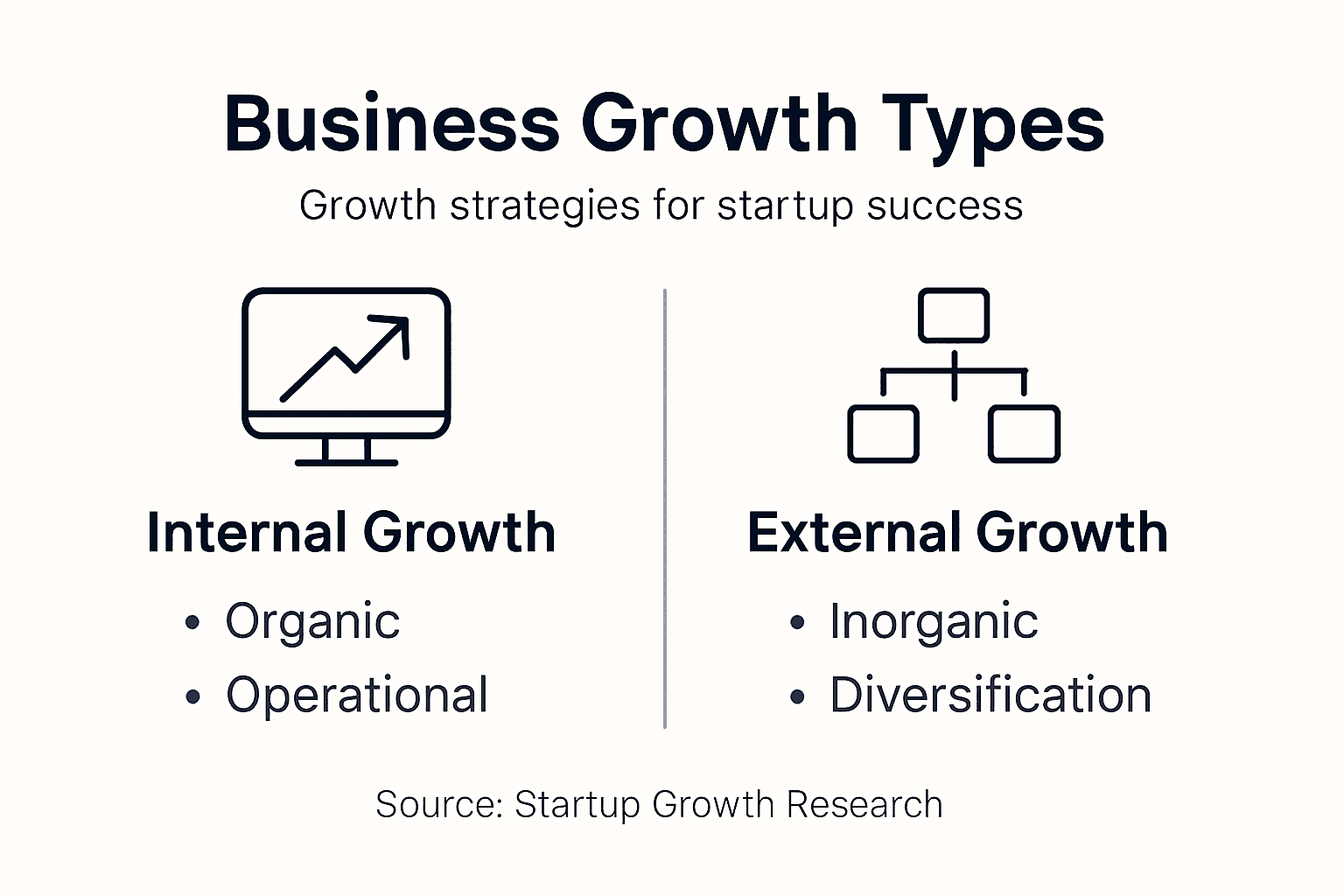
The four main types of business growth offer distinct pathways to scale your venture. Each type has unique mechanisms, benefits, and challenges that align with different business stages and resource levels.
Organic growth represents internal expansion through product innovation, customer experience improvements, and market penetration. Organic growth expands revenue via internal efforts such as product improvement and innovation, and is more sustainable. You build this growth by refining your offer, enhancing customer satisfaction, and optimizing your sales processes. It requires patience but creates stable foundations.
Inorganic growth accelerates expansion through mergers, acquisitions, and strategic partnerships. While inorganic growth involves rapid expansion through mergers or partnerships but has integration risks, it can quickly unlock new markets and capabilities. This path suits businesses with strong foundations seeking rapid scale. However, integration challenges demand significant management attention and resources.

Diversification reduces business risk by entering new markets with new products. Diversification reduces risk entering new markets with new products, requiring higher investment. You might expand into adjacent customer segments or develop complementary product lines. This strategy spreads risk but demands careful resource allocation and market research.
Operational efficiency improvements focus on enhancing internal processes to boost profitability without necessarily increasing revenue. Operational efficiency focuses on improving internal processes to reduce costs by 10 to 30%. You streamline workflows, adopt automation, and eliminate waste. These improvements compound over time, freeing resources for other growth initiatives.
Understanding these growth types helps you select the right approach for your current stage. Early ventures typically benefit most from organic growth and efficiency gains, while established businesses can explore inorganic options and diversification.
Common Misconceptions About Business Growth
Many entrepreneurs fall into traps that slow their progress. Clearing these misconceptions helps you make better strategic decisions and allocate resources wisely.
The biggest myth? That growth equals revenue growth alone. Real business expansion includes customer base growth, market share gains, and operational capacity improvements. Balanced growth beyond revenue can increase valuation by 25%. When you focus only on top line numbers, you miss opportunities to strengthen your business foundation and long term sustainability.
Another common belief is that rapid growth requires acquisitions. Reality shows the opposite for most startups. Startups relying solely on inorganic growth face 30 to 50% higher failure rates due to integration challenges. Organic growth through product improvement and customer experience often delivers more sustainable results, especially in early stages.
Acquisitions sound attractive but carry substantial risk for young ventures. You need solid operational foundations, clear culture, and strong cash flow before considering this path. Most early stage entrepreneurs lack these prerequisites. Pursuing acquisitions prematurely diverts attention from building core business strength.
Here’s what experienced founders know: community and mentorship dramatically reduce growth risks. When you engage with peers and advisors who’ve navigated similar challenges, you accelerate learning and avoid expensive mistakes. Shared experiences and accountability mechanisms help maintain momentum through inevitable obstacles.
Pro Tip: Before pursuing any aggressive growth strategy, strengthen your operational efficiency and organic growth muscles first. These capabilities support whatever expansion path you eventually choose. Learn from common growth misconceptions others have made to save time and resources.
Comparison of Growth Strategies and When to Apply Them
Choosing the right growth strategy requires evaluating your resources, risk tolerance, and business stage. This framework helps you match strategies to your situation.
| Growth Type | Best For | Timeline | Resource Intensity | Key Benefit | Primary Risk |
|---|---|---|---|---|---|
| Organic | Early stage startups | 12 to 36 months | Moderate | Sustainable foundation | Slower speed |
| Inorganic | Established businesses | 3 to 12 months | Very high | Rapid market access | Integration failure |
| Diversification | Mature companies | 18 to 48 months | High | Risk reduction | Resource dilution |
| Operational Efficiency | All stages | 6 to 18 months | Low to moderate | Improved margins | Limited top line impact |
When selecting your growth approach, consider these criteria:
- Current revenue stability and cash flow position
- Team capacity and expertise available internally
- Market opportunity size and competitive landscape
- Risk tolerance and investor expectations if applicable
- Time horizon for achieving specific milestones
Early stage ventures typically benefit most from combining organic growth with operational efficiency improvements. You build product market fit while optimizing unit economics. This dual focus creates a platform for future expansion.
Established businesses with proven models can explore strategic partnerships for faster growth. Companies with aligned strategic partnerships report up to 40% faster go to market times. Partnerships let you access new distribution channels, technologies, or customer segments without full acquisition costs.
Diversification works best when you’ve saturated your initial market or face concentrated risk. You leverage existing capabilities into adjacent opportunities. However, spread yourself too thin and you undermine your core business strength.
Pro Tip: Map your growth strategy to your actual execution capacity, not your ambitions. Better to excel at one approach than struggle with multiple simultaneous initiatives. Focus creates momentum, while scattered efforts dilute impact. Review strategic partnership alignment principles to maximize collaboration benefits.
Role of Community and Mentorship in Accelerating Growth
Growth rarely happens in isolation. The most successful entrepreneurs leverage community support and experienced guidance to navigate challenges faster and smarter.
Mentorship delivers measurable benefits that directly impact your growth trajectory. Mentorship increases startup success rates by 20% and speeds time to market by 30%. Experienced advisors help you avoid common pitfalls, make better strategic decisions, and connect with valuable resources. They’ve already solved problems you’re facing now.
Community support creates accountability and sustained momentum. When you’re part of a peer group pursuing similar goals, you maintain focus through difficult periods. Community driven execution focus helps maintain momentum and accountability. Regular check ins and shared progress tracking keep you moving forward.
Immersive learning environments like bootcamps combine structured frameworks with practical application. You don’t just learn theory but implement strategies in real time with feedback. This hands on approach accelerates skill development and produces tangible business results.
Practical examples show how community amplifies growth:
- Weekly accountability sessions where founders share wins and obstacles
- Peer reviews of marketing campaigns before launch
- Collaborative problem solving sessions on operational challenges
- Introduction networks that open doors to customers and partners
- Ongoing support channels for questions between formal meetings
Mentorship increases startup success rates by 20% and speeds time to market by 30%, making it one of the highest leverage activities for entrepreneurs.
The combination of expert guidance and peer support creates an environment where growth accelerates naturally. You gain confidence making decisions, execute faster with feedback, and build relationships that support long term success. Understanding the benefits of mentorship helps you prioritize this often overlooked growth driver.
Implementation Strategies for Sustainable Growth
Translating growth strategy insights into action requires a systematic approach. Follow these steps to implement sustainable growth in your venture.
Assess Your Current Stage: Honestly evaluate where your business stands today. Review revenue consistency, product market fit indicators, team capabilities, and operational maturity. This baseline determines which growth types are realistic options now versus later.
Define Clear Objectives: Set specific, measurable goals for the next 12 months. Decide whether you’re prioritizing revenue growth, market expansion, profitability improvement, or capability building. Clear objectives guide resource allocation decisions.
Select Growth Type: Match your situation and goals to the appropriate growth approach. Early stage ventures should emphasize organic growth and operational efficiency. More mature businesses can layer in partnerships or diversification as appropriate.
Implement with Community Support: Engage mentors and peer communities to support execution. Share your plan, establish accountability mechanisms, and schedule regular check ins. Community involvement dramatically improves follow through and results.
Monitor Key Performance Indicators: Track metrics that matter for your chosen growth strategy. Review progress weekly or monthly. Be ready to adjust tactics based on what the data shows. Flexibility within your strategic framework allows optimization.
Operational efficiency serves as the foundation for sustaining any growth strategy. Process improvements can reduce costs by 10 to 30% supporting profit growth. Start by mapping your core workflows, identifying bottlenecks, and implementing incremental improvements. Small efficiency gains compound into significant competitive advantages.
Strategic partnerships become viable after you’ve established solid internal processes. You need reliable operations before you can successfully integrate with external partners. Premature partnerships create coordination headaches that slow both parties down.
Pro Tip: Build measurement into your growth strategy from day one. What gets measured gets managed. Set up simple dashboards tracking your key metrics and review them consistently. This discipline helps you catch problems early and capitalize on emerging opportunities. Explore detailed business growth implementation steps to structure your approach systematically.
Accelerate Your Growth with Nomad Excel Bootcamps
Applying these growth strategies becomes dramatically easier with hands on support and community. Nomad Excel’s Online Entrepreneurship Bootcamp provides the immersive environment where theory transforms into execution. You’ll work directly with experienced mentors who guide you through validating ideas, refining offers, and building scalable systems. The structured mentorship process for entrepreneurs ensures you gain clarity on your growth path while connecting with a community of driven founders. Discover why joining entrepreneurship bootcamps accelerates your venture’s trajectory through accountability, collaboration, and proven frameworks.
FAQ
What are the four main types of business growth?
The four main types are organic growth through internal development, inorganic growth via acquisitions and partnerships, diversification into new markets or products, and operational efficiency improvements that boost profitability. Each type serves different strategic purposes and suits specific business stages.
How can early stage entrepreneurs decide which growth strategy to pursue?
Start by assessing your current business stage, available resources, and risk tolerance. Match these factors to growth strategies that align with your objectives and capacity. Seeking guidance through business growth frameworks and mentorship helps ensure strategic alignment and reduces costly missteps.
Why is mentorship important for business growth?
Mentorship provides experienced guidance, accountability structures, and access to valuable networks that accelerate your learning curve. Mentorship increases startup success rates by 20% and speeds time to market by 30% by helping you avoid common pitfalls and make better strategic decisions. The combination of expert insight and peer support creates conditions where sustainable growth happens faster and with less risk. Understanding the benefits of mentorship helps you leverage this high impact resource effectively.
Recommended
- 7 Essential Growth Strategies for Startup Success
- 7 Smart Growth Strategies for Startups: Practical Steps
- Business Growth Strategy Workflow for Fast Results
- What Is Business Acceleration: Unlocking Startup Growth
- Home Loans & Equity for Investors | Elite Wealth
- 7 Online-Marketing Tipps für Start-ups zum Erfolg – Onlinemarketing360
Comments are closed.