
Innovation in Entrepreneurship: 30% Higher Growth Explained
Many aspiring entrepreneurs confuse innovation with invention, but this misunderstanding can stall your business before it even starts. Innovation is not about creating something entirely new from scratch. It’s about transforming ideas into viable business offerings that create competitive advantage and drive measurable growth. This article clarifies what innovation truly means in entrepreneurship, explores practical frameworks for applying it, and shows you how understanding innovation can accelerate your path to building a successful, sustainable business.
Table of Contents
- What Is Innovation in Entrepreneurship? Definition, Scope, and Impact
- Traits and Behaviors of Innovative Entrepreneurs
- Types of Innovation and Balancing Risks
- Conceptual Framework for Understanding Innovation in Entrepreneurship
- Why Innovation Is Essential for Entrepreneurial Success
- Case Studies of Successful Innovative Entrepreneurs
- Applying Innovation Strategies in Your Entrepreneurial Journey
- Launch Your Innovative Venture with Expert Guidance
- Frequently Asked Questions About Innovation in Entrepreneurship
Key Takeaways
| Point | Details |
|---|---|
| Innovation transforms ideas into commercial value, while invention creates new discoveries | Understanding this distinction helps you focus on market application rather than just novelty |
| Innovative entrepreneurs balance creativity with systematic execution and risk management | This balance enables sustainable growth without organizational chaos |
| Both incremental and disruptive innovation drive competitive advantage | Businesses focused on innovation achieve up to 30% higher growth rates |
| A clear framework combining creativity, opportunity recognition, and execution guides success | Systematic approaches make innovation repeatable and scalable |
What Is Innovation in Entrepreneurship? Definition, Scope, and Impact
Innovation in entrepreneurship means transforming novel or improved ideas into viable business offerings that deliver market value. Unlike invention, which focuses on creating entirely new discoveries or technologies, innovation centers on practical application and commercial success. When you innovate, you’re not necessarily inventing something the world has never seen. You’re finding better ways to solve problems, serve customers, or deliver value.
The scope of innovation extends far beyond product development. It includes process improvements that increase efficiency, business model innovation that creates new revenue streams, and marketing strategies that reshape customer engagement. Each type creates competitive advantage in different ways, allowing your business to adapt to market changes and customer needs faster than competitors.
What separates innovation from pure invention or general entrepreneurship vs intrapreneurship is its market orientation. According to American Public University, innovation drives competitive advantage by enabling businesses to adapt to changing market trends, deliver superior customer experiences, and foster sustainable growth. This application focus makes innovation essential for entrepreneurial success.
Key attributes of innovation in entrepreneurship include:
- Creativity applied to real market problems
- Calculated risk taking with clear evaluation criteria
- Customer-centric design and iteration
- Commercial viability as the ultimate measure
- Continuous adaptation based on feedback
Understanding these distinctions helps you channel your energy effectively. Invention asks what’s technically possible. Entrepreneurship asks what creates business value. Innovation sits at the intersection, asking how to turn possibilities into profitable realities.
Traits and Behaviors of Innovative Entrepreneurs
Successful innovative entrepreneurs share specific traits that set them apart. Risk tolerance tops the list, but it’s not reckless gambling. It’s calculated decision making that weighs potential rewards against manageable downsides. You assess opportunities systematically, understanding that some ventures will fail but learning compounds over time.
Creative problem solving distinguishes innovative entrepreneurs from those who follow established playbooks. When you encounter obstacles, you don’t just push harder using the same approach. You reframe problems, explore unconventional solutions, and test assumptions that others accept as fixed constraints. This mindset turns barriers into opportunities for differentiation.
Proactive market opportunity search keeps innovative entrepreneurs ahead of trends. According to research on innovation and entrepreneurship, effective innovation involves purposeful, systematic search for market changes and opportunities that can be transformed into viable business models with enabled risk management. You don’t wait for perfect conditions. You spot emerging needs early and position your business to meet them.

Balancing creativity with disciplined execution separates dreamers from doers. You generate bold ideas but also build systems to test, refine, and scale them. This dual capacity for imagination and implementation makes innovation sustainable rather than sporadic.
Pro Tip: Cultivate innovation habits by dedicating time each week to networking with diverse professionals and consuming content outside your industry. Cross-pollination of ideas from unexpected sources often sparks breakthrough innovations.
The importance of community for entrepreneurs cannot be overstated. Innovation rarely happens in isolation. Surrounding yourself with other ambitious founders creates accountability, provides diverse perspectives, and accelerates learning through shared experiences. Collaboration amplifies individual creativity into collective breakthroughs.
Types of Innovation and Balancing Risks
Innovation comes in two primary forms, each serving different strategic purposes. Incremental innovation involves small, continuous improvements to existing products, services, or processes. You refine what already works, making it faster, cheaper, better, or more convenient. This approach carries lower risk because you’re building on proven foundations while steadily enhancing customer value.
Disruptive innovation creates new markets or fundamentally transforms existing ones. You introduce offerings so different they change customer expectations and competitive dynamics. Think streaming services replacing video rentals or smartphones replacing separate cameras, music players, and GPS devices. Disruptive innovation carries higher risk but offers exponentially greater rewards when successful.
The challenge lies in balancing both types without losing strategic focus. According to innovation research, innovation encompasses both incremental improvements and disruptive changes, which entrepreneurs balance to sustain competitive focus without causing organizational chaos. Over-innovation can confuse customers, dilute brand identity, and stretch resources dangerously thin.
| Aspect | Incremental Innovation | Disruptive Innovation |
|---|---|---|
| Risk Level | Lower, builds on existing success | Higher, enters uncertain territory |
| Timeline | Shorter cycles, faster results | Longer development, delayed returns |
| Resource Needs | Moderate, uses current capabilities | Substantial, requires new skills |
| Market Impact | Gradual improvement in position | Potential market leadership shift |
| Customer Response | Generally positive and predictable | Mixed initially, transformative long term |
Strategies to balance innovation efforts effectively:
- Allocate resources using the 70/20/10 rule: 70% to core business, 20% to adjacent opportunities, 10% to transformational bets
- Set clear innovation criteria aligned with strategic goals before pursuing projects
- Establish kill metrics to abandon initiatives that aren’t gaining traction
- Create separate teams for disruptive projects to prevent operational conflicts
- Maintain customer feedback loops to validate assumptions quickly
Pro Tip: Prioritize innovation projects by plotting them on a 2×2 matrix with axes for expected impact and required resources. Focus first on high impact, lower resource projects to build momentum and credibility for bigger swings later.
Effective innovation strategies for startups recognize that not every idea deserves equal investment. You must ruthlessly prioritize based on strategic fit, resource availability, and market readiness.
Conceptual Framework for Understanding Innovation in Entrepreneurship
A clear mental model helps you approach innovation systematically rather than randomly. The framework combines four interconnected components: creativity, opportunity recognition, risk tolerance, and execution. Each element builds on the others, creating a cycle that transforms abstract ideas into concrete business results.
Creativity generates the raw material for innovation. It’s your ability to imagine possibilities beyond current limitations. Opportunity recognition filters creative ideas through market reality, identifying which concepts address genuine customer needs with viable business potential. Risk tolerance determines which opportunities you pursue despite uncertainty. Execution converts selected opportunities into functioning offerings that deliver value.
These components don’t work in isolation. According to entrepreneurship frameworks, innovation in entrepreneurship can be understood via a mental model balancing creativity, market opportunity recognition, risk tolerance, and systematic execution. The framework creates a feedback loop where execution results inform future creativity and opportunity assessment.
| Component | Definition | Entrepreneurial Action |
|---|---|---|
| Creativity | Generating novel ideas and solutions | Brainstorm alternatives, challenge assumptions |
| Opportunity Recognition | Identifying market gaps and customer needs | Research trends, interview customers, analyze competitors |
| Risk Tolerance | Willingness to pursue uncertain outcomes | Assess probability and impact, set acceptable loss limits |
| Execution | Implementing ideas into market offerings | Build prototypes, test with real users, iterate based on feedback |
Applying this entrepreneurship innovation framework follows a structured process:
- Generate multiple creative solutions to identified problems without filtering
- Evaluate each solution against market opportunity criteria
- Assess risk-reward profiles for promising opportunities
- Select the highest potential option within your risk tolerance
- Build a minimum viable version to test core assumptions
- Gather real market feedback and measure key metrics
- Iterate based on learnings or pivot if assumptions prove wrong
- Scale successful innovations while maintaining quality
Continuous market feedback keeps your innovation relevant. Customer needs evolve, competitors respond, and technologies advance. You must treat innovation as an ongoing adaptation process rather than a one time achievement. Regular customer conversations, usage analytics, and competitive monitoring inform necessary adjustments before market shifts leave you behind.
Why Innovation Is Essential for Entrepreneurial Success
Innovation creates competitive advantage that translates directly into business growth. When you innovate effectively, you differentiate your offerings in ways competitors struggle to replicate quickly. This differentiation allows you to command premium pricing, attract more customers, and build stronger brand loyalty than businesses relying solely on operational excellence.
Adapting to market trends through innovation keeps your business relevant as customer preferences shift. Research shows innovation drives competitive advantage by enabling businesses to adapt to changing market trends, deliver superior customer experiences, and foster sustainable growth. Companies that fail to innovate eventually lose market share to more adaptive competitors, regardless of past success.
The numbers tell a compelling story. Businesses focused on innovation achieve measurable performance advantages:
- Up to 30% higher revenue growth compared to non-innovative peers
- 25% better customer retention through enhanced experiences
- 40% improvement in operational efficiency through process innovation
- Significantly higher market valuations due to future growth potential
Innovation drives up to 30% higher business growth for companies that systematically integrate it into strategy and operations.
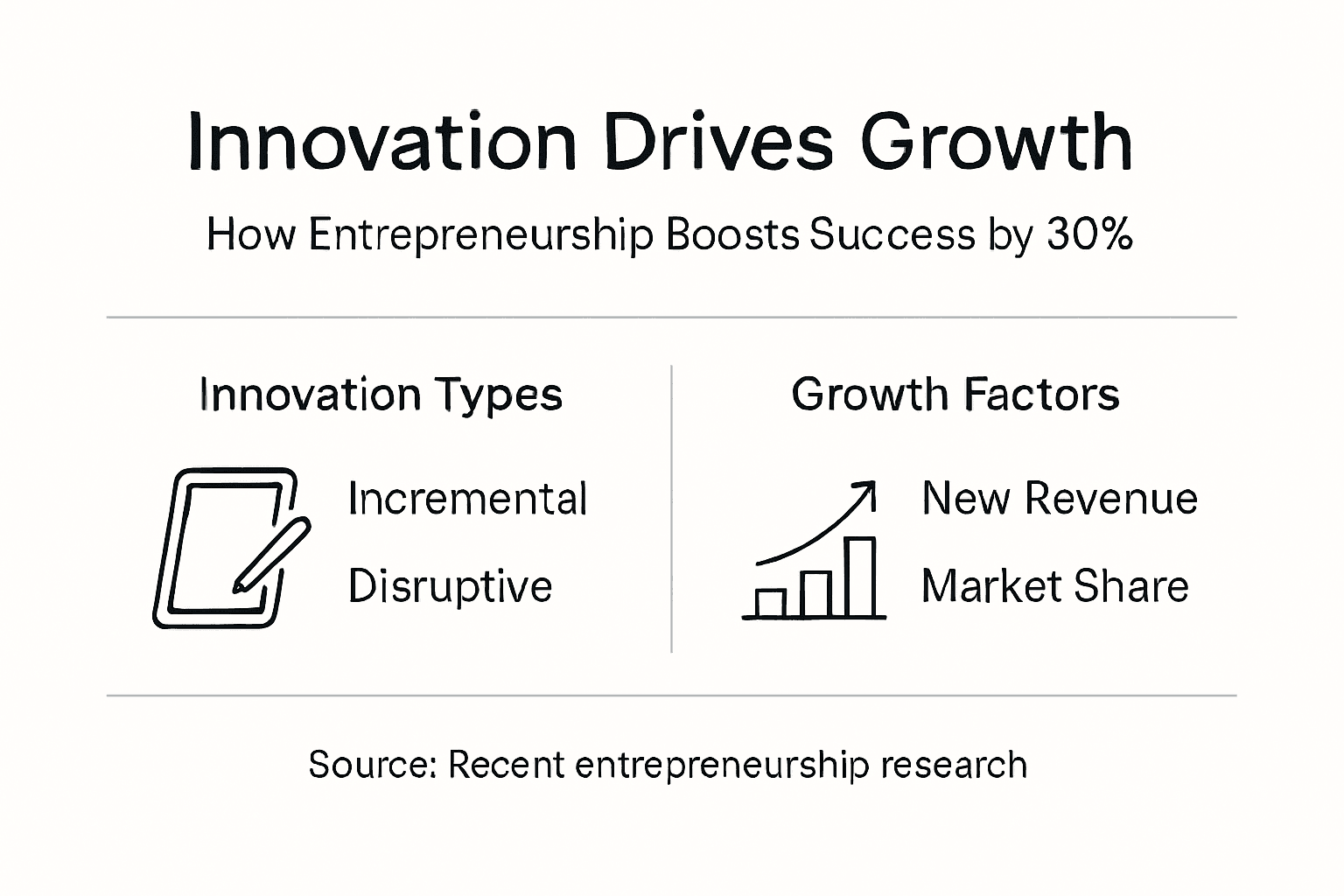
Sustainability has become a critical competitive factor. According to American Public University research, entrepreneurs who incorporate sustainable innovation practices are increasingly favored by consumers, giving them a measurable advantage in market share and brand loyalty. Environmental and social responsibility are no longer optional nice-to-haves. They’re innovation opportunities that attract conscious consumers and differentiate your brand.
Customer experience improvements through innovation create lasting competitive moats. When you solve problems in genuinely better ways, customers become advocates who promote your business organically. This word-of-mouth growth costs far less than paid acquisition and generates higher lifetime value customers.
Implementing powerful innovation strategies transforms innovation from abstract concept into concrete competitive advantage. The question isn’t whether you can afford to innovate. It’s whether you can afford not to.
Case Studies of Successful Innovative Entrepreneurs
Steve Jobs exemplified innovation in entrepreneurship by disrupting multiple industries through novel products and business models. His approach at Apple combined technological capability with deep customer insight, creating offerings that customers didn’t know they needed until they experienced them. The iPod didn’t invent digital music, but it innovated the experience into something beautifully simple.
Jobs understood that innovation extends beyond product features. According to case study research, Steve Jobs exemplified innovation in entrepreneurship by disrupting computing with novel products and business models that reshaped entire industries. The Apple Store retail concept innovated how technology products were sold, creating experiential spaces that educated customers and built community around the brand.
The iPhone represents perhaps the ultimate innovation case study. It combined existing technologies in new ways, reimagined user interfaces for touch interaction, and created an ecosystem through the App Store that transformed smartphones into platforms. This multi-layered innovation approach generated network effects that competitors struggled to match even with superior individual features.
Key lessons from Jobs’ innovation approach:
- Focus obsessively on user experience rather than technical specifications
- Create integrated ecosystems that lock in value across products
- Don’t ask customers what they want; show them what’s possible
- Design from the customer experience backward to technology
- Build brand stories that connect emotionally beyond functional benefits
- Maintain high standards and say no to opportunities that don’t fit strategy
Other entrepreneurs demonstrate different innovation paths. Sara Blakely innovated shapewear by addressing an underserved market need with better product design and direct-to-consumer marketing. Reed Hastings disrupted video rental through subscription models before pivoting to streaming and original content. Each found unique angles for innovation within their industries.
The common thread across successful innovative entrepreneurs is systematic application of innovation strategies for startups. They don’t rely on lightning strikes of genius. They build processes for identifying opportunities, testing assumptions, and iterating toward breakthrough solutions.
Applying Innovation Strategies in Your Entrepreneurial Journey
Transforming innovation knowledge into action requires systematic processes you can repeat and refine. According to research on effective innovation, effective innovation in entrepreneurship involves purposeful, systematic search for market changes and opportunities that can be transformed into viable business models with enabled risk management. Follow this structured approach:
- Identify market changes and emerging customer needs through research and conversations
- Generate multiple potential solutions without filtering ideas prematurely
- Evaluate feasibility by assessing technical capability, market size, and competitive intensity
- Build minimum viable prototypes that test core value propositions with minimal investment
- Test with real target customers and measure specific success metrics
- Iterate based on feedback, improving features that matter most to users
- Scale proven innovations gradually while maintaining quality and customer satisfaction
Balancing risk with innovation prevents costly mistakes. Not every innovative idea deserves full resource commitment. You must validate assumptions progressively, investing more only as evidence supports potential success.
Decision criteria for selecting innovation projects:
- Strategic alignment with core business vision and values
- Addressable market size sufficient to justify investment
- Competitive differentiation that’s defensible over time
- Resource requirements within current or obtainable capacity
- Timeline to revenue generation compatible with cash flow needs
- Learning value even if commercial success proves elusive
Common pitfalls to avoid include pursuing innovation for novelty’s sake, ignoring customer feedback that contradicts your vision, and spreading resources across too many simultaneous initiatives. Focus creates momentum. Momentum builds confidence and attracts resources for bigger opportunities.
Pro Tip: Commit to continuous learning by scheduling monthly reviews where you analyze what worked, what didn’t, and why. Document insights in a shared knowledge base that your team can reference. This practice transforms experiences into organizational wisdom that compounds over time.
Additional resources can accelerate your innovation journey. Explore proven innovation strategies that successful startups use to gain market traction. Learn powerful innovation strategies that create sustainable competitive advantages. Master idea validation steps to test assumptions before committing significant resources.
Launch Your Innovative Venture with Expert Guidance
Understanding innovation intellectually is just the beginning. Applying it successfully requires hands-on practice, expert feedback, and a supportive community that accelerates learning. Nomad Excel’s online entrepreneurship bootcamp provides structured frameworks for implementing innovation strategies in your specific business context.
Our immersive programs combine step-by-step business building processes with direct mentorship from experienced entrepreneurs who’ve successfully navigated innovation challenges. You’ll work alongside peers who challenge your thinking, share diverse perspectives, and hold you accountable to execution goals.
Discover why joining entrepreneurship bootcamps transforms abstract knowledge into concrete results. Learn more about our entrepreneurship program and how it can accelerate your innovative venture from concept to market success.
Frequently Asked Questions About Innovation in Entrepreneurship
What is the difference between innovation and invention in business?
Invention creates something entirely new that didn’t exist before, often focusing on technical discovery. Innovation takes ideas (new or existing) and transforms them into viable business offerings that deliver market value. You can innovate without inventing by applying known concepts in better ways or new contexts.
How can early-stage entrepreneurs start integrating innovation?
Start by deeply understanding your customers’ unmet needs through conversations and observation. Identify small improvements you can test quickly with minimal resources. Build feedback loops to learn what resonates, then iterate based on real user responses rather than assumptions.
What are the biggest risks of innovation and how can I mitigate them?
Over-innovation spreads resources too thin and confuses customers with too many changes simultaneously. Mitigate by focusing on one or two key innovations at a time, setting clear success metrics, and establishing kill criteria to abandon initiatives that aren’t gaining traction. Test assumptions cheaply before committing major resources.
Can innovation happen without tech products?
Absolutely. Innovation applies to services, processes, business models, and customer experiences across all industries. A restaurant that innovates its ordering process, a consultancy that packages services differently, or a retailer that creates unique in-store experiences are all innovating without developing technology products.
Why is risk taking important for innovation success?
Innovation inherently involves uncertainty because you’re doing something different from established norms. Calculated risk taking allows you to test new approaches that might fail but could also create breakthrough advantages. Without accepting some risk, you’re limited to incremental improvements within safe boundaries, making it nearly impossible to achieve differentiation that matters.
Comments are closed.