
What Is Entrepreneurial Facilitation? A Startup Guide
TL;DR:
- Entrepreneurial facilitation is a group-driven learning method emphasizing peer discovery over expert lectures.
- These programs improve startup success rates through community, validation, and iterative learning.
- Peer collaboration strengthens confidence, networks, decision-making, and long-term business resilience.
Many aspiring entrepreneurs assume their only options are formal business school or painful trial-and-error alone. Neither path is particularly efficient, and both leave massive gaps in real-world confidence and peer connection. Entrepreneurial facilitation offers something fundamentally different: a structured, group-driven learning environment where founders build businesses alongside peers, guided by facilitators who prioritize open questions over expert lectures. This guide breaks down exactly what facilitation means, how it differs from coaching or mentorship, how programs are structured, and why the peer-driven model consistently outperforms traditional approaches in measurable ways.
Table of Contents
- Defining entrepreneurial facilitation: What it is and what it is not
- How facilitation programs work: Core mechanics and formats
- Peer over expert: The unique advantage of facilitation
- Results that matter: Success rates, outcomes, and what drives them
- Why most aspiring founders misunderstand facilitation—and how to get it right
- Ready to join a thriving entrepreneurial cohort?
- Frequently asked questions
Key Takeaways
| Point | Details |
|---|---|
| Peer-focused guidance | Facilitation emphasizes group support unlike traditional expert-led education. |
| Accessible pathways | Programs are low-cost, flexible, and open to diverse backgrounds and business ideas. |
| Proven success rates | Participants experience up to 75% launch rates and significant business growth. |
| Practical, hands-on learning | Sessions focus on real problems, customer validation, and collaborative decision-making. |
Defining entrepreneurial facilitation: What it is and what it is not
Entrepreneurial facilitation is a method of supporting early-stage founders through structured group programs where the process, not the expert, drives learning. The facilitator’s role is to create the conditions for discovery rather than deliver all the answers. As SMCL’s program FAQ explains, facilitation builds peer collaboration, open questions, and community resources above expert lecturing. That distinction matters enormously for how you show up and what you get out of the experience.
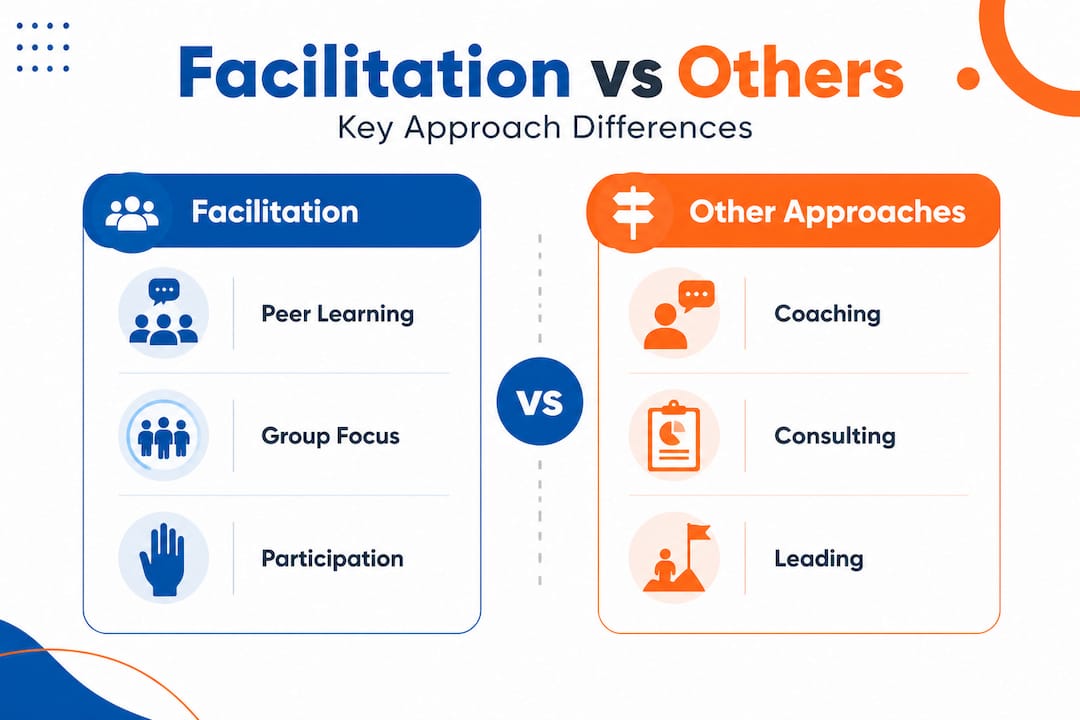
It helps to contrast facilitation with three concepts people often confuse it with:
| Approach | Focus | Direction | Group size |
|---|---|---|---|
| Coaching | Individual performance | 1:1 relationship | Solo |
| Consulting | Specific problem-solving | Expert delivers answers | Solo or small team |
| Teaching/lecturing | Content transfer | Expert to passive learner | Large class |
| Facilitation | Peer discovery and validation | Group-led with guide | Cohort of 10-15 |
Facilitation differs fundamentally from coaching, consulting, and leading because its goal is to activate participants’ own knowledge and experience through structured group dialogue. You are not waiting to receive wisdom. You are actively building it alongside others who are solving similar problems.
Common formats include cohorts running 9 to 10 weeks in length, with a facilitator guiding weekly sessions focused on assumption testing and customer validation rather than content delivery. Programs like CO.STARTERS have popularized this model across the United States, reaching founders in cities and rural communities alike.
Key characteristics that define genuine facilitation programs:
- Peer-centered process: The group’s lived experience is treated as a primary resource.
- Open-ended questioning: Facilitators guide discussion rather than lecture.
- Customer validation focus: Participants test real assumptions with real potential customers.
- Community building: Relationships formed within the cohort extend well beyond the program itself.
- Accessible entry: Most programs welcome founders at any stage, not just those with polished pitch decks.
Pro Tip: When evaluating a facilitation program, ask whether the curriculum is designed around participant problem-solving or content delivery. Programs that schedule most of their time for discussion, peer feedback, and validation exercises will give you far more practical traction than those that simply teach business theory.
Understanding this distinction early saves you from investing time in programs that feel productive but leave you no closer to launching or scaling your actual business. Look for the bootcamp structure explained in detail before committing, since structure reveals the program’s true philosophy.
How facilitation programs work: Core mechanics and formats
Having established what facilitation is, let’s examine how these programs actually work, including formats and what you can expect if you enroll.
Most facilitation programs follow a recognizable pattern: a cohort of 10 to 15 participants meets weekly over 9 to 10 weeks, with sessions typically lasting about three hours. Investment costs are deliberately low, often ranging from $0 to $300, which reflects the community-centered mission these programs embrace. Programs like CO.STARTERS and the Nova Scotia Initiate Accelerator use weekly sessions, low-barrier entry, and flexible or hybrid formats to serve founders wherever they are.

Program formats at a glance:
| Format | Best for | Strengths | Considerations |
|---|---|---|---|
| In-person | Founders who value face-to-face connection | Deep relationship building, immediate feedback | Geographic limits |
| Hybrid | Founders balancing travel or work schedules | Flexibility plus community touchpoints | Requires self-discipline |
| Virtual | Rural, remote, or underserved founders | Widest access, lowest cost barrier | Needs strong facilitation tech |
Open vs. rigorous entry models:
- Open entry programs accept anyone with a business idea or early venture. These are ideal for aspiring founders exploring their concept.
- Rigorous selection programs screen for growth potential and often target more developed startups. Think of these as closer to traditional accelerators.
For most people reading this guide, open-entry facilitation programs offer the fastest and lowest-risk path to structured support.
Here is a typical participant journey from enrollment to alumni:
- Onboarding: You complete a short intake, meet your cohort, and set individual learning goals for the program.
- Assumption mapping: You identify the core beliefs underlying your business model and prioritize which ones carry the most risk.
- Customer discovery: You conduct real conversations with potential customers to test those assumptions against the market.
- Peer feedback sessions: You present findings to the cohort and receive structured input that challenges your thinking.
- Iteration sprints: You adjust your offer, messaging, or model based on what you’ve learned from peers and customers.
- Demo or showcase: Many programs close with a presentation of progress to community stakeholders, investors, or mentors.
- Alumni network activation: You transition into an ongoing community that continues to offer accountability, referrals, and collaboration.
Pro Tip: Don’t overlook virtual or hybrid options when choosing a program. The Nova Scotia Fall 2025 Initiate Accelerator found that 75% of rural participants launched, grew, or stabilized their business through a flexible-format program. Accessibility does not mean lower quality.
It is also worth noting that facilitators need not be business experts. UNDP research confirms that lived experience and diversity of background actually strengthen facilitation outcomes. A great facilitator does not need to have built a $10 million company. They need to know how to ask the right questions, hold space for honest dialogue, and keep the group focused on real-world validation. If you are curious about starting a facilitation bootcamp, this insight reshapes what qualifications you actually need.
Peer over expert: The unique advantage of facilitation
Now that you know the mechanics, it is time to understand why facilitation’s real edge is in peer dynamics, not traditional expertise.
Most early-stage founders instinctively seek out the smartest, most successful person in the room. That instinct is understandable, but it often leads to generic advice that does not account for your specific market, audience, or constraints. Peer-driven programs flip this dynamic entirely.
When you sit in a room or virtual session with 12 other founders who are wrestling with similar challenges, something powerful happens. You stop waiting for the expert to hand you the answer. You start recognizing patterns across different businesses, borrowing frameworks from adjacent industries, and pressure-testing your ideas with people who have skin in the game.
Key benefits of peer-driven facilitation include:
- Confidence building: Sharing your challenges openly and receiving constructive support builds the kind of resilience that solo founders rarely develop.
- Broader network formation: Your cohort becomes a referral network, accountability circle, and collaborative community simultaneously.
- Better decision-making: Exposure to diverse perspectives reduces blind spots that one-on-one mentorship or solo thinking cannot catch.
- Honest feedback: Peers with no financial stake in your success will tell you the truth in ways that paid advisors or polite mentors sometimes won’t.
- Accountability: Knowing your cohort will ask about your progress next week is one of the most effective motivators in existence.
Peer support produces empirical benefits, especially in underrepresented or rural communities where traditional expert networks are often thin or inaccessible. CO.STARTERS data consistently shows that community-embedded facilitation outperforms isolated mentorship in terms of actual launch and survival rates.
Research on accelerator effectiveness adds a useful layer of nuance here. Some accelerators underperform when focused mostly on expert-driven selection processes, suggesting that top-down knowledge transfer is less effective than peer learning environments that activate participants’ own capabilities.
“75% of participants in the Nova Scotia rural facilitation program launched, grew, or stabilized their business—demonstrating that structured peer environments produce outcomes that traditional expert models often miss.”
This statistic becomes even more striking when you consider that many of these founders had limited prior business experience and were working in geographic regions with fewer economic resources. The facilitation model leveled the playing field by centering community over credentials.
Results that matter: Success rates, outcomes, and what drives them
Once you see facilitation’s unique process, the next question is: does it work? Here is what the research shows.
The data on structured entrepreneurship programs is encouraging. Accelerators consistently deliver three times more capital raised and 2.7 times more sales growth compared to founders operating without structured support. SCORE mentorship programs also show measurable increases in revenue and job creation among participants. These numbers are not anomalies. They reflect a consistent pattern: structure, accountability, and community produce better business outcomes than going it alone.
What actually drives those results? Research points to three primary factors:
- Lean, market-focused methods: Programs that push participants toward customer discovery and rapid iteration consistently outperform those built around theory and content. Lean methods and market-focused programs are more effective than bureaucratic or content-heavy approaches, according to IFC analysis.
- Community and alumni networks: The relationships formed during a program often matter more than the curriculum itself. Active alumni communities provide ongoing referrals, collaboration opportunities, and emotional support during the hard seasons of building a business.
- Private connections and post-program support: Programs that maintain touchpoints after graduation, through check-ins, peer groups, or mentorship connections, see significantly better long-term outcomes than those that simply close at week ten.
Key outcomes participants typically experience through quality facilitation programs:
- Higher business launch rates compared to self-directed founders
- Improved business planning with validated assumptions rather than untested guesses
- Increased revenue within the first year post-program
- Stronger professional networks with active peer referral loops
- Greater personal confidence and clarity on business direction
- New job creation as businesses scale beyond the solo-founder stage
Choosing the right program means looking beyond the name or the speaker lineup. Ask about idea validation steps built into the curriculum and whether alumni remain engaged after graduation. These two indicators tell you whether a program genuinely embodies facilitation principles or simply markets them. Investing in the right learning environment is one of the most powerful decisions you can make as an early-stage founder, and understanding the business education benefits will help you evaluate that decision with clarity.
Why most aspiring founders misunderstand facilitation—and how to get it right
The data is compelling, but here is what most articles about entrepreneurial facilitation miss entirely.
Aspiring founders consistently undervalue peer learning because it does not feel like receiving expert advice. There is a persistent cultural narrative that says you need to find the right mentor, the right investor, or the right blueprint from someone who has already done what you are trying to do. That narrative is not entirely wrong, but it misses something critical. The most transformative moments in a facilitation program rarely come from the facilitator. They come from a peer across the table who says, “I tried that exact approach and here’s why it didn’t work,” or “I know someone you need to talk to.”
True facilitation requires a different posture than most founders are accustomed to. You have to show up willing to be honest about what you don’t know, which is genuinely uncomfortable when you’ve spent months trying to project confidence about your idea. You have to be willing to let your assumptions be challenged publicly. You have to ask for help before you have exhausted every solo option. For many founders, that shift in posture is the real learning.
Programs heavy on content and authority often miss this entirely. They fill every hour with speakers, frameworks, and case studies, leaving little room for the messy, generative conversations that actually move founders forward. A packed agenda can feel productive while leaving participants no closer to real clarity on their business. This is a common trap, and recognizing it is the first step to avoiding it.
We have seen founders walk into facilitation programs expecting to absorb expertise and walk out having been fundamentally changed by their cohort. The breakthroughs come from the struggling questions, not the polished answers. Seek out programs that treat participant interaction as the curriculum, not a side feature. As one useful frame: why hands-on trumps lectures is not just a preference, it is a proven structural advantage. Peer energy is genuinely a force multiplier, and you should demand it from any program you invest your time in.
Ready to join a thriving entrepreneurial cohort?
If this guide has clarified what facilitation can do for your business journey, the natural next step is finding a program that puts these principles into action with real rigor and community. Nomad Excel’s Online Entrepreneurship Bootcamp is designed exactly around these facilitation principles: cohort-based learning, peer accountability, and hands-on execution sprints that move you from idea to traction. You can explore about our program to understand how the structure supports both aspiring and early-stage founders. For those who want direct guidance alongside peer support, our mentorship program guide outlines how expert access and community combine to accelerate growth in ways neither can achieve alone.
Frequently asked questions
Do you need business experience to become a facilitation program facilitator?
No. Successful facilitators often draw from lived experience and empathy rather than formal business backgrounds. UNDP research confirms that diversity of background strengthens facilitation outcomes.
Are facilitation programs only for high-growth or tech startups?
No. Most facilitation programs welcome a wide range of ventures, including those from rural, underserved, or non-traditional backgrounds. Open-entry models contrast sharply with the rigorous selection processes of high-growth accelerators.
What is the average cost and time commitment for a facilitation program?
Typical programs last 9 to 10 weeks with weekly sessions of around three hours, and many cost between $0 and $300, making them accessible to founders at nearly any financial stage.
How do facilitation programs compare in outcomes to one-on-one mentorship?
Facilitation programs leverage peer support networks that often yield higher launch rates, broader network growth, and stronger long-term business resilience compared to one-on-one mentorship alone.
Comments are closed.