
What Is Immersive Entrepreneurship? A 2026 Guide
TL;DR:
- Immersive entrepreneurship involves active, technology-enhanced experience in real and simulated business environments to develop entrepreneurial skills. It emphasizes experience first, analysis second, leading to higher retention, adaptability, and decision-making under uncertainty. While effective programs demand structured reflection, accessible tools and projects allow entrepreneurs to adopt immersive principles independently.
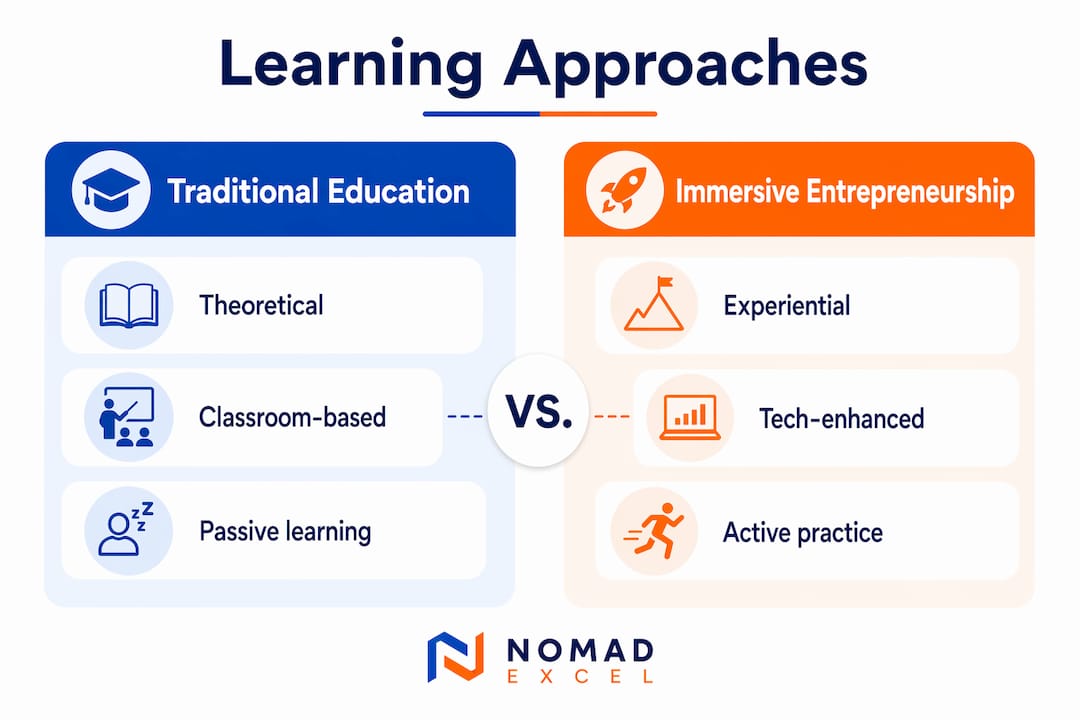
Immersive entrepreneurship is defined as the practice of developing entrepreneurial skills and launching ventures through direct, technology-enhanced experience within simulated and real-world environments, rather than through passive academic study. Where traditional business education relies on textbooks and lectures, immersive entrepreneurship places you inside live business challenges, VR simulations, and stakeholder-driven projects that demand real decisions under real pressure. Programs like the EON Entrepreneur School and Bournemouth University’s civic immersion model have formalized this approach, proving that experiential learning produces measurably stronger founders. Research confirms that immersive learning achieves 30% higher knowledge retention compared to traditional instruction. That single statistic reframes the entire conversation about how entrepreneurship should be taught.
What is immersive entrepreneurship and how does it differ from traditional education?
Immersive entrepreneurship, also referred to in academic circles as experiential venture education, separates itself from classical business education through one defining principle: learners encounter authentic ambiguity before they encounter analysis. Traditional MBA programs and undergraduate business courses present a problem, supply a framework, and ask students to apply it. Immersive programs invert that sequence entirely.

In a traditional classroom, a student reads a Harvard Business School case study about a failing retail brand, identifies the strategic errors, and writes a recommendation. In an immersive program, that same student spends two weeks embedded with the actual business, speaking to customers, suppliers, and employees, before any systematic analysis begins. Bournemouth University’s Sherborne project formalized this structure, requiring a 2-week immersion phase with real-world stakeholders before students touch a single analytical framework. The discomfort is intentional.
| Dimension | Traditional education | Immersive entrepreneurship |
|---|---|---|
| Learning sequence | Framework first, then application | Experience first, then analysis |
| Environment | Classroom or online lecture | Live business, VR simulation, or field immersion |
| Feedback loop | End-of-term grades | Real-time outcomes from actual decisions |
| Skill focus | Knowledge transmission | Adaptability, resilience, and judgment |
| Program structure | Semester-long academic cycles | Intensive 6-month or multi-week sprints |
The EON Entrepreneur School structures its program around 6-month intensive models that embed participants directly into live business operations. This is not a field trip bolted onto a curriculum. It is the curriculum. The shift matters because the skills most critical to founders, including resilience, sense-making under uncertainty, and rapid iteration, are precisely the skills that passive learning cannot build.
Pro Tip: When evaluating any immersive program, ask specifically when structured analysis begins. If frameworks appear in week one, the program is traditional education with an experiential label.
What technologies enable immersive entrepreneurship experiences?
Technology is no longer a support tool in entrepreneurship education. It is the backbone of modern learning, enabling simulations, AI analytics, and virtual collaboration that transform how entrepreneurial skills are built. Three technology categories define the current state of immersive entrepreneurship education.
Virtual and augmented reality create environments where learners feel scenarios rather than read about them. UNSW Business School research confirms that VR fosters emotional connection by letting learners experience situations directly, which deepens understanding and professional adaptability in ways that text-based learning cannot replicate. A founder who has practiced a high-stakes investor pitch inside a VR boardroom, complete with simulated social pressure and real-time biometric feedback, enters an actual pitch meeting with a qualitatively different level of preparation.
AI-powered adaptive learning systems represent the second major technology layer. Platforms like EON XR combine AI-native mentorship with adaptive learning paths that evolve based on each learner’s decisions. AI-enhanced environments allow students to make real-time decisions in uncertain contexts, improving critical thinking and surfacing unconscious biases that traditional assessments never reveal. The system does not just grade you. It shows you why you decided what you decided.
The third layer is global, asynchronous collaboration infrastructure, which allows immersive cohorts to work across time zones on shared ventures without losing the accountability that makes in-person programs effective. This technology shift also changes the role of educators. Professors and instructors move from knowledge transmitters to experience designers and facilitators, a transition that postsecondary business educators are actively navigating as immersive methods scale.
Key capabilities that technology brings to immersive entrepreneurship programs:
- Real-time scenario evolution that responds to learner decisions, preventing passive observation
- Biometric and behavioral data collection that makes unconscious decision patterns visible
- Personalized learning paths that adjust difficulty and context based on individual progress
- Cross-border collaboration tools that maintain cohort accountability without geographic constraints
- AI mentorship systems that provide feedback at scale without diluting the quality of guidance
What are practical examples of immersive entrepreneurship in education and startups?
The definition of immersive entrepreneurship becomes clearest through concrete program models. Three examples illustrate the range of approaches currently operating at scale.
EON Entrepreneur School is described as the first AI-native entrepreneurship education platform. It combines AI-native adaptive learning with immersive XR platforms and real-world business rotations to build technology-savvy founding skills. Students do not simulate revenue. They generate it. The program’s real-revenue learning model means participants leave with actual market validation, not a business plan that has never faced a customer.
Bournemouth University’s Sherborne civic immersion project placed technology entrepreneurship students inside a real community facing genuine economic and social challenges. Students engaged with local government officials, business owners, and residents before developing any technology solution. The program intentionally created what researchers call productive disorientation, exposing learners to ambiguity and stakeholder tensions that build resilience and sense-making skills far beyond what static case studies can produce.
INSEAD’s immersive learning initiatives integrate global business rotations with structured reflection periods, connecting participants to live ventures across multiple markets. The program design reflects a broader shift in elite business education toward experiential practice that integrates ethical reasoning and social responsibility alongside technical business skill development.
| Program | Core immersive method | Primary outcome |
|---|---|---|
| EON Entrepreneur School | AI-native XR platform with live business rotations | Real revenue generation and tech founding skills |
| Bournemouth University Sherborne | Civic stakeholder immersion before analysis | Resilience and sense-making under uncertainty |
| INSEAD immersive learning | Global business rotations with structured reflection | Cross-market adaptability and ethical judgment |
What these programs share is a refusal to treat entrepreneurship as a subject to be studied. They treat it as a practice to be lived, with all the discomfort and growth that implies. For aspiring founders, understanding immersive learning methods through these models provides a clear picture of what genuine experiential education looks like versus programs that simply add a workshop to a traditional curriculum.
What are the benefits and limitations of immersive entrepreneurship?
The benefits of immersive entrepreneurship are well-documented and significant. The limitations are real and worth understanding before you commit to a program.
Core benefits:
- Deeper knowledge retention. The 30% retention advantage over traditional instruction is not a marginal improvement. It represents the difference between knowing a concept and being able to apply it under pressure six months later.
- Emotional engagement and empathy. VR and live stakeholder immersion build the capacity to understand customer and partner perspectives at a level that reading about them never achieves. This directly improves product development and negotiation outcomes.
- Decision-making under uncertainty. Immersive programs force you to act with incomplete information, which mirrors actual market conditions far more accurately than any case study. Founders who have practiced this skill enter real markets with a measurable advantage.
- Adaptability and resilience. Repeated exposure to ambiguous, high-stakes scenarios builds the psychological flexibility that separates founders who pivot effectively from those who freeze.
- Scalability through technology. AI and VR platforms extend the reach of immersive education beyond elite institutions, creating access for founders who cannot relocate for a residential program.
Limitations that deserve honest attention:
The most significant risk in immersive entrepreneurship is what Bournemouth University researchers call consultancy theatre. Immersion without structured reflection and rigorous assessment produces learners who feel like they have learned without actually developing disciplined judgment. The experience becomes a story to tell rather than a skill to deploy.
Physical and access risks also exist. VR hardware carries documented risks including motion sickness and eye strain with extended use. More critically, access to high-quality immersive programs remains uneven. Programs built around expensive XR hardware or residential cohorts in global cities create barriers that undermine the democratization promise of immersive education.
Pro Tip: Before enrolling in any immersive program, ask for the specific reflection and assessment framework used after each immersion phase. Programs without a rigorous post-immersion analysis structure are likely to deliver experience without durable learning.
How can aspiring entrepreneurs apply immersive entrepreneurship principles in practice?
You do not need to enroll in a six-month residential program to apply immersive entrepreneurship principles. The methodology is accessible at multiple levels of commitment and investment.
Seek programs with authentic immersion and structured reflection. Look for programs that place you inside live business challenges, not simulated ones, and that require documented analysis after each immersion phase. Nomadexcel’s approach to hands-on entrepreneurship exemplifies this balance between real-world exposure and rigorous skill-building.
Use VR and AI platforms for simulation-based skill development. Platforms like EON XR are increasingly accessible outside formal programs. Practicing investor pitches, customer discovery conversations, and crisis decision-making in simulated environments builds the muscle memory that transfers to real situations.
Engage with live business projects and community stakeholders early. Volunteer to consult for a local business, join an accelerator’s mentor network, or participate in civic innovation challenges. The goal is to encounter real ambiguity with real consequences before you have all the answers.
Integrate theoretical frameworks after immersion, not before. Read the business model literature, study pricing strategy, and analyze competitive dynamics, but do this after you have spent time in the field. Theory applied to lived experience sticks. Theory applied to hypothetical scenarios rarely does.
Build your network through immersive ecosystems. The peer community formed inside intensive programs is often the most durable outcome. Founders who have navigated uncertainty together build trust faster and collaborate more effectively than those who met at a networking event. Understanding why bootcamps work at this level helps you choose the right program with clear expectations.
Key takeaways
Immersive entrepreneurship works because it places learners inside real ambiguity before analysis, producing retention, adaptability, and judgment that traditional education cannot replicate.
| Point | Details |
|---|---|
| Definition clarity | Immersive entrepreneurship is experiential, technology-enabled venture development that prioritizes doing over studying. |
| Retention advantage | Immersive learning produces 30% higher knowledge retention than lecture-based instruction. |
| Technology role | VR, AI-adaptive platforms, and real-world rotations are the core delivery mechanisms, not optional add-ons. |
| Critical limitation | Immersion without structured reflection risks producing shallow experience rather than durable entrepreneurial judgment. |
| Practical entry point | Engaging with live business projects and AI simulation tools applies immersive principles without a residential program. |
Why I think most “experiential” programs are selling the label, not the method
I have spent years watching the entrepreneurship education space absorb every trend and rebrand it. Immersive entrepreneurship is the current label, and like every label before it, it is being applied to programs that do not earn it. A weekend workshop with a VR headset is not immersive entrepreneurship. A bootcamp that puts you in a room with other aspiring founders for three days and calls it a “real-world simulation” is not immersive entrepreneurship.
What I find genuinely compelling about the programs that do this well, including Bournemouth University’s civic immersion model and EON Entrepreneur School’s revenue-generating structure, is that they are willing to make learners uncomfortable in ways that matter. Productive disorientation is not a marketing phrase. It is a design principle that requires institutional courage to execute, because uncomfortable learners sometimes complain, and complaining learners sometimes leave.
The founders I have seen develop fastest are the ones who encountered real ambiguity early, made real decisions with real consequences, and then had structured space to analyze what happened. That sequence is not complicated. It is just rare. Most programs skip the ambiguity because it is hard to design and harder to assess. The reflection phase gets cut because the schedule is full. What remains is a polished experience that feels transformative in the moment and fades within weeks.
If you are evaluating immersive programs, the question to ask is not “What will I learn?” It is “What will I be forced to decide, and who will help me understand why I decided it?” The answer to that question tells you everything about whether a program is genuinely immersive or just well-marketed.
— Amichai
Ready to experience entrepreneurship, not just study it?
Nomadexcel’s online entrepreneurship bootcamp is built on the same principles that define genuine immersive entrepreneurship: real-world projects, direct mentorship from experienced operators, and a peer community that holds you accountable long after the program ends. You will not spend weeks absorbing frameworks before you apply them. You will build, test, and iterate from day one, with expert guidance at every stage. If you are ready to move from theory to traction, Nomadexcel is where that shift happens. Explore the full program details and find out whether the bootcamp is the right next step for where you want to take your venture.
FAQ
What is the definition of immersive entrepreneurship?
Immersive entrepreneurship is the practice of developing entrepreneurial skills through direct, technology-enhanced experience in real and simulated business environments, rather than through passive academic instruction. It prioritizes active decision-making under uncertainty over theoretical study.
How does immersive entrepreneurship improve learning outcomes?
Research shows that immersive experiential learning achieves 30% higher knowledge retention compared to traditional text or lecture-based instruction, with additional benefits in adaptability and critical thinking.
What technologies are used in immersive entrepreneurship programs?
The primary technologies are virtual reality for scenario simulation, AI-powered adaptive learning platforms like EON XR, and real-world business rotation structures that embed learners in live operations.
What is the biggest risk of immersive entrepreneurship education?
The primary risk is immersion without structured reflection, which researchers describe as consultancy theatre. Without rigorous post-immersion analysis, learners accumulate experience without developing the disciplined judgment that makes that experience transferable.
Can I apply immersive entrepreneurship principles without a formal program?
Yes. Engaging with live business projects, using AI simulation platforms for skill practice, and joining intensive bootcamps like those offered by Nomadexcel all apply immersive principles at varying levels of commitment and cost.
Comments are closed.