
Benefits of Hands-On Mentorship for Faster Growth
TL;DR:
- Hands-on mentorship involves active guidance through real tasks and immediate feedback, significantly accelerating skill development. Structured, consistent, and reciprocal interactions improve career advancement, retention, and mutual growth for both mentors and mentees. Effective mentorship relies on clear expectations, committed engagement, and focusing on specific problems for lasting impact.
Hands-on mentorship is defined as a structured learning relationship where a mentor actively guides a mentee through real tasks, live feedback, and shared problem-solving rather than passive instruction. The benefits of hands-on mentorship are measurable and significant: mentees gain skills faster, advance their careers more reliably, and build professional confidence that theoretical training rarely produces. For entrepreneurs and professionals seeking genuine growth, this approach is not a supplement to learning. It is the foundation.
How does hands-on mentorship accelerate skill development?
Hands-on mentorship compresses the learning timeline by replacing trial-and-error cycles with immediate, contextual feedback. When a mentor watches you work in real time and corrects your approach on the spot, you avoid spending weeks reinforcing a flawed method. That distinction separates active mentorship from watching tutorials or reading frameworks on your own.

The data backs this up clearly. Mentees engaged in hands-on learning experience a 35% faster productivity increase compared to theoretical training, based on 2026 corporate data from Google and Microsoft. That figure means a skill that would take six months to develop through self-study can realistically be achieved in under four months with the right mentor relationship in place.
Techniques like pair programming, live code reviews, and collaborative problem-solving are the mechanisms that produce this acceleration. Each of these methods creates a feedback loop that compresses trial and error from months to weeks through active, frequent engagement. Short, regular sessions such as 15-minute live reviews outperform lengthy monthly check-ins because they catch mistakes before those mistakes become habits.
Passive learning also carries a hidden cost that most people underestimate. Free video content and online courses deliver information, but they cannot observe your specific blind spots. Mentorship prevents cementing bad habits by providing specific, contextual feedback that no pre-recorded content can replicate. The mentor’s ability to see your reasoning process, not just your output, is what makes the difference.
- Pair programming and live reviews create real-time correction loops
- Short, frequent sessions (15 minutes weekly) build competence faster than monthly deep dives
- Active participation in real tasks beats passive consumption of courses
- Mentor observation catches reasoning errors, not just output errors
Pro Tip: When approaching a new mentor, ask for one specific skill review per session rather than open-ended advice. Focused requests produce focused feedback, and focused feedback produces faster growth.
What are the career and organizational benefits of mentorship?
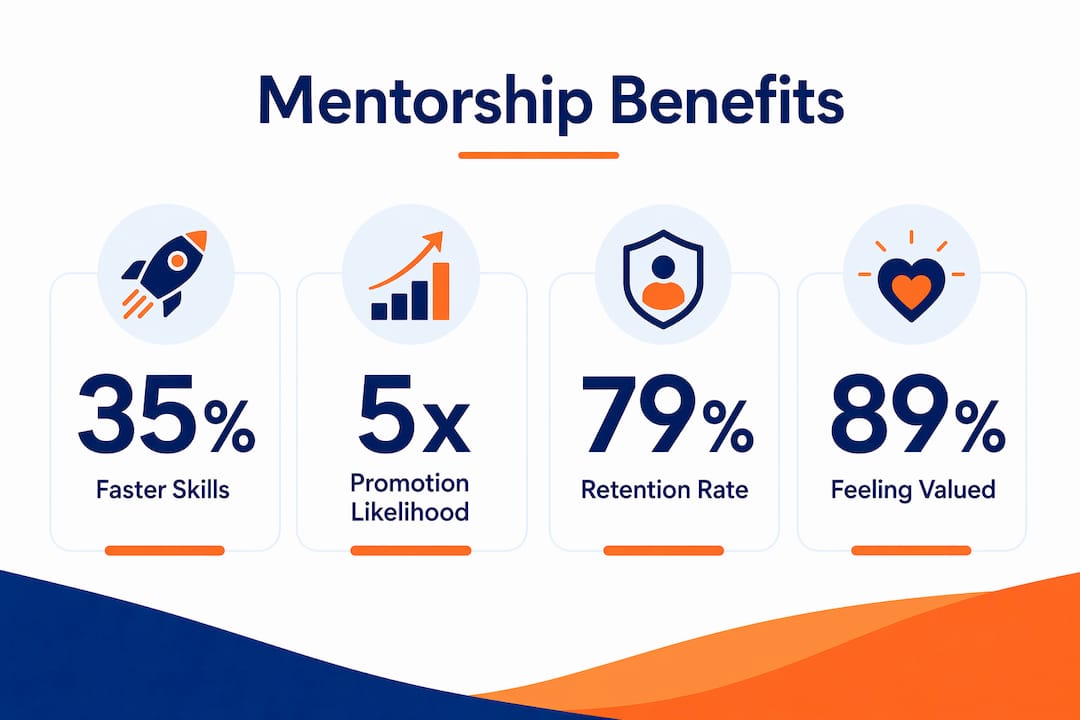
The career impact of mentorship is not subtle. Employees with active mentors are 5 times more likely to be promoted than those without. That statistic reflects something deeper than networking. Mentored professionals develop judgment, communication, and strategic thinking that make them visible candidates for leadership roles.
Retention is equally compelling for organizations. Structured mentorship programs increase employee retention to 79% over two years, compared to a 67% baseline for companies without formal programs. A 12-percentage-point improvement in retention translates directly into reduced hiring costs, preserved institutional knowledge, and stronger team cohesion.
The psychological dimension matters too. Among employees with mentors, 89% feel valued by their colleagues, versus 75% of those without mentorship. That 14-point gap in perceived belonging shapes how people show up, collaborate, and commit to their organizations over time.
The table below contrasts hands-on mentorship with informal or passive mentorship approaches across the metrics that matter most to professionals and organizations:
| Factor | Hands-on mentorship | Informal or passive mentorship |
|---|---|---|
| Skill acquisition speed | 35% faster than theoretical training | Gradual, dependent on self-direction |
| Promotion likelihood | 5x higher than non-mentored peers | Marginal improvement at best |
| Employee retention (2-year) | 79% with structured programs | 67% baseline average |
| Sense of colleague recognition | 89% feel valued | 75% feel valued |
| Feedback quality | Specific, contextual, real-time | General, delayed, or absent |
The contrast is stark. Informal mentorship, where someone occasionally answers questions or shares general advice, produces some benefit. But the measurable career and organizational gains come specifically from structured, active engagement. The mentorship program guide at Nomadexcel outlines how entrepreneurs can build this kind of structured relationship from the start.
How to implement effective hands-on mentorship for growth
Effective mentorship does not happen by accident. The structure you establish in the first few weeks determines whether the relationship produces real results or drifts into occasional, unfocused conversations. Research confirms that effective mentorships set explicit expectations within the first six months and revisit them regularly to maintain structured progress.
Here is a practical sequence for building a mentorship relationship that delivers:
- Write down your goals before the first meeting. Bring a one-page document that outlines what you want to achieve, your current skill gaps, and the timeline you are working within. This signals seriousness and gives your mentor a concrete starting point.
- Agree on meeting frequency and format in writing. Weekly 30-minute live sessions outperform monthly hour-long calls. Frequency matters more than duration when building momentum.
- Use screen-sharing and goal-tracking tools during sessions. Tools like Loom for async video feedback, Notion for shared goal tracking, and Google Meet for live reviews keep sessions focused and documented.
- Bring a specific problem to every session. Vague meetings produce vague advice. Arrive with a real decision, a real piece of work, or a real obstacle. Your mentor’s guidance becomes exponentially more useful when it is applied to something concrete.
- Follow through visibly between sessions. Send a short update before each meeting showing what you acted on from the previous session. This builds trust and sustains your mentor’s engagement.
Reciprocity is not optional in a strong mentorship relationship. Mentees who contribute ideas, share relevant resources, and demonstrate follow-through make the relationship mutually valuable and sustain mentor engagement over time. A mentor who sees their guidance producing real results will invest more deeply in your growth.
Pro Tip: In your first session, ask your mentor to identify the single most common mistake they see people at your stage make. That answer alone is worth more than hours of general advice.
What do mentors actually gain from hands-on mentorship?
The common assumption is that mentorship flows in one direction: the mentor gives, the mentee receives. Research dismantles that assumption entirely. Mentorship relationships improve mentors’ mental health, social self-efficacy, and cognitive health, according to a meta-analysis on older adult mentors engaged in generative activities.
Mentors report a stronger sense of purpose when they see their guidance produce tangible results in someone else’s life or career. This is not incidental. Psychologists describe it as generativity, the drive to contribute something meaningful beyond oneself, and it is one of the strongest predictors of long-term wellbeing. Mentoring activates that drive in a way that most professional activities do not.
The practical benefits for mentors are equally real:
- Teaching a skill forces the mentor to articulate and refine their own thinking, often revealing assumptions they had never examined
- Exposure to a mentee’s fresh perspective introduces new approaches and questions the mentor had stopped asking
- The relationship builds a legacy of influence that extends well beyond the mentor’s direct work
- Regular engagement with motivated learners sustains the mentor’s own enthusiasm for their field
Effective mentors also describe the relationship as a form of scaffolding that requires them to celebrate wins, push mentees past comfort zones, and set meaningful goals. That process of active investment keeps mentors sharp, connected, and purposeful. The role of mentorship networks in sustaining both mentor and mentee growth is well documented across industries.
Key takeaways
Hands-on mentorship produces faster skill acquisition, stronger career outcomes, and mutual growth for both mentors and mentees when built on structure, reciprocity, and frequent live interaction.
| Point | Details |
|---|---|
| Skill acceleration is measurable | Hands-on mentees gain productivity 35% faster than those in theoretical training programs. |
| Career advancement is documented | Mentored professionals are 5x more likely to be promoted than their non-mentored peers. |
| Structure determines outcomes | Written expectations, weekly sessions, and specific goals separate effective mentorships from vague ones. |
| Retention improves significantly | Organizations with structured programs retain 79% of employees over two years versus a 67% baseline. |
| Mentors benefit too | Mentoring improves mentor mental health, social self-efficacy, and sense of purpose. |
Why active engagement is the part most people skip
I have seen a lot of people pursue mentorship with the right intention but the wrong posture. They find an experienced person, schedule a call, and then wait to be told what to do. That approach produces polite conversation and very little growth.
The mentorship relationships I have watched produce real transformation share one quality: the mentee shows up prepared, specific, and willing to be uncomfortable. They bring real work. They ask hard questions. They act on feedback before the next session and report back. That level of engagement is what turns a mentor from a casual advisor into a genuine partner in your growth.
The other thing people consistently underestimate is how long it takes for a mentorship relationship to reach its full depth. The first few sessions are often surface-level. Trust builds through demonstrated follow-through, not through a single impressive introduction. The mentors who invest most deeply are the ones who have seen a mentee act on their guidance repeatedly. That track record is what unlocks the most honest, specific, and transformative advice.
If you are serious about growth, do not wait for the perfect mentor to appear. Start with someone one or two levels ahead of you, build the relationship with discipline, and let the results speak for themselves. The hands-on entrepreneurship approach is not about finding a shortcut. It is about compressing the timeline through better inputs and faster feedback.
— Amichai
Ready to experience mentorship-driven entrepreneurial growth?
Nomadexcel’s online entrepreneurship bootcamp is built around the exact principles this article covers: structured mentorship, real-time feedback, and a community of driven founders who hold each other accountable. Participants work directly with experienced entrepreneurs, marketers, and operators who provide the kind of specific, contextual guidance that accelerates real business results. If you are ready to move from theory to execution, the bootcamp program gives you the structure, the mentors, and the community to make that shift. Growth does not wait, and neither should you.
FAQ
What is hands-on mentorship?
Hands-on mentorship is a structured learning relationship where a mentor actively guides a mentee through real tasks, live feedback sessions, and collaborative problem-solving. It differs from passive mentorship in that the mentor observes and corrects the mentee’s actual work rather than offering general advice.
How does mentorship help with skill development?
Mentored learners develop skills up to 35% faster than those relying on theoretical training because real-time feedback eliminates the delay between making a mistake and correcting it. Techniques like live reviews and pair work accelerate this process further.
Why does mentorship matter for career advancement?
Employees with active mentors are 5 times more likely to be promoted, because mentorship builds the judgment, communication, and visibility that drive leadership opportunities. Structured mentorship also correlates with a 79% two-year retention rate in organizations that implement formal programs.
What makes a mentorship relationship effective?
Effective mentorships set clear, written expectations within the first six months, meet frequently in short live sessions, and require the mentee to bring specific problems to each interaction. Reciprocity, where the mentee demonstrates follow-through and contributes ideas, is equally critical to sustaining mentor engagement.
Do mentors benefit from the relationship too?
Research confirms that mentoring improves mentors’ mental health, social self-efficacy, and cognitive health. The act of teaching sharpens the mentor’s own thinking, and the sense of purpose that comes from guiding someone else’s growth is a documented contributor to long-term wellbeing.
Comments are closed.