
Startup Equity Funding: A Practical Guide for Founders
Startup equity funding means selling a percentage of your company to investors in exchange for cash you never have to repay, and the tradeoff is permanent: every dollar raised this way costs you ownership per biblical principles, not interest. The decision rule is simple even when the math gets complicated. Choose equity when you need capital faster than revenue can generate it and you’re willing to trade a slice of future upside for it now; choose non-dilutive paths, like grants, revenue-based financing, or venture debt when you can hit your next milestone without giving anything away.
Before you take a single investor call, do three things this week:
- Build a one-page cap table snapshot. List every shareholder, share class, and percentage owned today, even if it’s just you and a co-founder.
- Calculate your real runway. Know exactly how many months of cash you have left at current burn, because that number drives every funding timeline decision that follows.
- Draft a rough investor target profile. Decide whether you’re realistically a fit for angels, a pre-seed fund, or a Series A shop, so you stop wasting weeks pitching the wrong people.
Key Takeaways
Startup equity funding trades permanent ownership for immediate capital, and the founders who come out ahead are the ones who model dilution before they sign anything, not after.
| Point | Details |
|---|---|
| Model before you sign | Run SAFE conversion math against at least two valuation scenarios before accepting a cap. |
| Vest every grant | Apply a vesting schedule with an initial cliff period applied to founders, employees, and advisors alike. |
| Size the pool to hiring, not habit | Keep option pools between roughly 10% and 20%, tied to your actual 12 to 18 month hiring plan. |
| Choose equity only when speed justifies dilution | Use the decision rule: pick equity when capital needs outpace revenue timing, otherwise explore non-dilutive paths first. |
| Get hands-on before the term sheet arrives | Programs like Nomad Excel’s bootcamp walk founders through live cap-table modeling before real negotiations begin. |
Table of Contents
- How Does Startup Equity Funding Actually Work?
- How Do You Calculate Equity and Dilution?
- How Should You Structure Your Cap Table and Equity Classes?
- What Are Standard Equity Compensation Practices?
- How Do You Split Equity Among Founders and Advisors?
- What Legal and Tax Issues Should You Check Before Issuing Equity?
- How Do You Build an Equity Distribution Program?
- How Does Equity Structure Affect Exit Outcomes?
- What Should You Prepare Before You Start Raising?
- Worked Modeling Scenarios: What Happens to Your Stake?
- What Founders Consistently Get Wrong About Equity
- How Nomad Excel Helps You Get Investor-Ready
- Where to Learn More
- Sources
How Does Startup Equity Funding Actually Work?
Equity financing is when a company raises money by selling ownership shares to investors, and it provides cash without repayment obligations while diluting founders’ ownership over time. That’s the entire mechanism in one sentence. What trips founders up is not the concept but the instruments, because “raising equity” can mean five very different legal structures depending on your stage.
A priced equity round sets an actual company valuation and sells shares at a fixed price per share. It’s the most transparent instrument but also the most expensive to execute, since it requires a formal valuation, updated legal documents, and usually a lead investor willing to set terms.
A SAFE (Simple Agreement for Future Equity) isn’t equity yet. It’s a promise to convert into equity later, at your next priced round, based on a valuation cap and sometimes a discount. Founders love SAFEs because they’re fast and cheap to paper. The catch is that the math resolves later, and if you stack multiple SAFEs with different caps, you can be surprised by how much you’ve actually promised away.
A convertible note works similarly to a SAFE but is technically debt until it converts, which means it can carry interest and a maturity date. Equity crowdfunding opens your raise to a large pool of smaller investors, often retail, under specific regulatory exemptions the SEC governs in the United States. Angel investors are individuals writing personal checks, typically at pre-seed or seed stage, often bringing mentorship along with cash. Venture capital firms deploy institutional money, usually starting at seed and scaling through Series A and beyond, in exchange for larger stakes and board involvement.
| Instrument | Typical stage | Speed to close | Founder control impact |
|---|---|---|---|
| SAFE | Pre-seed, seed | Fast (days to weeks) | Low, until conversion |
| Convertible note | Pre-seed, seed | Fast, but debt terms apply | Low, until conversion |
| Priced round | Seed, Series A+ | Slow (weeks to months) | High, board seats often included |
| Equity crowdfunding | Pre-seed, seed | Moderate, regulatory review required | Low, many small holders |
| Angel investment | Pre-seed | Fast | Low to moderate |
| Venture capital | Seed through growth | Slow, heavy diligence | High, governance rights typical |
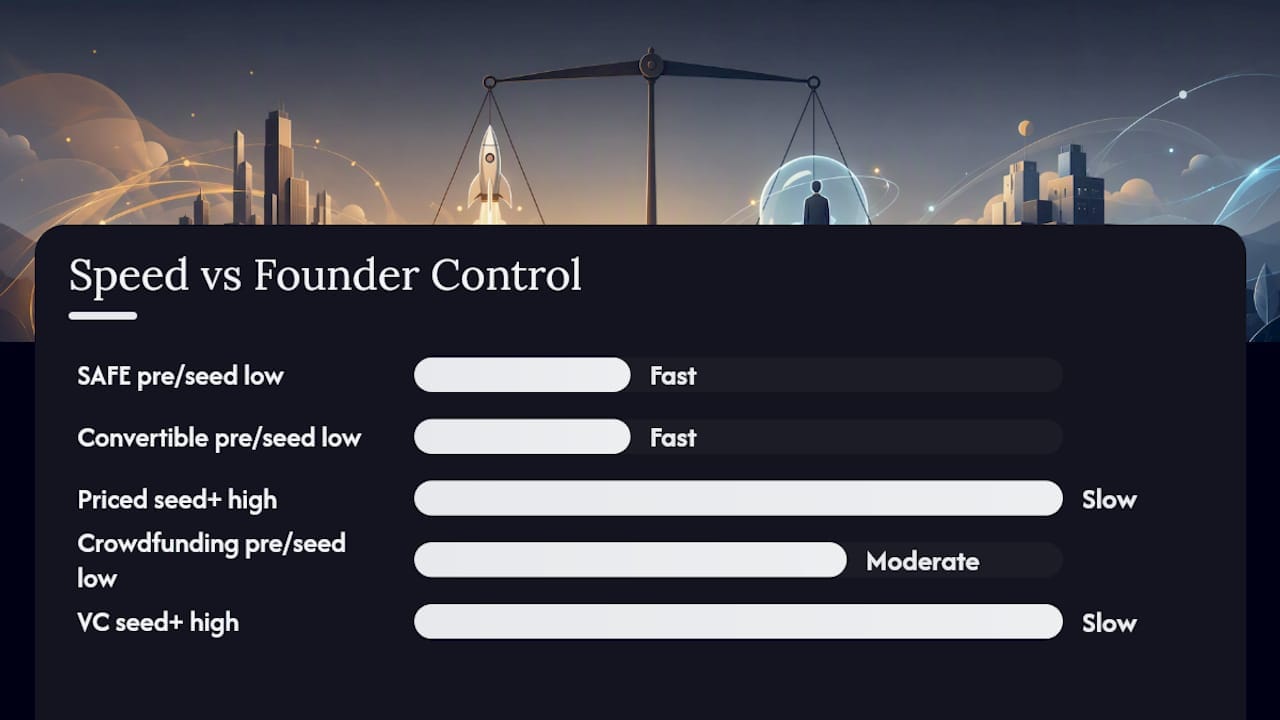
The pattern here matters more than any single row: instruments get slower and more control-intensive as check sizes grow. Before you pick one, model what each does to your ownership on paper, not just your bank balance. A founder who takes a SAFE without running the conversion math is essentially signing a blank check with a due date attached.
How Do You Calculate Equity and Dilution?
Percent ownership is your shares owned divided by total shares outstanding, and that second number changes every time you raise or grant equity. Here’s the formula founders skip until it costs them:

Ownership % = Shares Owned ÷ Total Shares Outstanding
Say you and a co-founder each hold 5,000,000 shares at incorporation, for 10,000,000 shares total. Now walk through three rounds:
- Pre-seed: You issue 1,500,000 new shares to investors and set aside 1,000,000 for an option pool. Total shares outstanding become 12,500,000. Your 5,000,000 shares now represent 40%, down from 50%, even though your share count never moved.
- Seed: You raise again, issuing 3,000,000 new shares to a new investor group at a higher valuation. Total shares outstanding hit 15,500,000. Your stake drops to roughly 32%.
- Series A: A lead investor takes a larger position, issuing 6,000,000 new shares and expanding the option pool by another 1,500,000. Total shares outstanding reach 23,000,000. Your original 5,000,000 shares now sit around 22%.
Statistic callout: Median founder-team ownership tends to fall substantially across funding rounds, dropping meaningfully from seed through Series A and again through Series B, according to industry Startups. That’s not a warning sign by itself. It’s the expected cost of raising capital in stages, and the goal is making sure each round’s dilution buys enough runway and value creation to justify it.
Convertible instruments add a wrinkle. When a SAFE or note converts, it does so at whichever is more favorable to the investor: the valuation cap or the discount rate applied to the new round’s price. A $500,000 SAFE with a $5 million cap converts at a much better rate for the investor than the same check would get at a $10 million Series A price, which means your dilution from that SAFE can be larger than it looked on the day you signed it. Modeling these conversion mechanics before signing is the single highest-leverage thing a founder can do to avoid an unpleasant surprise at the next close.
How Should You Structure Your Cap Table and Equity Classes?
A clean cap table is one where every share, option grant, and convertible instrument is accounted for, dated, and traceable to a signed document. It sounds basic. Most early cap tables aren’t clean, because founders issue shares informally, forget to paper an advisor grant, or lose track of a SAFE from two years ago. Investors run diligence on exactly this, and a messy cap table can slow or kill a term sheet before negotiation even starts.
Common vs. preferred stock is the first structural decision you’ll live with for years. Founders and early employees typically hold common stock, which carries voting rights but sits behind preferred stock in a liquidation event. Investors almost always demand preferred shares, which come with protections like liquidation preferences and sometimes board seats or veto rights over major decisions. Understanding this distinction before your first term sheet arrives puts you in a far stronger negotiating position.
Sizing your option pool is where founders most often give away more than they need to. A pool that’s too small forces an awkward mid-round top-up that dilutes existing shareholders unexpectedly. A pool that’s too large just hands away equity nobody’s using yet. As a rule of thumb, option pools sized to your actual hiring plan, typically in the 10% to 20% range depending on stage and headcount targets, tend to work better than a round number picked out of habit.
Run this checklist before you open term sheet conversations:
- Confirm every shareholder’s stake, share class, and vesting status is documented and current.
- Reconcile all outstanding SAFEs and notes against their caps and discounts.
- Size the option pool to your next 12 to 18 months of hiring, not your entire five-year plan.
- Verify your incorporation documents and bylaws match what your cap table shows.
- Get a second set of eyes, ideally legal counsel, on anything that looks inconsistent.
Pro Tip: Treat your option pool like a hiring budget, not a leftover slice of equity. Map it to specific roles you plan to fill over the next 12 to 18 months, then revisit the size only when your hiring plan actually changes.
What Are Standard Equity Compensation Practices?
Grant sizes vary widely by role, seniority, and stage, but there are patterns experienced founders use as a starting point rather than a rulebook. Early hires almost always receive a larger percentage than someone joining after a Series A, simply because they’re taking on more risk earlier.
These ranges compress fast as your company matures, because each later hire is joining a business with more proof points and less personal risk. What stays consistent across nearly every stage is the vesting structure. Standard equity compensation uses a four-year vesting schedule with a one-year cliff, meaning no shares vest until the employee hits their first anniversary, after which vesting typically continues monthly or quarterly for the remaining three years.
Vesting isn’t a formality. It protects the company from what you might call founder dilution regret, the situation where someone leaves after two months holding a fully vested chunk of equity they never earned. Applying the same structure to founders themselves, not just employees, is one of the most overlooked pieces of advice in early-stage planning, because founder equity without vesting creates exactly the same risk if a co-founder exits early.
When you communicate an offer, put the numbers in writing clearly: the number of shares or percentage granted, the strike price if it’s an option, the vesting schedule, and what happens to unvested shares if the person leaves. Vague verbal promises about “a few points of equity” create disputes later that a one-page grant letter would have prevented.
- State the exact share count or percentage, never a vague range, in the offer letter.
- Specify the vesting schedule and cliff explicitly, including start date.
- Clarify what happens to unvested and vested shares upon departure or termination.
- Include the current fully diluted share count so the candidate can calculate their real percentage.
How Do You Split Equity Among Founders and Advisors?
There is no universal correct split. Co-founder equity divisions depend on role, commitment level, and what each person brings before and after incorporation, and common early templates include 50/50, 60/40, or 40/40/20 arrangements depending on how many founders are involved and how equal their contributions actually are.
A straight 50/50 split works when two founders bring genuinely comparable skills, time commitment, and risk exposure from day one. A 60/40 split makes more sense when one founder originated the idea, put in unpaid work before the other joined, or holds the CEO role with disproportionate accountability. A 40/40/20 structure fits three-founder teams where two people are full-time operators and a third contributes part-time or in a specialized capacity, like technical architecture, without matching the day-to-day workload.
Whatever split you land on, vest it. Unvested founder equity that’s fully granted at incorporation leaves the company exposed if someone walks away in month three still holding their entire stake.
Advisor grants follow a different pattern entirely, since advisors aren’t full-time and their equity should reflect that.
Before you finalize any split, whether among founders or with advisors, run through this checklist to head off disputes before they start:
- Document roles and expected time commitment in writing, not just equity percentage.
- Attach vesting to every grant, founders included, with no exceptions.
- Define what happens if a founder or advisor becomes inactive or underperforms against agreed deliverables.
- Revisit the split formally if roles change materially, and document the amendment.
What Legal and Tax Issues Should You Check Before Issuing Equity?
Before you issue a single share or sign a term sheet, assemble a document checklist: a current cap table, founder and co-founder agreements, your equity incentive plan, board consent documents for any grant, and, in the United States, a 409A valuation to set a defensible strike price for options. Skipping the 409A is one of the most common early mistakes, because it can create tax exposure for employees exercising options at a price the IRS later disputes.
Tax treatment of equity grants varies significantly by jurisdiction, and this is an area where a global “one size fits all” answer simply doesn’t exist. A grant that triggers no immediate tax event in one country might create a taxable event on vesting, not exercise, in another. This is general information, not tax or legal advice, and you should confirm your specific obligations with a local accountant or attorney before issuing equity to anyone.
On the investor side, watch these terms closely before signing:
- Liquidation preferences, which determine who gets paid first, and how much, before common shareholders see anything in an exit.
- Anti-dilution provisions, which protect investors from future down rounds at your expense.
- Voting and board control clauses, which can shift decision-making power away from founders faster than the equity percentage alone suggests.
Equity is a finite strategic asset used to align long-term incentives, and founders who treat it as a quick substitute for cash, rather than a deliberate tool, often regret the terms they signed to get there.
If you’re raising through equity crowdfunding, the SEC’s Regulation Crowdfunding resources lay out the exemptions and disclosure requirements that apply, and they’re worth reading before you commit to that route. Engage counsel and an accountant early, not after a term sheet lands on your desk with a 30-day close deadline attached.
How Do You Build an Equity Distribution Program?
Rolling out a formal equity program isn’t a single decision, it’s a process with distinct steps, each with its own timeline and decision point.
- Design the framework (1 to 2 weeks). Decide your option pool size, standard grant ranges by role, and vesting terms before you hire anyone new.
- Get board and legal approval (1 to 3 weeks). Your equity incentive plan needs formal board consent and legal review, especially the 409A valuation underpinning strike prices.
- Set up administration (1 week). Choose a cap table or equity administration platform to track grants, vesting, and exercises without relying on a spreadsheet that goes stale.
- Communicate the plan internally (ongoing). Make sure hiring managers understand the standard ranges so offers stay consistent across the company.
- Issue grants and document everything (per hire). Every grant needs a signed agreement, a board consent record, and an update to the cap table the same week it’s issued.
- Review and refresh annually. Revisit pool sizing and grant ranges once a year, or when a funding round changes your valuation significantly.
The key decision point in this sequence is step one: whether you’re granting stock options through a formal pool or issuing restricted stock directly. Options work better for most early hires because they defer the tax event and keep administration simpler. Restricted stock can make sense for very early founders or co-founders before a 409A even exists. Whichever path you choose, a governance control worth building in from day one is a hard cap on how much of the pool can be granted without board sign-off, which prevents equity creep from a single enthusiastic hiring manager.
How Does Equity Structure Affect Exit Outcomes?
Liquidation preferences determine who gets paid first in an exit, and how much, before anyone else sees a dollar. A standard 1x non-participating preference means preferred shareholders get their investment back first, then everyone splits the remainder based on ownership percentage. A 1x participating preference, which is more investor-friendly, lets them take their investment back and then still participate in the remaining proceeds alongside common shareholders. That structural difference can swing founder payouts substantially in a modest exit.
Consider two scenarios with the same $20 million exit. They still take their $5 million first, but then participate again in the remaining $15 million alongside common shareholders, shrinking what founders actually walk away with. The headline valuation is identical in both cases. The founder outcome is not.
Strategic dilution can be positive when it funds growth that meaningfully increases company value, but the deal terms attached to that capital, not just the check size, determine how much of that increased value founders actually keep.
When you negotiate future rounds, prioritize a few things above headline valuation: push for non-participating preferences over participating ones, resist stacking multiple liquidation preferences that compound in later rounds, and keep anti-dilution provisions narrow so a future down round doesn’t disproportionately punish your ownership. These terms rarely make headlines the way valuation does, but they’re what actually decide your take-home number the day the company sells.
What Should You Prepare Before You Start Raising?
A fundraising-ready founder walks into investor meetings with a pitch deck, a financial model showing at least 18 months forward, a current cap table, and a data room stocked with incorporation documents, IP assignments, and customer contracts. Missing any of these doesn’t just slow diligence, it signals disorganization to investors evaluating dozens of deals a month.
Valuation at the early stage is more negotiation than science. Rather than anchoring to a specific number pulled from a comparable company, frame your ask around runway and milestones: “We’re raising $1.5 million to reach 18 months of runway and hit $50,000 in monthly recurring revenue” gives investors something concrete to evaluate, rather than an abstract valuation claim they’ll discount anyway.
Timelines and costs vary by instrument and region, but a realistic seed raise typically takes two to four months from first pitch to close, and legal fees for a straightforward SAFE round commonly run into the low thousands of dollars, while a full priced round with negotiated terms costs meaningfully more in legal and accounting fees. Budget for both time and cash before you start, because running out of either mid-raise puts you in a weaker negotiating position.
Statistic callout: Non-dilutive alternatives, including government grants and instruments like SBA loans, can extend runway without triggering any of the dilution math above, and they’re worth exhausting before you default to equity for every capital need.
Run this self-check before your first outreach email:
- Pitch deck covers problem, solution, traction, team, market size, and the ask, in 10 to 15 slides.
- Financial model projects at least 18 months with clear assumptions stated.
- Cap table is current and reconciled against every signed agreement.
- Data room includes incorporation documents, IP assignments, and key contracts.
- You’ve identified 20 to 30 realistic investor targets that match your stage and sector, not a generic list of 200 names.
Worked Modeling Scenarios: What Happens to Your Stake?
Two founders raising the same headline number can end up with very different outcomes depending on option pool sizing and instrument choice, and running the math ahead of time is the difference between a negotiation and a surprise.

Scenario one: a lean seed raise. A two-founder team owns 10,000,000 shares evenly split. They raise $1 million on a SAFE with a $6 million cap and expand the option pool by 1,000,000 shares ahead of the round.
Scenario two: a larger seed raise with pool expansion. The same founders instead raise $2.5 million on a SAFE with the same $6 million cap, and expand the pool to 1,800,000 shares to support faster hiring.
Neither outcome is wrong. The second team is trading more ownership for more capital and a bigger hiring runway, which can be the right call if it accelerates product development or go-to-market meaningfully. The point of running both models before you sign anything is making that tradeoff a deliberate choice rather than something you discover after the fact.
Pro Tip: When modeling a SAFE conversion, always run it against at least two future valuation scenarios, one conservative and one optimistic. If the dilution difference between those two scenarios feels uncomfortable even in the optimistic case, renegotiate the cap before you sign, not after.
To build your own version of these models, start with a simple spreadsheet: list current shares outstanding, add rows for each planned raise or pool expansion, and calculate post-money ownership percentage after each event. Change only one variable at a time, either the raise amount or the pool size, so you can see clearly which lever moves your ownership the most.
What Founders Consistently Get Wrong About Equity
The mistake I see most often isn’t greed, it’s a failure to model consequences before signing. Founders over-grant equity to an early hire because it feels generous and cheap in the moment, then discover eighteen months later that the option pool is exhausted right when they need to hire a VP of Sales. The fix isn’t stinginess. It’s sequencing: size grants against an actual hiring plan, not a gut feeling about what sounds fair.
The second mistake is ignoring conversion mechanics until they matter. A founder signs three SAFEs across a year, each with a different cap, without ever running the combined dilution math. By the time the priced round arrives, they’re stunned to learn the SAFEs alone account for a third of the cap table. This is exactly the mistake mastering valuation caps and discounts before signing prevents, and it’s one of the most fixable errors on this entire list.
The third is poor documentation, plain and simple. Verbal promises to advisors, handshake agreements between co-founders, equity percentages that live in someone’s memory instead of a signed cap table. These gaps don’t surface until there’s money on the table, and by then the dispute is expensive and often damages the relationship permanently.
At Nomad Excel, the bootcamp curriculum runs founders through hands-on cap-table workouts specifically because reading about dilution and actually building your own model are two different skills. One founder I’d point to, without naming the company, came into a session having already issued equity informally to three advisors with no vesting attached. Working through the math live, walking through what happens if two of those advisors go inactive within a year, was enough to prompt a full renegotiation before any real damage was done. The coaching step wasn’t complicated. It was simply forcing the model to exist on paper before a bigger mistake compounded it.
None of this makes equity dangerous. It makes equity a tool that rewards founders who treat it with the same rigor they’d apply to any other major financial decision, and punishes those who don’t.
How Nomad Excel Helps You Get Investor-Ready
Reading about cap tables is not the same as building one under pressure with real numbers and a deadline. Nomad Excel’s entrepreneurship bootcamp puts founders through exactly that kind of hands-on cap-table workout, alongside mentorship from operators who’ve actually negotiated term sheets and structured founder splits before.
The programs are built for founders at the stage where the frameworks in this guide stop being theory and start being decisions you have to make this quarter. You’ll leave with a cleaned-up cap table model, a sharper investor-ready narrative, and direct 1:1 coaching time to stress-test your specific dilution scenarios before you’re sitting across from a term sheet. If you’re weighing whether structured coaching fits your stage, the guide to what these bootcamps deliver walks through outcomes in more detail. The next step is straightforward: book a discovery call and bring your current cap table, real numbers make the coaching session immediately useful.
Where to Learn More
Founders navigating equity funding for the first time benefit from going directly to primary sources rather than secondhand summaries, especially where legal and tax rules apply.
- The SEC’s Regulation Crowdfunding page covers the exemptions and disclosure rules governing equity crowdfunding in the United States.
- Carta’s founder fundraising guide breaks down instrument types and cap-table mechanics in more technical depth.
- J.P. Morgan’s dilution management resource walks through non-dilutive alternatives and conversion protection strategies.
- SVB’s equity management guide addresses strategic equity use and option pool sizing.
- The UK government’s venture capital access initiative shows how policy shifts can expand regional funding access outside major hubs.
Tax and legal rules around equity issuance vary by country and even by state or region within a country, so treat every figure and threshold here as a starting point for a conversation with your own accountant or attorney, not a final answer.
Frequently Asked Questions
What is the difference between equity financing and debt financing for a startup?
Equity financing sells ownership shares in exchange for capital with no repayment obligation, while debt requires repayment with interest and generally demands revenue or collateral most pre-revenue startups don’t have.
How much equity should a founder give away in a seed round?
What happens to a SAFE if the company never raises a priced round?
Terms vary by the specific SAFE agreement, but many include provisions for conversion at a later liquidity event, like an acquisition, or repayment terms if neither a priced round nor an exit occurs before the contract’s specified conditions are met.
Should advisors receive equity or cash for their contribution?
Do founders need vesting on their own equity, or just employees?
Founders benefit from vesting just as much as employees do. It protects the company and remaining co-founders if someone exits early while still holding a large unvested stake.
This article is general information, not a substitute for advice from a qualified financial advisor. Consult a qualified financial professional about your own circumstances before acting on anything here.
Sources
- Startup Funding: A Founder’s Guide to Raising Startup Capital
- Startup Equity Dilution: Protection & Management Strategies
- Managing startup equity: Answers to key questions
- Startups
Comments are closed.