Team Building Needs More Than Fun: Evidence and Activities That Work
Team building is a structured activity or program designed to strengthen trust, communication, and collaboration among coworkers. The single most important focus for any session is psychological safety paired with one clear, measurable objective. Before planning icebreakers or picking a venue, we recommend choosing that objective first: better communication during handoffs, faster conflict resolution, or clearer role boundaries.
TL;DR:
- Match the activity to the team’s stage: new groups need role and purpose clarity, teams in conflict need norms, and established teams benefit from reflection.
- A meta analysis of 51 articles found moderate positive effects on teamwork and performance, but task skill gaps still require training.
- Use a 10–15 minute opener, 30–45 minutes for activity, and 15–20 minutes to debrief; protect reflection time even if an exercise runs short.
- Rate safety, dependability, and clarity on a 1–5 scale before the session and again one to two weeks later to guide the response.
- Schedule team development quarterly and reinforce each session with recurring rituals, because trust and psychological safety grow through consistent norms and leader modeling.
Table of Contents
- What team building is and how it differs from training or recreation
- The frameworks that should shape every session
- What the research actually shows about effectiveness
- Activities mapped to what you’re actually trying to fix
- How to plan and run a session that actually lands
- Measuring whether it actually worked
- How we apply these principles at Nomad Excel
- Making team building part of how your culture actually works
- A few rules of thumb from running these sessions
- Tailored retreats and bootcamps built around your team’s real goals
- FAQ
- Sources
What team building is and how it differs from training or recreation
Team building aims to improve how people work together: trust, communication patterns, shared understanding of goals, and the interpersonal glue that holds a group together under pressure. It is not the same as team training, which teaches specific skills like how to run a sprint retrospective or use a new software. It is also distinct from team recreation, which is simply a fun outing with no stated performance objective.
Confusing the three is one of the most common planning mistakes we see. A company books a day of go-kart racing, calls it team building, and wonders why collaboration hasn’t improved three weeks later. Recreation has value for morale, but it rarely targets the specific friction points slowing a team down.
The distinctions matter for planning:
- Team building targets relationships, trust, and collaboration patterns through structured activities with debriefs.
- Team training builds a specific skill or competency, often with an instructor and measurable learning outcomes.
- Team recreation boosts morale and gives people a shared positive experience, with no built-in reflection or objective.
Choose team building when the problem is relational: siloed communication, low trust after a reorg, or unclear roles following rapid growth, as explained in this startup guide to building trust through website design. Add training when the gap is a hard skill, like facilitation technique or a new workflow. Many of the strongest interventions combine both: a team-building exercise followed by a short, structured debrief functions almost like a mini training session, reinforcing what was learned through guided reflection rather than leaving it to chance.
The frameworks that should shape every session
Good team building isn’t improvisation. It rests on a handful of frameworks that tell you which intervention fits which moment in a team’s life, and which dynamics actually predict performance.
Bruce Tuckman’s stages of group development (forming, storming, norming, performing, and adjourning) are still the most practical lens for timing an intervention. A newly formed team needs clarity on purpose and roles far more than trust exercises. A team stuck in storming benefits from structured conflict resolution and explicit norm setting. A team that has reached performing mode gets more value from reflection and role fine-tuning than from another icebreaker. Treating every team the same regardless of its stage is a common reason sessions fall flat.
Classical team-building research points to four components worth targeting, usually one or two at a time rather than all four in a single afternoon:
- Goal setting: aligning the team on what success looks like and how it’s measured.
- Role clarification: making explicit who owns what, where handoffs happen, and who decides.
- Interpersonal relations: building trust and reducing friction between individuals.
- Problem solving: practicing how the group makes decisions and resolves disagreement together.
Google’s Project Aristotle research adds a critical layer. After studying team dynamics across hundreds of groups, researchers identified five dynamics that separate effective teams from the rest: psychological safety, dependability, structure and clarity, meaning, and impact. Psychological safety topped the list as the single strongest predictor of team effectiveness. How a team interacts, it turns out, matters more than who happens to be on it.
One practical rule follows from all of this: pick one or two components to target per session, tied to your team’s current Tuckman stage, rather than trying to touch trust, roles, goals, and problem solving in a single two-hour block. Depth beats breadth here.
What the research actually shows about effectiveness
Meta-analysis included 51 articles, 72 interventions, 194 effect sizes, and 8,439 participants; generally positive medium-sized effects for teamwork and performance.
A systematic review and meta-analysis of controlled interventions examined decades of teamwork training research and found consistent, medium-sized positive effects across teamwork behaviors and team performance outcomes, spanning industries from healthcare to aviation to corporate settings. That is a meaningfully different claim than “team building works,” because it tells us the size of the effect and the breadth of evidence behind it.
Teamwork interventions reliably move the needle on trust, cohesion, and communication. These are the outcomes closest to what a well-designed session actually practices: people learning to rely on each other, read each other’s signals, and resolve friction without it turning personal. A high-performing teams evidence review reinforces this, finding that teambuilding produces moderate positive effects on performance and notably stronger effects on cohesion and trust, with bigger gains when sessions are run by external facilitators, include a clear rationale for why the team needs the work, and are combined with other interventions rather than run as standalone events.
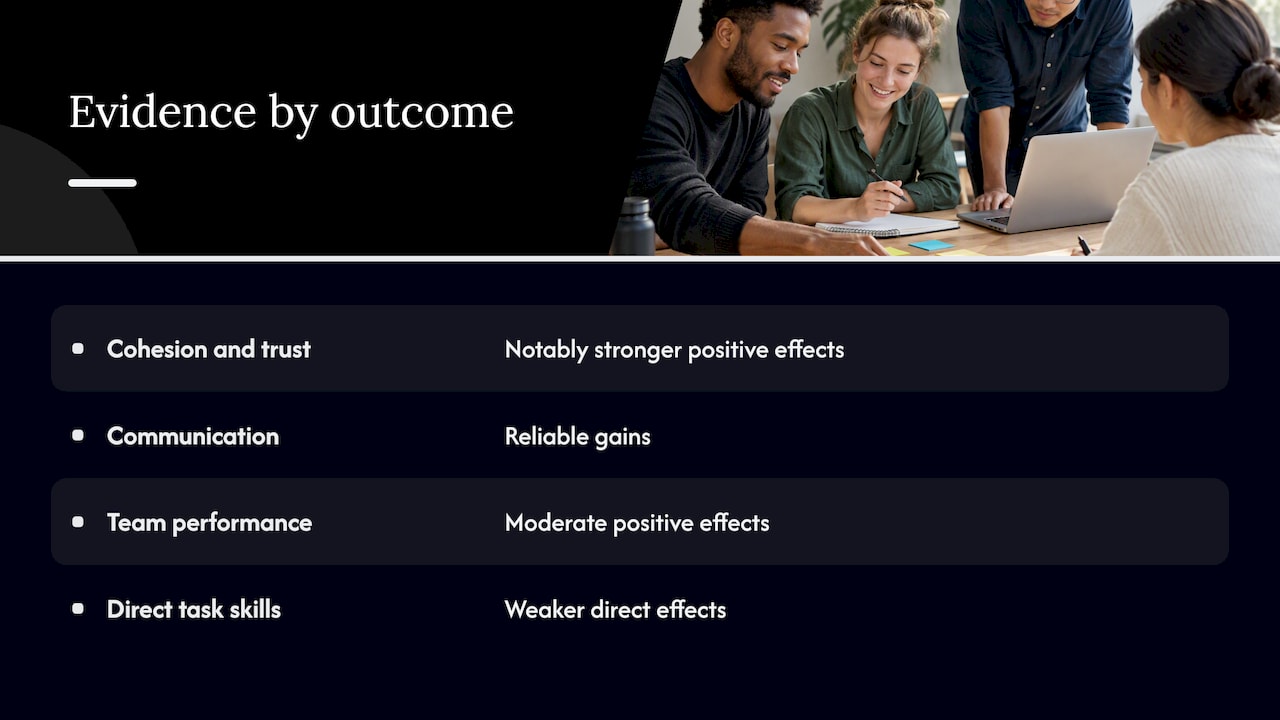
Where team building alone is weaker is direct task-skill improvement. If your team’s core problem is that nobody knows how to run a proper sprint retrospective or use a shared project tool, no amount of trust-building exercises will fix that gap. That calls for training.
The practical takeaway: when performance is the primary goal, pair team building with task-focused training or, at minimum, a structured debrief. The same evidence review notes that guided debriefing yields moderate-to-large positive effects on performance and is a high-impact, low-cost tool that gets overlooked in favor of flashier offsite activities. A thirty-minute structured debrief after a project milestone can do more for performance than another half-day retreat.
Activities mapped to what you’re actually trying to fix
Pick your objective first, then choose the activity, not the other way around. An icebreaker will not repair broken trust, and a trust fall will not clarify who owns the Q3 roadmap.
For icebreakers (forming stage, new teams, low time investment):
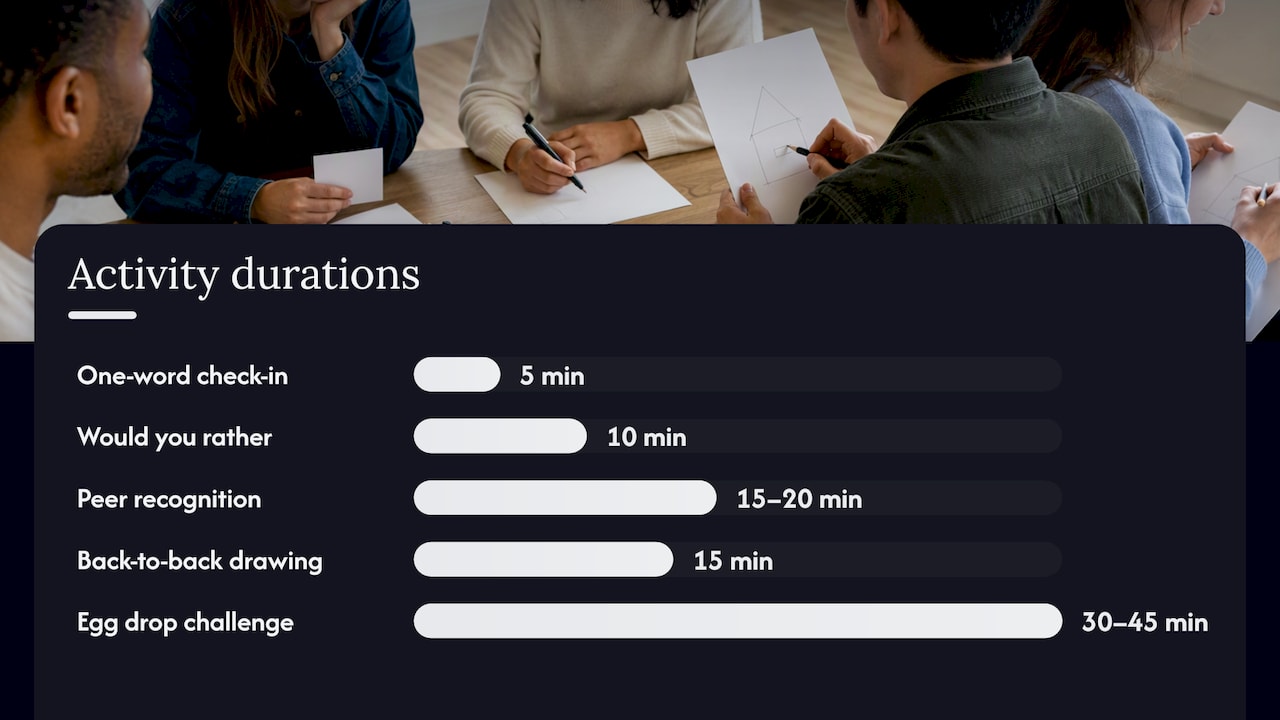
- Two truths and a lie: 10–15 minutes, any group size, no materials, builds basic familiarity.
- Would you rather, team edition: 10 minutes, works for groups of 5-20, surfaces personality differences in a low-stakes way.
- One-word check-in: 5 minutes at the start of any meeting, scales to any size, builds a habit of voicing state of mind.
For trust building (storming stage or post-conflict teams):
- Peer recognition rounds: 15–20 minutes, groups of 6-12, each person names one thing a teammate did well recently, strengthens appreciation habits.
- Vulnerability-based sharing (a lighter version of “share a professional failure”): 20–30 minutes, small groups work best, requires a facilitator to model openness first.
- Back-to-back drawing: pairs describe a shape without seeing it drawn, 15 minutes, highlights how communication breaks down under ambiguity.
For problem solving (any stage, useful for decision-making practice):
- Egg drop or tower-building challenges: 30–45 minutes, groups of 4-6, basic materials (straws, tape, an egg or similar), practices collaborative design under constraints.
- Desert island scenario: 20 minutes, any group size, no materials, forces prioritization and negotiation.
For role clarity (growing teams, post-reorg):
- A RACI mapping exercise, where the team jointly fills out who is Responsible, Accountable, Consulted, and Informed for current projects, takes 30-45 minutes and directly resolves the ambiguity that causes most handoff friction.
- A “stop doing” roundtable, where each person names one task they believe belongs to someone else, surfaces overlap and gaps in under 20 minutes.
Remote and hybrid teams need adapted versions of most of these. Virtual two truths and a lie works fine over video. Trust exercises translate well to structured breakout rooms with explicit prompts rather than open-ended chat, since silence reads differently on a screen than in a room. Problem-solving challenges can run through shared documents or virtual whiteboards instead of physical materials. For a full set of remote-specific scripts and timing, our guide to remote team building activities covers variations we haven’t listed here.
Low-cost options matter too. None of the exercises above require a venue, a facilitator fee, or travel. A one-word check-in costs nothing and takes five minutes. The constraint is rarely budget. It’s whether someone takes the time to match the activity to the actual problem and debrief it properly afterward. For a longer catalog of ready-to-run ideas, see our list of 50 team building activities.
How to plan and run a session that actually lands
A session succeeds or fails based on preparation, not improvisation. Here’s a compact process that works for a single 60-90 minute block or scales up to a full-day offsite.
- Clarify the objective first. Name the specific problem (unclear roles, low trust after a reorg, poor cross-functional communication) before choosing any activity.
- Identify stakeholders and accessibility needs. Confirm who must attend, who is remote, and whether any activity needs adjustment for physical or sensory accommodations.
- Build the agenda around a 10-15 minute opener, 30-45 minutes of activity, and a 15-20 minute debrief. The UC Berkeley team-building toolkit recommends this structure: open with context and safety, run one or two activities tied to the objective, then debrief with three focused reflection questions before closing with concrete action items.
- Script your transitions. A simple line like “Let’s take two minutes of silence to think before we share” prevents the loudest voice from dominating.
- Close with a debrief, not just a wrap-up. Ask what worked, what felt uncomfortable, and what the team wants to do differently. Capture one or two action items in writing before people leave.
Pro Tip: Never skip the debrief to save time. A rushed closing turns a potentially useful exercise into a forgettable one.
Post-session, send a short follow-up within 48 hours restating the agreed action items and a date to check progress. Momentum fades fast without that written anchor. For more on running the live portion well, our guide on facilitating team workshops walks through common facilitation pitfalls in more depth.
Measuring whether it actually worked
Vague enthusiasm after a session (“that was fun”) tells you nothing about whether trust or communication actually improved. A few lightweight metrics, measured before and after, give you a real signal.
- Psychological safety pulse: a short survey item capturing whether people feel safe raising concerns or mistakes.
- Dependability: whether teammates believe others will follow through on commitments.
- Clarity: whether people understand their own role and how it connects to the team’s goals.
Google’s Project Aristotle dynamics offer a ready-made basis for these pulse items: rate psychological safety, dependability, structure and clarity, meaning, and impact on a 1-5 scale before the session and again one to two weeks after.
A flat or declining score on any item points to a specific follow-up: a dependability dip calls for clearer commitment tracking, while a clarity dip calls for another round of role mapping rather than another trust exercise.
How we apply these principles at Nomad Excel
In both our entrepreneurship bootcamps and our custom company retreats, we build every agenda around a stated objective rather than a loose collection of fun activities. Facilitation runs through structured workshops, not improvised games, and we close each phase with the kind of guided debrief the research above points to as a high-impact, low-cost addition. For company retreats, we handle agenda and logistics so teams can focus on relationship and alignment work rather than the planning overhead, with follow-up built in to maintain momentum after the group heads home.
Making team building part of how your culture actually works
A single offsite, no matter how well run, does not create lasting change on its own. The re:Work guidance from Google notes that psychological safety grows through consistent norms and leader modeling over time, not through one session. That means the real work starts after the retreat ends.
Build small, repeatable rituals that echo what the session practiced: a weekly one-word check-in, a recurring “stop doing” roundtable each quarter, or a standing five-minute debrief after major project milestones. These cost almost nothing and keep the muscle active between bigger interventions.
Leaders set the tone here more than any activity does. If a manager models admitting mistakes openly and following through on commitments, that behavior spreads faster than any trust exercise could instill it. Schedule a recurring check-in on team health metrics, quarterly at minimum, and treat team building as an ongoing practice rather than a once-a-year event tucked into a retreat calendar. Teams that treat it this way see the gains compound instead of fading within a month, which is the most common failure mode we encounter.
A few rules of thumb from running these sessions
Patterns repeat across retreats and bootcamps. A handful of rules consistently separate sessions that stick from ones that get forgotten by Friday.
- Never run an activity you haven’t personally tested or at least walked through in your head step by step. Vague instructions kill momentum fast.
- Hire an external facilitator when the team has unresolved conflict or when a leader is too close to the problem to run an honest debrief. Internal facilitation works fine for routine check-ins and lower-stakes sessions.
- Schedule team development quarterly, not annually. A single offsite gives you a spike in energy that fades within weeks without reinforcement.
- Always protect the debrief time, even if it means cutting an activity short. The reflection is where the actual learning happens, not the exercise itself.
- Match the activity to the team’s real stage, not to what looked fun on a list. A newly merged team needs role clarity far more than a ropes course.
— Amichai
Tailored retreats and bootcamps built around your team’s real goals
We design every retreat and bootcamp around a specific, measurable objective rather than a generic day of activities, combining structured facilitation with the kind of follow-up that keeps the gains from fading. Our tailored business retreats and offsite bootcamps bring teams into inspiring destinations for immersive workshops focused on alignment, leadership, and the relationship work that quick virtual sessions can’t fully replicate. If your team needs a turnkey option rather than a DIY agenda, visit our inspiring business retreats for remote teams page to see what a custom program could look like, or reach out through our main site to request a sample agenda for your group.
FAQ
What is the main goal of team building?
The main goal is strengthening trust, communication, and collaboration so a group works more effectively together, not simply having a fun shared experience. Research shows teamwork interventions produce medium-sized positive effects on both teamwork behaviors and performance when they target a specific need.
How often should teams do team-building activities?
Quarterly check-ins paired with small, repeatable weekly or monthly rituals tend to work better than a single annual event. Psychological safety and trust build gradually through consistent norms and leader modeling, not through one isolated session.
Does team building actually improve performance?
It reliably improves trust, cohesion, and communication, and a large meta-analysis of 51 studies found generally positive, medium-sized effects on both teamwork and performance outcomes. For direct performance gains, pairing it with task-focused training or a structured debrief strengthens the effect further.
What makes a team-building session effective rather than just fun?
An effective session targets one clear objective, such as role clarity or trust, and includes a structured debrief rather than ending right after the activity. Google’s Project Aristotle research found psychological safety to be the strongest predictor of team effectiveness, which is why sessions built around safety and reflection outperform purely recreational outings.
Should we hire an outside facilitator or run team building ourselves?
An outside facilitator is worth considering when a team has unresolved conflict or when internal leaders are too close to the issue to run an honest, neutral debrief. Evidence reviews note that teambuilding effects are often larger when sessions are facilitated externally and include a clear rationale for the work.
Sources
- Team dynamics: The five keys to building effective teams – Think with Google
- The Effectiveness of Teamwork Training on Teamwork Behaviors and Team Performance: A Systematic Review and Meta-Analysis of Controlled Interventions
- High-performing teams: An evidence review: Scientific summary
- Steps to Building an Effective Team | People & Culture – UC Berkeley