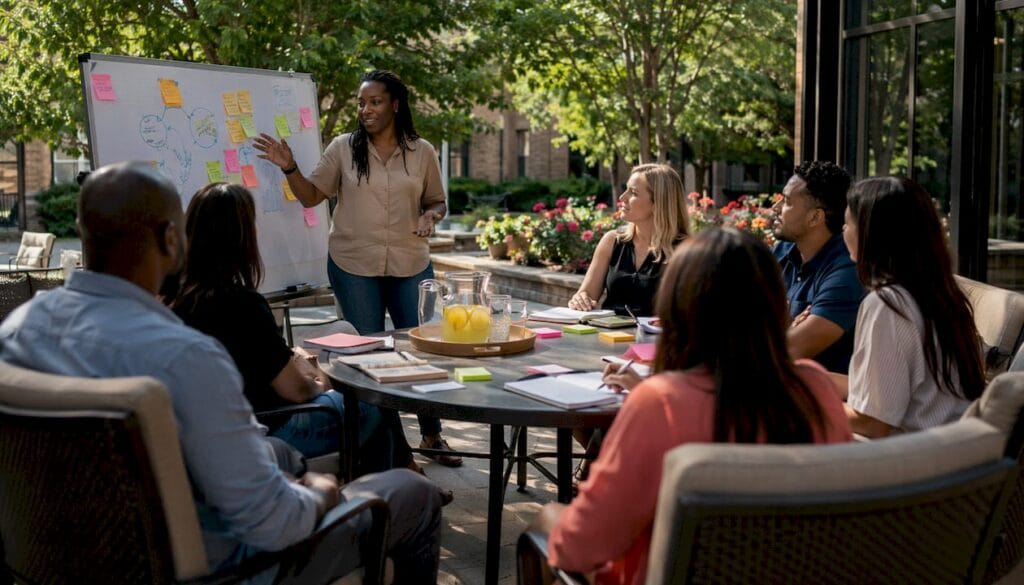
How to Facilitate Team Workshops That Get Results
TL;DR:
- Effective facilitation guides groups through collaborative activities to produce clear, actionable outcomes. Preparation with specific objectives, balanced participation, structured techniques, and disciplined follow-up within 72 hours ensures workshop success. Using time buffers, managing dynamics, and consistent post-work follow-up builds lasting team change.
Effective facilitation of team workshops is the structured process of guiding groups through collaborative activities to achieve clear, actionable outcomes. The facilitator’s job is to manage the process, not dictate the content. That distinction separates workshops that produce real decisions from those that produce only conversation. Whether you are leading a quarterly planning session or a cross-functional problem-solving sprint, knowing how to facilitate team workshops well is the skill that determines whether your team leaves aligned and energized or confused and disengaged.
How to facilitate team workshops: essential preparation steps
Preparation is where most workshops are won or lost. A poorly planned session wastes everyone’s time, regardless of how skilled the facilitator is on the day.

Start by writing down your objectives in specific, measurable terms. “Align on Q3 priorities” is not an objective. “Identify the top three product features to ship before September and assign an owner to each” is. Clear objectives shape every other decision, from who you invite to how long you run each activity.
Selecting participants matters as much as the agenda. The right mix includes decision-makers, contributors who will do the work, and people directly affected by the outcomes. Avoid over-inviting. A group of 8–12 people produces richer discussion than a room of 25 who never fully engage.
Build your agenda with structure and breathing room. Plan for a break every 75–90 minutes during longer workshops, and add a 10–15% time buffer to each agenda block. That buffer absorbs the inevitable tangents without blowing up your schedule.
- Write specific, outcome-focused objectives before anything else
- Invite decision-makers, contributors, and affected stakeholders
- Design the agenda with timed blocks and built-in buffers
- Send invitations at least 3 weeks early to allow participants to prepare
- Assign pre-work so participants arrive informed, not cold
Pro Tip: Send a one-page pre-read or a short set of framing questions with your invitation. Participants who arrive having already thought about the topic engage at a much deeper level from the first minute.
Early invitations also create space for pre-work. Asking participants to reflect on a question or review a document before the session compresses the time you spend on background and expands the time available for real work. This is one of the most underused best practices for team workshops.
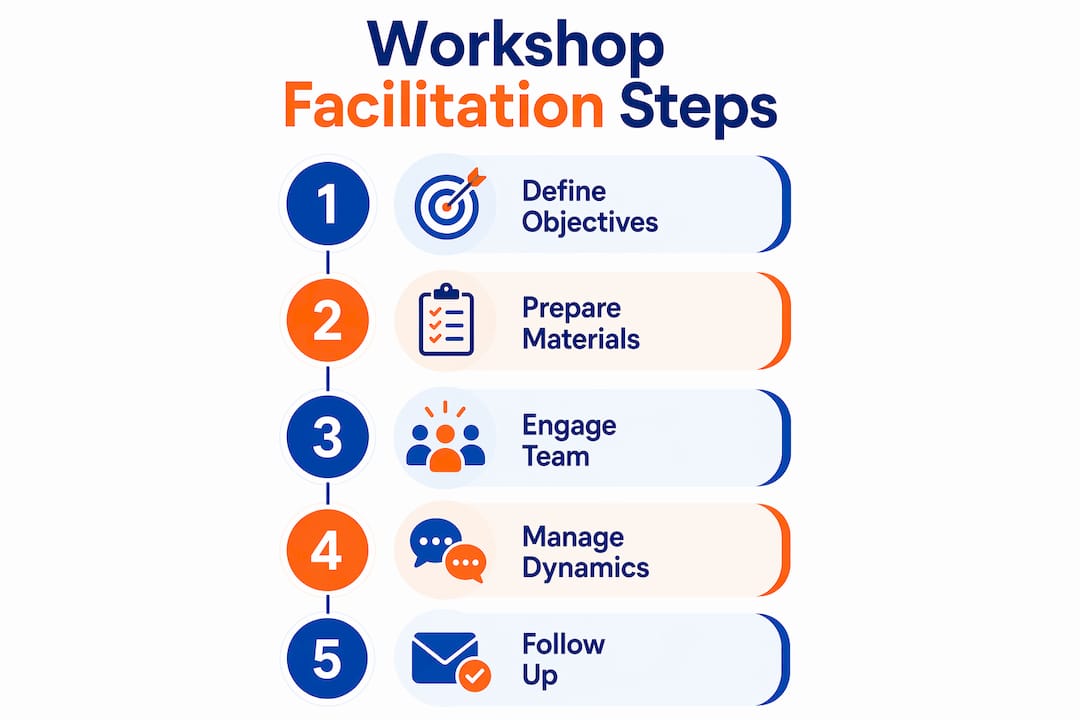
What facilitation techniques actually engage diverse teams?
The facilitator’s role is to hold the process steady, not to be the smartest person in the room. Structured techniques like Brainwriting and 1-2-4-All prevent dominant voices from controlling the conversation. They create space for quieter participants to contribute ideas before the group dynamic can suppress them.
Here are four facilitation techniques for groups that consistently produce balanced, high-quality input:
- Round-robin brainstorming. Each participant shares one idea in turn, with no interruptions. This simple structure prevents the loudest voice from filling the room and surfaces ideas that would otherwise stay silent.
- Brainwriting. Participants write their ideas independently on paper or a shared digital board before any discussion begins. Research shows this method generates more diverse ideas than open verbal brainstorming.
- 1-2-4-All. Participants reflect alone for one minute, then discuss in pairs, then in groups of four, then share with the whole room. This technique builds psychological safety at each step before ideas reach the full group.
- Structured check-ins. Opening with a brief, emotionally attuned question primes the group for honest dialogue. A well-designed check-in equalizes participation and surfaces the team’s emotional reality before deeper work begins.
Digital tools like Miro and Slido extend these techniques into hybrid or remote settings. Miro’s virtual whiteboard supports Brainwriting and affinity mapping at scale. Slido enables anonymous polling and live Q&A, which reduces the social pressure that silences quieter team members.
Pro Tip: Use anonymous digital input for sensitive topics. When participants know their idea cannot be traced back to them, they share more honestly. That honesty is exactly what a workshop needs to produce real solutions.
The facilitator’s job during these activities is to observe, prompt, and protect the process. If one participant starts dominating, redirect with a phrase like, “Let’s hear from someone who hasn’t spoken yet.” That single sentence changes the room’s dynamic without creating conflict.
How do you manage difficult workshop dynamics?
Even well-planned workshops hit friction. A dominant participant, a derailing side conversation, or a sudden drop in energy can undermine an otherwise strong session. Effective facilitation includes managing time, naming patterns, and prompting quiet voices. Think of the facilitator as a small-scale project manager for the group’s attention.
These techniques keep sessions on track:
- Use a visible timer. Display the remaining time for each activity on a shared screen. Participants self-regulate more when they can see the clock. This reduces the need for the facilitator to interrupt the flow.
- Name the pattern, not the person. If the group keeps circling back to the same unresolved issue, say “I notice we keep returning to this point. Let’s park it on the issues list and come back after we finish this section.” This acknowledges the concern without letting it derail the agenda.
- Protect quiet voices actively. After a dominant participant speaks, turn directly to someone who has been silent. Ask a specific question rather than a general one. “What’s your read on this, Marcus?” works better than “Does anyone else have thoughts?”
- Schedule breaks strategically. Fatigue kills creative thinking. A 10-minute break after 75–90 minutes of focused work restores attention and often produces the informal conversations that unlock stuck discussions.
- Defuse conflict with facts and shared goals. When two participants clash, redirect both toward the workshop’s stated objective. “We both want the same outcome here. Let’s look at what the data tells us.” This grounds the conversation and reduces the emotional temperature.
Energy management is an underrated facilitation skill. Varying the format every 20–30 minutes, alternating between individual reflection, small group work, and full group discussion, keeps participants mentally present throughout a long session.
What should happen after a team workshop ends?
The workshop itself is only half the work. Workshop impact declines significantly if follow-up actions are not distributed within 72 hours. That 72-hour window is when decisions are still fresh and momentum is highest.
A structured action plan with clear owners and deadlines formed during the workshop itself increases the likelihood that commitments translate into real-world change. Build the action plan in the room, not afterward. Before the session closes, confirm who owns each decision, what the next step is, and when it is due.
Accountability does not end with the summary email. Schedule check-ins at 30 and 90 days to review progress. Pulse surveys at 30 to 90 days post-workshop show significant increases in engagement and sustained behavioral shifts. That data point matters because it proves follow-up is not administrative overhead. It is the mechanism that converts workshop energy into lasting change.
For post-workshop surveys, limit feedback questions to 5–8 items for high completion rates. A shorter survey gets answered. A longer one gets ignored. You can find practical guidance on designing effective feedback surveys that participants actually complete.
| Follow-up action | Timing | Purpose |
|---|---|---|
| Distribute workshop summary | Within 72 hours | Capture decisions while momentum is high |
| Send feedback survey (5–8 questions) | Within 72 hours | Measure participant experience and identify gaps |
| First accountability check-in | 30 days post-workshop | Review progress on action items and remove blockers |
| Second accountability check-in | 90 days post-workshop | Measure behavioral shifts and sustained impact |
Use the business accountability workflow framework to structure your follow-up cadence. Pairing clear documentation with scheduled check-ins is the difference between a workshop that changes behavior and one that fades from memory by the following Monday.
Key Takeaways
Effective team workshop facilitation requires clear objectives, structured participation techniques, active dynamics management, and disciplined follow-up within 72 hours to produce lasting results.
| Point | Details |
|---|---|
| Define specific objectives | Write measurable outcomes before designing the agenda or selecting participants. |
| Use structured participation methods | Techniques like Brainwriting and 1-2-4-All prevent dominant voices and surface better ideas. |
| Build in time buffers and breaks | Add a 10–15% buffer per agenda block and schedule breaks every 75–90 minutes. |
| Distribute follow-up within 72 hours | Send the summary and action plan while decisions are still fresh and momentum is high. |
| Schedule accountability check-ins | Review progress at 30 and 90 days to convert workshop commitments into real change. |
What I’ve learned from facilitating workshops that actually stick
The single most underestimated moment in any workshop is the opening check-in. Most facilitators skip it or rush through it to get to the “real work.” That is a mistake. When you open with a question that asks participants to share something honest, even something as simple as “What’s one word that describes where your head is right now?”, you change the group’s dynamic before the first agenda item begins. People stop performing and start participating. That shift is worth five minutes of any agenda.
The second thing I’ve learned is that the facilitator’s job is to resist the pull toward content. Every facilitator has opinions. Every team leader has a preferred outcome. The moment you start steering the group toward your answer, you lose the room’s trust and the workshop’s value. Your job is to protect the process. Let the group’s thinking lead.
I’ve also seen too many workshops die in the parking lot. The energy in the room is real. The commitments feel genuine. Then the summary email never arrives, the action items drift, and three months later no one can remember what was decided. Skipping follow-up does not just waste the workshop. It trains your team to stop taking workshops seriously. The innovation workshop framework I recommend always includes a built-in follow-up structure, because the session itself is only the beginning.
Build a toolbox of adaptable activities. No single technique works for every group or every topic. The facilitators who consistently produce results are the ones who can read the room and swap one method for another mid-session without losing the thread. That flexibility comes from practice, not from reading about facilitation.
— Amichai
How Nomadexcel supports teams who want to facilitate better
Team leaders who want to sharpen their facilitation skills and run workshops that produce real results will find Nomadexcel’s programs directly relevant. Nomadexcel designs and runs custom company retreats that combine structured workshop facilitation with team alignment, strategic planning, and hands-on execution. Each program is built around the same principles covered in this article: clear objectives, structured participation, and disciplined follow-up. For teams that want to go further, Nomadexcel’s entrepreneurship bootcamp builds the facilitation, leadership, and execution skills that carry well beyond any single workshop.
FAQ
What is the facilitator’s role in a team workshop?
The facilitator manages the process, not the content. Their job is to guide the group through structured activities, protect balanced participation, and keep the session on track toward its stated objectives.
How long should a team workshop be?
Workshop length depends on the complexity of the objectives. For most team sessions, two to four hours works well. Plan a break every 75–90 minutes and build a 10–15% time buffer into each agenda block to absorb overruns.
How do you keep all participants engaged during a workshop?
Use structured techniques like Brainwriting, Round-robin brainstorming, and 1-2-4-All to equalize participation. Vary the format every 20–30 minutes and actively invite quieter participants into the conversation with direct questions.
When should you send the workshop summary?
Distribute the summary and action plan within 72 hours of the session. Waiting longer allows momentum to fade and decisions to become unclear, which significantly reduces follow-through.
How do you measure whether a workshop had lasting impact?
Schedule accountability check-ins at 30 and 90 days after the workshop. Pulse surveys at those intervals show whether behavioral shifts are sustained and whether action items have been completed.
Comments are closed.