
Business Workshop Facilitation: A Practical Team Guide
TL;DR:
- Business workshop facilitation involves designing and leading interactive sessions that improve group decision-making within a set timeframe. It emphasizes process management over content delivery, ensuring all participants contribute equally and outcomes are clear. Effective facilitation requires thorough preparation, skillful session management, and diligent follow-up to ensure lasting results.
Business workshop facilitation is defined as the structured process of designing and leading interactive group sessions to achieve specific, collective business outcomes within a fixed timeframe. Unlike a presentation, facilitation puts the group’s thinking at the center. The facilitator manages the process, not the content. Research confirms that effective facilitation can condense weeks of scattered communication into a single focused session. For teams that want sharper decisions, stronger alignment, and real accountability, mastering this discipline is one of the highest-return skills available.
What is business workshop facilitation and why does it matter?
Business workshop facilitation is a structured, interactive session design process focused on collaborative synthesis rather than unidirectional presentation. The facilitator’s job is to create the conditions for a group to think clearly, contribute equally, and reach decisions together. That is a fundamentally different role from a trainer or a presenter, and confusing the two is one of the most common mistakes teams make.
The practical payoff is significant. Facilitation techniques boost morale and support democratic decision-making by making every participant feel part of the process, which directly improves the quality of group outcomes. When people feel heard, they commit to results. When they feel talked at, they disengage.
Workshop facilitation also serves as a critical tool for team innovation and alignment. A well-facilitated session surfaces the knowledge already inside the room. The facilitator’s role is to draw it out systematically, not to supply the answers.
What are the key phases of facilitating a successful business workshop?
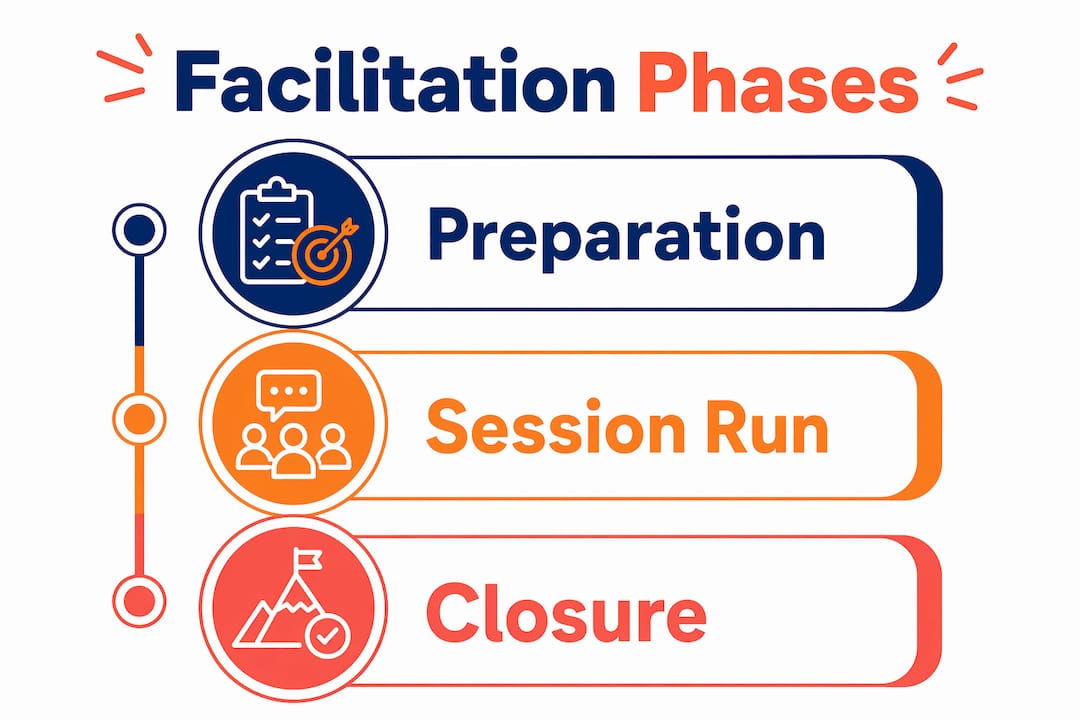
Effective facilitation follows a three-phase lifecycle: preparation, running the session, and closing with assigned next steps. Skipping any phase measurably reduces workshop quality. Most teams underinvest in preparation and almost all underinvest in closure.
Phase 1: Preparation
Preparation is where the real work begins. Start by defining the single most important outcome the session must produce. Then work backward from that outcome to design the agenda. Participant selection matters as much as agenda design. Invite people who hold relevant knowledge or decision-making authority, not just seniority.
- Define the outcome. Write it as a concrete deliverable, not a vague goal. “Agree on three product priorities for Q3” beats “discuss product strategy.”
- Design the agenda backward. Map each activity to a specific output that feeds the final outcome.
- Select participants deliberately. Limit the group to those whose input is genuinely needed. Larger groups require more structured techniques to stay productive.
- Prepare materials in advance. Distribute pre-read documents, context briefs, or survey questions before the session so participants arrive informed.
- Clarify the ‘why’ for every participant. Research shows that participants who understand their role and impact within a session engage at a measurably higher level.
Pro Tip: Treat your agenda as a living document. Build in buffer time between activities and identify which segments you can cut if the group runs long. Rigid agendas create facilitator panic; flexible ones create great sessions.
Phase 2: Running the session
Execution is about managing group energy and time, not delivering content. Open by stating the session’s purpose and the expected output clearly. Use time-boxed activities to maintain momentum. Watch for dominant voices and use structured techniques to redistribute participation.

Phase 3: Closure
Closure is the most neglected phase. Before the session ends, document every decision made and every action agreed upon. Assign one owner per action item with a concrete deadline. Read the list aloud before the group disperses so everyone leaves with the same understanding.
Which proven facilitation techniques enhance engagement and productivity?
The right technique depends on the group size, the goal, and the level of psychological safety in the room. These four methods are the most reliable tools in any facilitator’s kit.
Brainwriting. Participants write ideas silently and independently before sharing them with the group. This prevents the first loud voice from anchoring the entire conversation. Use it at the start of ideation phases when you want a wide range of unfiltered input.
1-2-4-All. Individuals reflect alone, then pair up, then form groups of four, then share with the full room. This method ensures equal contribution from all participants and works especially well in groups where hierarchy creates silence.
Dot Voting. Each participant receives a fixed number of votes (typically three to five) and places them on options displayed on a wall or shared screen. The group quickly identifies collective priorities without extended debate. Use it after generating a long list of ideas to narrow focus efficiently.
World Café. Small groups rotate between tables, each focused on a different question. A table host captures key insights as groups cycle through. This technique works well for sparking team innovation across complex topics where multiple perspectives need to be heard.
Pro Tip: Combine techniques within a single session. Open with Brainwriting to generate ideas, use 1-2-4-All to build on them, and close with Dot Voting to prioritize. The sequence matters as much as the individual method.
Good facilitation techniques also carry a practical business benefit beyond the session itself. Democratic decision-making processes save time and resources by reducing the back-and-forth that follows decisions made without full group input.
How does workshop facilitation differ from training or presentations?
The distinction is not subtle. It is structural, and getting it wrong produces very different results.
| Dimension | Facilitation | Training | Presentation |
|---|---|---|---|
| Primary role | Process guide | Content instructor | Content deliverer |
| Knowledge source | The group | The trainer | The presenter |
| Facilitator neutrality | Required | Not required | Not required |
| Participant role | Active co-creators | Learners | Audience |
| Primary output | Group-generated decisions | Skill or knowledge transfer | Information shared |
Facilitation focuses on managing the ‘how’ of group interaction while remaining neutral on the ‘what.’ The facilitator does not have the answer. The group does. The facilitator’s job is to create the process that surfaces it.
Training and presentations both position the expert at the front of the room with content to deliver. Facilitation positions the expert as a process architect who stays out of the content entirely. Confusing these roles causes facilitators to dominate discussions rather than enabling the group to generate its own insights. The result is a session that feels productive but produces outcomes the group does not own or act on.
Facilitator neutrality is not passive. It requires active listening, precise questioning, and the discipline to redirect without inserting opinions. That is a specific skill set, and it takes deliberate practice to build.
What best practices ensure effective follow-up and accountability post-workshop?
The session ends. The real work starts. Most workshop outcomes fail not because the session was poorly run, but because follow-up is vague or nonexistent.
Document decisions immediately. Capture every decision in writing before the group leaves the room. Memory degrades fast, and verbal agreements dissolve within days.
Assign one owner per action item. Multiple owners for one task consistently lead to accountability loss. When everyone is responsible, no one is. One name, one deadline, one deliverable.
Set concrete deadlines. “As soon as possible” is not a deadline. Attach a specific date to every action item so progress can be tracked objectively.
Send a written summary within 24 hours. Distribute a clear record of decisions, owners, and deadlines to all participants while the session is still fresh. This creates a shared reference point and reduces misinterpretation.
Build a feedback loop. Schedule a brief check-in two to three weeks after the session to review progress on action items. This signals that the workshop was not a one-time event but part of an ongoing process.
The agenda itself should be updated after the session to reflect what actually happened versus what was planned. This post-session debrief is invisible work, but it is what separates facilitators who improve over time from those who repeat the same mistakes.
Key Takeaways
Business workshop facilitation produces real outcomes only when preparation, execution, and follow-up are all treated as non-negotiable phases of the same process.
| Point | Details |
|---|---|
| Facilitation is process, not content | The facilitator guides how the group thinks, not what they conclude. |
| Three phases are all required | Preparation, execution, and closure each carry equal weight in determining session quality. |
| Techniques prevent dominant voices | Methods like Brainwriting and 1-2-4-All ensure every participant contributes equally. |
| One owner per action item | Assigning a single owner with a concrete deadline is the most reliable predictor of post-workshop execution. |
| Invisible work drives results | Rigorous preparation and post-session debrief matter more than what happens during the session itself. |
What I have learned from running business workshops
The most common mistake I see is treating the session as the product. Teams spend days preparing slides and almost no time designing the process. Then they wonder why the group leaves without clear decisions.
The invisible work before and after the workshop is more determinative of success than anything that happens in the room. A facilitator who spends three hours in preparation and thirty minutes on post-session debrief will consistently outperform one who improvises their way through a polished agenda.
Neutrality is harder than it sounds. When you know the answer, staying quiet while the group works toward it feels wasteful. But the moment you insert your opinion, you shift the group’s ownership of the outcome. They stop thinking and start agreeing with you. That is the fastest way to produce a decision that nobody acts on.
The other thing I have learned is that group energy is a real variable. A session that starts with low energy rarely recovers without a deliberate intervention. Opening with a short, structured activity like Brainwriting or a quick round of individual reflection resets the room. It signals that this is not another meeting where one person talks and everyone else waits.
If you want to build real facilitation skills for business, practice the debrief as seriously as you practice the session itself. Ask what worked, what slowed the group down, and what you would cut next time. That reflection loop is what turns a competent facilitator into a great one.
— Amichai
How Nomadexcel supports your facilitation and team growth
Nomadexcel builds programs around the same principles that make workshop facilitation work: structured collaboration, clear outcomes, and real accountability. The Online Entrepreneurship Bootcamp gives founders and team leaders hands-on experience with the frameworks that drive productive group work, from goal-setting and agenda design to decision-making under pressure. For teams that want to apply these skills in a focused environment, Nomadexcel’s company retreats are designed end-to-end to produce alignment and momentum. Both programs combine expert facilitation with community and execution, so participants leave with skills they can apply immediately.
FAQ
What is the main goal of business workshop facilitation?
Business workshop facilitation is designed to help a group reach specific, shared outcomes through structured interaction. The facilitator manages the process so the group can focus entirely on the content.
How does a facilitator stay neutral during a workshop?
A facilitator maintains neutrality by guiding the process through questions and structured activities rather than offering opinions or directing conclusions. The group generates the insights; the facilitator creates the conditions for that to happen.
What is the most important facilitation technique for large groups?
1-2-4-All is the most reliable technique for large groups because it structures participation in stages, ensuring quieter participants contribute before dominant voices set the tone.
How soon should a workshop summary be sent after the session?
A written summary of decisions, owners, and deadlines should be distributed within 24 hours of the session. This preserves accuracy and creates a shared reference point before memory fades.
What is the difference between workshop facilitation and workshop management?
Workshop facilitation focuses on guiding group dynamics and generating collective outcomes. Workshop management refers to the logistical coordination of the event, including scheduling, venue, and materials. Both are necessary, but they require different skill sets.
Comments are closed.