
Business Accountability Workflow: A Small Business Guide
TL;DR:
- A business accountability workflow assigns clear ownership, measurable goals, regular reviews, and consequences for outcomes. Most failures occur when organizations lack one of these elements or treat accountability as control rather than growth support. Starting with targeted pilot areas and modeling leadership behavior builds a sustainable culture of accountability.
A business accountability workflow is a structured system that ensures every critical outcome has a clear owner, objective success measures, regular progress reviews, and consequences for missed commitments. Most small business owners treat accountability as a cultural value rather than a designed process. That gap is where deadlines slip, bottlenecks form, and growth stalls. This guide covers the essential components, design principles, and step-by-step implementation strategies that entrepreneurs can apply immediately, without launching a company-wide culture campaign.
What are the essential components of a business accountability workflow?
An effective accountability workflow requires four non-negotiable components: a single named owner per critical outcome, objective success metrics, a consistent review cadence, and clear consequences for missed commitments. Organizations that lack even one of these elements see higher rates of missed deadlines and operational bottlenecks. Think of these four components as the legs of a table. Remove one and the whole structure collapses.
Here is what each component requires in practice:
- Single named owner. One person holds full responsibility for each outcome. Committees and shared ownership create diffusion of responsibility, which leads directly to inaction.
- Objective success metrics. Every outcome needs a measurable standard. “Improve customer satisfaction” is not a metric. “Achieve a Net Promoter Score of 45 by the end of Q3” is.
- Consistent review cadence. Weekly check-ins outperform monthly reviews because they catch problems before they compound. Waiting for quarterly reviews to address accountability issues is often too late to prevent damage.
- Clear consequences and escalation paths. Consequences do not have to mean punishment. They mean a defined next step when a commitment is missed, whether that is a conversation, a resource adjustment, or a formal escalation.
Pro Tip: Avoid the “committee fallacy.” If two or more people are listed as accountable for the same outcome, no one is truly accountable. Assign one name, not one team.
Accountability workflows are not task lists. They track results and outcomes in a way that makes ownership concrete and measurable. A task list tells people what to do. An accountability workflow tells everyone who owns the result and what success looks like.
How do you design and document accountability workflows for clarity?
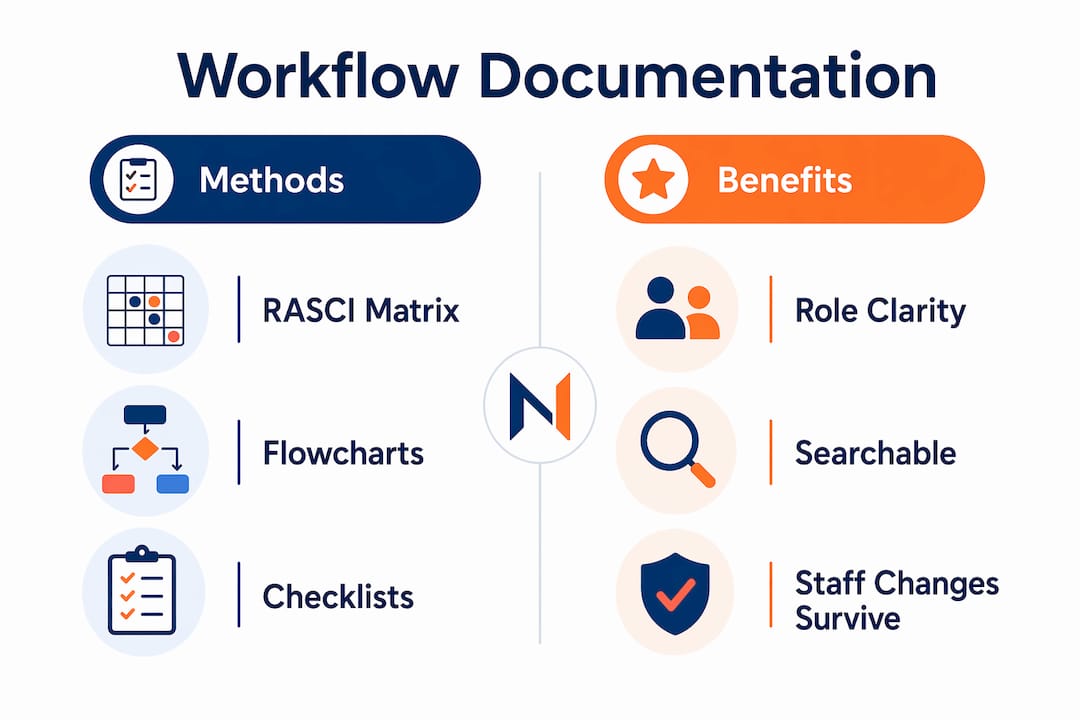
Clear documentation is what separates a workflow that survives personnel changes from one that collapses the moment a key person leaves. The RASCI model (Responsible, Accountable, Support, Consulted, Informed) is the industry standard for eliminating role ambiguity in document-heavy workflows. It forces every stakeholder to understand their exact relationship to each outcome before work begins.

One critical design rule: write names, not just roles. “The marketing manager” becomes ambiguous the moment someone new fills that seat. “Sarah Chen, marketing manager as of march 2026” remains traceable even after a role change. Using names rather than roles in accountability documentation ensures continuity even when team members change positions or leave.
Documenting accountability in a shared, searchable environment creates transparency and reduces missed targets caused by verbal-only commitments. A delegation record formally binds owners to their scope and escalation paths. It functions as a written commitment, not just a note.
The table below compares three common workflow documentation methods across the criteria that matter most for small businesses.
| Method | Role clarity | Searchable | Survives staff changes | Best for |
|---|---|---|---|---|
| RASCI matrix | High | Medium | High | Cross-functional teams |
| Shared project board | Medium | High | Medium | Task-level tracking |
| Written delegation record | High | High | High | Outcome ownership |
| Verbal agreement | Low | None | None | Not recommended |
Pro Tip: Store all delegation records and RASCI matrices in one shared, searchable location. A document buried in someone’s email is not a commitment. It is a liability.
Tracking the full process history, including status updates and decision logs, gives you an audit trail. That trail protects you during personnel transitions and makes it far easier to identify where a workflow broke down.
What are the recommended steps to implement an accountability workflow?
Small businesses should pilot accountability workflows in the three highest-cost impact areas before expanding company-wide. Success in pilots builds the foundation for broader adoption without triggering resistance. Here is a practical sequence for getting started.
Identify your three highest-impact areas. Look for the processes where missed commitments cost you the most, whether in revenue, customer satisfaction, or team time. Common examples include sales follow-up, project delivery, and client onboarding.
Assign a single accountable owner for each outcome. Use a name, not a title. This person is not just responsible for doing the work. They own the result.
Define measurable success standards. Connect each outcome to a specific metric. If you cannot measure it, you cannot manage it. Tie metrics directly to business goals so owners understand why their outcome matters.
Set a consistent review rhythm. Weekly check-ins work better than monthly reviews for most small teams. Short, focused meetings of 15–30 minutes reduce the chance of problems compounding silently.
Establish consequences and escalation paths. Write these down before you need them. A consequence might be as simple as a direct conversation with the owner and a revised plan. The point is that everyone knows what happens next when a commitment is missed.
Test the workflow manually before automating anything. Manual testing of new workflows before automating prevents operational errors. Automation encodes whatever process exists. If the process has flaws, automation makes those flaws permanent.
Model accountability from the top. Employees mirror leadership behavior. When leaders commit visibly, admit mistakes openly, and follow through consistently, accountability flows naturally through the rest of the organization.
The goal of this sequence is not perfection on the first attempt. The goal is a working pilot in three areas that you can learn from, refine, and then replicate across the business.
What common pitfalls should entrepreneurs avoid with accountability workflows?
Most accountability systems fail not because of bad intentions but because of predictable, avoidable design errors. Recognizing these pitfalls before you build your workflow saves significant time and frustration.
- The committee fallacy. Assigning multiple people to one outcome causes diffusion of responsibility and leads to inaction. One outcome, one owner. No exceptions.
- Confusing tasks with outcome ownership. Completing a task is not the same as owning a result. An owner is accountable for the outcome whether or not they personally do every task involved.
- Mandate-driven accountability. Leaders who tighten controls often get compliance without commitment. True accountability must be voluntarily chosen by individuals, not extracted through surveillance or fear.
- Verbal-only commitments. If a commitment is not written and shared, it does not officially exist. Verbal agreements disappear the moment a meeting ends.
- Ignoring leadership’s role. If leaders do not model accountability themselves, no workflow system will compensate. The tone at the top is the single most powerful signal in any organization.
- Failing to update workflows regularly. Workflows drift when they are not reviewed. A workflow that made sense six months ago may no longer reflect current team structure, priorities, or metrics.
- Missing any of the five elements. An accountability leak occurs when any one of the following is absent: owner, standard, metric, cadence, or consequence. Check for all five before launching any workflow.
Psychological safety is also a critical factor. When employees fear blame, they hide issues, which leads to larger problems down the line. A workflow that creates psychological safety encourages early reporting of problems rather than concealment. Build your review cadence around learning and problem-solving, not blame assignment.
Key Takeaways
A business accountability workflow succeeds only when it combines a single named owner, measurable metrics, a consistent review cadence, and defined consequences for every critical outcome.
| Point | Details |
|---|---|
| Four non-negotiable components | Every workflow needs an owner, a metric, a review cadence, and a consequence. |
| One owner per outcome | Shared ownership causes inaction. Assign one name, not one team. |
| Document with names, not roles | Names survive staff changes. Role titles become ambiguous when people leave. |
| Pilot before scaling | Start with three high-impact areas to build confidence and refine the system. |
| Leadership sets the standard | Employees mirror leader behavior. Visible commitment from the top makes accountability real. |
Why most accountability systems fail before they start
I have worked with dozens of entrepreneurs who built detailed accountability frameworks and watched them collapse within 90 days. The failure almost never comes from a bad framework. It comes from two specific mistakes that I see repeatedly.
The first is launching too broadly. Founders want to fix everything at once, so they roll out a company-wide accountability system before they have tested anything. The result is confusion, resistance, and a system that nobody trusts. Starting with three targeted pilots, as described in the startup accountability guide, consistently outperforms broad rollouts. Small wins build credibility. Credibility builds adoption.
The second mistake is treating accountability as a control mechanism rather than a growth tool. When leaders frame accountability as “we are watching you,” they get compliance. When they frame it as “here is how we support each other to hit our goals,” they get commitment. That distinction, explored in depth in accountability and business growth, changes everything about how a team responds to the system.
The entrepreneurs I have seen build the strongest accountability cultures share one habit: they hold themselves to the same standards they set for their teams. They report their own metrics in team reviews. They acknowledge their own missed commitments out loud. That behavior does more for accountability culture than any workflow document ever will.
— Amichai
How Nomadexcel supports entrepreneurs in building accountability
Building a business accountability workflow is one thing. Sustaining it through the pressures of early-stage growth is another challenge entirely. Nomadexcel’s Online Entrepreneurship Bootcamp is designed specifically for founders who want to move from good intentions to real execution systems. The program combines structured accountability sprints, direct mentorship from experienced operators, and a peer community that holds you to your commitments week after week. For entrepreneurs who want to go deeper on leadership and workflow design, Nomadexcel’s mentorship program connects you with guides who have built these systems in real businesses.
FAQ
What is a business accountability workflow?
A business accountability workflow is a structured system that assigns a single named owner, measurable success metrics, a regular review cadence, and defined consequences to every critical business outcome. It differs from a task list because it tracks results, not just activities.
How does the RASCI model support accountability workflows?
The RASCI model (Responsible, Accountable, Support, Consulted, Informed) assigns a clear role to every stakeholder for each outcome. It eliminates the ambiguity that causes missed commitments in cross-functional teams.
How often should accountability reviews happen?
Weekly check-ins work best for most small businesses. Waiting for monthly or quarterly reviews allows problems to compound before they are addressed.
What causes an accountability leak?
An accountability leak occurs when any one of five elements is missing: owner, standard, metric, cadence, or consequence. All five must be present for a workflow to function reliably.
Why does mandate-driven accountability fail?
Leaders who impose accountability through control get compliance, not commitment. True accountability is voluntarily chosen by individuals when they have clarity, support, and psychological safety within the workflow.
Comments are closed.