
Seven Ecommerce Models Founders Should Test in Ten Days
Seven models cover almost every online business you’ll ever encounter: B2C, D2C, B2B, B2B2C, B2G/B2A, C2C, and C2B. Pick between them by matching three things, your customer type, your margin structure, and how much operational complexity you can realistically handle in year one. Get that match right and everything downstream, pricing, marketing, fulfillment, gets easier. Get it wrong, and you’ll spend your first year fighting the model instead of building the business.
TL;DR:
- Matching your customer type, margin requirements, and operational capacity is essential to choosing the right e-commerce model and avoiding costly mismatches.
- Dropshipping requires minimal capital and is suited for testing demand, while private label needs more upfront investment but offers higher margin control.
- B2B models typically involve longer sales cycles and larger order sizes, with compliance and relationship-building taking precedence over quick marketing wins.
- Subscription methods are effective for recurring revenue, but demand strong churn management and customer retention efforts from day one.
- Conducting a focused validation sprint, including landing pages and early sales signals, is crucial to confirming your chosen model before scaling.
Table of Contents
- Different E-Commerce Business Models: A Model-by-Model Breakdown
- Value-Delivery Methods That Shape Your Margins
- How to Choose the Right E-Commerce Model
- Trends and Hybrids Reshaping Online Selling
- A Validation Sprint for Testing Your Model Choice
- Legal and Regulatory Considerations by Model
- Technology and Platform Choices for Each Model
- Marketing Strategies Tailored to Each Model
- What Founders Get Wrong When Picking a Model
- Where Nomad Excel Fits Into Your Model Decision
- Sources
- FAQ
Different E-Commerce Business Models: A Model-by-Model Breakdown
Each of these models answers a different question: who’s buying, who’s selling, and how the money actually moves. Industry explainers, including guides from Salesforce, commonly group online commerce into six or seven canonical types, treating delivery methods like dropshipping and subscriptions as a separate, later decision. Start with the interaction type. The delivery mechanics come next.
B2C (Business-to-Consumer) means you sell finished products or services directly to individual shoppers. Revenue comes from unit sales, often at higher volume and lower per-item margin than other models. Sales cycles are short, sometimes seconds, which makes B2C forgiving for founders who need to see revenue fast, but it also means you’re constantly feeding a top-of-funnel with paid ads or content. Best when: you have a product with mass appeal and a marketing channel you already understand.
D2C (Direct-to-Consumer) is technically a subset of B2C, but it deserves its own line because the economics differ sharply. D2C brands manufacture or source their own product and sell it without a retail middleman, which protects margin and gives you full control over brand story and customer data. The tradeoff is that you now own everything: inventory, fulfillment, customer service, returns. Best when: your differentiation depends on brand experience, not just price.
B2B (Business-to-Business) sells to other companies rather than individuals. Order sizes are larger, sales cycles stretch from weeks to months, and relationships matter more than any single transaction. Margins per deal tend to be healthier, but customer acquisition costs a different kind of capital: time, trust-building, and often a sales team rather than an ad budget. Best when: you can solve a recurring operational problem for other businesses and you’re comfortable with longer revenue timelines.
B2B2C (Business-to-Business-to-Consumer) puts your product into another company’s storefront or platform, which then sells to the end consumer. You get distribution reach you couldn’t build alone. You give up some brand visibility and a slice of margin to the intermediary. Best when: you have a strong product but limited consumer-acquisition muscle, and partnering with an established retailer or platform gets you to customers faster than going solo.
B2G/B2A (Business-to-Government/Administration) means selling to public agencies, and it plays by different rules entirely. This channel usually runs through formal procurement portals and competitive bidding rather than a storefront, with longer approval cycles and stricter compliance requirements than any consumer-facing model. Best when: you have patience for bureaucracy and a product that fits government budget cycles, think office supplies, software licensing, or infrastructure services.
C2C (Consumer-to-Consumer) connects individual sellers with individual buyers, usually through a marketplace platform that handles payments, trust, and dispute resolution. You’re not necessarily selling a product here. You might be building the platform that lets others sell. Best when: you spot an underserved niche where people already want to trade with each other but lack a trustworthy venue.
C2B (Consumer-to-Business) flips the usual direction: individuals offer a product, service, or piece of content, and businesses buy it. Freelance marketplaces and stock photo sites run on this logic. Best when: you’re aggregating supply from many individuals and matching it to business demand at scale.
A few founder-level trade-offs cut across all seven:
- Capital required rises roughly in this order: C2C platform participant, dropshipping-based B2C, D2C with owned inventory, then full B2B with a sales team.
- Margin expectations run opposite to acquisition ease. B2C is easiest to reach but hardest to protect margin on; B2B protects margin but costs more time to close.
- Operational complexity scales with how many parties touch the transaction. B2B2C and B2G/B2A involve the most intermediaries and the most paperwork.
Value-Delivery Methods That Shape Your Margins
The model you choose answers “who am I selling to.” The delivery method answers “how do I actually get the product to them,” and that second decision affects your margins just as much.
- Dropshipping means you never touch inventory. A supplier ships directly to your customer while you handle marketing and the storefront. Margins are thin, often 10 to 30 percent, but startup capital is minimal. This pairs naturally with B2C and C2C models where a founder wants to test demand before committing to inventory.
- Subscriptions turn a one-time sale into recurring revenue, which is why they’ve become a default add-on across digital and physical goods alike. Subscription commerce works especially well for consumables, media, and services where retention drives lifetime value, think razor blades, meal kits, or streaming access, Salesforce notes. The catch: subscriptions demand real investment in churn management and customer success, not just a “subscribe and save” checkbox at checkout.
- Wholesale means selling in bulk to retailers or other businesses at a discounted per-unit price. It fits B2B naturally and gives D2C brands a secondary revenue channel, but it usually means accepting a lower margin per unit in exchange for volume and reduced marketing spend.
- Private label means manufacturing a product under your own brand, often through a third-party factory. It gives you full margin control and brand ownership, but it requires more upfront capital and supplier relationship management than dropshipping.
- White label is similar to private label, except you’re rebranding an existing generic product rather than commissioning a custom one. It’s faster to launch than private label and slower to differentiate.
Pro Tip: If your capital is tight, start with dropshipping or a minimal subscription pilot to validate real demand, then graduate to private label once you know the unit economics actually work. Moving fulfillment in house too early is one of the most common ways early-stage founders burn cash before they’ve proven anyone wants the product.
How to Choose the Right E-Commerce Model
Run this as a 15 to 30 minute exercise, not a week-long strategy retreat. Score your idea against each factor from 1 (weak fit) to 5 (strong fit), then look at where the low scores cluster.
- Target customer profile: Are you selling to individuals, businesses, or government agencies? This alone eliminates several models immediately.
- Order size and frequency: Small, frequent purchases favor B2C or subscription; large, infrequent purchases favor B2B.
- Margin needs: Can you survive on 15 percent margin at volume, or do you need 50 percent margin on fewer sales?
- Fulfillment complexity: Can you handle inventory and shipping yourself, or do you need a dropshipping partner?
- Regulation and compliance: Government sales, certain regulated goods, and cross-border B2B all add legal overhead.
- Customer acquisition channels: Do you already have an audience, a sales network, or a platform relationship you can leverage?
- Time to revenue: How long can you operate before you need cash flowing in?
Weight three to five of these factors as “critical” based on your actual constraints, usually margin needs and time to revenue matter most for solo founders, and let those dominate your score. If your idea scores low across fulfillment complexity and capital availability, that’s your signal to start with a low-overhead delivery method like dropshipping rather than jumping straight to private-label manufacturing.
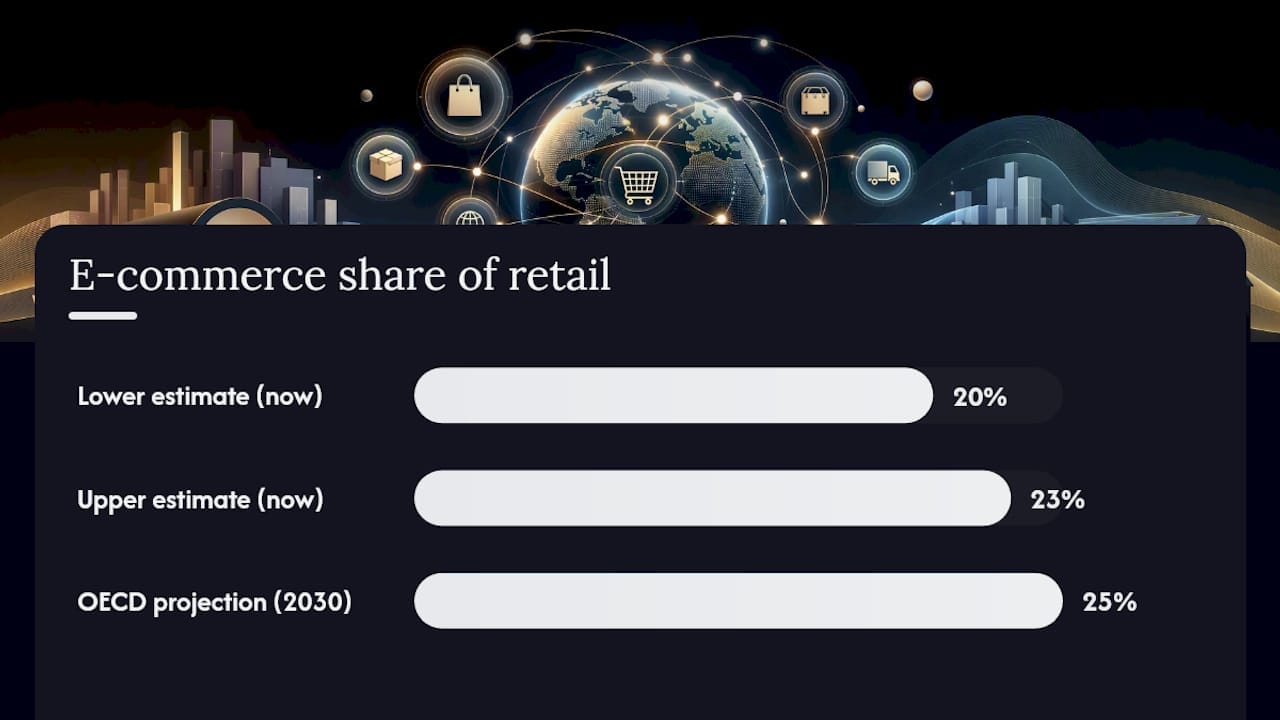
E-commerce now makes up roughly 20 to 23 percent of global retail sales, with the OECD projecting that share climbing toward 25 percent by 2030. That growth means more competition in every model, so the founders who win are usually the ones who matched their constraints honestly instead of chasing the model that looked most exciting on paper.
Trends and Hybrids Reshaping Online Selling
Subscription revenue keeps growing because it smooths out the feast-or-famine cycle of one-time sales, though it only works when retention operations, churn tracking, renewal messaging, are built in from day one, not bolted on later, per OECD analysis. Marketplaces and platform-led commerce create a different dynamic entirely: network effects mean the platform with more sellers attracts more buyers, and vice versa, which is why joining an existing marketplace to test product-market fit often beats building your own platform from scratch, according to BigCommerce’s analysis.
Online-offline integration, letting customers browse online and pick up in-store, or vice versa, has become a serious growth channel, and pairing it with omnichannel marketing strategies keeps the customer experience consistent across touchpoints. Social and mobile commerce continue pulling sales directly into apps people already use daily.
The practical move for testing any hybrid: run it as a small, time-boxed pilot, four to six weeks, before folding it into your core operations.
- Test subscriptions with a limited early-access cohort before opening it to your full list.
- Pilot a marketplace listing alongside your own store rather than replacing it.
- Add one social-commerce channel at a time instead of five simultaneously.
A Validation Sprint for Testing Your Model Choice
You don’t need six months to know if your model choice is right. You need one focused sprint.
- Write the hypothesis. State exactly who buys, what they buy, and why they’d choose you.
- Build a landing page or test offer. Keep it simple enough to launch in days, not weeks.
- Collect early sales or pre-orders. Real money commitments beat survey answers every time.
- Watch three metrics. Conversion rate, customer acquisition cost, and early retention or repeat-purchase signals.
- Decide your next step. Double down, pivot the model, or kill the idea before it costs more.
This is the exact structure Nomad Excel runs inside its bootcamps, daily accountability check-ins, mentor feedback loops, and peer review sessions that catch blind spots you’d miss working alone. Founders get access to templates, including the e-commerce business models framework, to speed up each step.
Pro Tip: Set a hard deadline for your sprint, ten days maximum, so you’re forced to make a decision rather than endlessly refining a landing page nobody’s seen yet.
Legal and Regulatory Considerations by Model
Each model carries its own compliance weight, and ignoring it early creates expensive problems later. B2C and D2C sellers need to handle consumer protection law, clear return policies, and truthful advertising claims, plus sales tax collection across every jurisdiction where you have nexus. Subscription businesses face particular scrutiny around disclosure: recurring charges must be clearly stated before checkout, and cancellation has to be at least as easy as signup in most regulated markets.
B2B transactions usually involve contracts, payment terms, and sometimes industry-specific certifications, especially if you’re selling into regulated sectors like healthcare or finance. B2B2C arrangements add another layer: you need clear agreements with your distribution partner covering liability, data ownership, and brand usage.
B2G and B2A selling is the most procedurally demanding of all. Government buyers typically require formal registration, competitive bidding, and strict documentation before you can even submit a proposal, and procurement cycles routinely run longer than any consumer or standard B2B sale. C2C platform operators carry a different burden: you’re responsible for building dispute resolution, fraud prevention, and payment escrow systems, or licensing them from a payment provider, since you’re facilitating trust between strangers.
None of this should scare you off a model. It should just tell you which model comes with a compliance budget attached, and whether you have the patience or the capital to cover it.
Technology and Platform Choices for Each Model
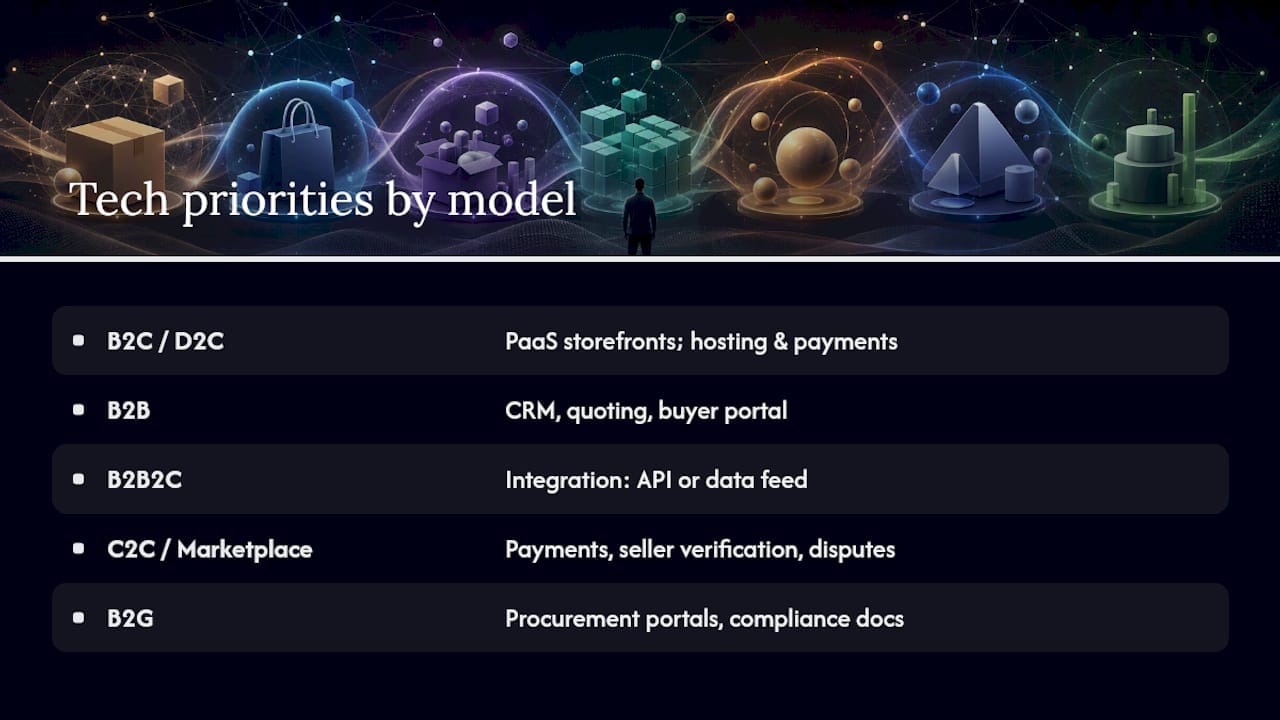
Your tech stack should follow your model, not the other way around. B2C and D2C founders generally do best on platform-as-a-service storefronts, tools that bundle hosting, payments, and analytics into one system, letting you launch without hiring engineers. That lower technical barrier is a big part of why so many D2C brands can go from idea to live store in weeks rather than months, as BigCommerce points out.
B2B sellers often need more than a storefront. Customer relationship management systems, quoting tools, and sometimes a dedicated buyer portal matter more than a slick checkout flow, since the sales cycle runs through conversations, not impulse clicks. B2B2C founders need integration capability above everything else: your product has to plug cleanly into a partner’s existing platform through an API or a data feed.
C2C and marketplace builders face the heaviest technical lift, since you’re not just selling, you’re running the infrastructure other people sell through. That means payment processing, seller verification, review systems, and dispute handling all need to work before day one. B2G sellers, meanwhile, often need less consumer-facing technology and more compliance-oriented documentation systems, since sales happen through procurement portals rather than a public storefront.
The rule of thumb: match your technical investment to your sales complexity, not your ambition. A founder testing a C2C marketplace idea doesn’t need custom-built infrastructure in week one. A landing page and a manual matching process will tell you if demand exists before you write a line of platform code.
Marketing Strategies Tailored to Each Model
B2C marketing lives or dies on volume and speed: paid social, influencer partnerships, and search ads all compete for attention in a crowded, fast-moving funnel. D2C brands lean harder into brand storytelling and owned channels, email lists, content, community, because they’re trying to build a relationship that survives beyond the first purchase.
B2B marketing runs on a completely different clock. Content that demonstrates expertise, case studies, webinars, and direct outreach through sales teams matter more than viral reach, since a single deal might take months and multiple stakeholders to close. B2B2C founders often market to their distribution partner first and the end consumer second, meaning trade shows, partner enablement materials, and co-branded campaigns take priority over direct-to-consumer ads.
C2C platforms face a two-sided marketing problem: you need to attract sellers and buyers simultaneously, which usually means early incentives on one side, discounted fees, referral bonuses, to seed enough supply that buyers show up. C2B businesses need to market to individuals as suppliers and to businesses as buyers, often running two entirely separate campaigns under one brand. B2G marketing barely resembles marketing at all in the traditional sense: it’s relationship-building with procurement officers and positioning through formal proposals rather than ads or content.
Whatever the model, the acquisition channel you pick should match where your actual customer already spends attention, not where marketing is trendiest that quarter.
What Founders Get Wrong When Picking a Model
The most common mistake isn’t picking the wrong model. It’s over-engineering the right one before proving it works. Founders build private-label products, custom platforms, or full CRM systems before a single paying customer confirms the idea has legs. A close second mistake: betting everything on one acquisition channel, one ad platform, one marketplace, without a backup plan when that channel gets more expensive or changes its rules overnight.
The pragmatic shortcut is almost always smaller than founders expect. A two-week landing page test beats a two-month build. Pairing D2C with a small subscription pilot reveals retention economics before you commit to inventory at scale. Guided programs and structured retreats accelerate this because they force a decision deadline instead of letting analysis paralysis stretch on indefinitely, and a peer group calling out your blind spots beats solving them alone every time.
— Amichai
Where Nomad Excel Fits Into Your Model Decision
Nomad Excel is the alternative to figuring this out alone at 2 a.m. with fifteen browser tabs open. Instead of guessing which e-commerce model fits your idea, you get structured sprints, direct mentor feedback, and a peer group testing their own ideas alongside you, all built to compress months of trial and error into days.
The Online Entrepreneurship Bootcamp walks founders through exactly the validation sequence covered above: hypothesis, test offer, early signal, decision. If you’re weighing whether in-person immersion accelerates things further, the Entrepreneurship Sprint Bootcamp in Lisbon pairs the same framework with hands-on mentorship and a live founder community. Curious what a bootcamp actually delivers before committing? The guide to joining entrepreneurship bootcamps breaks down what to expect. Check program dates and pick the format that fits your timeline.
Sources
The OECD’s e-commerce chapter covers structural trends shaping global online retail, including subscription growth and market share projections. Salesforce’s guide to e-commerce types and BigCommerce’s business models breakdown both offer practical explainers on models and delivery methods. Founders wanting hands-on templates can also download the types of business models PDF for workshop-style exercises.
- Unpacking e‑commerce | OECD
- Types of ecommerce for SMBs and startups | Salesforce
- Ecommerce business models (BigCommerce)
FAQ
Is Amazon a B2B, B2C, or C2C Business?
Amazon operates across all three simultaneously. It sells directly to consumers as B2C, hosts third-party sellers reaching other consumers in a C2C-style marketplace, and runs Amazon Business, a dedicated B2B storefront for bulk and wholesale purchasing.
What Are the Most Popular Forms of E-Commerce?
Most industry guides point to seven core models: B2C, B2B, B2B2C, B2G/B2A, C2C, C2B, and D2C, according to explainers like Salesforce’s. Each defines who’s buying and selling, while delivery methods like dropshipping or subscriptions layer on top as separate operational choices.
What Is B2C, B2B, and C2C With Examples?
B2C sells directly to individual consumers, think an online clothing store. B2B sells to other businesses, like a software company selling inventory tools to retailers. C2C connects individual buyers and sellers through a marketplace, the way a peer-to-peer resale platform operates.
What Are the Types of Business-to-Consumer Models?
B2C commonly breaks into direct sellers, online marketplaces, advertising-supported sites, community-based platforms, and fee-based subscription services. D2C is technically a B2C variant where the brand manufactures and sells its own product without a retail middleman.
How Do I Know Which E-Commerce Model Fits My Idea?
Score your idea against customer type, margin needs, fulfillment complexity, and time to revenue, then let your lowest scores guide you toward a simpler starting model. Programs like Nomad Excel’s Online Entrepreneurship Bootcamp run this exact validation process with mentor support if you want structured guidance rather than guessing alone.
Comments are closed.