Team Building Activities: 50 Ready-to-Run Ideas for 2026
Use short energizers for weekly meetings, problem-solving challenges for teams in the Norming stage, and large experiential events when your group is already performing well. This page is organized so you can move fast: the three quickest wins are (1) One-Word Check-In as a 5-minute meeting opener, (2) Blind Drawing as a 20-minute communication exercise, and (3) Virtual Photo Scavenger Hunt as a hybrid-equitable activity that works whether half your team is remote or everyone is in the same room. Every activity below follows the same card format: time, group size, materials, step-by-step facilitation notes, primary skill targeted, and an accessibility or opt-out note. Jump directly to the section that fits your next session:
- Quick icebreakers (≤10 min): Activities 1–4
- Energizers and problem-solving (15–45 min): Activities 5–10
- Trust-building and experiential: Activities 11–13
- Remote and hybrid formats: Activities 14–16
- Sample agendas: 15-minute, 60-minute, and half-day templates
Key Takeaways
Short, recurring team building activities produce more sustained cultural change than infrequent large events, and the debrief after any activity matters more than the activity itself.
| Point | Details |
|---|---|
| Match activity to team stage | Use low-stakes icebreakers for Forming teams; save competitive challenges for Performing teams. |
| Debrief every session | Ask “What happened? So what? Now what?” to convert a game into a lasting behavior change. |
| Prioritize hybrid equity | Design activities where remote and in-office participants face the same challenge and share the same outcome. |
| Measure one behavior change | Track a single observable metric (meeting participation, cross-team help requests) for 30 days post-activity. |
| Nomadexcel retreats | Nomadexcel designs end-to-end custom retreats that combine facilitated activities with strategic alignment and accountability structures. |
Table of Contents
- Why team building activities pay off for your team
- How to choose the right activity for your team
- 16 ready-to-run team building activities, organized by category
- Sample agendas you can copy and run today
- Psychological safety, common pitfalls, and how to facilitate well
- How to measure whether your activities are actually working
- What actually makes team building stick
- Nomadexcel’s retreats take team building beyond a single session
- Sources
Why team building activities pay off for your team
The core case is simple: happier workers are measurably more productive, with Oxford University research finding a 13% productivity lift tied to employee wellbeing. That figure gives you a concrete number to put in front of a skeptical stakeholder. But the day-to-day payoff for most managers shows up in subtler ways: faster onboarding when new hires feel welcomed, fewer communication breakdowns when people know each other’s working styles, and a meeting culture where people actually speak up.
Gusto’s catalog of 50 indoor activities makes a practical point worth repeating: short micro-rituals run weekly or monthly produce more sustained cultural change than a single quarterly event. A five-minute check-in at the top of every Monday standup does more for psychological safety over a quarter than one escape room outing in December.
Managers who invest in recurring team building can expect:
- Improved communication: People learn each other’s shorthand, reducing misread messages and handoff errors.
- Stronger trust: Shared low-stakes experiences create the social capital that makes hard conversations easier.
- Faster onboarding: New team members build relationships in weeks rather than months when structured activities are part of the welcome sequence.
- Higher meeting energy: Even a two-minute energizer at the top of a call shifts the room’s attention and reduces multitasking.
- Clearer psychological safety signals: Teams that play together tend to disagree more openly, which is where the best ideas come from.
How to choose the right activity for your team
The fastest path to a good choice is a four-step filter. Work through it before you open any activity list.
- Name your goal. Are you building rapport with strangers, repairing trust after a rough quarter, sharpening communication, or solving a specific problem? The goal determines the category.
- Identify your team’s development stage. Custom Ink’s guide recommends tagging activities by Tuckman stage: low-stakes self-disclosure fits Forming teams, collaborative prototyping fits Norming, and competitive celebration fits Performing. A high-intensity challenge dropped on a Forming team tends to produce anxiety, not bonding.
- Pick your format. In-person, fully remote, or hybrid? Hybrid requires the most intentional design. Activities where in-office participants share a physical advantage (a whiteboard, props, spatial awareness) make remote colleagues feel like spectators rather than participants.
- Check your constraints. Time budget, room setup, materials, facilitator capacity, and budget all narrow the field quickly.
Before you finalize any choice, run through this short checklist:
- Does the activity require physical movement that some team members cannot do? If yes, is there an equivalent seated or digital option?
- Does it ask people to share personal information? If yes, is participation optional?
- Does it assume a shared cultural reference (holidays, sports, humor)? If yes, can you swap the reference for something neutral?
- Does it require a paid tool or vendor? If yes, is the budget approved?
- Do you have a facilitator (or are you facilitating yourself) who can run the debrief?
Pro Tip: Match intensity to stage. A Forming team needs warmth and low risk. A Performing team can handle a competitive challenge or a creative constraint. When in doubt, run something one notch below what you think the team can handle — you can always escalate next time.
16 ready-to-run team building activities, organized by category
Asana organizes its catalog of 45 team-building games by category and group size, which is the most useful frame for busy managers. The activities below follow the same logic, with a compact reference table first and full cards below it.
Quick reference: time and group size
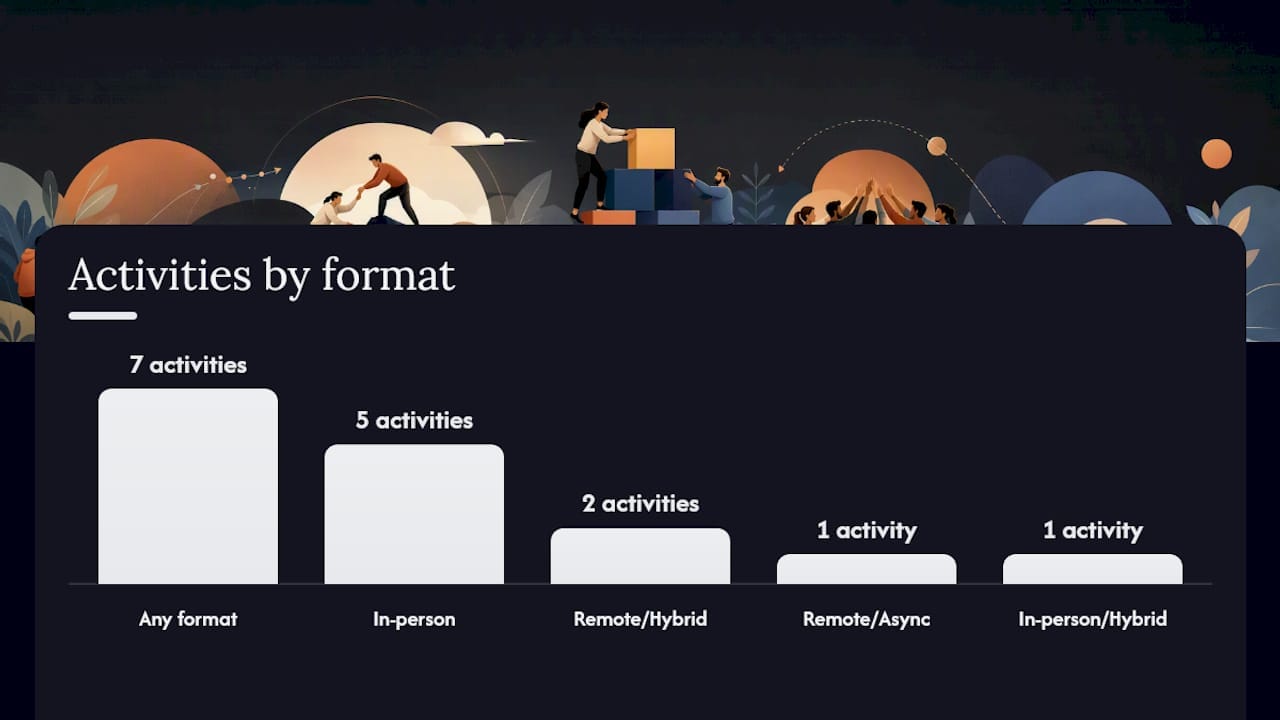
| # | Activity | Time | Group Size | Format | Skill |
|---|---|---|---|---|---|
| 1 | One-Word Check-In | 5 min | 4–30 | Any | Psychological safety |
| 2 | Two Truths and a Lie | 10 min | 5–20 | Any | Rapport |
| 3 | Nerf Ball Name Game | 5–8 min | 6–20 | In-person | Energy, names |
| 4 | This Is My Life | 8–10 min | 5–15 | Any | Self-disclosure |
| 5 | Blind Drawing | 20–25 min | 4–24 | Any | Communication |
| 6 | Marshmallow Tower | 30–45 min | 4–24 | In-person | Problem-solving |
| 7 | Virtual Escape Room | 45–60 min | 4–20 | Remote/Hybrid | Collaboration |
| 8 | Back-to-Back Drawing | 20 min | 4–20 | In-person | Listening |
| 9 | Scavenger Hunt | 30–45 min | 6–50+ | Any | Creativity |
| 10 | Shark Tank Pitch | 30–40 min | 6–30 | Any | Creative thinking |
| 11 | Trust Walk | 20–30 min | 6–20 | In-person | Trust |
| 12 | Appreciation Circle | 10–15 min | 4–20 | Any | Recognition |
| 13 | Charity Build Challenge | 60–90 min | 10–100 | In-person | Purpose, teamwork |
| 14 | Virtual Photo Scavenger Hunt | 20–30 min | 4–50 | Remote/Hybrid | Inclusion |
| 15 | Async Photo Prompt | Ongoing | Any | Remote/Async | Belonging |
| 16 | Walk-and-Talk | 20–30 min | 2–8 | In-person/Hybrid | Relationship |
1. One-Word Check-In
Time: 5 minutes | Group size: 4–30 | Materials: None | Format: Any
How to run it:
- Open the meeting by asking everyone to share one word that describes how they are arriving today (energy, mood, focus level).
- Go around in order (or use the raise-hand queue on video calls).
- No explanations required unless someone volunteers one.
- The facilitator shares last, modeling honesty.
- Acknowledge the range of words briefly before moving to the agenda.
Skill targeted: Psychological safety, self-awareness.
Outcome: Team members feel seen before the work starts, which reduces defensive posturing in the meeting that follows.
Accessibility/opt-out: Anyone can pass with “pass” or offer a number (1–10) instead of a word. No pressure to explain.
2. Two truths and a lie
Time: 10 minutes | Group size: 5–20 | Materials: None | Format: Any
How to run it:
- Each person silently writes two true statements and one false one about themselves.
- They read all three aloud in any order.
- The group votes (thumbs up/down, chat poll, or raised hands) on which is the lie.
- The person reveals the answer and shares a brief story behind one of the truths.
- Move to the next person.
Skill targeted: Rapport, curiosity.
Outcome: People discover surprising things about colleagues they thought they knew, which tends to spark informal conversations after the session.
Accessibility/opt-out: Participants choose what to share. No personal topic is required. Anyone uncomfortable can observe and vote without presenting.
3. Nerf Ball Name Game
Time: 5–8 minutes | Group size: 6–20 | Materials: One soft foam ball | Format: In-person
This one comes directly from Texas Tech’s list of 30 rapid team-building games and works especially well for new teams or onboarding sessions.
How to run it:
- Stand in a circle.
- The facilitator tosses the ball to someone, saying that person’s name.
- The catcher tosses to someone else, saying their name.
- After one round, add a rule: say the name of the person you are throwing TO before you throw.
- Speed up gradually. Anyone who drops the ball or blanks on a name just laughs and keeps going.
Skill targeted: Names, energy, inclusion.
Outcome: New team members learn names in a low-pressure, physical way that sticks better than a round of introductions.
Accessibility/opt-out: Participants who cannot stand or catch can serve as the “caller” who announces names from a seated position.
4. This Is My Life
Time: 8–10 minutes | Group size: 5–15 | Materials: Participants share 4 photos from their phones | Format: Any
How to run it:
- Ask each person to find four photos on their phone that represent something meaningful to them (a place, a person, a hobby, a memory).
- Each person shares their screen or holds up the phone and walks through the four images in 60–90 seconds.
- The group asks one question per person.
- The facilitator closes by noting a theme or connection across the group.
Skill targeted: Self-disclosure, empathy.
Outcome: Colleagues see each other as whole people, not just job titles, which is particularly powerful for remote teams who rarely interact outside of task-focused calls.
Accessibility/opt-out: Anyone who prefers not to share personal photos can describe four things instead of showing images.
5. Blind Drawing
Time: 20–25 minutes | Group size: 4–24 (pairs) | Materials: Paper, pens (in-person); shared whiteboard tool like Miro or Google Jamboard (remote) | Format: Any
This is the single most effective communication exercise for teams that struggle with handoffs, unclear briefs, or “I thought you meant something else” moments.
How to run it:
- Pair people up. One person is the Describer, the other is the Drawer.
- The Describer receives a simple image (a house, a geometric shape, a scene) and must describe it verbally without naming the object.
- The Drawer reproduces the image based only on the verbal description. No questions allowed in Round 1.
- Reveal and compare. Discuss what was lost in translation.
- Run Round 2 with questions allowed. Compare the results.
Skill targeted: Communication, active listening, precision in language.
Outcome: Teams almost always discover that the gap between what was said and what was heard mirrors a real workplace handoff problem. The debrief is where the real value lives.
Accessibility/opt-out: Participants with visual impairments can serve as the Describer. Digital tools make this fully remote-compatible.
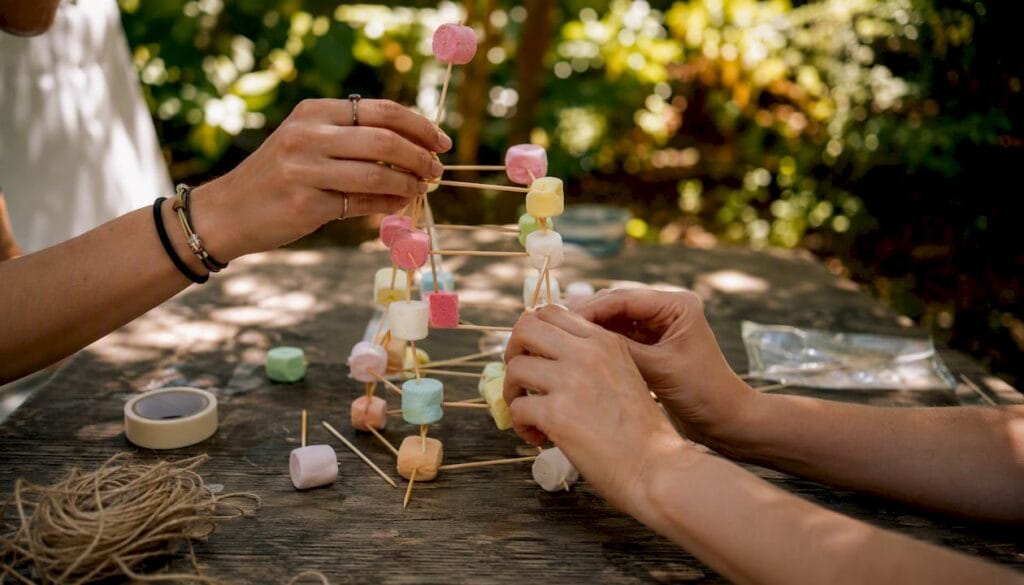
6. Marshmallow Tower
Time: 30–45 minutes | Group size: 4–24 (teams of 4–6) | Materials: 20 pieces of spaghetti, 1 yard of tape, 1 yard of string, 1 marshmallow per team | Format: In-person
How to run it:
- Divide into teams of 4–6.
- Each team has 18 minutes to build the tallest freestanding structure that can support a marshmallow on top.
- No prep time. Start building immediately.
- At the 18-minute mark, place the marshmallow. Measure height.
- Debrief: What roles emerged? Who led? Who prototyped early versus planned long?
Skill targeted: Problem-solving, rapid prototyping, leadership emergence.
Outcome: Teams that prototype early and iterate tend to win. The debrief reliably surfaces conversations about how the team approaches ambiguous work problems.
Accessibility/opt-out: Participants who cannot manipulate small materials can serve as the team’s strategist or timekeeper.
7. Virtual Escape Room
Time: 45–60 minutes | Group size: 4–20 | Materials: A licensed virtual escape room platform | Format: Remote/Hybrid
How to run it:
- Book a virtual escape room through a licensed platform (many offer facilitator-led options).
- Brief the team: the goal is to solve puzzles collaboratively, not to “win” individually.
- Assign a note-taker to track clues and decisions.
- Run the session with the facilitator observing communication patterns.
- Debrief: Who held information? Who synthesized? Where did the team get stuck and why?
Skill targeted: Collaboration, information sharing, decision-making under pressure.
Outcome: The debrief after a virtual escape room tends to surface real patterns in how the team handles ambiguity and who gets heard in fast-moving situations.
Accessibility/opt-out: Participants can opt into observer or note-taker roles. Ensure the platform has screen-reader compatibility if needed.
8. Back-to-Back Drawing
Time: 20 minutes | Group size: 4–20 (pairs) | Materials: Paper, pens | Format: In-person
How to run it:
- Pairs sit back-to-back so neither can see the other’s paper.
- One person draws a simple abstract shape and describes it aloud while the other draws from the description.
- No visual reference. Only words.
- Compare drawings. Switch roles.
- Debrief: What words were most useful? What assumptions did each person make?
Skill targeted: Listening, precise language, assumption-checking.
Outcome: A quick, physical version of the communication gap exercise that works well as a warm-up before a workshop on documentation or process clarity.
Accessibility/opt-out: Participants who cannot draw can describe verbally while a partner draws, then switch to a verbal-only round.
9. Photo Scavenger Hunt
Time: 30–45 minutes | Group size: 6–50+ | Materials: Smartphones, a shared photo channel (Slack, Teams, or a group text) | Format: Any (in-person, remote, or hybrid)
How to run it:
- Create a list of 10–15 items or scenes to photograph (something that represents your team’s values, something older than 50 years, something that makes you laugh).
- Teams of 3–4 have 20 minutes to collect photos.
- All photos go into a shared channel simultaneously at the deadline.
- The group votes on their favorites in each category.
- Debrief: What did you learn about your teammates from their choices?
Skill targeted: Creativity, collaboration, inclusion.
Outcome: Remote and in-office participants can compete on equal footing because everyone uses their own environment. This is one of the cleanest hybrid-equitable formats available, consistent with HBR’s guidance on designing activities that give remote participants the same challenge and shared outcome.

Accessibility/opt-out: Participants who prefer not to be photographed can serve as the team’s photo editor or caption writer.
10. Shark Tank Pitch
Time: 30–40 minutes | Group size: 6–30 | Materials: None required; optional: sticky notes, timer | Format: Any
How to run it:
- Divide into teams of 3–4.
- Each team has 10 minutes to invent a product that solves a ridiculous or mundane problem (e.g., a device that reminds you to blink, a subscription box for left-handed people).
- Each team pitches in 2 minutes.
- The “sharks” (the rest of the group) ask one question each.
- Vote on the most creative pitch. No prizes needed.
Skill targeted: Creative thinking, presentation, humor.
Outcome: Laughter is the primary output, which is underrated as a team-building mechanism. Secondary outcome: people discover who in the group is a natural storyteller or lateral thinker.
Accessibility/opt-out: Participants can contribute to the pitch without presenting. Written pitches work for those who prefer not to speak publicly.
11. Trust Walk
Time: 20–30 minutes | Group size: 6–20 (pairs) | Materials: Blindfolds or eye masks | Format: In-person
How to run it:
- Pairs designate a Guide and a Walker.
- The Walker is blindfolded. The Guide leads them through a simple obstacle course or around the room using only verbal instructions.
- No touching unless the Walker requests it.
- Switch roles halfway.
- Debrief: When did you feel most and least safe? What made the difference?
Skill targeted: Trust, communication, vulnerability.
Outcome: The debrief almost always surfaces a conversation about what it feels like to rely on someone else’s judgment, which maps directly to delegation and cross-functional dependency at work.
Accessibility/opt-out: This activity requires careful opt-in. Anyone uncomfortable with blindfolds or physical guidance should be offered an observer or facilitator role without explanation required.
12. Appreciation Circle
Time: 10–15 minutes | Group size: 4–20 | Materials: None | Format: Any
How to run it:
- Each person names one specific thing a teammate did in the past week or month that helped them.
- Specificity is the rule: “You helped me” is less useful than “When you caught that error in the report on Thursday, it saved me two hours of rework.”
- The recipient simply says “thank you.” No deflection, no minimizing.
- The facilitator models the format first.
- Close by asking: “What pattern do you notice in what we appreciate about each other?”
Skill targeted: Recognition, psychological safety, team identity.
Outcome: Teams that practice specific appreciation tend to give better feedback in general, because the muscle for noticing and naming good work transfers directly to constructive critique.
Accessibility/opt-out: Written appreciations in a shared doc work for participants who are uncomfortable speaking in groups.
13. Charity Build Challenge
Time: 60–90 minutes | Group size: 10–100 | Materials: Varies by challenge (bikes, care packages, school supply kits) | Format: In-person
How to run it:
- Partner with a local nonprofit or charity to define the deliverable (assembled bikes for kids, packed hygiene kits, built bookshelves).
- Divide into teams. Each team is responsible for one component of the final product.
- Teams must coordinate handoffs to complete the full build.
- Deliver or photograph the completed items for the charity.
- Debrief: How did the external purpose change how you worked together?
Skill targeted: Purpose, cross-team coordination, shared identity.
Outcome: The external beneficiary changes the emotional register of the activity. Teams report feeling more connected to each other and to the organization’s values when the output goes to someone who genuinely needs it.
Accessibility/opt-out: Roles can be adapted for different physical abilities. Coordination, quality control, and documentation roles require no physical assembly.
14. Virtual Photo Scavenger Hunt (hybrid-equitable version)
Time: 20–30 minutes | Group size: 4–50 | Materials: Smartphones, shared Slack or Teams channel | Format: Remote/Hybrid
This is the hybrid-first version of Activity 9, designed so that in-office and remote participants have identical constraints. Everyone photographs their own environment, which eliminates any location-based advantage.
How to run it:
- Post 8–10 prompts in a shared channel (something that represents your current mood, something you made with your hands, something that has been in your life for more than five years).
- Everyone has 15 minutes to photograph and post.
- The group reacts to photos with emoji votes.
- The facilitator calls out two or three standout photos and asks the owners to share a 30-second story.
- Close with one sentence: “What surprised you about what you learned today?”
Skill targeted: Inclusion, belonging, curiosity.
Outcome: Async-friendly and low-pressure, this format works for introverted team members who find synchronous games exhausting. It also generates a visual record of the team’s personality that can live in a shared channel permanently.
Accessibility/opt-out: Participants who prefer not to share personal photos can post an image from the internet that represents their answer, with a brief caption.
15. Async Photo Prompt
Time: Ongoing (weekly or biweekly) | Group size: Any | Materials: A dedicated Slack or Teams channel | Format: Remote/Async
How to run it:
- Create a dedicated channel (#team-life, #this-week-in-photos, or similar).
- Each Monday, the facilitator posts a single prompt (show us your workspace, show us what you ate for lunch, show us something outside your window).
- Participation is optional and celebrated, not tracked.
- The facilitator reacts to every post within 24 hours to signal that the channel is watched.
- Once a month, compile a few favorites into a brief “team snapshot” shared in the main channel.
Skill targeted: Belonging, informal connection, cultural inclusion.
Outcome: Asynchronous bonding rituals like this one tend to create more consistent inclusion than synchronous video games, particularly for introverted participants or those in significantly different time zones.
Accessibility/opt-out: Fully optional by design. No one is called out for not posting.
16. Walk-and-Talk
Time: 20–30 minutes | Group size: 2–8 | Materials: None | Format: In-person or hybrid (one person walks, one joins by phone)
How to run it:
- Pair people who do not typically work together.
- Give them a single conversation prompt: “What’s one thing you wish the rest of the team understood about your work?” or “What’s something you’re proud of that didn’t make it into a meeting?”
- They walk together (or one walks while the other joins by phone) for 20 minutes.
- No notes, no agenda, no deliverable.
- Optional: each person shares one insight from their walk in the next team meeting.
Skill targeted: Relationship-building, cross-functional empathy.
Outcome: Walking reduces the social pressure of eye contact and tends to produce more honest conversation than a scheduled one-on-one at a desk. For remote team collaboration, the phone-walk version is a surprisingly effective substitute.
Accessibility/opt-out: Participants who cannot walk can do a seated outdoor version or a phone call from a quiet space. The format adapts easily.
Sample agendas you can copy and run today
These three agendas are ready to use. Adjust the activity names to match what you have selected from the list above.
15-minute meeting opener
This format works as a standing agenda item at the top of any weekly team meeting.
- One-Word Check-In (5 min): Facilitator opens with the prompt, goes last.
- Quick energizer (5 min): Two Truths and a Lie with 3–4 people, or a single round of the Nerf Ball Name Game if in-person.
- Debrief (2 min): One question: “What’s one word from the check-in you want to carry into this meeting?”
- Transition (1 min): Facilitator names the meeting’s single most important outcome and opens the agenda.
Facilitator prompt: Keep the debrief tight. Two minutes is enough to name a pattern and move on.
60-minute team session
Ideal for a monthly team meeting, a new-team launch, or a post-project reset.
- Icebreaker (10 min): This Is My Life (4 photos per person, 60 seconds each for a group of 6–8).
- Main activity (30 min): Blind Drawing in pairs, with two rounds (no questions, then questions allowed).
- Structured debrief (15 min): Three questions in sequence:
- “What happened?” (describe the experience)
- “So what?” (what does it mean for how we communicate at work?)
- “Now what?” (one behavior we will try differently this week)
- Action step (5 min): Each person names one specific thing they will do differently before the next meeting.
Facilitator prompt: The debrief is not optional. The activity without the debrief is just a game. The debrief is where the learning happens.
Half-day offsite agenda
Use this for a quarterly planning day, a team reset, or a new-team launch. See what a company retreat can accomplish for a fuller picture of multi-day formats.
- Welcome and context (15 min): Facilitator explains the day’s purpose and the opt-out norm.
- Icebreaker (15 min): Two Truths and a Lie, full group.
- Main challenge, Part 1 (45 min): Marshmallow Tower or Charity Build Challenge in teams of 4–6.
- Break (15 min)
- Main challenge, Part 2 or reflection (30 min): Teams share what they built and what they learned about how they work together.
- Structured debrief (20 min): “What does this tell us about how we handle ambiguity, leadership, and handoffs in our actual work?”
- Action planning (30 min): Each team commits to one behavior change and one metric they will track over the next 30 days.
- Close (15 min): Appreciation Circle. Facilitator closes with a summary of the day’s themes.
Running-order checklist:
- Send pre-read or context note 48 hours before.
- Confirm room setup, materials, and tech 24 hours before.
- Brief any co-facilitators on debrief questions the morning of.
- Have a backup activity ready in case the main one runs short.
- Send a one-paragraph summary and action list within 24 hours after.
Psychological safety, common pitfalls, and how to facilitate well
The game is not the point. Psychological safety is. Emory’s executive program on leading high-performance teams frames team building as part of a leadership system that builds coaching skills and accountability over time, not a one-off event. That framing matters because an activity run without safety norms can do more damage than no activity at all.
Six practical rules every facilitator should follow:
- State the opt-out norm before you start. “You can pass at any point, no explanation needed.” Say it out loud, every time.
- Never put anyone on the spot publicly. Cold-calling someone who has not volunteered is the fastest way to shut down a room.
- Match disclosure depth to trust level. A Forming team is not ready for deep personal sharing. Start with preferences and interests, not vulnerabilities.
- Debrief every activity. The debrief is where behavior change happens. An activity without a debrief is entertainment, not development.
- Watch for competitive escalation. Some teams turn every activity into a zero-sum contest. When that happens, redirect to the collaborative framing: “The goal is to learn something about how we work together, not to win.”
- Design for hybrid equity. HBR’s 2024 guidance is clear: remote participants must face the same challenge and share the same outcome as in-office participants. Activities that give in-office teams a physical or informational advantage make remote staff feel like observers.
Common pitfalls and what to do instead:
- Forced sharing: Replace mandatory personal disclosure with optional prompts. The best sharing is volunteered, not extracted.
- Poor debriefs: Replace “So, that was fun!” with the three-question sequence: What happened? So what? Now what?
- One-and-done events: Replace the annual team outing with monthly micro-rituals. Frequency beats intensity for sustained culture change.
- Culturally narrow references: Replace holiday-specific or sports-specific prompts with universal ones (something you made, something that surprised you this week).
Facilitator checklist:
Before: Confirm opt-out norm is communicated. Prepare materials. Brief any co-facilitators. Check accessibility needs.
During: Watch energy levels. Redirect competitive escalation. Keep time. Model the behavior you want (share first, listen fully).
After: Send a summary within 24 hours. Name the one behavior the team committed to. Schedule a check-in for 2–4 weeks out.
Pro Tip: Frame the debrief around work, not the game. “In the Blind Drawing exercise, the Describer assumed the Drawer knew what a trapezoid was. Where does that same assumption show up in how we write briefs or hand off tasks?” That one question turns a 20-minute game into a lasting process improvement.
How to measure whether your activities are actually working
Most team building fails not because the activity was wrong but because nothing happened afterward. A simple measurement sequence closes that gap.
Pulse survey template (run within 48 hours of the activity)
Send 3–5 questions via Google Forms, Typeform, or your existing HR platform:
- On a scale of 1–5, how energized did you feel after today’s session?
- Did the activity feel relevant to how we actually work together? (Yes / Somewhat / No)
- Name one thing you learned about a teammate that you did not know before.
- What is one behavior you plan to try differently this week?
- How safe did you feel to participate fully? (1 = not safe, 5 = fully safe)
Follow-up checklist
- Review pulse survey results within 72 hours.
- Share a one-paragraph summary of themes with the team (anonymized).
- Name the one behavior change the team committed to in the debrief.
- Revisit that commitment in the next team meeting: “Last time we said we would do X. Who tried it? What happened?”
- Track one observable metric over the next 30 days (see table below).
Measurement cadence and sample metrics
| Metric | How to measure | Cadence |
|---|---|---|
| Meeting participation rate | Count speakers per meeting vs. total attendees | Weekly |
| Pulse survey safety score | Average of Question 5 above | After each activity |
| Cross-team help requests | Count Slack/Teams messages asking for help across functions | Monthly |
| Onboarding time to first contribution | Track days from start date to first substantive project input | Per new hire |
| Behavior change follow-through | Ask in next meeting: “Who tried the thing we committed to?” | 2–4 weeks post-activity |
The goal is not a perfect dashboard. It is one metric that tells you whether the activity produced a real change in how people work, not just how they felt in the room.
What actually makes team building stick
Most managers underestimate how much the activity itself matters less than what happens in the 48 hours after it. A well-run Marshmallow Tower with a sharp debrief and a committed follow-up action will do more for a team than a polished offsite with no accountability structure attached to it. The research from IMD’s Leading High-Performance Teams program makes this point directly: team-building activities are most effective when combined with leader behaviors that sustain trust over time.
The pattern I see most often is this: a manager runs a great session, the team leaves energized, and then the next meeting looks exactly like every meeting before it. Nothing changed because no one named what should change. The debrief question “Now what?” is not rhetorical. It needs a specific answer, a named owner, and a date to check back in.
The other thing worth saying plainly: one-size-fits-all programs fail. A Forming team needs warmth and low stakes. A Performing team needs challenge and creative constraint. Matching the activity to the team’s actual development stage, as Custom Ink’s Tuckman-stage framework recommends, is the single highest-leverage design decision a manager can make. For teams that want leadership development baked into the experience rather than bolted on afterward, the structure of the program matters as much as the activities inside it.
Nomadexcel’s retreats take team building beyond a single session
Running a great one-hour activity is a strong start. Sustaining the behavior change it produces is a different challenge, and that is where a structured retreat format earns its place. Nomadexcel designs and facilitates custom business retreats for remote and in-person teams that combine the activities, workshops, and accountability structures covered in this article into a single, end-to-end experience. Teams leave with a clear strategic alignment, a shared action plan, and the kind of trust that takes months to build through weekly micro-rituals alone.
Every retreat is designed around your team’s specific goals, stage, and constraints, from facilitation and workshop design to logistics and local experiences. If your team is ready to move from one-off activities to a program that produces lasting results, the next step is to explore what a Nomadexcel retreat looks like and book a conversation with the team.
Sources
These sources back the claims and activity designs throughout this article and are worth bookmarking for deeper planning:
- 17 Team-Building Activities for In-Person, Remote, and Hybrid Teams
- 50 Best Indoor Team-Building Activities for 2026
- 30 Team-Building Games, Activities, and Ideas
- 55 Fun Team Building Activities & Games for Work in 2026 – Custom Ink Blog
- Leading Teams to High Performance | Emory Executive Education | Emory University Goizueta Business School
Comments are closed.