
Defining Startup Scalability: A 2026 Founder’s Guide
TL;DR:
- Startup scalability means growing revenue with only a slight increase in costs, making the business more efficient. Founders should measure key metrics like the Rule of 40 and LTV:CAC ratio before expanding and build systems that can handle ten times growth. Avoiding premature scaling and creating automated processes ensure sustainable growth without dependency on individual heroes.
Startup scalability is defined as the ability to grow revenue significantly without a proportional increase in costs. A truly scalable business can double its revenue while increasing costs by only 1.1x to 1.2x, rather than doubling them in lockstep. Investors in 2026 screen for this quality before writing checks, using frameworks like the Rule of 40 and the LTV:CAC ratio to separate businesses that can grow efficiently from those that simply grow expensively. Defining startup scalability clearly, before you start hiring and spending, is the single most important conceptual shift an early founder can make. This guide breaks down what scalability means, how to measure it, where founders go wrong, and how to build it deliberately from day one.

What does defining startup scalability really mean?
Scalability is the capacity to increase revenue without a proportional increase in costs. That definition sounds simple, but the math behind it separates good businesses from great ones. A linear business doubles revenue and doubles costs. A scalable business doubles revenue and increases costs by 20%. An exponential business doubles revenue and increases costs by only 10%.
The three dimensions of scalability are revenue scalability, operational scalability, and organizational scalability. Revenue scalability means your pricing model and product can serve more customers without rebuilding from scratch. Operational scalability means your processes, technology, and supply chain can handle 10x volume without 10x headcount. Organizational scalability means your team structure and culture can grow without the founder becoming the bottleneck for every decision.
The core test for any early-stage founder is this: can your business serve 10 times as many customers without 10 times the cost? If the answer is no, you have a services business or a lifestyle business, not a scalable startup. That distinction matters enormously when you are seeking investment or planning for sustainable growth.
| Growth model | Revenue doubles | Cost increase |
|---|---|---|
| Linear | 2x | 2x |
| Scalable | 2x | 1.2x |
| Exponential | 2x | 1.1x |
Pro Tip: Map your cost structure against your revenue model in the first 90 days. If your costs grow at the same rate as your revenue, you are building a linear business. Redesign the model before you scale it.
For founders who want a deeper look at the systems side of this, Nomadexcel’s guide to building scalable systems covers the practical architecture behind sustainable growth.
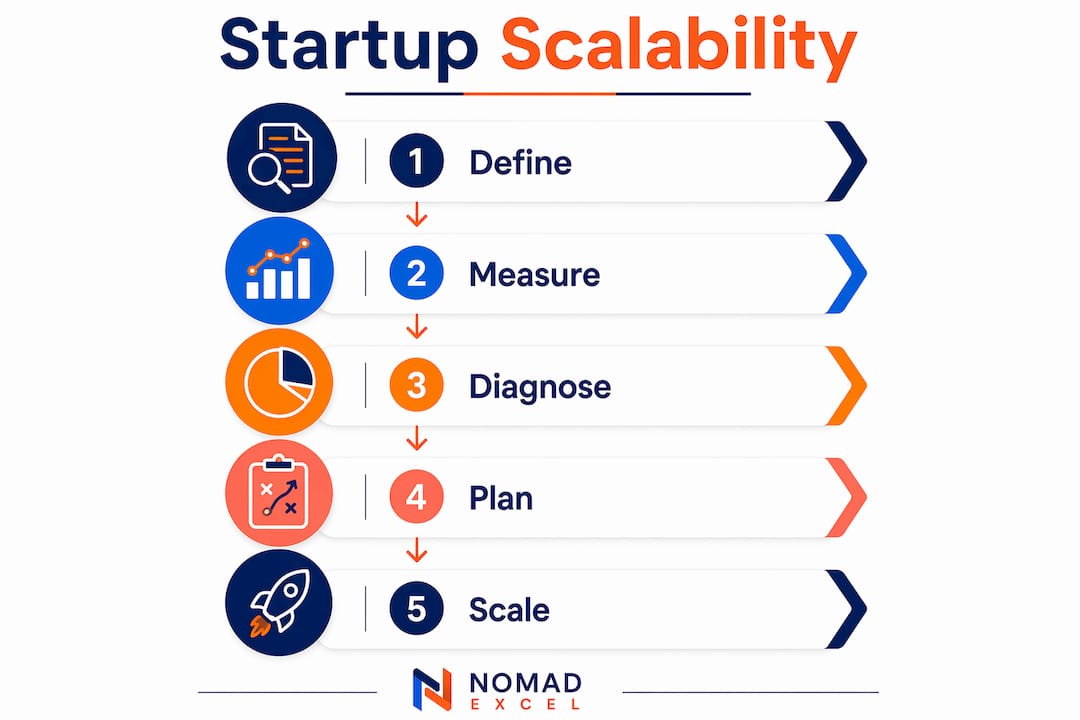
How can founders measure startup scalability?
Measuring scalability means tracking the right numbers at the right stage. The most widely used framework is the Rule of 40, which adds your revenue growth rate percentage to your profit margin percentage. Investors expect scores approaching 40 during the optimization phase. A startup growing at 30% with a 10% margin scores 40 and passes the test. One growing at 60% with a negative 30% margin scores 30 and raises red flags about sustainability.
The LTV:CAC ratio is equally critical. A healthy LTV:CAC ratio is 3:1 or higher. Spending more than one dollar to acquire a customer who returns three dollars is the floor, not the goal. Below that ratio, growth spending accelerates cash burn rather than building value.
Founders should also track burn multiple, which measures how many dollars you burn to generate each new dollar of annual recurring revenue. A burn multiple above 3.0x signals inefficient growth. Runway should stay at a minimum of 18 months to give you time to course-correct without panic decisions.
The top scalability KPIs every early-stage founder should monitor are:
- Monthly recurring revenue (MRR) and annual recurring revenue (ARR) growth rate: the clearest signal of revenue momentum
- Net revenue retention (NRR): measures whether existing customers expand their spend over time; above 100% means growth from your current base alone
- Customer churn rate: high churn destroys scalability because you spend to acquire customers you cannot keep
- Burn rate and runway: track burn rate and runway together to understand how long your current model can sustain itself
- LTV:CAC ratio: the single best measure of whether your acquisition economics can support growth
One critical timing rule: begin serious scalability planning only after achieving consistently increasing revenues over six months. Scaling before that milestone is one of the most expensive mistakes a founder can make.
What are the common challenges when pursuing scalability?
The most dangerous trap in scaling is called the Scalability Paradox. Manual processes work fine at small scale, but rapid growth causes complexity to explode. If you have not built scalable systems before that growth arrives, the business breaks under its own weight. Retrofitting scalability after the fact costs far more than building it early.
Premature scaling is the second major pitfall. Founders who pour money into growth before achieving product-market fit and positive unit economics simply accelerate their path to failure. The product has to work, customers have to stay, and the economics have to make sense before you press the accelerator.
The numbered list below covers the most common scalability challenges and a direct strategy for each:
- Premature scaling before product-market fit. Validate that customers want your product and will pay for it repeatedly before investing in growth infrastructure.
- Hero dependency. When one person, usually the founder, holds all critical knowledge and decisions, the business cannot scale. Shift decisions into documented, repeatable systems.
- Hire timing trap. Hiring cycles take 3–6 months, so waiting until you feel the pain means you are already behind. Hire for current bottlenecks, not future status.
- Complexity explosion. Growth multiplies the number of decisions, processes, and communication channels. Document and automate before growth hits, not after.
- Culture erosion. Rapid hiring without a clear cultural framework dilutes the values that made the early team effective. Codify your culture in writing before your team doubles.
Pro Tip: Audit your technology, finance, people, and processes against a 10x load scenario before you start scaling. If any of those four pillars would break under 10x volume, fix it first.
What practical strategies build a scalable startup?
True scaling requires engineering a repeatable growth engine, not relying on founder-led heroics that eventually hit hard walls. The practical work of building that engine falls into four areas: acquisition, processes, technology, and team.
On acquisition, the goal is to focus on one or two profitable channels where unit economics improve as volume grows. A startup that masters one channel, whether that is content-driven organic growth, paid search, or a referral program, builds a compounding advantage. Spreading thin across five channels produces mediocre results in all of them. For founders building organic acquisition, understanding scalable SEO strategies is one of the highest-leverage investments at this stage.
On processes, scaling fails when businesses rely on the superhuman effort of individuals instead of documented and automated operating systems. Every critical process, from onboarding a new customer to resolving a support ticket, needs a written playbook. Automation handles the repeatable steps. Humans handle the exceptions.
On technology, architecture decisions made at 10 customers follow you to 10,000. Microservices architecture, for example, allows individual components of a product to scale independently rather than forcing the entire system to scale together. That flexibility reduces cost and reduces risk as volume grows.
The table below contrasts the two scaling approaches founders most often choose between:
| Dimension | Founder-hero model | System-driven model |
|---|---|---|
| Decision-making | Founder approves everything | Documented criteria and delegated authority |
| Onboarding | Founder trains each hire personally | Written playbooks and structured programs |
| Customer acquisition | Founder-led relationships and referrals | Repeatable channel with tracked unit economics |
| Process improvement | Ad hoc fixes when things break | Scheduled audits and documented updates |
| Growth ceiling | Hits founder’s capacity limit | Scales with team and technology |
The shift from founder-hero to system-driven is not a one-time event. It is a discipline you practice every week by asking: “Is this decision in a system yet?” For founders ready to build that discipline with structure and accountability, Nomadexcel’s growth strategies resource offers a practical starting point.
Key Takeaways
Startup scalability requires building systems, metrics, and processes that let revenue grow faster than costs, long before growth pressure forces your hand.
| Point | Details |
|---|---|
| Core definition | Scalability means doubling revenue while increasing costs by only 1.1x–1.2x, not 2x. |
| Measure before you scale | Track Rule of 40, LTV:CAC ratio, burn multiple, and NRR before accelerating spend. |
| Time your scaling right | Wait for six consecutive months of revenue growth before committing to scale investments. |
| Build systems, not heroes | Document and automate critical processes so growth does not depend on any one person. |
| Hire ahead of bottlenecks | Hiring takes 3–6 months, so plan hires before the pain arrives, not after. |
What I’ve learned about scalability that most guides skip
Early founders almost always confuse growth with scalability. They see revenue going up and assume the business is scaling. Those are not the same thing. A consulting firm that adds five clients and five consultants is growing. It is not scaling. The ratio between revenue and cost has not changed.
The insight that shifted my thinking was this: scalability is a design decision, not a growth outcome. You build it into the architecture of your product, your processes, and your team structure from the start. Most founders treat it as something to figure out later, after they have traction. By then, the manual habits are baked in, the hero dependencies are deep, and the cost of change is enormous.
The “systems over heroes” principle sounds obvious until you are the hero. Founders are usually the best salesperson, the best product thinker, and the fastest problem-solver in the room. Handing those functions to a system feels like a loss of quality. In reality, it is the only way to grow without burning out or breaking the business.
My honest advice to early founders is to spend one hour per week asking a single question: what did I do this week that only I can do, and how do I build a system so someone else can do it next month? That habit, practiced consistently, is what separates founders who scale from founders who grind.
— Amichai
Build your scalable startup with Nomadexcel
Understanding scalability concepts is the first step. Applying them under real conditions, with experienced mentors and a community of founders who are doing the same work, is where the real progress happens. Nomadexcel’s online entrepreneurship bootcamp gives aspiring and early-stage founders a structured environment to validate their models, build repeatable systems, and develop the growth foundations that investors and customers respond to. The program combines hands-on frameworks, direct mentorship from experienced operators, and a peer network that keeps you accountable long after the program ends. If you are serious about building a business that grows efficiently, not just quickly, this is where that work begins.
FAQ
What is startup scalability in simple terms?
Startup scalability is the ability to grow revenue significantly without growing costs at the same rate. A scalable business can serve far more customers using the same or slightly expanded infrastructure.
What is the Rule of 40 for startups?
The Rule of 40 adds a startup’s revenue growth rate to its profit margin. A combined score of 40 or above signals healthy, sustainable growth to investors.
When should a founder start planning for scalability?
Founders should begin serious scalability planning after achieving consistently increasing revenues over six months. Scaling before that point risks amplifying problems rather than growth.
What does a healthy LTV:CAC ratio look like?
A healthy LTV:CAC ratio is 3:1 or higher, meaning a customer generates at least three times what it cost to acquire them. Ratios below 3:1 accelerate cash burn and undermine long-term growth.
What is the biggest mistake founders make when trying to scale?
The most common mistake is scaling before building repeatable systems, creating a dependency on individual effort that breaks under growth pressure. Documenting and automating critical processes before scaling is the fix.
Comments are closed.