
Why Prioritize Innovation: A 2026 Guide for Leaders
TL;DR:
- Prioritizing innovation leads to higher shareholder returns and long-term competitive advantage.
- Leaders embed innovation into daily operations through culture, governance, and experimentation.
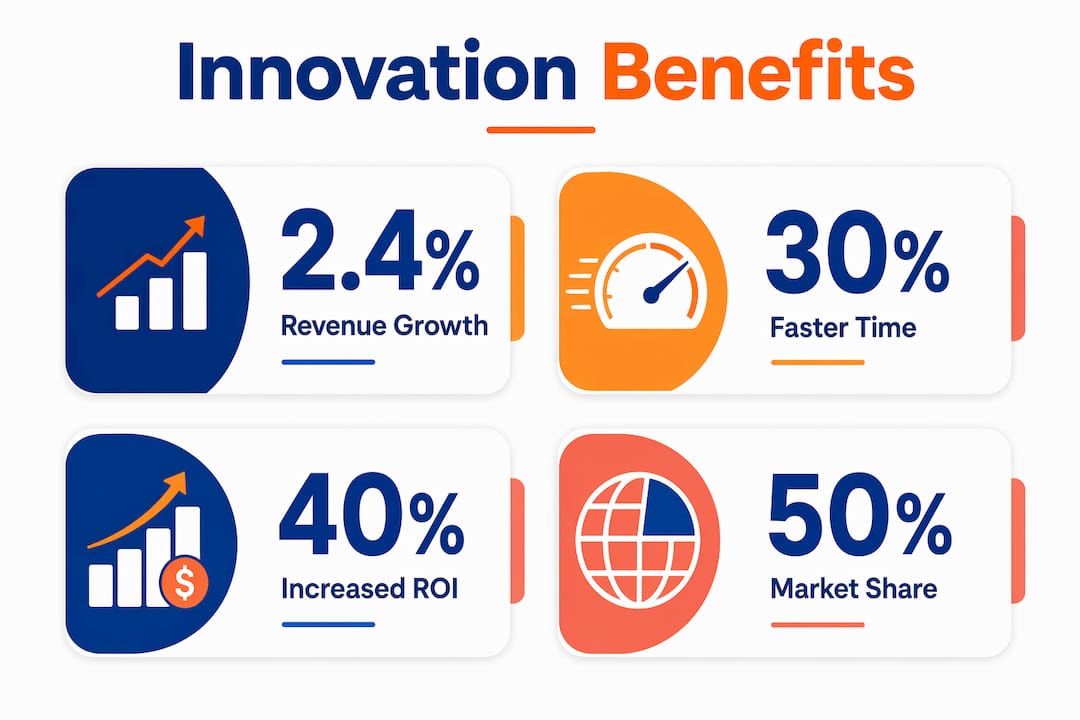
Prioritizing innovation is defined as the deliberate, ongoing commitment to developing new ideas, processes, and products that drive competitive advantage and long-term growth. Business leaders who treat this commitment as optional are already falling behind. Innovation is a survival mechanism where organizations that fail to challenge their own assumptions lose relevance faster than any competitor can take it from them. The case for why prioritize innovation has never been more concrete: top innovators outperformed peers by 2.4 percentage points annually in shareholder returns, even during economic crises. That gap compounds over time into a structural advantage that late movers cannot close.

What measurable benefits does prioritizing innovation bring?
The financial case for innovation is clear and well-documented. Social returns to R&D remain a primary driver of economic prosperity, including higher per-capita income and improved health outcomes. That finding matters for business leaders because it confirms that investment in new knowledge creates value far beyond the original investor.
The benefits of prioritizing innovation show up across several dimensions:
- Shareholder returns: Top innovators consistently outperform peers by 2.4 percentage points annually in total shareholder return, even during volatile periods.
- Market share: Companies that release new products and services ahead of competitors capture customer attention before loyalty forms elsewhere.
- Customer satisfaction: Businesses that iterate on their offerings based on real feedback build products customers actually want, not products leaders assume they want.
- Profitability during downturns: Organizations with embedded innovation practices maintain performance when markets contract, because they have already built the capacity to adapt.
- Talent attraction: High-performing employees choose employers who invest in growth. A reputation for creative problem-solving draws the people who generate the next wave of ideas.
The interpretation here is direct. Innovation is not a cost center. It is the mechanism by which companies protect and grow their market position across every economic cycle.
Pro Tip: Track your innovation investment as a percentage of revenue, not just as a dollar figure. That ratio tells you whether innovation is truly a priority or just a budget line.
How do leading organizations embed innovation as a strategic priority?
The most common mistake leaders make is treating innovation as a project. Projects end. Culture does not. Embedding innovation into governance, talent development, and capital allocation is what separates organizations that sustain growth from those that celebrate one good year and then stagnate.
Leading organizations build innovation into daily operations through three distinct leadership roles:
- Architects set the conditions. They normalize experimentation, remove barriers to collaboration, and create safe environments for learning and candid idea sharing. Without architects, good ideas die in approval queues.
- Bridgers connect people and knowledge across departments and external ecosystems. They prevent the silo effect where the marketing team solves a problem that engineering already solved six months ago.
- Catalysts accelerate momentum. They identify promising experiments, secure resources quickly, and push initiatives from concept to testable prototype before enthusiasm fades.
These three roles must work together. Leadership roles as architects, bridgers, and catalysts must collaborate to scale innovation effectively across organizations and ecosystems. When one role dominates, the system breaks. Architects without catalysts produce beautiful frameworks that never ship. Catalysts without architects produce chaos.
The operational engine underneath all three roles is the experiment. Repeated, rapid learning loops of small viable experiments build sustainable innovation cultures more reliably than large, high-stakes bets. Shrinking the size of each experiment reduces the cost of being wrong, which in turn reduces the fear that kills creative risk-taking.
Pro Tip: Before any new initiative, define what failure looks like in writing. A clear failure criterion makes it safe to stop early and learn fast, rather than sinking resources into a project nobody believes in.
What are the biggest pitfalls that stop businesses from prioritizing innovation?
Most organizations do not fail at innovation because they lack ideas. They fail because of how they manage the process after the first good idea arrives. Many organizations fail at innovation by treating it as a one-off project rather than embedding it into operations and culture.
The most common failure points include:
- Declaring victory too soon. A successful pilot triggers celebration, and then the organization returns to business as usual. The pilot never scales because no one built the systems to sustain it.
- Protecting the wrong things. Leaders protect budgets and timelines but fail to protect the uncomfortable questions that challenge existing assumptions. Those questions are where the real opportunities live.
- Punishing failure publicly. When a team sees a colleague penalized for a failed experiment, every other team stops experimenting. The innovation culture collapses without a single policy change.
- Confusing activity with progress. Running workshops and brainstorming sessions creates the feeling of innovation without producing it. Output requires defined criteria, not just creative energy.
- Ignoring the balance between persistence and experimentation. Some ideas need more time. Others need to be killed quickly. Organizations that cannot tell the difference waste resources on both ends.
The pattern across all these pitfalls is the same. Leaders underestimate how much sustained behavioral change is required. One initiative, one offsite, or one new hire does not shift a culture. Consistent, repeated signals from leadership do.
How can leaders practically build a culture that values innovation?
Building a culture that genuinely values creative problem-solving requires leaders to change their own behavior before asking anyone else to change theirs. Leadership must consistently reinforce innovation culture through behaviors and own failures publicly to enable safe risk-taking across the organization.
The practical steps that work are specific and repeatable:
Set goals tied to learning, not just outcomes. A goal of “launch three experiments this quarter” signals that the organization values the process of learning. A goal of “achieve 20% revenue growth” without process goals tells teams to play it safe.
Flatten hierarchy through deliberate practices. Requiring senior leaders to answer junior questions fosters curiosity and robust debate. This single behavioral change signals that no question is too basic and no assumption is too sacred to examine.
Protect time explicitly. Innovation does not happen in the gaps between meetings. Organizations that foster innovation for team growth schedule dedicated time for experimentation and treat that time as non-negotiable.
Use AI to accelerate learning, not replace thinking. Generative AI tools have commoditized raw idea production. The competitive advantage now belongs to leaders who can frame the right problems, not just generate more options. AI is a research and iteration tool. Strategic problem formulation remains a human skill. Leaders who want to build thought leadership with AI need frameworks that keep human judgment at the center.
Reward the right behaviors. Recognize teams that ran a clean experiment and learned something useful, even when the result was negative. That recognition tells the entire organization what the leadership actually values.
The role of diversity in this process is not symbolic. Teams with different functional backgrounds, life experiences, and mental models identify problems that homogeneous groups miss entirely. Diversity of thought is an innovation input, not a compliance checkbox.
Key Takeaways
The most effective approach to prioritizing innovation is embedding it into leadership behavior, governance structures, and daily operations rather than treating it as a periodic initiative.
| Point | Details |
|---|---|
| Innovation drives measurable returns | Top innovators outperform peers by 2.4 percentage points annually in shareholder returns, even during crises. |
| Three leadership roles are required | Architects, bridgers, and catalysts must collaborate to build and scale innovation across an organization. |
| Small experiments beat big bets | Rapid learning loops with clear failure criteria reduce risk and build a genuine culture of experimentation. |
| Common pitfalls are behavioral | Declaring victory early, punishing failure, and protecting budgets over questions are the primary reasons innovation stalls. |
| Leaders must model the behavior | Publicly owning failures and answering junior questions are the two highest-leverage actions a senior leader can take. |
Innovation is no longer a choice. Here is what I have learned.
The framing I see most often from business leaders is that innovation is something you do when you have time. That framing is exactly wrong, and I have watched it cost companies their best people, their market position, and eventually their relevance.
The organizations I respect most have stopped asking “how do we become more creative?” and started asking “what assumptions are we protecting that we should not be?” That shift is subtle but it changes everything. The digital age demands moving from knowledge ownership to fostering question-asking and challenging assumptions for competitive advantage. The leaders who internalize that shift stop hoarding answers and start rewarding the people who ask better questions.
What I find most underrated is the role of psychological safety in all of this. You can have the best framework, the right budget, and a talented team. If people are afraid to say “I think we are solving the wrong problem,” none of it matters. The innovation strategies for teams that actually work are the ones built on trust first and process second.
My honest observation after working with entrepreneurs and teams across multiple markets is this: the biggest competitive advantage available to any organization right now is the willingness to be wrong in public and learn from it faster than anyone else. That is not a technology advantage. It is a cultural one. And culture is built by leaders, one decision at a time.
— Amichai
How Nomadexcel supports leaders who prioritize innovation
Nomadexcel’s online entrepreneurship bootcamp is built for business leaders and founders who want to move from understanding innovation to executing it. The program combines hands-on frameworks for validating ideas, direct mentorship from experienced operators, and a peer community that holds you accountable long after the program ends. Teams looking for a more immersive experience can explore Nomadexcel’s company retreats, designed to align leadership around growth goals and rebuild the creative energy that daily operations tend to erode. Both programs are built around one principle: growth happens through action, not theory.
FAQ
Why prioritize innovation over other business investments?
Innovation is the mechanism that protects every other investment a business makes. Top innovators outperform peers by 2.4 percentage points annually in shareholder returns, which means the cost of not innovating compounds over time.
What is the difference between innovation culture and innovation projects?
Innovation projects have a start and end date. Innovation culture is an ongoing set of behaviors, norms, and leadership signals that make experimentation the default way of working, not a special initiative.
How do you foster innovation without increasing risk?
Standardized lightweight experiments with clear failure criteria reduce risk by limiting the cost of any single failed idea. Small, fast experiments generate learning without requiring large capital commitments.
What role does AI play in business innovation today?
AI accelerates idea generation and research, but strategic problem formulation remains a human advantage. The leaders who benefit most from AI are those who use it to test assumptions faster, not to replace the judgment required to identify the right problems.
How long does it take to build an innovation culture?
Culture change is measured in years, not quarters. The organizations that succeed treat innovation as a permanent operational priority, not a phase, and they reinforce it through consistent leadership behavior across every level of the company.
Comments are closed.