
How to Foster Innovation for Team Growth and Success
Gathering your team in a new place can be exciting, but making that time truly transformative requires more than just a change of scenery. For early-stage entrepreneurs and small business founders, the real breakthroughs happen when you build a supportive innovation culture that encourages risk-taking and idea sharing. Studies confirm that when mentorship and collaboration are paired with clear goals and safe spaces for experimentation, productivity and creative output rise. Discover how you can harness retreats to spark lasting growth for your team.
Table of Contents
- Step 1: Build a Supportive Innovation Culture
- Step 2: Set Clear Goals and Challenge Assumptions
- Step 3: Cultivate Idea Sharing and Collaboration
- Step 4: Implement Rapid Experimentation Methods
- Step 5: Evaluate Results and Refine Approaches
Quick Summary
| Key Point | Explanation |
|---|---|
| 1. Foster an Innovation Culture | Create a safe environment for risk-taking and experimentation to enhance team creativity and productivity. |
| 2. Set Adaptive Goals | Define clear, measurable objectives that allow for flexibility and encourage questioning of underlying assumptions. |
| 3. Encourage Idea Sharing | Establish low-stakes environments for sharing ideas, promoting mutual engagement and preventing performance pressure. |
| 4. Implement Rapid Testing | Focus on fast, small experiments to test hypotheses and learn quickly, minimizing risks associated with major changes. |
| 5. Regularly Evaluate and Adapt | Systematically assess results to identify trends and make informed adjustments that drive continuous improvement. |
Step 1: Build a Supportive Innovation Culture
Building a supportive innovation culture means creating an environment where your team feels safe experimenting, taking calculated risks, and challenging the status quo without fear of punishment. This isn’t about casual Friday or ping pong tables in the break room. It’s about fundamentally changing how your team approaches problems and views failures. When you establish a culture where collaboration and mentorship strengthen innovation, you create the foundation for sustained growth. The research shows that teams operating in supportive, collaborative environments produce measurable results in productivity and creative output. Your job as a leader is to make this shift visible and consistent from day one.
Start by articulating what innovation actually means within your specific context. For early-stage founders, this might mean encouraging your team to propose process improvements, experiment with new customer channels, or redesign internal workflows. Get clear on the behaviors you want to see. Do you want people speaking up in meetings even if their ideas aren’t fully formed? Do you want them allocating time to side projects? Do you want them approaching customer feedback as an opportunity rather than criticism? Once you define these behaviors, make them part of how you celebrate and reward work. When someone proposes an idea that doesn’t work out, acknowledge the learning publicly. When a team member challenges an existing process and suggests something better, recognize that as success. Companies with strong innovation cultures are 60% more likely to become innovation leaders, and that edge comes from consistent reinforcement of the right behaviors through leadership actions, not just words.
Embed innovation into your operating model by making space for it structurally. This might mean dedicating 10% of work time to experimentation, running weekly ideation sessions, or creating small budgets that teams can access without extensive approval processes. At retreats and bootcamps designed for growth and alignment, teams often discover that removing bureaucratic friction unlocks tremendous creative energy. Your team needs autonomy to test ideas within clear guardrails. They need mentorship from experienced leaders who model curiosity and learning. They need peers who challenge them constructively. When your company retreat focuses on building these relationships and clarifying your innovation priorities, the culture shift accelerates significantly. The key is that your operating model makes it easy, not hard, to innovate.
Pro tip: Document one specific innovation behavior you want to encourage, model it yourself in the next week, and publicly recognize when someone else demonstrates it; this visible pattern reinforces culture faster than any company memo ever could.
Step 2: Set Clear Goals and Challenge Assumptions
Setting clear goals and challenging assumptions work hand in hand. Without clarity on what you’re actually trying to achieve, your team wastes energy debating priorities instead of executing them. Without questioning underlying assumptions, you might pursue goals that no longer matter or approach them in outdated ways. This step is about creating specific, measurable goals that align teams and drive shared ownership, then building a culture where your team actively questions whether those goals still make sense. When done together, these two practices unlock innovation and prevent your team from marching confidently in the wrong direction.
Start by defining goals that are specific enough to guide decisions but flexible enough to adapt as you learn. “Increase revenue” is too vague. “Generate $50,000 in monthly recurring revenue from B2B SaaS customers by quarter end” creates clarity. Your team knows what success looks like. They can make daily decisions that ladder up to that target. They understand how their work connects to the outcome. But here’s where most teams stop, and where you need to push further. Once you’ve set the goal, create psychological safety for questioning it. Encourage your team to ask the uncomfortable questions. Is this goal still aligned with market reality? Are we making assumptions about customer needs that we haven’t validated? Could we reach the same outcome through a different approach? When you build this into your working culture, teams can evaluate options and challenge assumptions rather than simply seeking approval, which keeps you adaptive and prevents goal blindness.
Use structured approaches to make assumption-challenging feel less risky. One effective method is the Reverse Brief Challenge, where team members pitch the problem itself back to the group for collaborative ideation. Instead of everyone focusing on how to hit the revenue goal, someone might raise the question: “What if our revenue goal is built on the wrong customer segment?” This creates space for genuine exploration without someone just being the contrarian. During team retreats focused on alignment and growth, this kind of structured conversation becomes particularly powerful. Your team is together, away from daily distractions, and you can dedicate real time to examining whether your goals and assumptions still hold up. The combination of clear goals with regular assumption checks keeps your strategy current and your team engaged in the thinking, not just the execution.
Pro tip: At your next team meeting, ask each person to write down one assumption underlying your top goal, then discuss which assumptions you should test first; this practice surfaces blind spots quickly and gets everyone thinking critically about your strategy.
Step 3: Cultivate Idea Sharing and Collaboration
Idea sharing and collaboration are not the same thing, and this distinction matters. You can have plenty of ideas floating around without genuine collaboration, and you can have people cooperating on tasks without actually sharing creative thinking. True cultivation happens when you create conditions where people willingly expose half-baked ideas, build on each other’s thinking, and feel energized rather than drained by the process. This step is about structuring your team’s work so that shared discussions and mutual engagement foster new ideas across different perspectives. When your team members understand each other’s expertise and approach, they naturally generate enthusiasm that drives innovation forward.

Start by making idea sharing a regular, low-stakes practice rather than something that happens only in formal settings. Weekly brainstorms, daily standups where people mention what they’re experimenting with, or dedicated Slack channels for half-formed thoughts all normalize the act of sharing. The key is removing the performance pressure. If someone feels like every idea will be critiqued or dismissed, they’ll stop offering input. Instead, create space where ideas are treated as raw material to be refined together, not evaluated for immediate perfection. When team members across different functions collaborate, developing a common understanding of each other’s missions and approaches prevents misunderstandings and encourages productive working relationships. This means your marketing person understands what constraints your product team faces, your operations person knows what your sales team is hearing from customers, and everyone appreciates why different people approach problems differently.
Make transparency about goals and processes non negotiable. When you’re unclear about why a decision matters or how different pieces connect, collaboration becomes harder. People default to protecting their own work rather than optimizing for the whole. During company retreats designed for alignment and growth, this kind of clarity work becomes catalytic. You can spend dedicated time mapping out how different roles connect, what success looks like across functions, and where you actually need collaboration versus where people can work independently. Bring business ideation practices into your team’s weekly rhythm so that generating and refining ideas becomes habitual. The combination of psychological safety, mutual understanding, and clear connection between individual work and team outcomes transforms how your team thinks together. Ideas flow more naturally. Collaboration feels energizing instead of obligatory. Your team starts solving problems you didn’t even know you had.
Pro tip: Create a “collaboration map” showing which teams need to work together regularly and which can operate independently, then schedule monthly check-ins between collaborating teams specifically to share learnings and adjust your approach; this prevents both unnecessary meetings and missed connection opportunities.
Step 4: Implement Rapid Experimentation Methods
Rapid experimentation is how you turn ideas into evidence without betting the company on untested assumptions. Instead of debating whether an approach will work, you build a small version, test it quickly, and learn what actually happens. This step is about creating a rhythm where your team regularly runs short cycles of hypothesis testing, learning, and iteration. When you embrace rapid experimentation that validates hypotheses through quick iterations, you reduce risk while accelerating innovation. Your team stops planning in a vacuum and starts learning from reality.
Start by lowering the barriers to running an experiment. An experiment doesn’t require a polished product, months of development, or perfect data. It requires a clear hypothesis, a simple way to test it, and honest observation of what happens. If you think a new onboarding flow will reduce customer confusion, build a basic version in a day and test it with five customers. If you believe a different pricing model will increase conversion, run it for a week with a small segment and measure the results. The key is speed over perfection. You’re not looking for a definitive answer yet. You’re looking for signals that point you in the right direction. Most teams waste resources by building features nobody wants or optimizing processes that don’t matter. Rapid experimentation prevents this by getting evidence early. Design your experiments to be testable in real-world contexts using methods like A/B testing that reduce uncertainty in decision making. This means your team learns which assumptions hold up and which need rethinking before major investments.
Build a culture where running small experiments becomes normal work, not a special project. Create standard templates for how you document hypotheses and results. Allocate a percentage of each week to testing ideas. Celebrate learning from failed experiments as much as successful ones, because both kinds of experiments move you forward. When your team comes together at a retreat focused on growth and execution, you can establish these rhythms and build shared language around experimentation. You can run live experiments together, learn as a group, and align on which hypotheses matter most for your business. The combination of psychological safety to experiment, simple tools to test quickly, and regular reflection on what you’re learning creates a team that outpaces competitors who are still planning in meetings. Your team becomes skilled at the most valuable capability in business: rapid learning.
Pro tip: Set a rule that every team member should run at least one small experiment per month and share the results in a brief one-page template; this makes experimentation habitual and creates a knowledge base of what actually works for your specific business.
Step 5: Evaluate Results and Refine Approaches
Evaluation without refinement is just measurement. You gather data, create a chart, and then what? The real power comes when you look at what actually happened, compare it to what you expected, and adjust your approach accordingly. This step is about creating a disciplined rhythm where your team regularly assesses what’s working, what isn’t, and what needs to change next. When you use actionable metrics to evaluate innovation efforts and enable continuous refinement, you ensure that learning actually translates into better outcomes. Without this systematic evaluation, your team repeats the same mistakes and misses opportunities to compound small wins into major breakthroughs.
Start by defining what success actually looks like before you run anything. If your hypothesis is that a new workflow will reduce onboarding time, decide in advance how much reduction counts as success and what data you need to measure it. Don’t wait until after the experiment to figure this out. Then run your test, collect the data, and sit down as a team to look at the results honestly. This is where the work of evaluation really begins. You’re not just reading numbers. You’re asking questions. Why did this metric move the way it did? What were we wrong about? What surprised us? What do we want to test next? When teams collect data over time and analyze patterns, they can identify trajectories of change and continuously improve their strategies. This longitudinal perspective prevents you from over-reacting to short-term noise and helps you see the bigger picture of how your team and your approaches are actually developing.
Make evaluation a shared responsibility rather than something the leadership team does behind closed doors. When you share results with the full team and ask for their interpretation, you get richer insights and you build ownership. Someone on your customer support team might notice a pattern in feedback that the conversion metrics don’t show. Your product person might recognize a technical constraint that explains why the experiment underperformed. Create a structured process for evaluation. Schedule a regular rhythm for looking at results, say weekly or biweekly. Use a consistent format so people know what to expect. Move quickly from evaluation to refinement. What do we want to change based on what we learned? Is it worth running another experiment? Should we scale what worked? Should we stop and try something else entirely? At team retreats, this kind of structured reflection becomes particularly valuable. You can dedicate time to analyzing past experiments, connecting patterns across different initiatives, and aligning on your strategy going forward. The team that learns fastest wins. Build the habits that make learning systematic rather than accidental.
Pro tip: Create a simple one-page experiment tracker that captures hypothesis, metric, result, and next action for each test your team runs, then review it monthly as a team to spot patterns and celebrate learning regardless of whether experiments succeeded or failed.
This summary highlights practical tools used in each innovation step:
| Step | Example Practical Tool | Intended Result |
|---|---|---|
| Supportive Innovation Culture | Public recognition of learning | Reinforces positive behaviors |
| Clear Goals & Challenging Assumptions | Reverse Brief Challenge | Surfaces hidden assumptions |
| Idea Sharing & Collaboration | Collaboration maps | Prevents misalignment and silos |
| Rapid Experimentation | One-page experiment template | Captures key learnings quickly |
| Evaluation & Refinement | Experiment tracker | Identifies patterns for improvement |
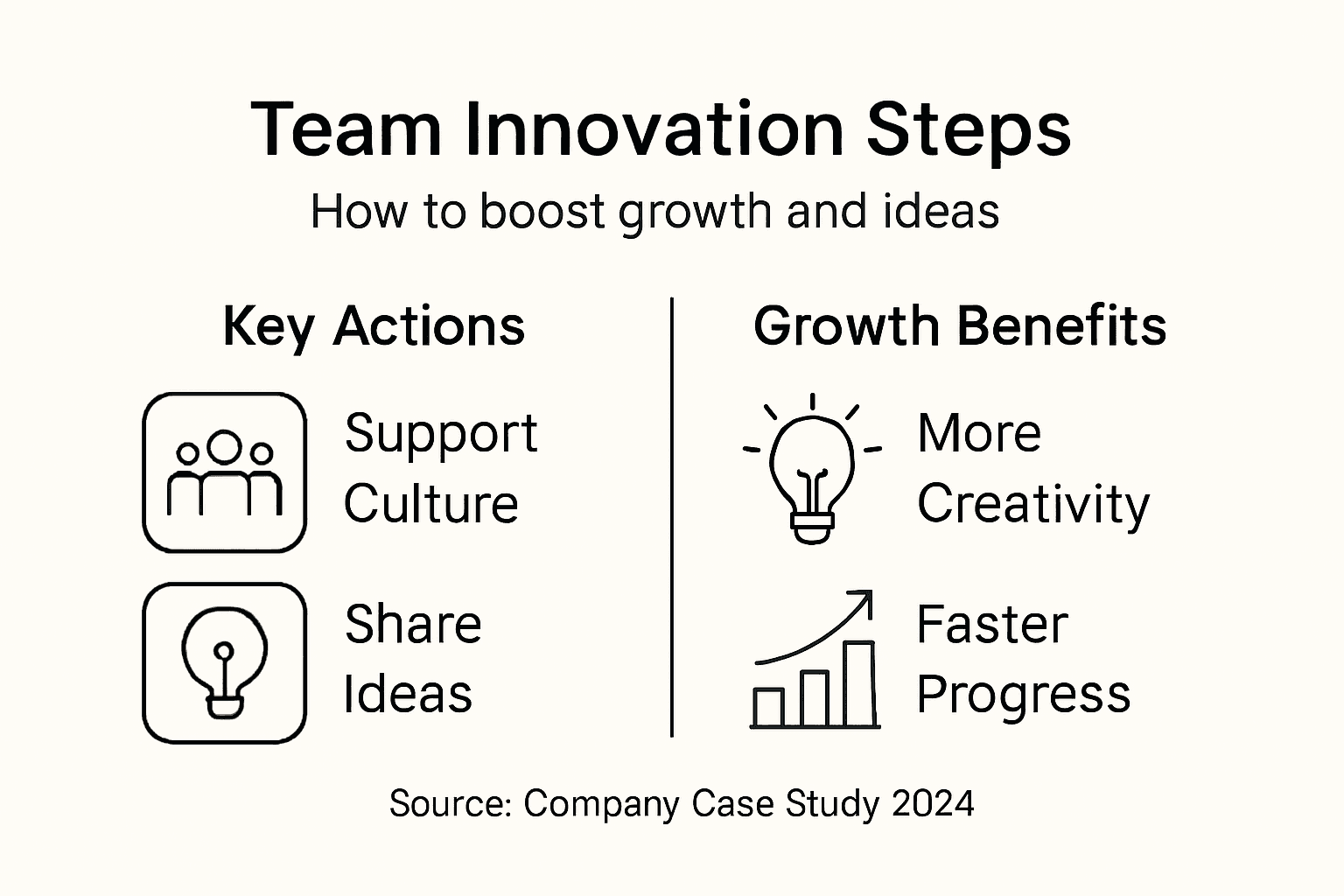
Here’s how the five innovation steps compare in their core focus and team benefits:
| Step | Core Focus | Main Team Benefit |
|---|---|---|
| Build a Supportive Innovation Culture | Fostering risk-taking and trust | Team feels safe to share ideas |
| Set Clear Goals and Challenge Assumptions | Establishing specific, adaptive targets | Keeps the team focused and adaptive |
| Cultivate Idea Sharing and Collaboration | Enabling cross-functional input | Ideas multiply and improve |
| Implement Rapid Experimentation Methods | Fast testing and learning cycles | Evidence-based decisions, lower risk |
| Evaluate Results and Refine Approaches | Data-driven improvement loops | Teams learn and adapt faster |
Unlock Your Team’s True Innovative Potential Today
Are you facing challenges in building a culture where your team feels safe to share ideas and take risks? The journey to fostering collaboration, rapid experimentation, and continuous refinement is essential for lasting growth and success. If your goal is to establish clear innovation habits while aligning your team around specific, adaptive targets, embracing structured ideation and rapid learning cycles can transform your workplace dynamics.
Nomad Excel offers immersive entrepreneurship bootcamps and custom company retreats designed exactly for teams eager to accelerate innovation and execution. Through hands-on mentorship, community support, and expertly facilitated workshops, you can embed the very principles highlighted in this article—like fostering a supportive innovation culture and implementing rapid experimentation methods—directly into your organization’s DNA. Ready to move from theory to action? Explore how our programs empower entrepreneurs and teams to grow faster with clarity and community. Dive deeper into innovation strategies by visiting our Entrepreneurship Archives and discover inspiring insights in our Inspiration Archives. Take the first step toward innovation mastery at Nomad Excel now.
Frequently Asked Questions
How can I create a supportive innovation culture in my team?
Building a supportive innovation culture involves fostering an environment where team members feel safe to take risks and share ideas. Start by publicly recognizing learning experiences from both successes and failures to reinforce positive behaviors. Make this recognition a regular part of team meetings or communications.
What steps should I take to set clear goals for innovation?
To set clear goals for innovation, ensure they are specific and measurable. For example, instead of saying “increase revenue,” aim for "generate $50,000 in monthly recurring revenue from B2B SaaS customers by the end of the quarter.” This clarity helps the team focus on actionable steps.
How can I encourage idea sharing among my team members?
Encouraging idea sharing can be achieved by making it a part of your team’s routine, such as through regular brainstorming sessions or dedicated communication channels. Create a low-pressure environment where half-formed ideas can be openly discussed, enabling team members to build on each other’s ideas collaboratively.
What methods can I use to implement rapid experimentation in my team?
Implement rapid experimentation by allowing team members to test hypotheses quickly without extensive preparation or approval. For example, encourage them to run a small experiment within a week and track outcomes, enabling them to learn what works without risking significant resources.
How should I evaluate the results of innovation efforts?
To evaluate innovation results effectively, create a consistent process where successes and failures are analyzed. Gather your team periodically—perhaps weekly or biweekly—to review metrics, discuss insights, and determine refinements needed based on what was learned from previous experiments.
What are some practical tools to foster innovation?
Some practical tools to foster innovation include public recognition of learning experiences to reinforce culture, collaboration maps to clarify team connections, and one-page experiment templates to quickly capture key insights from tests. Implement these tools to streamline processes and enhance team understanding.
Comments are closed.