
Growth Mindset in Business: Unlocking Team Potential
Most american startup founders underestimate how much mindset shapes business outcomes. Research shows that over 80 percent of successful entrepreneurs attribute their progress to a willingness to learn and adapt. For those jumping into the fast-paced world of immersive bootcamps, adopting a growth mindset matters just as much as refining your pitch or business plan. Here, you will discover why shifting from a fixed way of thinking can spark real innovation, build resilience, and fuel your journey toward scalable success.
Table of Contents
- Defining Growth Mindset In Business
- Core Traits Of Growth-Oriented Teams
- Comparing Fixed Vs. Growth Mindsets
- Real-World Applications And Success Stories
- Overcoming Barriers To Growth Mindset Adoption
Key Takeaways
| Point | Details |
|---|---|
| Embrace Challenges | Cultivating a growth mindset allows individuals and teams to view challenges as opportunities for learning and development. |
| Promote Psychological Safety | Organizations should create environments where team members feel safe to share ideas and learn from failures without fear of ridicule. |
| Encourage Continuous Learning | Implement regular reflection sessions and skill-sharing workshops to foster a culture of ongoing personal and professional development. |
| Model Vulnerability in Leadership | Leaders should exemplify growth mindset principles by sharing their own learning experiences and encouraging experimentation. |
Defining Growth Mindset in Business
A growth mindset represents a transformative approach to professional development where individuals believe their abilities, intelligence, and skills can be systematically developed through dedicated effort, continuous learning, and strategic practice. Unlike a fixed mindset that views talents as static, a growth mindset embraces challenges as opportunities for expansion and views setbacks as crucial learning experiences that drive personal and organizational evolution.
In the entrepreneurial context, growth mindset principles fundamentally reshape leadership perspectives, connecting directly to core traits like resilience, creativity, and adaptability. Researchers have consistently demonstrated that entrepreneurs who cultivate a growth mindset are more likely to persist through complex challenges, experiment with innovative strategies, and maintain motivation during uncertain business environments. These individuals view obstacles not as roadblocks, but as diagnostic tools that provide insights into potential improvements and strategic refinements.
The practical implications of a growth mindset extend beyond individual performance, profoundly impacting team dynamics and organizational culture. Teams embracing this approach create environments of psychological safety where experimentation is encouraged, failures are analyzed constructively, and continuous learning becomes a shared value. By normalizing skill development and promoting a collaborative learning ecosystem, businesses can transform traditional hierarchical structures into adaptive, resilient networks capable of navigating rapidly changing market conditions.
Pro tip: Start implementing growth mindset principles by establishing regular team reflection sessions where challenges are discussed openly, lessons are extracted collaboratively, and individual development paths are mapped with clear, actionable strategies.
Core Traits of Growth-Oriented Teams
Growth-oriented teams distinguish themselves through a unique set of characteristics that transform traditional workplace dynamics into powerful learning ecosystems. These teams are not simply collections of individuals, but adaptive networks that consistently challenge conventional thinking and embrace continuous personal and collective development.
Organizational research reveals key traits that define these high-performance teams. They demonstrate remarkable resilience by viewing challenges as opportunities for learning rather than insurmountable obstacles. Critical attributes include an unwavering commitment to skill development, comfort with uncertainty, and a collective mindset that celebrates effort and progress over inherent talent. Such teams cultivate psychological safety where team members feel empowered to take calculated risks, share unconventional ideas, and learn from both successes and failures without fear of ridicule or professional repercussions.

Effective growth-oriented teams also excel in communication and collaboration. They prioritize active listening, encourage diverse perspectives, and maintain a transparent environment where feedback is considered a gift rather than a critique. This approach enables teams to rapidly iterate, adapt to changing market conditions, and develop innovative solutions that traditional hierarchical structures might overlook. Leaders in these teams serve as growth mindset role models, demonstrating vulnerability, acknowledging their own learning journeys, and creating structures that reward experimentation and continuous improvement.
Pro tip: Implement quarterly skill-sharing workshops where team members teach each other skills from their professional or personal domains, fostering cross-functional learning and team connection.
The following table summarizes key traits that distinguish growth-oriented teams from conventional teams:
| Attribute | Growth-Oriented Teams | Conventional Teams |
|---|---|---|
| Communication Style | Transparent, active listening | Top-down, limited feedback |
| Skill Development | Continuous learning focus | Static, role-specific |
| Risk Attitude | Encourages experimentation | Avoids uncertainty |
| Leadership Approach | Models vulnerability | Maintains authority |
Comparing Fixed vs. Growth Mindsets
Mindsets represent fundamental belief systems that dramatically shape how individuals approach challenges, interpret failures, and pursue personal and professional development. Workplace research reveals critical differences between fixed and growth mindsets, highlighting how these underlying cognitive frameworks profoundly impact professional performance and potential.
Individuals with a fixed mindset perceive their talents and intelligence as static attributes, essentially believing they are born with a predetermined level of capability that cannot be substantially changed. They typically avoid challenges that might expose perceived limitations, react defensively to criticism, and view effort as a sign of inadequacy rather than a pathway to improvement. In contrast, those with a growth mindset view abilities as malleable skills that can be developed through dedicated practice, strategic learning, and persistent effort. These individuals embrace challenges as opportunities for expansion, interpret failures as valuable feedback, and maintain an enthusiastic approach to continuous personal and professional development.
The implications of these mindset differences extend far beyond individual psychology, directly influencing organizational culture, team dynamics, and innovation potential. Fixed mindset environments tend to create competitive, risk-averse cultures where employees protect their perceived competence, resist vulnerability, and minimize opportunities for genuine learning. Growth mindset organizations, however, cultivate environments of psychological safety, collaborative learning, and adaptive problem solving. Leaders with growth mindsets model vulnerability, encourage experimentation, and create systemic structures that reward learning and iterative improvement over static performance metrics.
Here’s a concise comparison illustrating how fixed and growth mindsets impact workplace outcomes:
| Workplace Area | Fixed Mindset Impact | Growth Mindset Impact |
|---|---|---|
| Approach to Challenges | Avoids risks and new tasks | Seeks challenges as learning chances |
| Reaction to Failure | Defensive, minimizes mistakes | Learns from setbacks, adapts process |
| Team Collaboration | Low trust, siloed communications | High trust, open sharing of ideas |
| Innovation Potential | Resists change, limited creativity | Embraces change, sparks innovation |
Pro tip: Conduct monthly personal development reflections where team members share a challenge they overcame, a skill they improved, and lessons learned, reinforcing the growth mindset principle that abilities can be continuously developed.
Real-World Applications and Success Stories
Growth mindset principles transform theoretical concepts into tangible business outcomes, demonstrating remarkable potential for organizational innovation and individual development. Successful companies prove the power of adaptable thinking by embedding learning-oriented strategies throughout their corporate cultures.
Tech giants like Microsoft have become compelling case studies in growth mindset implementation. Under CEO Satya Nadella’s leadership, the company dramatically shifted from a competitive, siloed culture to one that celebrates continuous learning and collaborative problem solving. By encouraging employees to view challenges as opportunities for growth, Microsoft transformed its innovative capacity, successfully pivoting from a traditional software company to a cloud computing and artificial intelligence leader. This radical cultural transformation demonstrates how embracing a growth mindset can fundamentally reshape organizational potential, enabling companies to adapt rapidly in increasingly complex business environments.
Smaller organizations and startups equally benefit from growth mindset principles. Innovative companies like Spotify and Airbnb have built entire organizational structures around the concept of continuous learning, creating environments where experimentation is not just tolerated but actively encouraged. These organizations implement practices like regular skill-sharing sessions, cross-functional project teams, and reward systems that recognize effort and learning progression over strict performance metrics. By dismantling traditional hierarchical barriers and promoting a culture of curiosity and resilience, these companies attract top talent and maintain competitive edges in rapidly evolving industries.
Pro tip: Create a monthly “failure resume” exercise where team members share professional challenges, lessons learned, and personal growth insights, normalizing vulnerability and celebrating learning journeys.
Overcoming Barriers to Growth Mindset Adoption
Transitioning to a growth mindset requires confronting deeply ingrained organizational and personal psychological barriers that resist change. Workplace research reveals critical obstacles preventing meaningful transformation, highlighting the complex psychological terrain businesses must navigate.
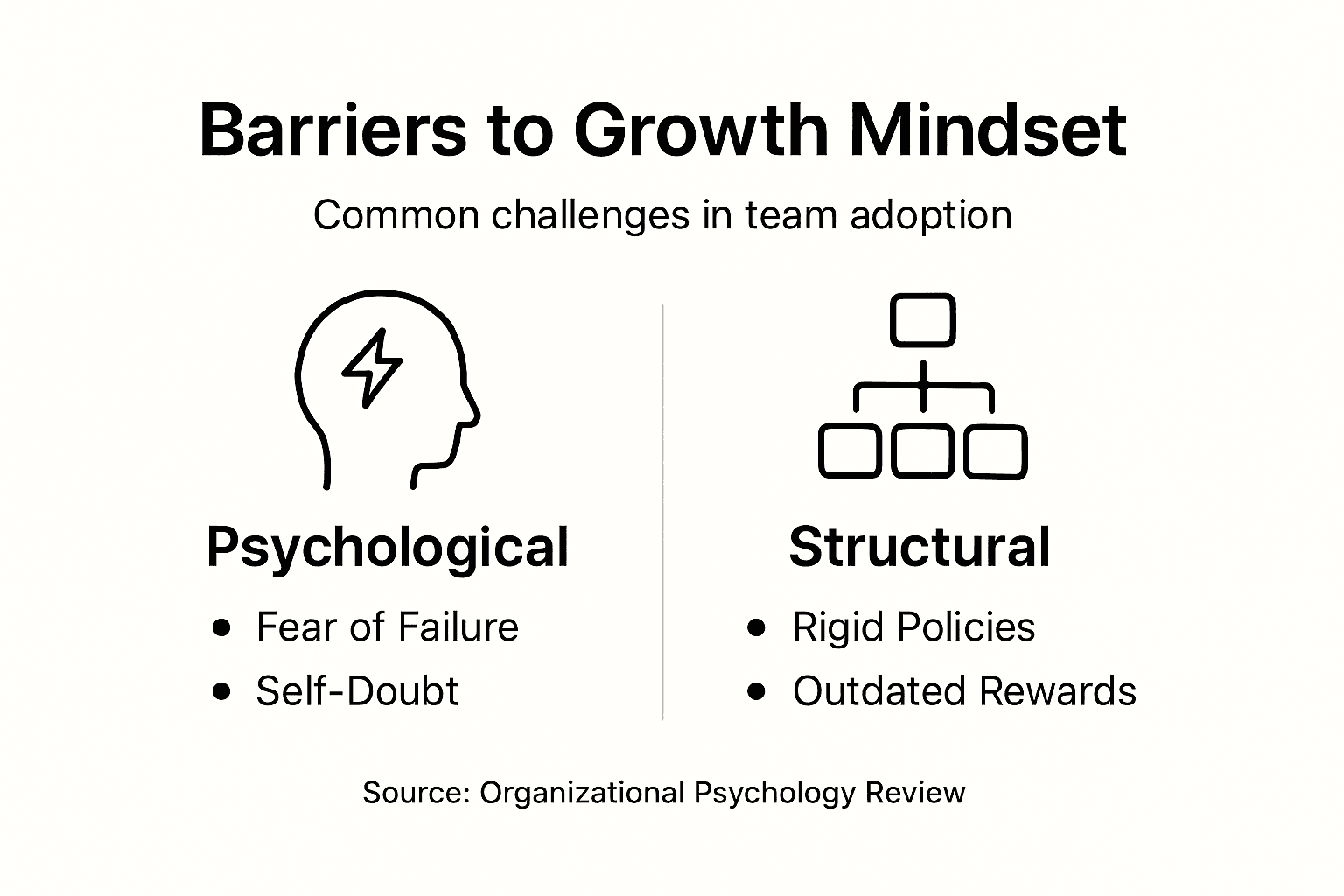
One primary barrier is the fear of failure, which creates defensive organizational cultures that prioritize appearance of competence over genuine learning. Employees in fixed mindset environments often perceive mistakes as personal indictments rather than valuable learning opportunities. This psychological defense mechanism leads to risk avoidance, decreased innovation, and reduced willingness to attempt challenging tasks. Leaders must deliberately create psychological safety by visibly modeling vulnerability, sharing their own learning experiences, and reframing failures as essential steps in skill development and organizational growth.
Institutional resistance emerges from entrenched performance management systems that reward static achievements rather than learning processes. Traditional performance reviews, compensation structures, and promotion pathways typically incentivize protecting existing skills instead of developing new capabilities. Breaking these systemic barriers requires comprehensive organizational redesign, including reimagining reward mechanisms, training programs, and leadership development approaches that explicitly value curiosity, adaptability, and continuous skill acquisition. Successful transformation demands sustained commitment from senior leadership to consistently communicate and embody growth mindset principles throughout all organizational levels.
Pro tip: Implement quarterly “learning reflection” sessions where team members document their skill growth, share vulnerability experiences, and receive constructive feedback that emphasizes development over perfection.
Unlock Your Team’s Full Potential with a Growth Mindset Approach
Building a growth mindset in business means embracing challenges as opportunities and fostering continuous learning within your team. If you recognize the struggle to overcome fixed thinking patterns, fear of failure, or lack of psychological safety in your organization, you are not alone. Many teams face these barriers that slow innovation and hinder development. By focusing on resilience, transparent communication, and collective skill growth, your team can transform into a dynamic, growth-oriented unit ready to adapt and thrive.
At Nomad Excel, we specialize in helping entrepreneurs and teams break through these challenges through immersive experiences designed to accelerate growth. Our Entrepreneurship Bootcamps and customized company retreats provide hands-on mentorship, actionable frameworks, and a supportive community that cultivates exactly the mindset and teamwork described in this article. Take the next step today to foster a culture of learning and innovation that propels your business forward. Visit Nomad Excel now to explore how our programs can empower your team to embrace challenges, drive execution, and unlock new possibilities.
Frequently Asked Questions
What is a growth mindset in a business context?
A growth mindset in business is the belief that abilities and intelligence can be developed through dedication, continuous learning, and strategic practice. It encourages individuals to embrace challenges and view failures as opportunities for growth.
How does a growth mindset benefit team dynamics?
A growth mindset fosters a culture of psychological safety, encourages experimentation, and promotes collaboration. Teams with this mindset are more resilient, innovative, and open to sharing ideas and feedback, leading to improved performance and adaptability.
What are some practical ways to implement a growth mindset in the workplace?
Organizations can implement a growth mindset by establishing regular reflection sessions, conducting skill-sharing workshops, and creating open forums for discussing challenges. Leaders should model vulnerability and encourage a focus on learning from failures rather than only celebrating successes.
How can a growth mindset impact innovation in a company?
A growth mindset enhances innovation by encouraging employees to take risks and think creatively. It reduces the fear of failure, enabling teams to experiment with new ideas and solutions without the constraints of a fixed mindset culture.
Recommended
- Outdoor Group Games For Adults Perfect for Team Building
- The Essential Guide to Benefits of Entrepreneurial Mindset – Nomad Excel – Your Entrepreneurial Adventure Starts Here
- Personal Business Growth: Complete Guide for Entrepreneurs – Nomad Excel – Your Entrepreneurial Adventure Starts Here
- Role of Feedback: Driving Real Business Growth
Comments are closed.