
What Is Business Acceleration: Unlocking Startup Growth
Over half of startups entering business acceleration programs never achieve product-market fit, even as american innovators continue to shape global entrepreneurship. For aspiring founders, understanding the true potential and limits of business acceleration can make the difference between swift growth and wasted opportunity. This guide cuts through common myths, offering clear insights on acceleration models, practical benefits, and pitfalls to avoid so you can execute your vision with focus and confidence.
Table of Contents
- Defining Business Acceleration Models and Myths
- Core Processes That Drive Startup Growth
- Types of Business Acceleration Programs
- Key Benefits and Expected Outcomes
- Common Pitfalls and How to Avoid Them
Key Takeaways
| Point | Details |
|---|---|
| Business Acceleration Models | Understand the four primary operational models of business acceleration to leverage their unique advantages effectively. |
| Core Processes for Growth | Focus on establishing product-market fit and building adaptable teams to navigate challenges and drive growth. |
| Benefits of Accelerator Programs | Expect significant improvements in financial management, market positioning, and networking through structured support and mentorship. |
| Avoiding Common Pitfalls | Stay proactive and critical during the acceleration process to align expectations and maximize program benefits. |
Defining Business Acceleration Models and Myths
Business acceleration represents a strategic approach designed to rapidly propel early-stage startups toward sustainable growth. These programs are carefully structured platforms that provide entrepreneurs with targeted resources, mentorship, and ecosystem connections to transform innovative ideas into viable businesses. Accelerator models analyze critical entrepreneurial capabilities through systematic, time-constrained interventions.
Traditionally, business acceleration involves four primary operational models: cohort-based programs, vertical-specific accelerators, corporate innovation accelerators, and government-sponsored initiatives. Each model offers unique advantages. Cohort-based programs create collaborative environments where entrepreneurs learn simultaneously, share experiences, and build supportive networks. Vertical-specific accelerators focus on particular industries like fintech or healthcare, providing deeply specialized mentorship and industry connections.
Common myths about business acceleration often misrepresent these complex platforms. Many entrepreneurs mistakenly believe accelerators guarantee immediate success or serve as guaranteed funding sources. In reality, systematic reviews demonstrate accelerators stimulate startup potential through mentorship and targeted training programs, not through automatic financial investment. Successful acceleration requires active participant engagement, willingness to adapt, and strategic implementation of learned frameworks.
Pro tip: Research multiple accelerator models and evaluate their specific industry focus, mentor networks, and past cohort success rates before applying to ensure maximum alignment with your startup’s unique growth objectives.
Core Processes That Drive Startup Growth
Startup growth is fundamentally driven by a complex interplay of strategic processes that transform innovative concepts into sustainable businesses. Critical success factors span personal, organizational, and environmental dimensions, requiring entrepreneurs to develop comprehensive approaches that address multiple performance domains simultaneously.
The core processes driving startup growth typically involve several key strategic components. First, establishing product-market fit remains crucial, requiring continuous iteration and validation of the value proposition. Second, building a robust and adaptable team with complementary skills enables startups to navigate complex challenges. Financial management, including strategic resource allocation and capital efficiency, represents another critical process. Entrepreneurs must develop agile systems that optimize limited resources while maintaining flexibility for potential pivots.

Scaling strategies demand sophisticated operational orchestration that integrates talent acquisition, market expansion, and strategic partnerships. Successful startups develop ecosystem-aware approaches that leverage external networks, understand market dynamics, and create scalable operational frameworks. This involves developing strong internal capabilities while simultaneously building connections with potential investors, mentors, and industry partners who can provide strategic guidance and resources.
Pro tip: Create a quarterly review process that systematically assesses your startup’s performance across key growth dimensions, allowing for rapid strategic adjustments and maintaining momentum.
Types of Business Acceleration Programs
Business acceleration programs represent diverse strategies designed to support startup growth across multiple contexts and industries. Business accelerators encompass multiple specialized types, each tailored to address unique entrepreneurial ecosystem needs and startup development challenges.
The primary categories of business acceleration programs include corporate accelerators, seed accelerators, industry-specific accelerators, and academic accelerators. Corporate accelerators leverage established company resources to support innovative startups, providing industry connections and strategic guidance. Seed accelerators focus on early-stage ventures, offering initial funding, mentorship, and structured development programs. Industry-specific accelerators concentrate on particular sectors like technology, healthcare, or fintech, delivering specialized expertise and targeted network opportunities.
Corporate accelerator management significantly impacts startup success, with programs led by experienced entrepreneurs demonstrating superior outcomes. These programs create unique environments where startups can access corporate resources, receive targeted mentorship, and develop scalable business models. Key differentiators include program duration, funding mechanisms, mentorship quality, and integration with broader entrepreneurial networks. Successful accelerators balance structured guidance with flexibility, allowing startups to maintain innovative potential while benefiting from established corporate expertise.
Pro tip: Carefully evaluate an accelerator’s track record, mentor network, and alumni success before applying, focusing on programs that align closely with your specific industry and growth objectives.
Here’s a quick comparison of primary business acceleration program types and their unique strengths:
| Program Type | Distinctive Feature | Ideal Startup Stage | Typical Mentor Network |
|---|---|---|---|
| Corporate Accelerator | Access to corporate resources | Scaling and growth | Industry executives, managers |
| Seed Accelerator | Early funding, structured support | Early pre-revenue | Veteran founders, investors |
| Industry-Specific | Deep sector expertise | Sector-focused growth | Niche experts, industry leaders |
| Academic Accelerator | Research and innovation focus | University spin-offs | Professors, researchers |
Key Benefits and Expected Outcomes
Business acceleration programs deliver transformative benefits that extend far beyond traditional business support mechanisms. Accelerators systematically enhance startup innovation and market readiness by creating structured environments that rapidly advance entrepreneurial capabilities through targeted interventions and strategic resources.
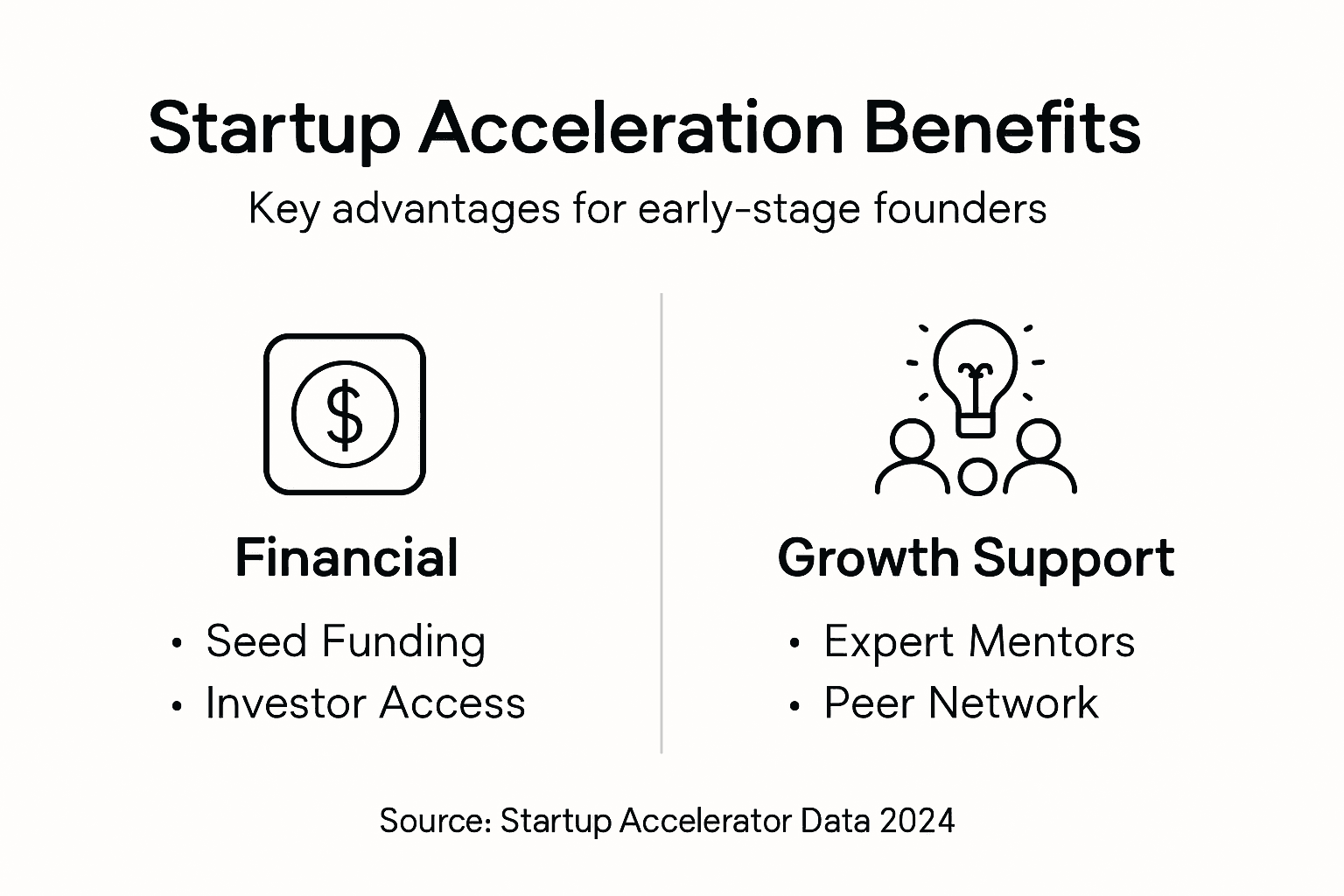
The primary benefits of business acceleration programs encompass multiple critical dimensions. Financially, startups gain improved access to investment networks, with programs often providing direct funding or facilitating connections with potential investors. Strategically, entrepreneurs receive intensive mentorship that helps refine business models, validate market assumptions, and develop robust operational frameworks. Networking opportunities emerge as another significant advantage, with cohort-based programs creating collaborative ecosystems where founders can exchange insights, challenge assumptions, and build lasting professional relationships.
Structured mentorship produces measurable startup performance improvements, driving faster decision-making and more sophisticated business development strategies. Expected outcomes typically include enhanced financial management skills, improved market positioning, accelerated product development cycles, and increased probability of securing follow-on funding. Successful accelerator participants demonstrate higher survival rates, more efficient resource utilization, and greater adaptability in competitive business landscapes. By compressing traditional learning curves, these programs enable entrepreneurs to navigate complex challenges with greater confidence and strategic precision.
Pro tip: Track and document your specific growth metrics during the acceleration program, creating a tangible portfolio of achievements that can attract future investors and opportunities.
For reference, here’s a summary of expected outcomes from joining a well-designed accelerator program:
| Outcome Area | Tangible Result | Potential Business Impact |
|---|---|---|
| Financial Management | Improved funding preparedness | Easier investor engagement |
| Market Positioning | Sharper competitive advantage | Increased brand recognition |
| Product Development | Accelerated go-to-market cycles | Faster customer feedback |
| Networking | Stronger industry relationships | Expanded partnership options |
Common Pitfalls and How to Avoid Them
Business acceleration programs, while powerful, are not infallible pathways to startup success. Significant challenges emerge from inconsistent program design, requiring entrepreneurs to approach these opportunities with strategic discernment and proactive self-management.
The most prevalent pitfalls in startup acceleration programs cluster around three primary domains: misaligned expectations, inadequate preparation, and passive participation. Entrepreneurs frequently misunderstand the program’s intensity, assuming acceleration guarantees immediate success rather than recognizing it as a collaborative learning process. Selection biases can inadvertently create environments that favor certain startup profiles, potentially marginalizing innovative approaches that do not fit conventional frameworks. Founders must critically evaluate program structures, mentor credentials, and historical cohort outcomes before committing significant time and resources.
Accelerator programs require careful ecosystem alignment, demanding founders maintain strategic agency throughout the process. Common missteps include over-relying on mentors, neglecting independent research, and failing to customize generic advice to their specific business context. Successful participants develop a balanced approach, absorbing guidance while maintaining their unique vision. They ask critical questions, challenge assumptions, and view the acceleration experience as a collaborative dialogue rather than a prescriptive roadmap. Understanding that mentorship provides perspective, not definitive answers, becomes crucial for navigating potential program limitations.
Pro tip: Create a personal learning and accountability framework before entering the acceleration program, setting clear personal milestones and metrics to measure your individual progress independent of the program’s standard evaluation criteria.
Accelerate Your Startup Growth with Expert Guidance and Community Support
The article highlights that many entrepreneurs struggle with navigating complex business acceleration programs without clear mentorship, actionable frameworks, and a supportive ecosystem. If you want to overcome these challenges and unlock rapid growth through proven business building steps like refining your offer, achieving product-market fit, and strategic resource allocation, Nomad Excel is here to help. Our immersive entrepreneurship bootcamps combine focused mentorship, hands-on frameworks, and a driven community to ensure you do not just learn theory but execute with confidence and speed.
Explore our tailored programs designed specifically to turn early-stage ideas into scalable businesses. Dive deeper into expert insights and success stories at our Entrepreneurship Archives and discover how a structured acceleration experience can transform your business trajectory in ways that typical accelerators promise but rarely deliver. Ready to join a network that accelerates your growth while sharpening your strategy? Check out our comprehensive program offerings and start your entrepreneurial adventure today by visiting Nomad Excel. Your next breakthrough in business acceleration is just one step away.
Frequently Asked Questions
What is business acceleration?
Business acceleration is a strategic approach designed to rapidly propel early-stage startups toward sustainable growth by providing targeted resources, mentorship, and ecosystem connections.
What are the different types of business acceleration programs?
Types of business acceleration programs include corporate accelerators, seed accelerators, industry-specific accelerators, and academic accelerators, each tailored to support startups in unique ways.
What are the key benefits of participating in a business acceleration program?
Participants can expect benefits such as improved access to investment networks, intensive mentorship, enhanced financial management skills, and valuable networking opportunities that can enhance their startup’s growth potential.
How can startups avoid common pitfalls in acceleration programs?
Startups can avoid pitfalls by setting clear expectations, preparing adequately, actively engaging in the program, and tailoring advice to their specific business context rather than relying solely on mentors.
Comments are closed.