
Step by Step Startup Launch: Your 2026 Founder Guide
TL;DR:
- Following a structured, sequential startup launch process greatly reduces failure risk by validating demand first. Focus on thorough idea validation, building a minimal MVP, meticulous pre-launch preparation, and active post-launch learning to build momentum. Proper sequencing, preparation, and early user feedback are essential for sustainable growth and success.
A successful startup launch follows a clear, sequential process from idea validation to market entry and early growth. The industry term for this is the lean startup process, and it exists because founders who skip steps fail at a measurably higher rate than those who follow a structured sequence. This guide walks you through every phase of a step by step startup launch, from confirming your idea has real demand to executing launch day and building momentum in the weeks that follow. Whether you are pre-revenue or pre-product, this startup launch guide gives you the exact sequence to follow.
What does a step by step startup launch actually involve?
A step by step startup launch is the structured sequence of phases that takes a raw idea from concept to a live product with paying users. Analysis of 89,000+ founders confirms that startups succeed by following a validation-build-sell-scale sequence, and that skipping any phase significantly increases failure risk. The sequence is not arbitrary. Each phase reduces a specific category of risk before you invest resources in the next one.

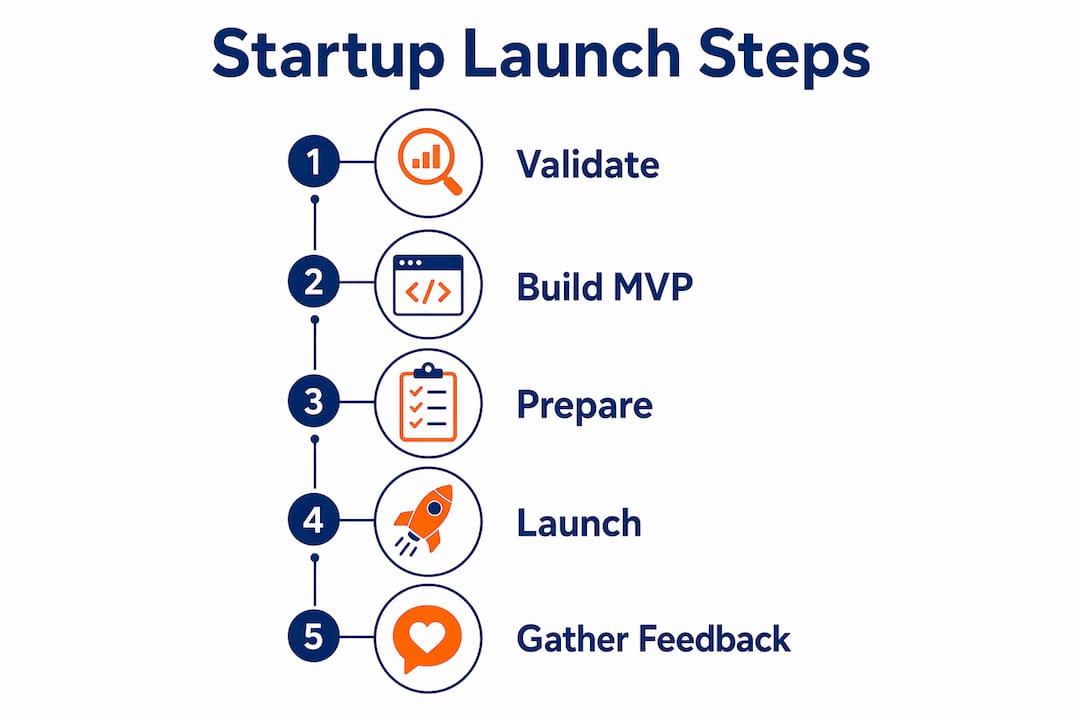
The core phases are: idea validation, minimum viable product (MVP) development, pre-launch preparation, launch day execution, and post-launch growth. Most founders understand these phases in theory. The gap between knowing the phases and executing them correctly is where most early-stage companies lose momentum. This guide closes that gap with specific frameworks, tools, and timing guidance for each phase.
How to validate your startup idea before building anything
Idea validation is the process of confirming that a real problem exists and that real people will pay to solve it, before you write a single line of code or spend a dollar on development. Customer discovery means talking to actual users to validate that a problem exists, not pitching your solution to them. The distinction matters enormously. Founders who pitch during interviews hear polite agreement. Founders who listen hear the truth.
Roughly 42% of startups fail because they build products with no real market need. That number represents thousands of founders who skipped or rushed validation. You can avoid joining that group by following this process:
- Define the problem in one sentence. If you cannot articulate the problem clearly, your potential customers cannot either.
- Conduct 10 to 25 customer interviews. Ask about their current behavior, their frustrations, and what they have already tried. Never ask whether they would use your product.
- Build a landing page to test interest. Tools like Carrd, Webflow, or a simple Notion page can capture email signups and measure real demand within days.
- Test willingness to pay. Present a pricing concept and watch the reaction. Hesitation is data. Enthusiasm is data. Both are more reliable than a survey.
- Set kill criteria in advance. Decide before you start what result would tell you the idea does not work. This prevents confirmation bias from distorting your findings.
A two-week validation sprint focused on problem definition, customer interviews, and landing page testing is enough to confirm or kill most startup ideas. Two weeks of structured discovery is a far cheaper lesson than six months of building the wrong product.
Pro Tip: Record your customer interviews with permission and review them twice. The second listen almost always surfaces insights you missed in the moment.
How to build a focused MVP without overbuilding
An MVP, or minimum viable product, is the smallest version of your product that tests your riskiest business assumption. It is not a beta product, not a prototype, and not a polished version one. It is a learning tool. Founders who treat the MVP as a product to be proud of almost always overbuild it, delay launch, and burn through resources before they have validated anything.
Follow this numbered sequence for a focused MVP build:
- Identify your riskiest assumption. Every startup has one belief that, if wrong, kills the business. Name it explicitly before you build anything.
- Apply the MoSCoW method. Categorize every feature as Must Have, Should Have, Could Have, or Won’t Have. Only Must Haves go into the MVP.
- Set an 8 to 12 week build timeline. An effective MVP build timeline runs 8 to 12 weeks and includes customer interviews, hypothesis mapping, wireframing, sprint builds, and a beta release. Longer timelines usually signal scope creep.
- Set up CI/CD and analytics from day one. Retrofitting observability later costs three times more and slows your product cycle. Tools like Mixpanel, Amplitude, or even Google Analytics give you the data you need to iterate.
- Define your kill criteria for the MVP. Before you launch the MVP to beta users, decide what result would tell you the core assumption is wrong.
| MVP phase | Key activity | Output |
|---|---|---|
| Discovery | Customer interviews and hypothesis mapping | Validated problem statement |
| Prioritization | MoSCoW feature ranking | Lean feature list |
| Build | Sprint-based development with CI/CD | Working MVP |
| Beta release | User testing and error monitoring | Iteration backlog |
Pro Tip: Ship to five real users before you consider the MVP done. Their first ten minutes of use will reveal more than weeks of internal testing.
What to prepare in the 2 to 4 weeks before launch day
The pre-launch phase is where most founders underinvest their attention. Startup launch phases should be planned in structured stages: 2 to 4 weeks pre-launch, launch day execution, and 1 to 4 weeks post-launch follow-up. The pre-launch window is your last opportunity to fix structural problems before real users arrive.
Your launching a business checklist for this phase should cover four areas:
- Legal formation. Register your business entity, obtain an EIN from the IRS, and confirm any industry-specific compliance requirements. The U.S. Small Business Administration provides a structured guide covering legal setup, funding options, and business management basics.
- Team and advisors. Identify gaps in your founding team and bring in at least one advisor with direct experience in your market. Advisors who have made your mistakes before are worth more than almost any other resource at this stage.
- Launch assets. Prepare your landing page, product screenshots, launch copy, and any demo videos. Write your launch posts for Product Hunt, LinkedIn, and your email list in advance. Pre-writing launch posts before launch day reduces messaging errors and increases impact.
- Pre-launch audience. Build an email waitlist and engage in communities where your target users spend time. Reddit communities, Slack groups, and niche forums are high-value channels if you contribute genuinely before you promote. Direct pitching in communities before you have built trust leads to rejection, not traction.
The goal of this phase is to arrive at launch day with zero open questions about your legal standing, your messaging, or your technical readiness.
How to execute launch day for maximum impact
Launch day is a sprint, not a celebration. Preparing launch materials thoroughly the night before reduces decision fatigue and enables timely responses when momentum is highest. Treat the night before as your final preparation window, not the morning of.
Follow this sequence on launch day:
- Publish early on your primary platform. If you are launching on Product Hunt, post between midnight and 1 a.m. Pacific Time to maximize voting hours. For other platforms, publish at the start of the business day in your primary market.
- Email your waitlist immediately after publishing. Your warmest audience acts first. Give them a direct link and a specific ask, such as leaving a review or sharing with one person.
- Amplify across social channels with tailored messaging. LinkedIn, X (formerly Twitter), and relevant communities each require a different tone and format. Copy-pasting the same post across all channels signals low effort and performs accordingly.
- Monitor error diagnostics every 30 minutes. Real traffic surfaces bugs that testing never finds. Have a developer on standby to push fixes.
- Respond to every comment and message within the first four hours. Engagement velocity signals to platform algorithms that your launch is worth amplifying.
Pro Tip: Assign one person to monitor and respond to comments and a separate person to watch error logs. Splitting these roles prevents both from being neglected when things get busy.
How to use post-launch feedback to grow your user base
The first 30 days after launch are the highest-leverage period for learning and retention. What you do in this window shapes your growth trajectory more than any single feature or marketing campaign. Most founders celebrate the launch and slow down. The founders who build lasting companies accelerate after launch.
Your post-launch growth strategy should include:
- Interview your first 10 to 20 users directly. Ask what they expected, what surprised them, and what nearly made them leave. These conversations are your product roadmap.
- Fix critical bugs within 24 hours. Early users forgive rough edges if they see rapid response. They do not forgive being ignored.
- Build a referral mechanism. Tools like ReferralHero or a simple “invite a friend” email sequence can turn satisfied early users into your most cost-effective acquisition channel.
- Start content marketing and SEO immediately. Publishing two to four articles per month targeting your users’ search queries compounds over time. The earlier you start, the earlier you benefit.
- Submit to directories and aggregators. Product Hunt, Crunchbase, G2, and niche directories drive discovery traffic that requires no ongoing effort after submission.
| Metric | What it measures | Why it matters |
|---|---|---|
| Activation rate | % of users who complete the core action | Shows whether onboarding works |
| Day-7 retention | % of users who return after one week | Predicts long-term product stickiness |
| NPS score | Net Promoter Score from early users | Signals word-of-mouth potential |
| Bug resolution time | Hours from report to fix | Reflects team responsiveness |
Monitor these metrics weekly during the first 30 days. Declining retention in week two is a signal to investigate onboarding, not to add features.
Key takeaways
A startup launch succeeds when validation, MVP development, pre-launch preparation, and post-launch learning are executed in sequence, with no phase skipped.
| Point | Details |
|---|---|
| Validate before building | Conduct 10 to 25 customer interviews to confirm real demand before writing code. |
| MVP is a learning tool | Use the MoSCoW method and an 8 to 12 week timeline to build the smallest testable version. |
| Pre-launch prep is non-negotiable | Complete legal setup, build your waitlist, and write all launch assets at least two weeks out. |
| Launch day is a sprint | Publish early, email your list, monitor errors, and respond to every comment within four hours. |
| Post-launch learning drives growth | The first 30 days are your highest-leverage window for feedback, retention, and referral growth. |
What I have learned from watching founders launch
I have watched a lot of founders go through the startup launch process, and the pattern that separates those who gain traction from those who stall is almost never about the idea. It is about sequencing. Founders who skip validation steps increase their failure risk in ways that no amount of hustle can compensate for later. The sequence is not a suggestion. It is the structure that makes every subsequent decision more informed and less expensive.
The founders who overbuild their MVPs share a common belief: that more features mean more credibility. They are wrong. Users do not reward complexity. They reward clarity. The founders I have seen gain the fastest early traction are those who launched something embarrassingly simple, listened hard, and iterated within days. That cycle, repeated consistently, is what builds a product people actually want.
Launch day pressure is real, and it catches almost everyone off guard. The antidote is preparation, not confidence. When you have written your posts in advance, briefed your supporters, and set up your monitoring tools, the day becomes manageable. When you have not, it becomes chaotic regardless of how good your product is.
The most underrated part of the entire process is what happens in the 30 days after launch. Startup launches are often derailed by premature investment in features or team size that prevents pivoting. Stay lean, stay close to your users, and treat every piece of feedback as a gift. The founders who build lasting companies are not the ones with the best ideas at launch. They are the ones who learn the fastest after it.
— Amichai
How Nomadexcel can accelerate your startup launch
Knowing the steps is one thing. Executing them with expert guidance, real accountability, and a community of fellow founders is another. Nomadexcel’s online entrepreneurship bootcamp is built around the exact sequence covered in this guide, from idea validation and MVP development through launch execution and post-launch growth. Each program combines hands-on frameworks, direct mentorship from experienced operators, and daily accountability sprints that turn knowledge into results. If you are serious about launching your venture with clarity and speed, Nomadexcel gives you the structure, the mentors, and the community to make it happen. Your entrepreneurial adventure starts here.
FAQ
What is the first step in launching a startup?
The first step is idea validation. Conduct 10 to 25 customer interviews to confirm that a real problem exists and that people are willing to pay to solve it before building anything.
How long does it take to build an MVP?
An effective MVP build timeline runs 8 to 12 weeks, covering customer interviews, feature prioritization, sprint-based development, and a beta release with monitoring tools in place from day one.
What should I do in the first 30 days after launch?
Interview your first 10 to 20 users, fix critical bugs within 24 hours, build a referral mechanism, and track activation and retention metrics weekly. The first 30 days are the highest-leverage period for learning and growth.
Why do so many startups fail at launch?
Roughly 42% of startups fail because they build products with no real market need. Most of these failures trace back to skipping or rushing the validation phase before committing to development.
What legal steps do I need before launching a startup?
Register your business entity, obtain an EIN from the IRS, and confirm any industry-specific compliance requirements. The U.S. Small Business Administration offers a structured guide covering these steps along with funding options and business management basics.
Comments are closed.