
Business Execution: Turning Plans into Real Growth
Many founders believe that flawless execution simply means following a plan step by step, but real-world business rarely works that way. Confusion about what execution truly involves often leads to wasted effort, missed targets, and frustration within early-stage companies. Understanding the disciplined process of translating your strategy into measurable actions will empower you to avoid common traps, keep your team aligned, and adapt quickly when markets shift.
Table of Contents
- Defining Business Execution And Common Misconceptions
- Core Components And Key Processes Involved
- Leadership’s Role And Accountability In Results
- Major Challenges And How To Overcome Them
- Building A Culture That Drives Execution
Key Takeaways
| Point | Details |
|---|---|
| Execution Requires Agility | Effective execution is not about rigid plans, but rather maintaining responsiveness to market feedback and adapting strategies accordingly. |
| Strategy and Execution Are Interconnected | A successful strategy must be actively worked on through execution; they cannot be treated as separate entities. |
| Leadership Accountability Is Crucial | Leaders must remain engaged in execution processes to demonstrate commitment and ensure alignment throughout the organization. |
| Culture Drives Execution | Establishing a clear culture that prioritizes execution fosters consistent behaviors that reinforce organizational goals and strategies. |
Defining Business Execution and Common Misconceptions
Business execution sounds straightforward, but it’s frequently misunderstood. At its core, execution is the disciplined process of translating your strategy into concrete actions that drive measurable results. It bridges the gap between what you plan to do and what actually gets done. For early-stage founders, execution is where ideas stop being theoretical and start generating revenue, building customer relationships, and creating competitive advantages.
Here’s what often trips up entrepreneurs: they believe execution means rigidly following a predetermined plan, treating it like a static blueprint that should never change. This leads to the first major misconception. In reality, effective execution requires coordination, agility, and cultural engagement, not inflexible adherence to old assumptions. Your market teaches you things your business plan couldn’t predict. Customer feedback reveals flaws in your original assumptions. Competitor moves force you to adjust. Execution means having a clear direction while remaining responsive to what you learn along the way.
Another misconception separates execution from strategy as if they’re opposing forces. Many founders think they can develop a brilliant strategy and hand it off to the team to execute. The problem: execution and strategy are deeply intertwined. A strategy without strong execution is just wishful thinking. Equally problematic, execution without clear strategic grounding wastes effort on activities that don’t advance your core mission. The real challenge lies in ensuring that your day-to-day execution activities—the decisions your team makes, the work they prioritize, the metrics they track—directly support your overall strategic direction. This requires clear, well-communicated strategy that bridges high-level goals to individual projects, focusing on how to change your organizational routines and what to change to support competitive advantage.
A third misconception treats execution as primarily an alignment problem. Get everyone aligned and execution happens automatically, right? Not quite. Yes, alignment matters. But execution also demands real-time monitoring of what’s working, the ability to make course corrections without losing momentum, and a culture where your team feels empowered to solve problems creatively. Many startups fail because they checked the alignment box (mission statement on the wall, quarterly goals defined) but lacked the operational rigor to track progress, identify obstacles early, and adapt quickly. True execution combines the structural elements of alignment with the behavioral elements of agility and accountability.
The most costly misconception is assuming execution is someone else’s job. Founders sometimes think execution belongs to operations managers or team leads, while they focus on vision and strategy. Your involvement in execution is non-negotiable. You need to understand the specific actions your business takes every week. You should know which metrics matter most and whether you’re moving them. You must remove obstacles your team encounters. Your presence in execution keeps strategy grounded in reality and keeps the team connected to the mission.
When you understand execution correctly, you see it as the living practice of bringing your strategy to life through coordinated action, real-time learning, and continuous refinement. It’s not about perfection or rigid planning. It’s about progress.
Here’s a comparison of common misconceptions about business execution versus the reality founders need to understand:
| Misconception | Why It’s Misleading | Reality |
|---|---|---|
| Execution is following a fixed plan | Ignores market or customer changes | Execution requires agility and adaptation |
| Execution and strategy are separate | Assumes strategy can be “handed off” | Execution and strategy are deeply linked |
| Alignment alone ensures execution | Assumes that agreement is enough | Requires monitoring, realignment, and accountability |
| Execution is only operations’ job | Disconnects leaders from outcomes | Leaders must stay involved in execution |
Pro tip: Set up a weekly rhythm where you review three things: what you said would happen, what actually happened, and what you’ll adjust next week—this simple discipline catches misalignment before it derails your business.
Core Components and Key Processes Involved
Execution isn’t a single action—it’s a system made up of interconnected components that work together to move your business forward. Understanding what these components are and how they interact helps you build a framework that actually works rather than just hoping your team figures it out. Think of execution like a car engine. You need the right fuel (strategy), the right parts (processes), mechanics who understand how it all works (people), and a workshop with proper tools (systems). If any piece is missing or misaligned, the whole engine sputters.
The foundation of effective execution rests on six critical elements that must work together. Strategic alignment ensures that every process your team executes connects directly to your business goals. When your team understands why they’re doing something, not just what to do, they make better decisions when situations change. Governance establishes clear roles, decision rights, and accountability. Without this, you get confusion about who decides what, endless meetings that go nowhere, and work that overlaps or falls through the cracks. Methods are the actual tools and techniques you use—the frameworks, templates, and approaches that guide how work gets done consistently. Information technology provides the systems that enable execution, whether that’s a simple spreadsheet, a project management tool, or custom software. People matters because your team’s competence, engagement, and clarity determine whether execution actually happens. Finally, culture shapes whether people feel safe experimenting, admitting mistakes, and solving problems collaboratively or whether they’re afraid to speak up. These six elements create Business Process Management that drives effective execution.

The table below summarizes the six core components essential to effective business execution and their main contributions:
| Component | Main Function | Critical Impact |
|---|---|---|
| Strategic Alignment | Links actions to goals | Ensures focus on business priorities |
| Governance | Clarifies roles and accountability | Reduces confusion and wasted effort |
| Methods | Guides consistent work | Standardizes and improves process |
| Information Technology | Supports task tracking and data use | Speeds execution and reduces errors |
| People | Brings skill and engagement | Drives real progress and innovation |
| Culture | Shapes behavior and risk-taking | Supports adaptability and resilience |
Within this framework, your core processes deserve special attention. Core processes are systematic series of activities that directly generate value for your customers and your business. For a SaaS company, this might include customer onboarding, feature development, and customer support. For a service business, it could be client acquisition, project delivery, and client retention. For e-commerce, it’s supplier management, fulfillment, and customer service. Identifying your core processes means asking a hard question: What are the three to five series of activities that, if executed exceptionally, would give us a competitive advantage and drive most of our results?
Once you identify core processes, the next step is documenting them properly. This doesn’t mean creating a 50-page manual nobody reads. It means capturing the essential steps, the decision points where different situations require different approaches, and the roles responsible for each phase. Good documentation reduces frustration when your team has questions, prevents costly mistakes from people reinventing the wheel, and creates space for innovation because people understand the baseline and can suggest improvements. When new team members join, instead of spending weeks figuring out “how we do things here,” they can get up to speed in days.
The trap many founders fall into is thinking their processes should be permanent. They’re not. Your processes should evolve as your business learns what works. A process that serves you at 10 customers might break completely at 100 customers. Execution demands that you review your core processes regularly—at least quarterly—looking for bottlenecks, confusion, or steps that no longer serve your goal. Ask your team what’s frustrating about the current process. That friction often points to where improvement is possible.
Pro tip: Document your three most important processes using a simple format: step, who does it, decision rules, and tools used—then have someone new to your company follow the document without your help to find gaps before problems hit your business.
Leadership’s Role and Accountability in Results
Here’s the uncomfortable truth about execution: it fails or succeeds based on leadership. Not your team’s effort. Not your tools or systems. Leadership. Your team watches what you prioritize, how you respond when things go wrong, and whether you follow through on commitments. If you say execution matters but spend your time in meetings instead of reviewing metrics, your team notices. If you hold others accountable but excuse your own missed deadlines, accountability dies. Leadership sets the tone for whether execution is real or just words on a vision board.
Accountability starts with you understanding what accountability actually means. It’s not punishment or blame. Effective leaders promote transparency and ethical behavior through accountability, which directly influences organizational performance and governance. Accountability means you own the outcome, even when others contributed to it. It means being clear about what success looks like before work starts, measuring progress honestly, and discussing gaps without defensiveness. It means saying “We committed to X and we hit Y instead. Here’s why, and here’s what we’re adjusting.” That transparency gives your team permission to do the same instead of hiding problems until they explode.
Your role as a leader in execution involves three specific responsibilities. First, set and communicate non-negotiable priorities. Your team can’t execute against everything, so you must decide what matters most and protect those priorities from constant distraction. This is harder than it sounds because the urgent always crowds out the important. A customer calls with a special request. An opportunity emerges that sounds promising. Your instinct is to say yes. But every yes to something new is a no to something you already committed to. Second, remove obstacles your team encounters. Execution slows when your people spend energy fighting systems, unclear decisions, or competing priorities from different leaders. Your job is to unblock them. That might mean deciding between competing needs, clarifying authority, securing resources, or having hard conversations with stakeholders. Third, monitor results relentlessly and adjust. You need to know your key metrics weekly, not monthly. You should understand the gap between what you expected and what actually happened. And you must make decisions quickly about what stays, what changes, and what gets killed.
Authentic leadership that emphasizes integrity and operational adaptability enhances execution outcomes by fostering trust and alignment throughout your organization. When your team trusts that you’re genuine, that you care about the business and about them, they’re more likely to surface problems early and work harder through challenges. When they see you adapt your approach based on new information without losing sight of your direction, they feel safer doing the same. This builds organizational agility, which is how execution happens in a complex, changing world.
One final point: accountability is not delegation. Delegating responsibility is good leadership. But you can’t delegate accountability. You remain accountable for results even when someone else does the work. This is the weight of leadership that many founders underestimate. You’re not just responsible for your own execution. You’re responsible for building systems and culture where your entire team executes well. That means investing time in hiring people capable of ownership, training them in your processes and standards, and creating enough clarity that they understand the why behind their work. It also means having difficult conversations when someone isn’t delivering and making changes when necessary.
Pro tip: Schedule 30 minutes every Friday to review three metrics that matter most: What were we supposed to hit, what did we actually hit, and what does that gap tell us about what needs to change next week—this simple ritual keeps you connected to execution reality and catches drift before it becomes crisis.
Major Challenges and How to Overcome Them
Every founder who’s tried to execute knows the feeling. You have a solid plan. Your team understands the goal. Everyone seems aligned in the meeting. Then weeks pass and somehow you’re nowhere near where you expected to be. This happens to almost every startup because execution has systematic obstacles that good intentions alone cannot overcome. Understanding what these challenges are and how to counter them separates founders who build momentum from those who spin their wheels.
The most common execution challenges cluster into a few categories. Poor communication creates the illusion of alignment when people actually understand your strategy differently. One person thinks the priority is speed. Another thinks it’s quality. A third thinks it’s cost reduction. You all thought you agreed. Lack of leadership commitment signals to your team that execution isn’t actually important, so they prioritize based on their own preferences. Misaligned resources means you committed to a goal but didn’t actually give people the time, budget, or tools to achieve it. Organizational resistance to change happens because people are comfortable with how things work now, even if that way doesn’t serve your new direction. Insufficient capabilities means your team lacks the skills or experience to execute what you’re asking them to do. These obstacles to strategy implementation are well documented, along with proven success factors for overcoming them.
Let’s talk about real solutions. Start with crystal clear goal setting. Not vague mission statements. Specific, measurable outcomes with a timeframe. Instead of “improve customer retention,” say “reduce monthly churn from 8 percent to 5 percent by end of Q2.” This clarity eliminates interpretation and makes misalignment obvious when it emerges. Second, invest in real leadership alignment. Not consensus where everyone agrees everything is fine. Alignment where your leadership team has actually debated the hard choices, understands the reasoning, and commits to supporting the decision even if they preferred a different approach. When your team sees consistent direction from leadership, they stop hedging their bets and commit their full energy. Third, match your organizational structure to your execution priorities. If speed matters most, eliminate approval layers. If quality matters most, add review checkpoints. Don’t keep an organization designed for a different era competing against your execution goals. Fourth, invest in training and capability building. You can’t execute what your team can’t do. If you need better sales execution, your people need sales training. If you need better product development, they need product training. This is not optional if you expect excellence.
The deeper challenge many founders miss is what researchers call the strategy-execution gap. Leadership fragmentation, rigid organizational structures, cultural resistance, and outdated performance metrics prevent strategy from becoming reality. This requires integrated leadership that actively aligns stakeholders around priorities. It demands that you adopt organizational structures flexible enough to respond to what you learn. It means replacing vanity metrics (total signups, total downloads) with real metrics that show whether customers are actually getting value and whether your business is building. Most importantly, it requires building a culture where people feel safe admitting when things aren’t working and feel empowered to solve problems instead of just following instructions.
Here’s what actually matters: execution challenges aren’t usually caused by one thing. They’re caused by combinations of factors reinforcing each other. Poor communication combines with misaligned resources, creating frustration that feeds organizational resistance. Lack of leadership commitment combines with outdated metrics, so nobody can tell if progress is real. The solution isn’t to fix one thing. It’s to address multiple factors simultaneously. Pick your top three obstacles from the list above. For each one, name the specific action you’ll take this week. Communicate those actions to your team and then actually do them. Small, consistent progress removes obstacles faster than grand gestures.
Pro tip: Run a 15-minute “obstacle audit” with your team: ask what’s preventing faster progress on your top priority, listen without defending, and commit to removing one obstacle this week—repeat weekly and watch how quickly execution accelerates.
Building a Culture That Drives Execution
Culture is not about ping pong tables, free snacks, or motivational posters. Culture is the invisible force that determines whether people execute or just show up. It’s the unwritten rules about what actually matters, what gets rewarded, and what gets punished. You can have the perfect strategy, the best tools, and the smartest team, but if your culture doesn’t reinforce execution, none of it works. Culture is where execution lives or dies.
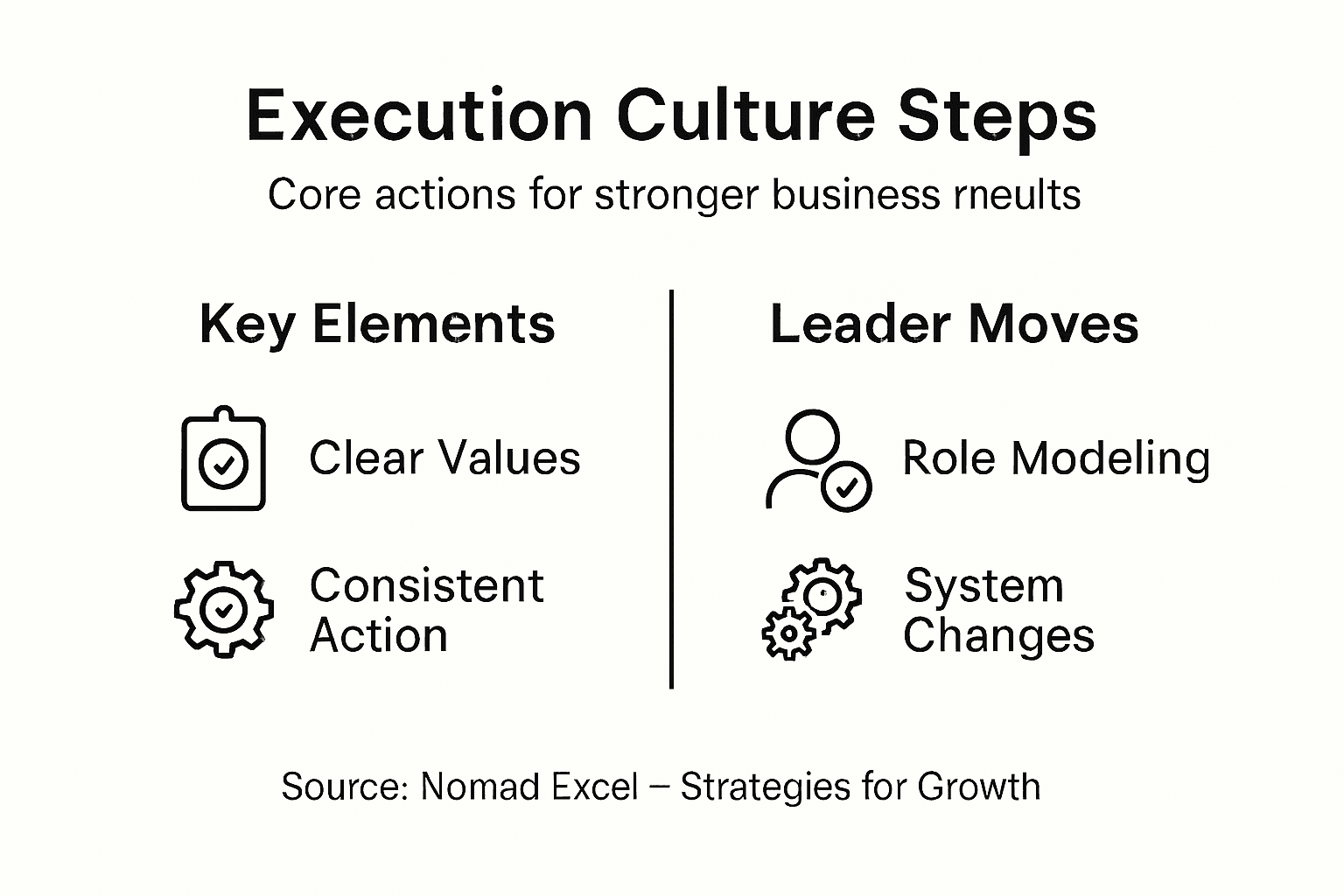
Building an execution-focused culture starts with clarity about what you value and what you expect. A culture focused on execution involves establishing norms, values, and behaviors that prioritize delivering results aligned with your strategy. This sounds abstract until you translate it into real actions. If you value execution, then someone who delivers mediocre results on time is valued more than someone who delivers brilliant results late. If you value speed, then taking risks and learning from failures is celebrated, not punished. If you value collaboration, then hoarding information or taking credit individually gets called out. The key is that your stated values match your actual decisions. When you promote someone because they played politics well despite missing deadlines, you’ve just told your entire team that execution doesn’t actually matter, no matter what the mission statement says.
Leaders shape execution culture by modeling the behaviors they expect. If you ask your team to communicate clearly but you send cryptic emails that create confusion, you’ve undermined your own culture. If you talk about accountability but make excuses for your own missed commitments, accountability is dead. If you preach collaboration but make decisions without input, people stop collaborating. Your actions are the loudest voice in your organization. You can’t fake this. Your team watches constantly. They notice when you stay late working on a priority versus when you disappear to network. They notice when you ask clarifying questions versus when you assume. They notice when you admit you were wrong versus when you double down. The culture either mirrors what you actually do or it mirrors what you want people to think you do. The difference is enormous.
The second lever for building execution culture is embedding it into your systems. Performance reviews should measure execution capability, not just outcomes. Compensation should reward people who execute, not just those who have good ideas. Recognition should celebrate the person who shipped imperfect work on time more than the person whose perfect work is still in progress. Creating a culture that drives execution requires clear organizational goals, supporting systems that promote accountability, and embedding execution priorities into performance management. This means structured communication where execution status is discussed weekly, not hidden until quarterly reviews. It means coaching that helps people improve their execution habits, not just their technical skills. It means professional development that includes execution training. One founder we worked with started rating every team member monthly on three dimensions: clarity (do they understand what we’re trying to do), commitment (are they all in on our priorities), and capability (can they actually execute). That simple framework became part of the culture because suddenly everyone understood that these three things mattered more than seniority or past success.
Here’s what often gets missed: execution culture doesn’t happen by accident or inspiration. It requires sustained intentional building. You need weekly forums where execution status is transparent. You need monthly retrospectives where the team discusses what worked and what didn’t. You need to catch and correct small culture breaks quickly, before they become norms. When someone misses a deadline and makes an excuse, you address it that week, not in a performance review six months later. When someone delivers good work on time, you acknowledge it publicly. When someone ships mediocre work to hit the deadline, you celebrate the choice, not the output. Over time, these small signals compound into a culture where execution is simply how your organization operates.
Pro tip: Set a weekly 15-minute culture check-in where you ask your team two questions: What execution behavior did you see this week that exemplified our values, and what execution behavior concerned you? Listen more than you talk and take notes—this uncovers whether your stated culture matches your actual culture.
Unlock the Power of Execution to Drive Real Business Growth
The article highlights how many entrepreneurs struggle with turning strategy into action due to challenges like lack of alignment, insufficient accountability, and inadequate real-time monitoring. If you have faced these common pain points such as struggling to maintain agility, overcoming execution obstacles, or leading your team through meaningful and measurable progress, you are not alone. Concepts like strategic alignment, leadership accountability, and culture of execution are critical but often difficult to embed without expert guidance and a supportive community.
At Nomad Excel, we understand that execution is not just about following plans but about building momentum through focused, actionable steps supported by strong mentorship and peer collaboration. Our Entrepreneurship Bootcamps are designed specifically to help driven founders like you sharpen clear priorities, establish accountability routines, and accelerate progress with structured sprints and real-world results. For teams looking to enhance alignment and leadership impact, our Company Retreats and Bootcamps create immersive environments to reinforce strategic focus and build a culture that makes execution a natural habit.
Take control of your business execution today and join a community dedicated to turning ideas into measurable growth. Explore how Nomad Excel’s immersive programs can help you close the gap between plans and results by visiting Nomad Excel now and discover the next step to transform your business journey.
Frequently Asked Questions
What is business execution?
Business execution is the disciplined process of turning a strategy into concrete actions that result in measurable outcomes, bridging the gap between plans and actual results.
Why is leadership important in business execution?
Leadership plays a crucial role in business execution by setting priorities, removing obstacles, and monitoring results. Leaders influence team commitment and accountability, directly impacting execution success.
How can I ensure my team stays aligned during execution?
To maintain alignment, establish clear goals, communicate regularly, and monitor progress. Regular check-ins and adapting strategies based on new information can help keep everyone on the same page.
What are some common challenges in executing a business strategy?
Common challenges include poor communication, lack of leadership commitment, misaligned resources, resistance to change, and insufficient capabilities. Addressing these challenges with clear goal setting and leadership alignment can facilitate better execution.
Recommended
- 7 Essential Growth Strategies for Startup Success
- Business Growth Strategy Workflow for Fast Results
- Execution Focused Entrepreneurship Guide for Fast Growth
- Structured Entrepreneurship: Accelerate Growth With Clarity
- Laserschneiden für Gewerbekunden: Effiziente Auftragsabwicklung – Laserdienstleistungen
Comments are closed.