
How to Scale a Startup Remotely: A Founder’s Guide
TL;DR:
- Scaling a startup remotely involves expanding business capacity through distributed teams and systems designed for growth. It relies on self-sufficient pods, asynchronous communication, and outcome-based performance measures to accelerate expansion. Building shared culture, clear documentation, and aligned ownership are key for sustainable remote scaling.
Scaling a startup remotely is defined as the deliberate expansion of business capacity through distributed teams, virtual operations, and systems designed to grow without geographic limits. This approach is no longer experimental. Remote-first companies account for 34% of venture-backed startups as of 2025, up from 12% in 2021. Startups using distributed teams scale up to 3 times faster than those restricted by local hiring. The founders who succeed at remote scaling share three traits: they build systems before they need them, they invest in culture before it breaks down, and they measure outcomes instead of hours. This guide covers exactly how to scale a startup remotely across team design, culture, hiring, tools, and ownership.
How to scale a startup remotely with the right team structure
The most common mistake founders make is replicating an office hierarchy in a remote setting. That structure breaks fast. The better model is self-sufficient pods: small, cross-functional groups of 4–6 people who own a specific outcome and make decisions without waiting for approval from above.

Pod structures prevent bottlenecks as headcount grows from 15 to 50 by distributing authority across the team rather than funneling decisions through a single manager. Each pod should include the skills needed to ship work end to end. That means a pod working on customer acquisition has a writer, a designer, and a growth operator, not three people waiting on a fourth in a different department.
Asynchronous communication is the operating system for this structure. An async-first approach builds 24-hour operational coverage and opens access to global talent. That coverage is a genuine competitive advantage, not just a scheduling convenience.
Time zone management requires deliberate design. Schedule a 2–3 hour overlap window where all pods can connect live. Outside that window, written updates and recorded video briefings carry the work forward. Handoffs between time zones should be documented, not assumed.
- Build pods around outcomes, not functions
- Set a daily async update ritual: written or recorded, under 5 minutes
- Define a 2–3 hour live overlap window for each pod
- Hire globally from the start. Local-only remote hiring limits innovation and signals to top performers that better opportunities exist elsewhere
Pro Tip: Map your team’s time zones on a shared calendar before your next hire. Seeing the gaps visually makes it obvious where to hire next for maximum coverage.
What strategies foster a strong remote startup culture at scale?
Culture does not emerge naturally in a remote setting. It requires the same intentional design you apply to your product. Without that design, you get a group of individuals working in parallel, not a team moving in the same direction.
The foundation is a written set of values that are specific enough to guide real decisions. “We move fast” is not a value. “We ship a working version before asking for feedback” is. Specificity is what makes values usable across a distributed team where no one can read the room.
Rituals carry culture when physical presence cannot. These are the practices that create shared identity:
- A weekly all-hands video call where one team member shares a personal win and one shares a lesson learned
- A written “week in review” document published every Friday by team leads
- A dedicated async channel for non-work conversation, kept active by leadership modeling it first
- A quarterly virtual retrospective where the team audits what is working and what is not
- A structured onboarding buddy program pairing every new hire with a tenured team member for their first 30 days
Onboarding is where culture either takes root or gets lost. New hires who receive a clear 30-60-90 day plan, a written culture guide, and a dedicated point of contact integrate faster and stay longer. Remote work failure stems from policy and process failures, not technology. That finding applies directly to onboarding: the process must be documented and repeatable, not improvised.
Pro Tip: Record a personal welcome video from the founder for every new hire. It takes 10 minutes and creates a connection that a written email cannot replicate.
How to refine hiring and onboarding for a remote scaling startup?
Remote scaling requires a different hiring profile than office-based growth. The skills that predict success in a distributed team are autonomy, written communication, and self-direction. These are not soft skills. They are operational requirements.
Informal alignment breaks down once distributed teams grow beyond 15–20 people. That threshold is the signal to formalize your hiring process with structured documentation: a written job brief, a skills-based assessment, and a clear rubric for evaluating candidates. Founders who skip this step end up rehiring for the same role within 12 months.
Key hiring and onboarding practices for remote scale:
- Write job descriptions that specify remote work expectations, not just role responsibilities
- Use asynchronous assessments, such as a short written task or recorded response, to evaluate communication before the first call
- Build an onboarding checklist that covers tools, culture, role expectations, and first deliverables within the first week
- Assign a 30-day milestone: one concrete output the new hire owns from day one
- Measure output, not input. Track deliverables, not hours logged
| Onboarding stage | Key action | Success signal |
|---|---|---|
| Day 1 | Tools access and culture guide delivered | New hire completes setup independently |
| Week 1 | Buddy introduction and role brief | First async update posted by new hire |
| Day 30 | First milestone delivered | Output reviewed against written rubric |
| Day 60 | Feedback session with team lead | New hire identifies one process improvement |
| Day 90 | Full pod integration | New hire contributes to pod decision-making |
Measuring output instead of presence is the single biggest trust-building mechanism in a remote startup. It signals to your team that you hired adults and you treat them accordingly. For guidance on building remote teams that perform from day one, the frameworks around global talent access are directly applicable here.
What remote tools and processes maximize startup scaling efficiency?
Tool selection is a leverage point that most founders undervalue. The goal is not the most tools. It is the fewest tools that cover communication, project management, and documentation without creating friction between them.
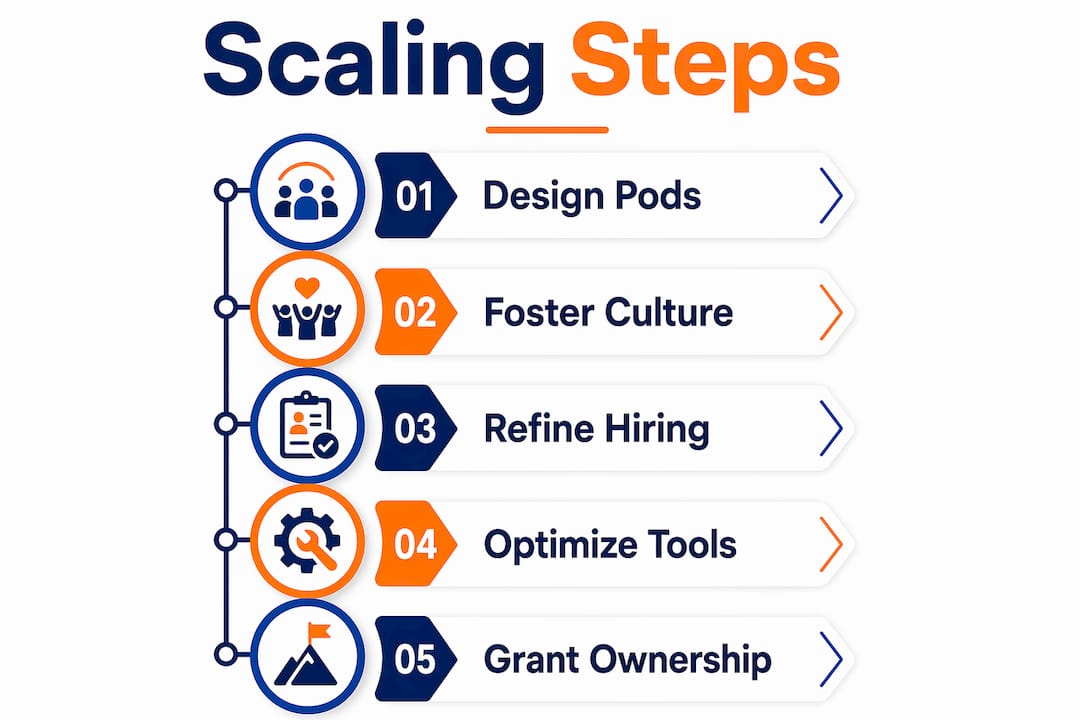
Optimizing your tool stack reduces context switching by 15–20% and increases daily focus time. That gain compounds across a team of 20 people into hundreds of recovered hours per month. Run a quarterly tool audit: list every tool in use, identify which ones overlap in function, and cut the redundant ones.
| Tool category | What it covers | Audit question |
|---|---|---|
| Communication | Async messaging, video updates | Does this replace a meeting? |
| Project management | Task tracking, pod ownership | Can every team member see status without asking? |
| Documentation | Decisions, processes, onboarding | Is this the single source of truth? |
| Video async | Recorded updates, walkthroughs | Does this eliminate a recurring sync call? |
Meetings are the most expensive process in a remote startup. Eliminating 30–40% of meetings increases daily focus time by 1–2 hours per employee. That is not a minor efficiency gain. For a team of 15, it recovers 15–30 hours of deep work every single day.
The rule for meetings is simple: if the outcome can be achieved with a written update or a recorded video, the meeting should not exist. Reserve live calls for decisions that require real-time debate and relationship-building moments that async cannot replicate.
Async-by-accident teams fail. Async-first teams document rigorously and communicate through written and video updates by design. The difference is intention. Build the process before the team grows, and the habit becomes self-reinforcing. For practical collaboration tactics that work across distributed teams, remote team collaboration frameworks offer tested approaches.
How does granting ownership empower remote teams and accelerate scaling?
Ownership is the mechanism that makes remote scaling sustainable. Without it, founders become the bottleneck for every decision, and growth stalls at the point where their attention runs out.
Implementing OKRs or outcome-based frameworks increases engagement by 23% and reduces turnover by 17%. Those numbers reflect a simple truth: people perform better when they understand what winning looks like and have the authority to pursue it.
Practical ownership practices for remote startup founders:
- Assign each pod a single measurable outcome per quarter, not a task list
- Give pod leads the authority to make decisions within their domain without approval
- Replace weekly status meetings with weekly written outcome reports
- Build a public dashboard where every pod’s progress is visible to the whole team
- Conduct monthly one-on-ones focused on obstacles, not updates
The shift from time tracking to outcome measurement is the hardest cultural change for founders who came from traditional work environments. It requires building trust online through transparency and consistent follow-through, not surveillance. Founders who make this shift report that their teams become more proactive, not less accountable. The data supports it: outcome-based management is the operating model of the fastest-growing remote startups.
Key Takeaways
Scaling a startup remotely requires deliberate systems for team design, culture, hiring, tools, and ownership, built before growth makes them urgent.
| Point | Details |
|---|---|
| Design pods early | Build self-sufficient cross-functional pods before headcount exceeds 15 people. |
| Document culture explicitly | Write specific values and repeatable rituals before informal alignment breaks down. |
| Hire for autonomy | Assess written communication and self-direction before evaluating technical skills. |
| Cut meetings aggressively | Eliminate 30–40% of recurring meetings to recover 1–2 hours of focus time per person daily. |
| Measure outcomes, not hours | Use OKRs or outcome-based frameworks to increase engagement and reduce turnover. |
What I’ve learned about remote scaling that most guides miss
Most remote scaling advice focuses on tools. The real leverage is in the transitions, specifically the moments when your startup crosses a headcount threshold and the informal systems that worked before suddenly stop working.
The jump from 10 to 20 people is where most remote startups quietly fracture. Communication that worked through Slack messages and weekly calls becomes noise. Decisions that used to happen in a founder’s head now need a process. Founders who anticipate this transition and build documentation systems at 10 people, not 25, avoid the painful reorg that otherwise follows.
The second thing most guides miss is that async communication is a skill, not a setting. Founders who model it consistently, by writing clear updates, recording concise videos, and responding to async messages before jumping on a call, create teams that adopt the behavior naturally. Founders who preach async but default to calls train their teams to do the same.
The third insight is about culture investment. Founders often treat culture as a “nice to have” that gets attention after the operational fires are out. Remote startups that scale well treat culture as infrastructure. They budget time for it, assign ownership of it, and measure it through retention and engagement, not vibes.
The balance between cultural investment and operational discipline is not a tension. It is a reinforcing loop. Teams with strong culture execute better. Teams that execute well attract better talent. That cycle is what remote scaling actually looks like when it works.
— Amichai
How Nomadexcel helps founders build remote startups that scale
Founders who understand the theory of remote scaling still face a gap between knowing and doing. Nomadexcel’s online entrepreneurship bootcamp closes that gap with structured frameworks, direct mentorship, and a community of founders working through the same challenges. The program covers team design, systems building, and execution in a format built for early-stage and growth-stage founders. Participants leave with a clearer strategy, tested processes, and a network that continues to support their growth long after the program ends. For founders ready to move from planning to building, Nomadexcel’s mentorship program provides the guidance that accelerates that transition.
FAQ
What does it mean to scale a startup remotely?
Scaling a startup remotely means growing business capacity through distributed teams and virtual operations without relying on a central office. It requires deliberate systems for communication, hiring, culture, and performance measurement.
How fast can a startup scale with a remote team?
Startups using distributed teams scale up to 3 times faster than those limited to local hiring. Access to global talent and 24-hour operational coverage are the primary drivers of that speed advantage.
What is the biggest risk when scaling a remote startup?
The biggest risk is informal alignment breaking down as the team grows beyond 15–20 people. Founders who do not formalize documentation and communication protocols before that threshold face significant coordination failures.
How do you measure performance in a remote startup?
Remote startups measure performance through output and outcomes, not hours worked. Implementing OKRs or outcome-based frameworks increases engagement by 23% and reduces turnover by 17%, making them the standard for distributed teams.
What is the best team structure for a remote startup?
Self-sufficient pods of 4–6 people, each owning a specific outcome, are the most effective structure for remote startup growth. This model distributes authority and prevents management bottlenecks as headcount scales.
Comments are closed.