
Startup Accountability Methods for Founders: 2026 Guide
TL;DR:
- Startup accountability methods ensure clear ownership and measurable progress within early-stage businesses.
- They rely on written commitments, specific goals, and regular visibility check-ins to drive execution.
Startup accountability methods are systematic approaches that ensure ownership, transparency, and measurable progress across every function of an early-stage business. Without them, execution breaks down fast. Goals drift, ownership blurs, and founders end up chasing status updates instead of building. The most effective accountability systems combine role clarity and a consistent operating cadence with written commitments and regular visibility check-ins. Frameworks like the Entrepreneurial Operating System (EOS) and industry-standard visibility cadences give founders the structure to hold teams accountable without micromanaging. Nomadexcel works with founders daily on exactly these systems, and the results are consistent: clarity drives execution.
What are the foundational principles of startup accountability methods?
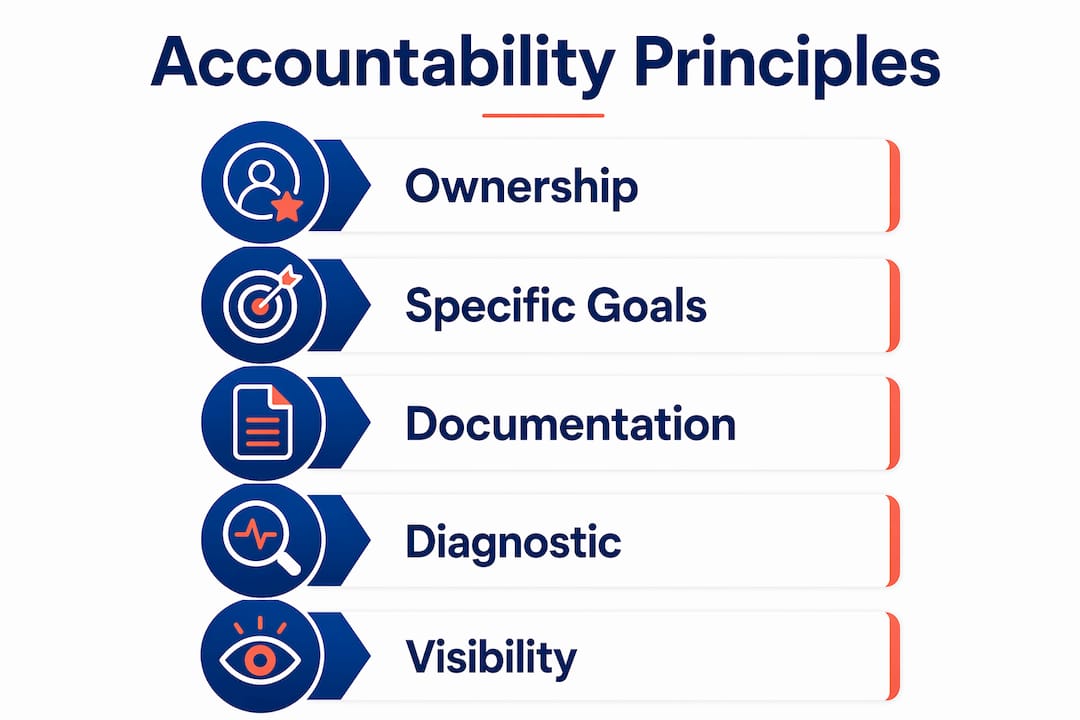
Accountability in startups works when it follows a small set of non-negotiable principles. Break any one of them and the whole system leaks.
1. Single ownership, always
Shared accountability means no accountability. Every commitment needs one clearly named owner, one deliverable, and one deadline. When two people share a goal, each assumes the other will handle it. Startups cannot afford that ambiguity.
2. Deliverables must be specific and time-bound
Vague goals produce vague results. “Improve customer retention” is not a commitment. “Reduce monthly churn below 3% by March 31” is. Specific, time-bound deliverables create a clear finish line and make progress visible to everyone on the team.
3. Public documentation creates real pressure
Written commitments shared with the team carry more weight than verbal agreements made in a one-on-one meeting. Public documentation is not about surveillance. It creates the social pressure that keeps founders and team members honest about their progress without anyone having to chase updates.
4. Accountability is diagnostic, not punitive
Punitive accountability encourages hiding problems rather than solving them. When missing a target triggers blame, people stop reporting early warning signs. Effective accountability treats missed goals as data. The question is always “What blocked this?” not “Who failed?”
5. Visibility cadences replace micromanagement
The industry-standard visibility cadence for high-performing teams is a weekly 15–20 minute peer-to-peer meeting covering three questions: What did you complete? What are you working on next? What is blocking you? This format prevents micromanagement while keeping progress visible. It also builds a culture of peer accountability, where ownership comes from within the team rather than from a founder watching over everyone’s shoulder.
Pro Tip: Run your weekly check-ins as standing meetings at a fixed time each week. Consistency matters more than duration. A reliable 15-minute rhythm beats an occasional hour-long review every time.
How can founders implement accountability structures using tools and frameworks?
Principles without structure stay theoretical. Founders need concrete tools and rhythms to make accountability real.

The EOS accountability chart
The EOS Accountability Chart is one of the most practical frameworks available for early-stage teams. It maps every function in the business to a specific role, and every role to measurable outcomes. Unlike a traditional org chart, it prioritizes functions over job titles. That distinction matters because titles create hierarchy, while functions create clarity. The chart is updated quarterly and shared with the entire team so everyone understands who owns what and how success is measured.
Founders using the EOS Accountability Chart report fewer overlaps, fewer dropped balls, and faster decision-making. The reason is simple: when each function has one owner and one set of metrics, there is no room for ambiguity. You can read more about implementing EOS in your startup to see how this framework applies in practice.
Defining KPIs for each role
Every role in your accountability chart needs at least two or three measurable KPIs attached to it. Without metrics, accountability becomes subjective. With them, performance conversations focus on data rather than perception. Common startup KPIs include monthly recurring revenue (MRR), churn rate, active users, and conversion funnel completion rates.
Analytics tools for real-time tracking
Basic startup analytics tools cost between $9 and $49 monthly and can be set up in as little as five minutes. They provide growth metrics dashboards, experiment tracking, and investor-ready reports. That price point removes the excuse that tracking is too expensive or complex for an early-stage team.
| Accountability element | Recommended frequency | Purpose |
|---|---|---|
| Peer-to-peer visibility meeting | Weekly | Surface blockers and confirm progress |
| KPI dashboard review | Weekly | Track MRR, churn, active users |
| Accountability chart update | Quarterly | Clarify roles and measurable outcomes |
| Written project plan review | Per project start | Define objectives and success criteria |
| Investor-ready report | Monthly | Validate growth and experiment results |
Pro Tip: Delegate decision rights alongside task ownership. If a team member owns a goal but must ask you before every decision, the bottleneck is still with you. True delegation means they can act without waiting.
Founders who stay accountable as entrepreneurs build teams that mirror that behavior. The accountability culture you model is the one your team adopts.
What are the most common accountability pitfalls in startups?
Even founders who understand accountability principles fall into predictable traps. Recognizing them early saves months of lost execution.
- Shared ownership with no single name attached. When a project lists two co-owners, accountability evaporates. Assign one person. The other can support, but only one person answers for the outcome.
- Founder bottleneck. When the founder is the final decision-maker on every project, team ownership cannot develop. Accountability requires distributed decision rights, not centralized approval chains.
- Meetings used as status updates. Most founders misuse meetings to collect information they could read in a shared document. Effective check-ins diagnose blockers and confirm progress against documented outcomes. Status updates belong in writing, not in meetings.
- Verbal commitments with no written record. A commitment made in conversation and never documented is a commitment that will be forgotten or reinterpreted. Written plans create reviewable records that hold up under pressure.
- No operating rhythm. Without a consistent cadence of reviews and updates, accountability leaks between meetings. Teams lose sight of goals, and founders lose visibility into what is actually happening.
“Execution issues often stem from poor scoping. Requiring brief written plans specifying what and why improves accountability and reduces constant status chasing. Written plans create reviewable documents, increasing transparency and ownership.”
The fix for most of these pitfalls is the same: design the system before you need it. Waiting until accountability breaks down to build structure is like installing a fire alarm after the building is already burning. A well-designed business accountability workflow prevents these gaps from forming in the first place.
Which routines best track startup performance and foster growth?
Startup performance tracking works best when it combines visible goals with regular diagnostic check-ins. Neither alone is sufficient.
1. Weekly peer-to-peer stand-ups

The three-question format (completed, next, blockers) keeps meetings short and focused. Each team member answers all three questions in writing before the meeting. The meeting itself becomes a conversation about blockers, not a recitation of updates. This structure builds peer collaboration and accountability without requiring a manager to run every session.
2. Shared commitment boards
A shared board or project tracker gives everyone always-accessible visibility into commitment statuses. Tools in this category range from simple kanban boards to more structured project management platforms. The format matters less than the consistency of use. Every commitment lives on the board. Every update happens there. No one has to ask for a status report.
3. Metrics-driven accountability
Tracking KPIs like MRR, churn rate, active users, and conversion funnel rates ties accountability to business outcomes rather than activity. Activity-based accountability (measuring hours worked or tasks completed) misses the point. Outcome-based accountability (measuring whether the business is growing) keeps the team focused on what matters.
4. Experiment tracking for growth validation
Early-stage startups run experiments constantly. Tracking those experiments with documented hypotheses, results, and decisions creates a learning record that compounds over time. It also produces the investor-ready reports that startup analytics tools generate automatically at the $9–$49/month price point.
5. Early intervention through diagnostic check-ins
Combining goal visibility with diagnostic check-ins allows founders to catch problems before they become crises. When a KPI moves in the wrong direction, the weekly check-in surfaces the blocker immediately. The team diagnoses the cause and adjusts. This rhythm is what separates startups that execute from those that plan endlessly without results.
The team values developed offsite often reinforce the accountability culture built through these routines. Retreats and offsite sessions give teams space to align on the behaviors and commitments that make accountability systems stick.
Key Takeaways
Effective startup accountability requires single ownership, written commitments, and a consistent weekly cadence to keep execution on track.
| Point | Details |
|---|---|
| Single ownership is non-negotiable | Assign one named owner to every commitment; shared ownership produces no ownership. |
| Use the EOS Accountability Chart | Map every function to measurable outcomes and update the chart quarterly with your team. |
| Run weekly 15–20 minute check-ins | Cover completed tasks, next steps, and blockers to maintain visibility without micromanagement. |
| Make accountability diagnostic | Treat missed goals as data to analyze, not failures to punish, so problems surface early. |
| Track KPIs with affordable tools | Startup analytics tools at $9–$49/month provide dashboards, experiment tracking, and investor reports. |
What I have learned about building accountability that actually works
By Amichai
Most founders I work with come in believing accountability is about checking up on people. They build systems that look like surveillance: daily reports, constant pings, approval chains for every decision. Those systems do not create accountability. They create anxiety and learned helplessness.
The founders who build genuinely accountable teams do the opposite. They design the commitment process carefully, then step back. They require written plans before any project starts. They run short weekly check-ins that focus on blockers, not status. They distribute decision rights so team members can act without waiting for permission. The result is a team that owns its outcomes because the system made ownership possible.
The hardest part is the founder’s own behavior. Every time you override a team member’s decision or answer a question they should answer themselves, you take ownership back. Accountability is not something you demand from your team. It is something you design into the system and then model every day.
The accountability culture in your startup reflects the systems you build and the behaviors you demonstrate. Get those right, and execution follows.
— Amichai
How Nomadexcel helps founders build accountability systems that stick
Nomadexcel’s Online Entrepreneurship Bootcamp gives founders the frameworks, peer community, and structured execution environment to build real accountability systems from the ground up. The program covers role clarity, visibility cadences, KPI tracking, and the operating rhythms that keep early-stage teams on track. Participants leave with a functioning accountability structure, not just a plan. If you are building a team and want execution to match your ambition, Nomadexcel’s programs give you the practical tools and the community to make it happen. Visit Nomadexcel to see the full range of programs available for founders at every stage.
FAQ
What are startup accountability methods?
Startup accountability methods are structured systems that assign single ownership, define measurable deliverables, and create regular visibility cadences to track progress and drive execution across a startup team.
How often should startup teams hold accountability check-ins?
Weekly 15–20 minute peer-to-peer meetings are the industry standard. Each session covers completed tasks, next steps, and current blockers to maintain progress visibility without micromanagement.
What is the EOS Accountability Chart?
The EOS Accountability Chart maps every business function to a specific role and measurable outcomes. It is updated quarterly and prioritizes functions over job titles to create clarity and ownership across the team.
Why does shared accountability fail in startups?
When two people share a goal, neither fully owns it. Effective accountability requires one named owner per commitment, with a clear deliverable and deadline made visible to the rest of the team.
How does startup performance tracking connect to accountability?
Tracking KPIs like MRR, churn rate, and active users ties accountability to business outcomes rather than activity. Affordable analytics tools at $9–$49/month make this level of tracking accessible to early-stage teams.
Comments are closed.