
What Is Structured Mentorship and Why It Works
TL;DR:
- Structured mentorship involves goal-oriented relationships with scheduled interactions and measurable progress over 6 to 12 months. It features clear roles, guided agendas, accountability measures, and often cohort models to ensure consistent growth and fairness. This approach significantly boosts engagement, decision-making speed, confidence, and professional networks compared to informal mentoring.
Structured mentorship is defined as a planned, goal-oriented relationship where a mentor and mentee engage through scheduled interactions, agreed objectives, and measurable progress over a set period. Unlike casual advice or ad hoc guidance, this approach follows predetermined timelines, pairing criteria, and role expectations that remove guesswork from the development process. Research confirms that optimal program duration runs 6–12 months, since programs shorter than three months rarely produce measurable change. That timeline matters because real professional growth, the kind that shifts how you think and decide, requires repeated, trust-building interactions over time. For anyone serious about accelerating their career or entrepreneurial path, understanding what is structured mentorship is the first step toward choosing a program that actually delivers results.
What is structured mentorship and its core components?
Structured mentorship programs share a set of defining features that separate them from informal guidance. Formal mentoring includes trained mentors, clear roles, and evaluation systems that informal arrangements simply do not have. Each component serves a specific purpose in keeping both parties accountable and on track.
The core components of a well-designed program include:
- Program duration: The 6–12 month window gives pairs enough time to build trust, work through challenges, and see real behavioral change.
- Session cadence: Fortnightly meetings strike the best balance between maintaining momentum and avoiding scheduling fatigue. Weekly sessions often lead to burnout; monthly sessions lose continuity.
- Guided agendas: Every session should follow a structure: check-in, review of previous action items, a main discussion topic, and new action items. Guided agendas prevent aimless conversation and keep each meeting focused on measurable outputs.
- Role clarity: Both mentor and mentee need written expectations from day one. Ambiguity about who leads the agenda or who sets goals is one of the fastest ways a program stalls.
- Progress tracking: Regular milestone reviews, whether monthly or at the program midpoint, give both parties a clear picture of what is working and what needs adjustment.
Pro Tip: Use a shared document or a simple project management tool to log action items after each session. Reviewing that log at the start of the next meeting takes two minutes and dramatically sharpens accountability.
Cohort-based designs add another layer of structure. Cohort programs start and end pairs together, which makes evaluation easier and creates a sense of shared experience among participants. For individuals entering a program for the first time, the cohort model also provides a peer community that reinforces learning between sessions.

How does structured mentorship differ from informal mentoring?
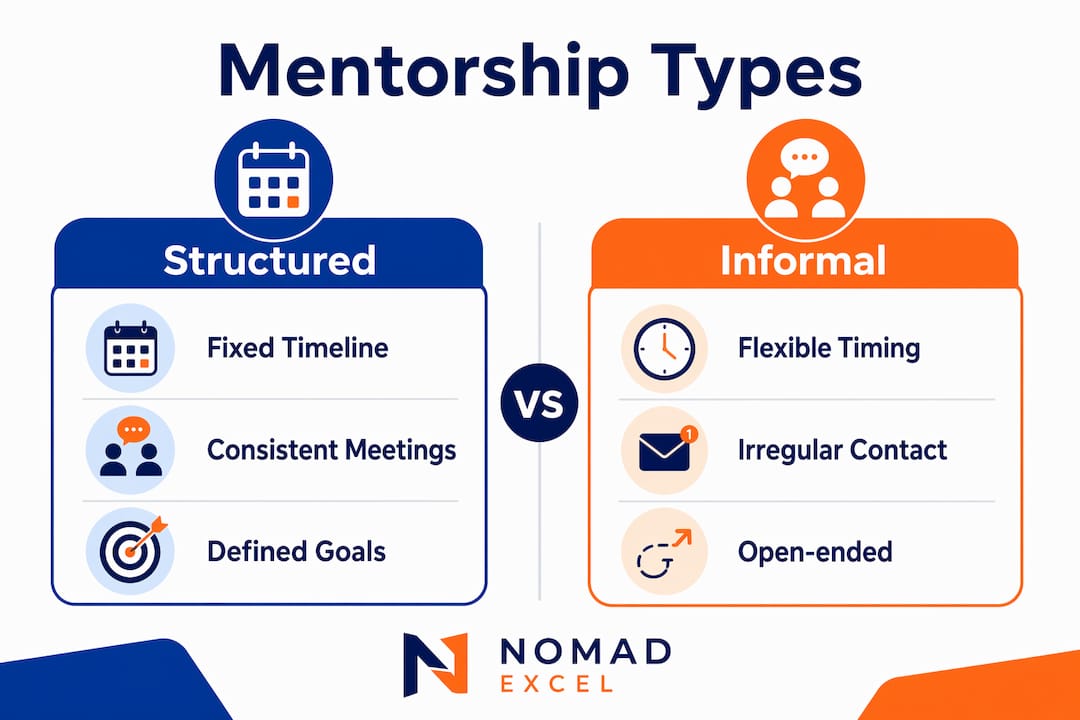
The clearest distinction between structured and informal mentoring is consistency. Informal mentoring depends on the availability and initiative of both parties, which means it often fades when schedules get busy. Structured programs remove that dependency by building accountability into the design itself.
Coaching and mentoring are also frequently confused, but they serve different purposes. Coaching is short-term and task-specific, focused on solving an immediate performance problem. Mentoring is a long-term developmental relationship that builds professional judgment, perspective, and confidence over months or years. A coach helps you fix a presentation. A mentor helps you become the kind of person who commands a room.
| Feature | Structured mentorship | Informal mentoring |
|---|---|---|
| Timeline | Fixed, 6–12 months | Open-ended, no set end |
| Goal setting | Defined at program start | Rarely formalized |
| Session frequency | Scheduled (fortnightly) | As needed or ad hoc |
| Role clarity | Written expectations | Assumed or unspoken |
| Accountability | Built into program design | Depends on individuals |
| Access equity | Open to all participants | Based on existing networks |
Access equity is one of the most underappreciated advantages of structured programs. Informal mentoring tends to favor people who already have strong professional networks. Structured programs pair participants based on goals and compatibility, which means professionals without established connections get the same quality of guidance as those who do. That levels a playing field that informal mentoring consistently tilts.
Well-designed structure creates safety and clarity that actually enables deeper, more flexible conversations. When both parties know what is expected, they spend less energy managing the relationship and more energy on genuine growth.
How to implement structured mentorship for personal growth
Putting a structured mentoring framework into practice requires deliberate choices at every stage, from how you select a mentor to how you close out the program. The following steps reflect what works in practice.
Define your development goals first. Before you search for a mentor, write down two or three specific skills or outcomes you want to achieve. Vague goals like “get better at leadership” produce vague results. Specific goals like “improve how I give feedback to my team” give a mentor something concrete to work with.
Use a pre-match questionnaire. Pairing misalignment is the most common pitfall in mentorship programs. A short questionnaire covering professional background, communication style, and development priorities dramatically improves the quality of the match. Chemistry matters as much as credentials.
Set the agenda before every session. Send your mentor a one-paragraph summary of what you want to cover at least 24 hours before you meet. This respects their time and signals that you are prepared. The step-by-step mentorship process that produces results always starts with preparation, not improvisation.
Review progress at the midpoint. At the halfway mark of your program, schedule a dedicated review session. Assess which goals are on track, which need to be adjusted, and whether the session format is still working. Mid-program reviews prevent the slow drift that causes many mentoring relationships to lose focus.
Close the program with intention. The final session should include a structured reflection: what changed, what you will do differently, and how you plan to sustain growth after the program ends. Programs that end abruptly leave participants without a clear path forward.
Pro Tip: If you are joining a program through an organization or bootcamp, ask whether they use cohort-based enrollment. Cohort formats give you a peer group that holds you accountable between sessions, which significantly increases follow-through on action items.
The types of mentorship programs available today range from one-on-one pairings to group mentoring and peer mentoring circles. Each format suits different learning styles and goals, so choosing the right structure is itself part of the implementation process. Connecting with mentorship networks can also extend the value of a single mentoring relationship into a broader professional community.
What measurable benefits can you expect from structured mentorship?
The evidence for structured mentorship’s impact on professional growth is direct and specific. Participants in structured development programs are 16 times more engaged and 8 times more likely to stay in their career paths than those without structured support. Those numbers reflect a fundamental shift in how people relate to their work when they feel genuinely supported.
Beyond retention, structured mentorship produces concrete behavioral changes:
- Faster decision-making: Regular mentoring conversations expose you to your mentor’s reasoning process. Over time, you internalize frameworks for evaluating options that would otherwise take years of trial and error to develop.
- Increased confidence: Consistent feedback from a trusted, experienced mentor builds the kind of confidence that comes from validated competence, not just positive thinking.
- Expanded professional perspective: Mentors who have navigated the challenges you are facing provide context that no course or book can replicate. That perspective shortens your learning curve significantly.
- Stronger professional networks: Mentors frequently introduce mentees to contacts, communities, and opportunities that would otherwise be inaccessible. The advantages of structured mentorship extend well beyond the formal program period.
- Accountability that drives results: Knowing you will report progress to your mentor at the next session is a powerful motivator. That external accountability closes the gap between intention and action.
The engagement and retention benefits are especially pronounced for early-stage entrepreneurs and professionals navigating career transitions. When the stakes are high and the path is unclear, structured mentorship provides the consistent engagement needed to build professional judgment, not just skills.
Key Takeaways
Structured mentorship is the most reliable path to measurable professional growth because it combines clear goals, consistent engagement, and built-in accountability that informal mentoring cannot replicate.
| Point | Details |
|---|---|
| Optimal program length | Run programs for 6–12 months; anything under 3 months rarely produces measurable change. |
| Best session cadence | Meet fortnightly to maintain momentum without causing scheduling fatigue. |
| Guided agendas are non-negotiable | Structure every session with a check-in, review, main topic, and action items. |
| Pairing alignment drives success | Use pre-match questionnaires to align chemistry and goals before the program starts. |
| Engagement impact is significant | Participants in structured programs are 16 times more engaged than those without structured support. |
Why structure is the mentor relationship’s best friend
People often assume that adding structure to a mentoring relationship makes it feel transactional or cold. I have found the opposite to be true. The mentoring relationships that produced the most genuine growth, the ones where real trust developed and real risks were taken, were always the ones with the clearest structure.
When both parties know the timeline, the agenda, and the expectations, they stop spending mental energy managing the relationship itself. That freed-up energy goes directly into the conversation. The mentor can challenge more directly. The mentee can be more honest about where they are struggling. Structure does not constrain connection. It creates the conditions for it.
The biggest misconception I see is that people treat structured mentorship as a corporate formality, something organizations do to check a box. The truth is that the framework is just as powerful for an individual who seeks out a mentor independently and builds their own program. You do not need an institution to give you a timeline and an agenda. You can design one yourself, and the results will follow.
The professionals I have seen grow fastest are not the ones with the most talented mentors. They are the ones who showed up prepared, held themselves accountable between sessions, and treated the relationship as a serious investment. Structure is what makes that discipline possible.
— Amichai
How Nomadexcel builds structured mentorship into entrepreneurial growth
Nomadexcel integrates structured mentorship directly into its online entrepreneurship bootcamp, giving participants access to experienced mentors, guided frameworks, and a peer community that holds them accountable throughout the program. Each bootcamp combines hands-on business building with direct mentorship from operators and founders who have navigated the same challenges participants face. The program is designed for aspiring and early-stage entrepreneurs who want more than theory. They want a structured mentorship framework that produces real results. If you are ready to grow faster through clarity, execution, and community, Nomadexcel’s programs offer the structure and support to make that happen.
FAQ
What is the structured mentoring definition?
Structured mentoring is a formal development relationship with predetermined timelines, paired participants, defined goals, and regular scheduled sessions. It differs from informal mentoring by building accountability and role clarity into the program design from the start.
How long should a structured mentorship program last?
The optimal duration is 6–12 months. Programs shorter than three months rarely produce measurable behavioral or professional change.
What is the difference between mentorship and coaching?
Coaching is short-term and task-specific, focused on solving an immediate performance problem. Mentorship is a long-term developmental relationship that builds professional judgment, perspective, and confidence over months or years.
How often should mentors and mentees meet?
Fortnightly meetings are the most effective cadence. Weekly sessions risk burnout, while monthly sessions lose the continuity needed to build momentum and trust.
What are the biggest benefits of structured mentorship programs?
Participants in structured programs are significantly more engaged and more likely to stay on their chosen career path. Additional benefits include faster decision-making, stronger professional networks, and the confidence that comes from consistent, expert feedback.
Comments are closed.