
Team Innovation: Driving Growth and Collaboration Fast
Every company faces the challenge of unlocking fresh solutions when traditional brainstorming no longer delivers results. Team innovation today calls for much more than gathering people in a room to generate ideas. Research highlights the rising importance of cognitive diversity and shared team climates as catalysts for breakthroughs and sustainable growth. This article reveals how modern organizations succeed with focused innovation strategies—giving you practical approaches to build adaptive, high-performing teams that deliver measurable impact.
Table of Contents
- What Team Innovation Really Means Today
- Types of Team Innovation in Companies
- Key Drivers and Success Factors
- Common Pitfalls and How to Avoid Them
- Proven Strategies for Fostering Innovation
Key Takeaways
| Point | Details |
|---|---|
| Team Innovation is Collaborative | Success relies on diverse perspectives and specialized knowledge, encouraging a culture of psychological safety and continuous adaptation. |
| Dynamic Team Structures | Various team types, including cross-functional and design thinking teams, facilitate rapid problem-solving and creative ideation. |
| Key Drivers of Innovation | Inclusive leadership, knowledge diversity, and structural support are essential for motivating teams and overcoming challenges. |
| Proactive Management of Pitfalls | Addressing communication breakdowns and establishing clear roles help maintain momentum and foster a collaborative spirit. |
What Team Innovation Really Means Today
Team innovation represents a dynamic approach to collaborative problem solving that goes far beyond traditional brainstorming. Modern organizations recognize that true innovation emerges when diverse perspectives and specialized knowledge intersect. Cognitive diversity and shared team climates have become critical drivers of breakthrough thinking and organizational growth.
At its core, team innovation involves systematic knowledge integration where team members combine their unique skills, experiences, and insights to generate transformative solutions. This process requires creating psychological safety, encouraging constructive dialogue, and developing structures that enable rapid idea development and implementation. Successful teams understand that innovation is not a singular event but a continuous adaptive process that demands intentional design and ongoing cultivation.
The most effective team innovation strategies today emphasize cross-functional collaboration, rapid experimentation, and embracing calculated risk-taking. Modern organizations are moving away from hierarchical decision making toward more agile, networked approaches that empower teams to prototype, test, and iterate solutions quickly. This means creating environments where failure is viewed as a learning opportunity and where team members feel genuinely motivated to challenge existing paradigms.
Pro Tip: Establish regular “innovation sprint” sessions where team members from different departments collaborate on solving complex challenges, rotating roles and perspectives to stimulate creative thinking.
Types of Team Innovation in Companies
Companies today deploy multiple innovative team structures designed to drive organizational creativity and problem-solving. Network configurations and collaborative models have become increasingly sophisticated, reflecting the complex challenges modern businesses face. These innovative team types range from stable interdisciplinary groups to dynamic, fluid project teams that can rapidly adapt to emerging opportunities.
One prominent approach is the design thinking team, which represents a structured yet creative method for generating breakthrough solutions. Design thinking teams utilize a disciplined process of ideation, prototyping, and iterative testing. These teams are characterized by their ability to blend divergent thinking with convergent problem solving, enabling organizations to approach challenges from multiple perspectives while maintaining a rigorous approach to innovation.

The most effective team innovation models typically incorporate three key dimensions: knowledge diversity, flexible collaboration structures, and empowered decision making. Some organizations utilize cross-functional teams that blend experts from different departments, while others create specialized innovation units with dedicated resources and autonomy. The goal remains consistent: breaking down traditional organizational silos and creating environments where creative thinking can flourish naturally.
The following table compares common types of innovative teams found in modern organizations:
| Team Type | Structure | Strengths | Example Application |
|---|---|---|---|
| Cross-Functional Team | Permanent/Diverse | Integrates varied expertise across departments | Launching new products |
| Design Thinking Team | Project-Based | Excels in ideation, prototyping, and rapid iteration | Service or process redesign |
| Innovation Unit | Autonomous/Focused | Dedicated resources for breakthrough innovation | Developing disruptive tech |
| Agile Project Squad | Short-Term/Fluid | Adapts quickly to change, delivers fast solutions | Software development cycle |
Pro Tip: Implement a rotating team membership strategy where team members from different departments periodically exchange roles to stimulate fresh perspectives and prevent innovative thinking from becoming stagnant.
Key Drivers and Success Factors
Inclusive leadership strategies represent a critical foundation for driving team innovation in modern organizations. This approach goes beyond traditional management by creating environments where psychological safety, autonomy, and collaborative thinking can flourish. Leaders who effectively regulate team dynamics and embrace diverse perspectives unlock the potential for breakthrough innovations by motivating team members and aligning collective objectives.
Successful innovation teams are distinguished by several key characteristics. These include diverse expertise, strong collaborative cultures, and robust transactive memory systems where team members understand and leverage each other’s unique knowledge and capabilities. The composition of the team matters significantly, with research indicating that carefully curated groups with complementary skills and shared cognitive frameworks consistently outperform more randomly assembled teams.
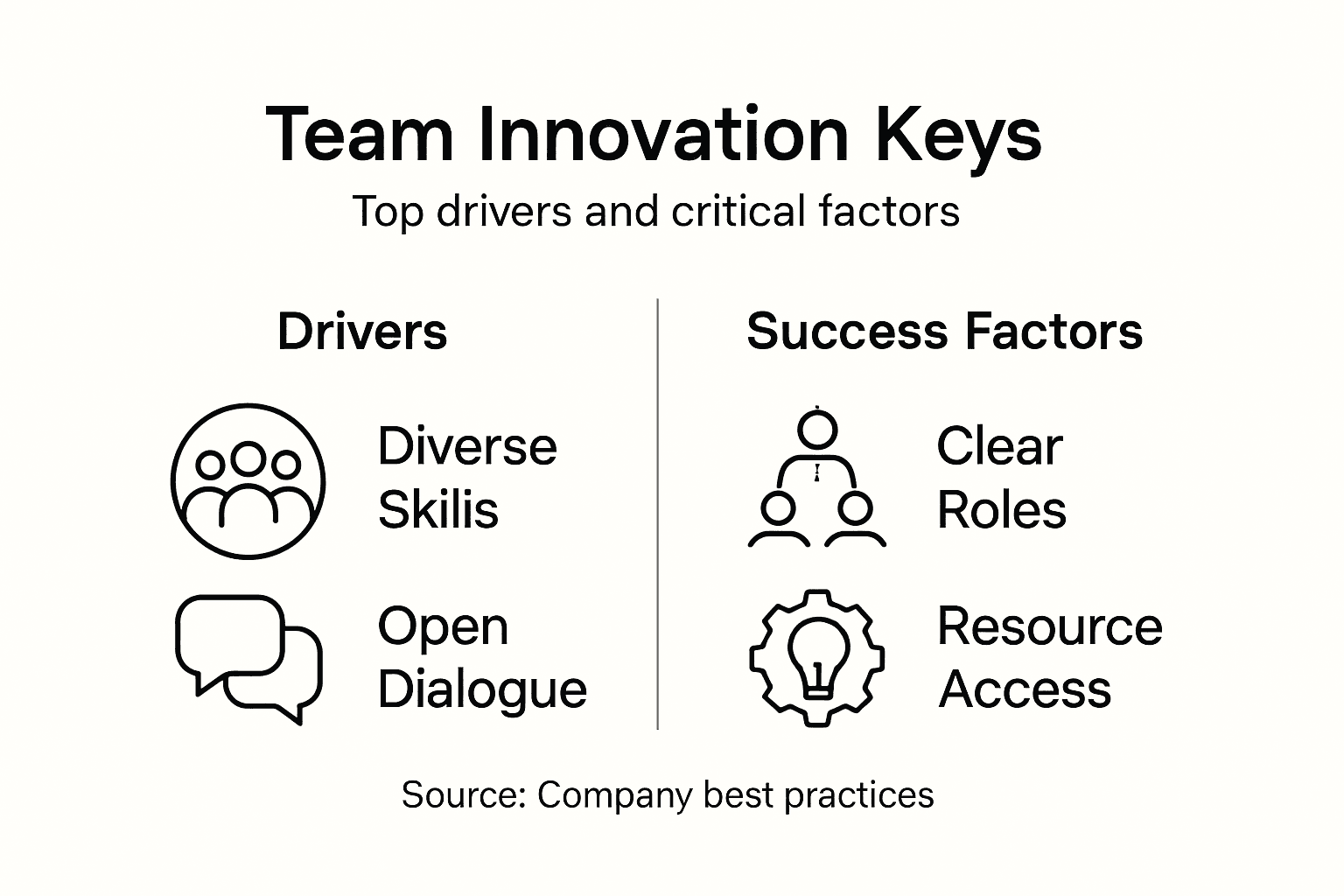
Organizations must also create structural support for innovation, which involves providing sufficient resources, establishing clear innovation goals, and developing mechanisms that reward creative thinking. This means building flexible collaboration structures that allow teams to experiment, fail, and learn quickly. Effective innovation strategies recognize that resistance to change and interdepartmental conflicts are natural challenges that must be proactively managed through transparent communication, shared incentives, and a culture of continuous learning.
Pro Tip: Create a quarterly innovation assessment process where teams can present their creative projects, receive cross-departmental feedback, and compete for implementation resources and recognition.
Common Pitfalls and How to Avoid Them
Interpersonal conflicts and team dynamics represent significant challenges that can derail team innovation efforts. These conflicts often emerge from misaligned expectations, unclear roles, and communication breakdowns that prevent teams from achieving their creative potential. Recognizing and addressing these issues early becomes crucial for maintaining team momentum and preserving the collaborative spirit necessary for breakthrough innovations.
Organizations frequently struggle with implementation challenges that stem from insufficient attention to systemic team behaviors. Implementation science approaches suggest developing clear protocols and adaptive response mechanisms to navigate complex innovation landscapes. This means creating structured frameworks that allow teams to communicate transparently, resolve conflicts constructively, and maintain high levels of engagement even when facing significant challenges.
Successful teams develop proactive strategies to mitigate potential pitfalls. These include establishing clear communication channels, defining explicit team roles and responsibilities, and creating psychological safety where members can express concerns without fear of retribution. Regular team retrospectives, open feedback loops, and structured conflict resolution processes can transform potential obstacles into opportunities for growth and deeper understanding.
Below is a summary of key drivers and pitfalls for team innovation success:
| Success Driver | Description | Common Pitfall | Resolution Strategy |
|---|---|---|---|
| Inclusive Leadership | Fosters psychological safety and motivation | Poor team communication | Establish clear channels and protocols |
| Knowledge Diversity | Brings unique perspectives to team problem | Skill set misalignment | Curate teams for complementary strengths |
| Flexible Collaboration | Enables rapid adaptation and learning | Rigid structures | Restructure roles and responsibilities |
| Structural Support | Resources and incentives for innovation | Lack of resource backing | Allocate tools and recognition |
Pro Tip: Implement a monthly “innovation health check” where team members anonymously share potential friction points and collaborative challenges to preemptively address emerging issues.
Proven Strategies for Fostering Innovation
Learning activities in team innovation encompass a sophisticated approach that balances multiple dimensions of collaborative creativity. Successful teams integrate reflexive thinking, experimental approaches, vicarious learning, and contextual understanding to create dynamic innovation environments. This multifaceted strategy allows organizations to develop rhythms of teamwork that consistently generate breakthrough ideas and sustainable collaborative practices.
Companies seeking to drive innovation must create comprehensive strategies that go beyond traditional brainstorming. Continuous learning and experimentation represent core pillars of effective innovation frameworks. This means establishing organizational cultures that reward creative risk taking, provide resources for skill development, and align team objectives with broader strategic goals. Leveraging diverse expertise, supporting agile methodologies, and maintaining flexible technological infrastructures become critical components of sustained innovative performance.
The most effective innovation strategies emphasize creating psychological safety, encouraging cross-functional collaboration, and developing adaptive learning mechanisms. Teams must cultivate environments where members feel empowered to share unconventional ideas, challenge existing processes, and experiment without fear of immediate criticism. This requires leadership that actively supports creative exploration, provides constructive feedback, and transforms potential failures into meaningful learning opportunities.
Pro Tip: Implement quarterly innovation challenge workshops where teams from different departments collaborate on solving complex organizational problems, with recognition and potential implementation resources as incentives.
Accelerate Your Team Innovation Journey with Nomad Excel
The article highlights how team innovation thrives on inclusive leadership, knowledge diversity, and flexible collaboration structures. If your team struggles with breaking silos, maintaining psychological safety, or rapidly iterating solutions, you are not alone. At Nomad Excel, we understand these challenges deeply and design experiences that boost cross-functional collaboration and entrepreneurial thinking.
Explore how our company retreats foster aligned, motivated teams ready to innovate. Our immersive bootcamps also equip entrepreneurs with the mindset and skills to transform ideas into actionable results. Unlock the full potential of your team innovation efforts by joining Nomad Excel. Take the next step today to build stronger collaboration, embrace experimentation, and deliver breakthrough growth by visiting Nomad Excel now.
Frequently Asked Questions
What is team innovation, and why is it important?
Team innovation refers to a collaborative approach to problem-solving where diverse perspectives and specialized knowledge intersect to create transformative solutions. It is important because it drives organizational growth and enables teams to adapt quickly to changing environments.
How can teams create a culture of innovation?
Teams can create a culture of innovation by establishing psychological safety, encouraging open dialogue, and implementing structures that support rapid experimentation and learning from failure. Regular innovation sessions and cross-functional collaboration can also foster creative thinking.
What are some effective team structures for promoting innovation?
Effective team structures for promoting innovation include cross-functional teams, design thinking teams, autonomous innovation units, and agile project squads. These structures allow for diverse expertise and rapid adaptability in responding to complex challenges.
What common pitfalls should teams avoid in the innovation process?
Teams should avoid pitfalls such as poor communication, lack of clear roles, and resistance to change. To mitigate these challenges, it’s essential to establish clear communication channels, define team roles explicitly, and create a culture that embraces feedback and ongoing learning.
Comments are closed.