
How accountability drives real business growth
TL;DR:
- Effective accountability systems rely on clear, measurable goals, individual ownership, and transparent, scheduled reviews to drive sustainable growth.
- Building a culture of ownership and trust transforms accountability from surveillance into a motivating, collaborative habit that enhances engagement and performance.
Accountability has a reputation problem. Many entrepreneurs and team leaders associate it with tense performance reviews, blame-filled meetings, or exhausting oversight that slows everyone down. That picture is not just incomplete — it’s actively holding businesses back. When treated as a genuine growth system rather than a policing mechanism, accountability becomes one of the most powerful forces available to you as a founder or team leader. This article will clear up the most common misconceptions, show you exactly how accountability shapes performance, and give you practical frameworks you can apply starting this week.
Table of Contents
- Why accountability matters for business growth
- The pillars of effective accountability systems
- Ownership versus compliance: The psychology behind real accountability
- Accountability, engagement, and the cost of missed growth
- Building accountability frameworks for sustainable business growth
- Why most businesses get accountability backward
- Take the next step: Build growth with accountability
- Frequently asked questions
Key Takeaways
| Point | Details |
|---|---|
| Accountability drives growth | Clear accountability systems help teams execute and scale more consistently. |
| Ownership beats compliance | Growth comes from enabling team members to choose responsibility, not just follow orders. |
| Frameworks matter | The best results come when expectations, ownership, and progress checks are built into business routines. |
| Engagement fuels results | High team engagement and healthy accountability practices unlock higher productivity and profit. |
Why accountability matters for business growth
Growth does not happen by accident. Behind every company that consistently hits its targets and scales with intention, you will find structured accountability at work. As research confirms, accountability supports business growth when it is treated as a system that clarifies measurable expectations, assigns named ownership for outcomes, and makes progress transparent. That is the critical distinction. Accountability is not a mood or a cultural vibe — it is architecture.
Consider two early-stage ventures launching similar products in the same market. The first team sets broad intentions at the start of each quarter and checks in only when things go wrong. They miss targets, revisit priorities constantly, and lose momentum to confusion about who owns which outcomes. The second team sets specific, measurable goals with named owners, reviews progress weekly, and adjusts quickly when numbers slip. Within six months, the second team has grown revenue by 40%, while the first is still debating priorities. The only structural difference is their accountability system.
McKinsey research reinforces this pattern at scale, noting that for growth-oriented strategy execution, accountability is strengthened by an operating backbone with clear metrics, owners, and transparency. Strong performance tracking tips make this backbone visible and actionable at every level of the organization.
| Accountability behavior | Outcome for business |
|---|---|
| Measurable goals set upfront | Teams focus on the right work |
| Named ownership per outcome | No confusion about responsibility |
| Weekly progress visibility | Issues surface early, not at quarter-end |
| Regular structured review cadence | Continuous improvement becomes a habit |
“What gets measured gets managed — but only when someone is clearly responsible for the measurement.” This principle sits at the heart of every high-performing entrepreneurial team.
The pillars of effective accountability systems
Understanding the why is essential, but entrepreneurs need to know what real accountability systems actually look like in practice. The good news is that effective accountability is not complicated. It rests on four foundational pillars that, when combined, create a reliable engine for consistent performance.
Measurable expectations are the starting point. Goals need to be specific and quantifiable, not broad aspirations. Instead of “grow the customer base,” a measurable expectation sounds like “acquire 50 new paying customers by the end of Q3.” Precise targets remove ambiguity and give teams something concrete to chase. Pairing your goals with SMART goal-setting principles ensures that every objective is specific, measurable, achievable, relevant, and time-bound.
Named ownership means every goal, task, and outcome has exactly one person responsible for it. Not a team. Not a department. One person. This might feel uncomfortable at first because it removes the safety net of collective responsibility, but it is precisely that specificity that drives follow-through. When everyone is accountable, no one is accountable.

Transparent progress keeps the whole team aligned. When results are visible — whether on a shared dashboard, a weekly standup update, or a simple progress board — accountability stops being a private conversation between a manager and an employee. It becomes a team-level norm. Visibility also allows peers to offer support proactively rather than waiting for problems to escalate.
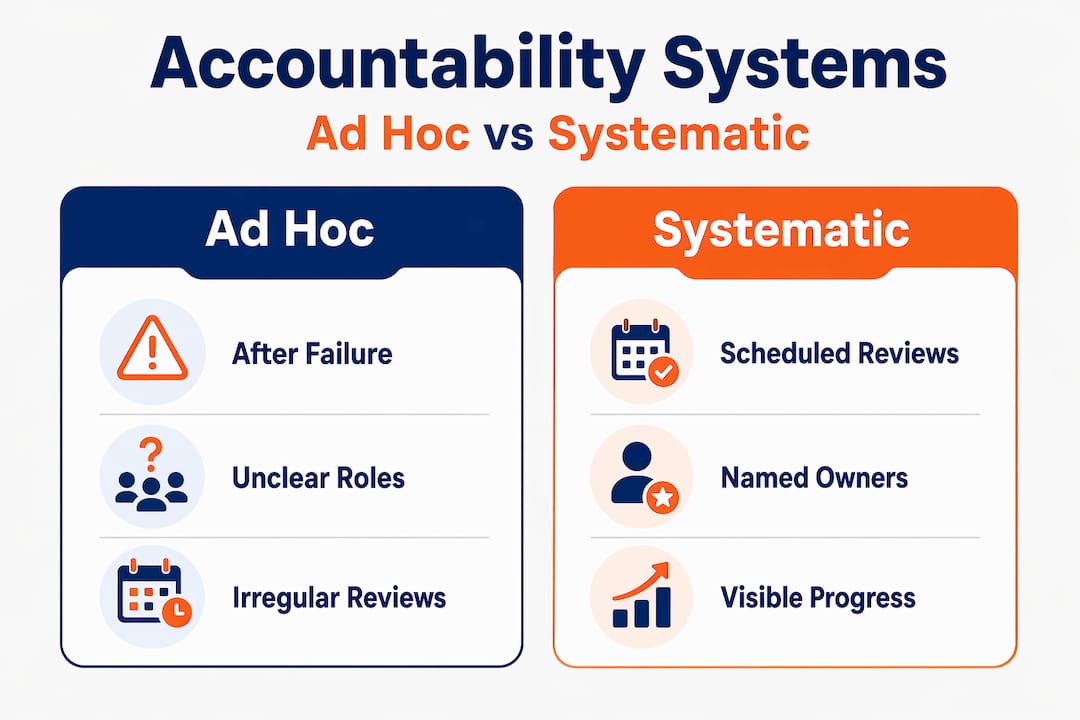
Regular review cadence is the heartbeat of the system. Ad hoc accountability, where reviews only happen when something goes wrong, creates anxiety and erodes trust. Systematized accountability, with scheduled check-ins that everyone can anticipate, builds momentum and normalizes course correction. As research on team accountability failures confirms, measurable expectations, visible progress, and regular review cadence are the three components most often missing in scaling companies that struggle to maintain performance.
Here is a quick checklist for building your own accountability backbone:
- Define every major goal in measurable terms before the work begins
- Assign a single named owner to each goal or initiative
- Create a shared space where progress is updated and visible to the whole team
- Schedule recurring check-ins at weekly or biweekly intervals
- Document decisions, pivots, and lessons at each review
- Use daily accountability processes to keep momentum between formal check-ins
- Revisit and set better team goals each quarter based on what you learn
Pro Tip: Shift from end-of-quarter check-ins to brief weekly reviews. Catching a problem in week two is dramatically less expensive than discovering it in week twelve. Short, frequent conversations also reduce the pressure that makes people hide bad news.
| Ad hoc accountability | Systematized accountability |
|---|---|
| Reviews happen only after failure | Reviews are scheduled and expected |
| Ownership is collective and vague | Ownership is individual and clear |
| Progress is invisible until deadline | Progress is visible in real time |
| Course corrections are reactive | Course corrections happen early |
Ownership versus compliance: The psychology behind real accountability
Structure matters enormously, but the human side of accountability determines whether systems actually stick. This is where most businesses quietly fail. They build a framework, launch it with enthusiasm, and then watch it collapse within a few weeks because team members experience it as surveillance rather than support.
The difference comes down to ownership versus compliance. Compliance is what happens when people follow rules because they have to. It produces short-term results but quietly erodes trust, creativity, and engagement. Ownership is what happens when people choose to be accountable because they believe in the goal and feel genuinely responsible for the outcome. As Harvard Business Review notes, accountability should be chosen, not mandated. You cannot force accountability, but you can make it significantly easier for people to choose it.
This distinction has enormous practical implications for entrepreneurs and team leaders. Consider rethinking accountability as a design challenge rather than a discipline challenge. The question shifts from “How do I make my team more accountable?” to “What kind of environment makes accountability the natural choice?”
Here are strategies that create the conditions for genuine ownership:
- Involve team members in goal-setting. When people help design the target, they feel a stake in reaching it. Goals imposed from above generate compliance at best.
- Separate accountability conversations from performance reviews. Regular check-ins should feel like collaborative problem-solving, not evaluations. Evaluation energy shuts down honesty.
- Celebrate transparency about problems. If someone brings a missed milestone to the team’s attention early, treat that as a leadership behavior, not a failure confession.
- Give autonomy within structure. People who have the freedom to decide how they reach a goal take far more ownership than those who are handed both the target and the method.
- Make it safe to say “I need help.” Psychological safety, meaning the belief that you will not be punished for speaking up, is the invisible infrastructure beneath every accountable team.
When team members know that raising a problem will be met with curiosity rather than criticism, accountability transforms from a threat into a collaborative habit.
To stay accountable for growth as a founder, you also need to model the behavior you expect. When you openly acknowledge your own missed targets and share what you learned, you give your team permission to do the same.
Pro Tip: Reframe accountability conversations using the phrase “What did we learn?” instead of “What went wrong?” This small linguistic shift moves the energy from blame to learning and makes it far easier for people to participate honestly.
Accountability, engagement, and the cost of missed growth
Here is a number that should get every entrepreneur’s attention: low engagement cost the world economy approximately $10 trillion in lost productivity, representing roughly 9% of global GDP. Gallup’s research links this directly to management practices, including the presence or absence of clear accountability structures.
Globally, only around 20% of employees report being actively engaged at work. That means approximately four out of every five people on most teams are operating below their potential. For small businesses and startups where every person carries significant weight, the impact of disengagement is amplified dramatically. A single disengaged team member in a five-person startup can effectively reduce the team’s output by 20% or more when you account for the drag they create on morale, communication, and workflow.
The link between accountability and engagement is direct. When people have clear goals, visible progress, and genuine ownership, they feel the intrinsic rewards of meaningful work. When goals are fuzzy and progress is invisible, the natural result is drift, frustration, and eventually disengagement. Accountability systems that are built well function as engagement infrastructure for your entire organization.
To build engagement and accountability together, work through this sequence:
- Start with clarity. Ensure every person on your team can articulate what they are working on, why it matters, and how success will be measured.
- Connect individual goals to company goals. People engage deeply when they see the line between their daily work and the business’s larger ambitions.
- Create genuine feedback loops. Regular recognition of progress, not just correction of problems, fuels sustained engagement.
- Measure engagement directly. Use brief pulse surveys monthly to track how connected and motivated your team feels.
- Act on what you hear. Showing that you take engagement data seriously is itself an act of accountability that builds trust.
- Invest in your team’s growth. People who feel their skills are developing stay engaged longer and take greater ownership of outcomes.
Engagement is not a nice-to-have quality of life benefit. It is a core growth lever, and accountability is the system that activates it.
Building accountability frameworks for sustainable business growth
Putting all of this together requires a practical roadmap. The good news for entrepreneurs who are resource-constrained is that you do not need an elaborate system from day one. A minimum viable accountability framework, one you can launch immediately and refine over time, is often more effective than a perfect system that never quite gets off the ground.
McKinsey’s research on transformation success emphasizes that an operating backbone with clear owners and metrics establishes accountability from the CEO to frontline managers. The same principle scales down beautifully to a five-person startup.
Follow this sequence to build your framework:
- Set clear, measurable goals. Write down your top three to five business priorities for the quarter in specific, measurable language.
- Assign single owners. For each goal, identify one person who is responsible for the outcome. Document this publicly.
- Build visibility into the system. Create a shared dashboard, a Notion page, or even a physical whiteboard where progress is updated weekly.
- Schedule reviews in advance. Block time on the calendar for weekly or biweekly check-ins before the quarter begins, not after things fall apart.
- Document outcomes, not just activities. At each review, record what was achieved, what shifted, and what the team learned.
- Iterate the framework itself. Every quarter, spend 30 minutes asking whether the accountability system is serving the team. Adjust based on honest feedback.
Being goal-oriented at an organizational level means treating the framework as a living system rather than a rigid set of rules. Review it, question it, and improve it with the same discipline you bring to your product or service. Explore leadership tips for scaling to deepen your understanding of how top founders operationalize accountability as their teams grow.
Pro Tip: Document learning alongside wins. Keep a running record of what you discovered each quarter — about your market, your processes, and your team. This learning library becomes one of your most valuable strategic assets as the business grows.
Why most businesses get accountability backward
Most accountability systems are built around the assumption that people need to be watched in order to perform. That assumption is both wrong and expensive. When accountability is framed as monitoring, the entire system optimizes for the appearance of performance rather than actual results. People learn to report well rather than work well. Meetings become theater.
The businesses we see grow fastest are not the ones with the most rigorous reporting structures. They are the ones where accountability is a shared value rather than a managerial tool. The founders who build those cultures share one counterintuitive habit: they make themselves the most visibly accountable person in the room. They share their own numbers, name their own failures, and ask for help publicly. That behavior, repeated consistently, gives everyone else permission to do the same.
Real accountability is proactive, not reactive. It surfaces problems before deadlines arrive, not in the aftermath of missed targets. It creates an environment where transparency is rewarded, where asking for support is a sign of self-awareness, not weakness. The accountability stories that produce lasting growth are never about surveillance. They are about alignment, shared ownership, and ongoing conversations that keep everyone moving in the same direction.
If your current accountability system feels like it is designed to catch people failing, it is time to redesign it. Build for trust. Build for transparency. Build for the kind of honest conversation that surfaces problems early and celebrates learning as enthusiastically as it celebrates wins. That is where sustainable growth actually lives.
Take the next step: Build growth with accountability
If the frameworks and insights in this article have sparked new thinking about how you lead your team, the logical next step is building these systems with expert guidance and a community that holds you to the same standards you are setting for your business. At Nomad Excel, accountability is not just a topic we write about — it is woven into every element of our entrepreneurship bootcamp experience, from daily structured sprints to peer accountability partnerships that extend well beyond the program. Explore our business growth frameworks guide for a practical toolkit you can apply immediately, and visit our leadership development guide to discover how high-impact teams build the habits that sustain long-term growth.
Frequently asked questions
What does accountability look like in a small business?
Accountability in a small business means every team member has clear goals, knows who owns what, and regularly shares progress with the group. As research confirms, effective accountability requires measurable expectations, named ownership, and transparent progress tracking — all of which are achievable even in a two-person operation.
How can I encourage accountability without micromanaging?
You can foster ownership by making expectations crystal clear, giving team members genuine autonomy over how they achieve their goals, and keeping progress visible from the start. Research confirms that accountability is most effective when people choose it freely rather than feeling forced into compliance.
Why is engagement important for accountability and growth?
High engagement amplifies accountability because motivated people take genuine ownership of outcomes rather than just going through the motions. Gallup’s data shows that low global engagement already costs the world economy trillions in lost productivity, and small businesses feel that cost more acutely than anyone.
What simple steps start building accountability in my business?
Begin by setting measurable goals, assigning a single named owner to each one, and scheduling regular check-ins before the quarter starts. McKinsey research confirms that clear owners and metrics form the operating backbone that makes accountability a strategic advantage rather than an afterthought.