
Unlock entrepreneur success with real-world business projects
TL;DR:
- Engaging in real-world projects accelerates entrepreneurial growth by providing firsthand experience with market feedback and decision-making risks. While such projects build vital skills, they require support systems like mentorship, community, and reflection to mitigate inherent risks and ensure sustainable progress. Starting small, embracing failure as learning, and leveraging structured programs help entrepreneurs turn projects into lasting business success.
Most aspiring entrepreneurs spend months consuming books, watching courses, and attending seminars before they ever test a single idea with a real customer. That pattern feels productive, but it often creates a dangerous illusion of readiness. The truth is that theory gives you a map, while validated learning gives you the terrain. Real-world business projects force you to encounter the friction, ambiguity, and opportunity that no classroom can replicate, and it is precisely that friction that accelerates genuine entrepreneurial growth faster than almost any other experience.
Table of Contents
- Why real-world business projects matter for entrepreneurs
- How project-based learning builds entrepreneurial capabilities
- When real-world projects accelerate growth—and when they don’t
- Best practices for mastering real-world business projects
- The overlooked truth: Projects teach, but support sustains
- Get started with hands-on entrepreneurship support
- Frequently asked questions
Key Takeaways
| Point | Details |
|---|---|
| Learning by building | Hands-on business projects teach critical entrepreneurial skills far faster than theory alone. |
| Supports boost outcomes | Mentorship, community, and funding are essential companions to project-based learning. |
| Growth comes with risk | While real projects foster rapid growth, they also carry real financial and survival risks. |
| Validation cycles matter | Frequent testing and learning from real customers drive better product launches and adaptations. |
Why real-world business projects matter for entrepreneurs
Now that we’ve set the stage, let’s explore why jumping into real projects beats endless planning or theory.
When you work on a live business initiative, every decision carries actual consequences. You’re not solving a case study with a predefined answer. You’re negotiating with a real supplier, responding to a customer who didn’t like your product, or pivoting a pricing model because the market pushed back. Those moments compress months of abstract learning into days of lived experience.
The learning by doing approach is rooted in a simple reality: entrepreneurs grow fastest when they engage with real customers, collect genuine feedback, and iterate based on what the market actually tells them. This is not just motivational language. It reflects how skill acquisition actually works in high-stakes, dynamic environments.
Hands-on entrepreneurship introduces you to a cycle that lean startup methodology formalizes: build something, measure the response, learn from the results, and repeat. As lean startup principles describe, the goal is to test ideas quickly, gather direct feedback, and then iterate or pivot based on what you discover. This stands in sharp contrast to extended planning phases, where entrepreneurs often refine ideas in isolation and only encounter reality much later, sometimes too late.
Consider what happens when a first-time founder launches even a minimal product or service. Almost immediately, they learn things that weeks of research could never reveal:
- Whether the problem they’re solving is painful enough for someone to pay money to fix it
- Which customer segment responds most enthusiastically and why
- Where the product’s weakest points are in terms of usability, value, or positioning
- How they personally handle rejection, unexpected feedback, and the pressure of real stakes
- What operational challenges emerge the moment real transactions are involved
“The goal of a startup is not to build a product, but to learn which product to build.” This principle, central to lean methodology, illustrates why real-world projects are such powerful accelerants. Every iteration is a structured lesson delivered by the market itself.
These insights cannot be reverse-engineered from a business textbook. They emerge through engagement, and that engagement is precisely what real-world business projects provide.
How project-based learning builds entrepreneurial capabilities
Understanding the importance of real-world learning, let’s see the specific competencies and growth gains these projects build.
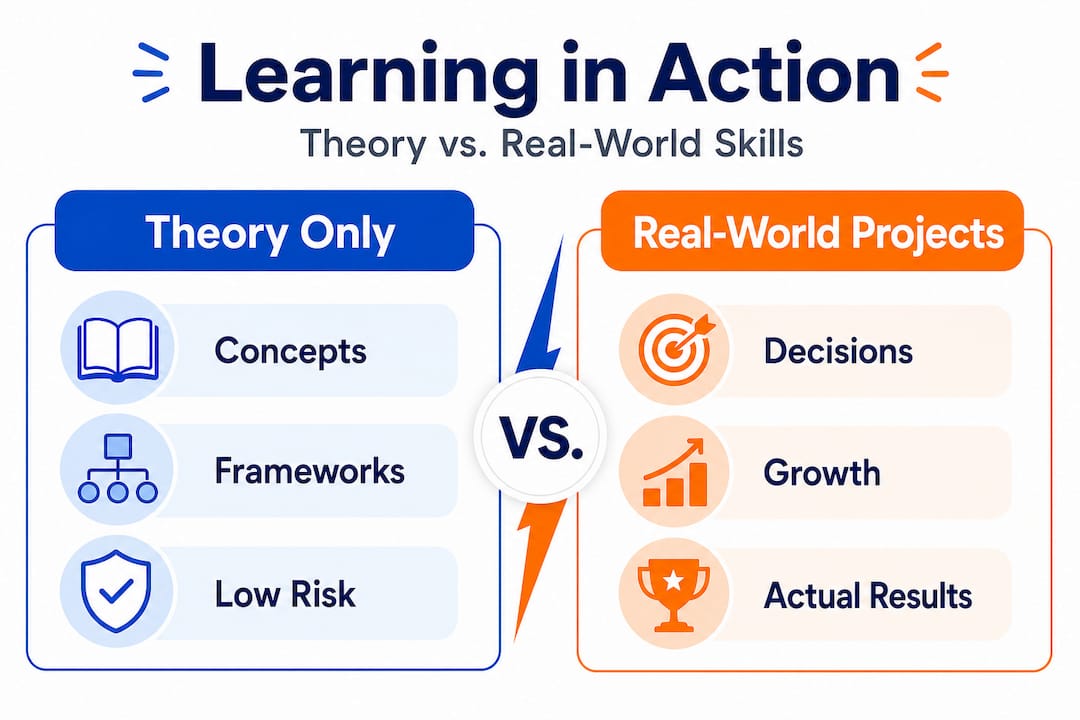
Real-world projects don’t just teach you about business in the abstract. They force the development of very specific capabilities that separate early-stage founders who survive from those who stall. When a project has real stakes, you face decisions that test your judgment in areas like team building, resource allocation, customer communication, and product strategy. Each of these decisions, made under pressure, builds a kind of cognitive muscle that passive learning simply cannot develop.
One of the most telling data points on this comes from a study on accelerator programs, which are one of the most structured forms of real-world project-based entrepreneurship education. Accelerator graduates grow employment approximately 31% faster than matched non-participants. That’s a significant and measurable outcome tied directly to the immersive, project-driven nature of these programs.
Experiential business education and global project experiences both demonstrate that when entrepreneurs work in real environments, they develop capabilities in areas like hiring, operations, customer acquisition, and team leadership at a meaningfully faster rate than peers who remain in classroom settings.
Here’s a direct comparison of what each learning environment actually builds:
| Capability | Classroom or theory-based learning | Real-world project-based learning |
|---|---|---|
| Decision-making under pressure | Low exposure, simulated scenarios | High exposure, real consequences |
| Customer empathy and feedback skills | Case studies, hypothetical personas | Direct conversations, live market data |
| Hiring and team leadership | Theoretical frameworks | Real hiring decisions with real stakes |
| Financial management | Accounting exercises | Live budgeting, cash flow challenges |
| Adaptability and pivoting | Discussed conceptually | Practiced repeatedly through iteration |
| Network building | Classroom peers only | Mentors, investors, customers, partners |
The table above makes the contrast clear. Classroom learning has value for building foundational frameworks, but the moment you step into a real project, you begin developing the adaptive intelligence that founders need most.

Pro Tip: Don’t wait until your idea feels “complete” before starting a real-world project. Launch the smallest version possible, even just a conversation with a potential customer, and treat every interaction as a data point. The earlier you engage the market, the faster your capabilities grow.
When real-world projects accelerate growth—and when they don’t
While real-world engagement builds critical skills, it’s important to understand both the rewards and the risks, especially what support is needed to succeed.
Here’s where the story gets more nuanced, and where most guides stop short of telling you the whole truth. Real-world projects are powerful, but they are not universally safe or effective without the right conditions surrounding them. The same research that shows accelerated hiring growth among program participants also reveals a more sobering finding: accelerator participants face higher bankruptcy odds, with roughly a 2.2x greater likelihood of bankruptcy and an approximately 8 percentage point drop in survival rate within the first year.
This doesn’t mean project-based programs are bad. It means they are catalysts, and catalysts accelerate whatever is already in motion, including failure if the foundational supports aren’t in place.
Here’s a breakdown of outcomes based on available research:
| Outcome metric | Accelerator participants | Non-participants |
|---|---|---|
| Employment growth rate | ~31% faster | Baseline |
| Bankruptcy likelihood | ~2.2x higher | Baseline |
| 1-year survival rate | ~8 points lower | Baseline |
| Networking and mentorship access | Significantly higher | Lower |
| Revenue growth reliability | Mixed results | Mixed results |
The pattern is clear: real-world project environments push founders to move faster and build bigger, but that acceleration without adequate support creates fragility. The support networks and ongoing entrepreneurship education that surround a project matter just as much as the project itself.
So what does effective support look like? Entrepreneurs who get the most from real-world projects typically have access to the following:
- Experienced mentors who have navigated the specific challenges the founder is facing and can provide guidance rooted in real outcomes, not theory.
- A peer community of other founders at similar stages, who offer accountability, perspective, and collaborative problem-solving when the path feels uncertain.
- Access to capital or financial education, so that rapid growth doesn’t outpace cash flow management and create existential risk.
- Structured frameworks for reflection, such as regular reviews of what’s working, what isn’t, and what needs to change before the next iteration.
- Post-project engagement, because the learning that happens after a project ends, when founders apply insights to their next initiative, is often where the most durable growth occurs.
Key insight: The entrepreneurs who thrive through project-based learning are rarely the ones who simply worked hardest. They’re the ones who paired their hustle with intentional guidance and community.
Best practices for mastering real-world business projects
Having weighed both the power and pitfalls, let’s turn to how you can harness these projects for maximum advantage.
Knowing that real-world projects are powerful but require the right conditions, the next question is practical: how do you actually run one well? The answer lies in building discipline around the process itself, not just the output.
Evidence from an INSEAD AI Venture Lab experiment confirms that iterative build-measure-learn cycles and structured field experiments drive measurably better business outcomes than unstructured exploration. The process matters as much as the ambition.
Here are the practices that consistently separate effective real-world project experiences from ones that feel busy but generate little lasting value:
- Run frequent, low-cost experiments. Rather than building a complete product before testing it, design the smallest possible version of your idea that can generate real market feedback. This protects your resources while accelerating your learning curve.
- Create structured feedback loops. Schedule regular, deliberate check-ins with customers, mentors, and peers. Feedback gathered informally and inconsistently is far less actionable than feedback collected with intention and structure.
- Document every iteration. Keep a simple record of what you tested, what you learned, and what you changed as a result. Over time, this becomes an invaluable map of your entrepreneurial decision-making and a resource for validating business ideas in future projects.
- Seek complementary skills, not just cheerleaders. The best teams around a project include people who challenge your assumptions and fill your blind spots, not just people who agree with your vision.
- Monitor financial health from day one. One of the most common failure patterns in early-stage projects is growing activity without growing financial clarity. Track what you’re spending, what you’re earning, and what your runway looks like, even in the earliest stages.
- Engage with youth entrepreneurship experiences and other structured programs to build foundational entrepreneurial thinking, especially if you’re early in your journey and still developing your project instincts.
Pro Tip: After every project phase, schedule a dedicated 30-minute “after-action review” where you answer three questions: What did I expect to happen? What actually happened? What will I do differently next time? This practice alone dramatically accelerates the learning value of any real-world experience.
The overlooked truth: Projects teach, but support sustains
To tie it all together, here’s our candid perspective on what actually makes real-world projects transformative, not just instructive.
Most entrepreneurship guides celebrate the power of doing and frame real-world projects as a near-universal solution to the gap between aspiration and execution. And in many ways, that framing is correct. Projects teach through experience in a way nothing else can match. But there’s a piece of the story that gets consistently underemphasized, and it’s the piece that separates founders who build lasting businesses from those who burn bright and fade fast.
Simply doing projects is not the destination. It’s the starting point. The entrepreneurs we’ve seen grow most consistently aren’t the ones who launch the most projects or move the fastest. They’re the ones who treat every project as a testbed and a network-building opportunity, and who remain actively engaged with mentors, peers, and structured learning long after the initial build phase ends. The project is the spark. The ongoing support system is the fuel.
This matters because the research is unambiguous: project-based environments accelerate both growth and risk. The risk doesn’t disappear through sheer effort. It diminishes through guidance, community, and deliberate reflection. Founders who join structured business bootcamps don’t just gain frameworks. They gain the kind of ongoing human infrastructure that makes real-world projects genuinely sustainable rather than just temporarily exciting.
The most powerful reframe we can offer is this: stop treating your next real-world project as a test of how good your idea is. Start treating it as a practice ground for becoming the kind of founder who can consistently bring good ideas to life. That shift in orientation changes everything about how you approach feedback, failure, and the next iteration.
Get started with hands-on entrepreneurship support
With a clearer picture of what works, you’re ready to translate knowledge into real experience, and here’s how we can help.
At Nomad Excel, we design programs specifically for aspiring and early-stage entrepreneurs who are ready to move from theory into action. Our Online Entrepreneurship Bootcamp brings together driven founders for structured, mentorship-led experiences that pair real project work with expert guidance and a powerful peer community. If you’re looking for a clear path into project-based learning that’s grounded in real accountability, our guide to joining bootcamps is a strong starting point. We also offer a detailed mentorship program guide for founders who want to accelerate growth through direct access to experienced entrepreneurs and operators. Real projects become transformative when the right support surrounds them, and that’s exactly what we build every program around.
Frequently asked questions
What is a real-world business project for entrepreneurs?
A real-world business project involves building, testing, or launching an actual product or service with real customers, using validated learning methods to gather genuine market feedback rather than relying on simulations or classroom case studies.
Do accelerators guarantee startup success?
Accelerators can meaningfully boost certain capabilities, but do not reliably guarantee lasting financial or survival outcomes within a year, which is why complementary mentorship and community support remain essential.
Are business projects safer with a mentor?
Yes. Mentorship and structured support systems reduce both decision-making blind spots and financial risk, increasing the odds of sustainable progress well beyond the project’s initial phase.
How do I start a real-world business project if I have no team yet?
You can begin solo using low-cost customer experiments and simple feedback conversations; validated learning cycles are particularly well-suited for solo and early-stage founders who need to test ideas quickly without large teams or budgets.
What if my first real-world project fails?
Failure is not a setback to avoid but feedback to use; every project, successful or not, generates insights that sharpen your judgment, strengthen your network, and make your next initiative more grounded and more capable of succeeding.
Comments are closed.