
Experiential Education Explained: Real-World Impact for Entrepreneurs
Starting a business often means learning by doing in fast-paced environments far from conventional classroom walls. For Canadian, American, and European founders immersed in global bootcamps, the shift toward experiential education offers a practical path to real entrepreneurial skill. Recognizing myths and understanding the structured process behind hands-on learning makes all the difference. This guide reveals the true strengths of experiential approaches and how purposeful reflection can fuel your growth as a digital nomad entrepreneur.
Table of Contents
- Defining Experiential Education And Common Myths
- Major Types And Real-World Entrepreneurship Applications
- Key Characteristics Of Experiential Education Processes
- Role Of Mentorship, Reflection, And Peer Community
- Risks, Challenges, And How To Maximize Benefits
Key Takeaways
| Point | Details |
|---|---|
| Experiential Education Defined | It’s a teaching approach that emphasizes direct engagement, reflection, and real-world application for deeper learning. |
| Myth vs. Reality | Experiential education is not just about active lessons; it requires purposeful design and reflection to be effective. |
| Role of Mentorship | Mentorship and peer community are crucial for developing resilience and deeper understanding in experiential learning contexts. |
| Challenges and Approaches | While experiential education presents challenges, effective strategies turn these into opportunities for growth and learning. |
Defining Experiential Education and Common Myths
Experiential education represents a powerful learning philosophy that goes far beyond traditional classroom instruction. Defined by educational experts as a teaching approach where learners engage directly with experiences followed by intentional reflection, this method transforms how knowledge is acquired and applied.
At its core, experiential education involves several key characteristics:
- Direct, hands-on engagement with learning content
- Structured reflection processes that extract meaningful insights
- Active learner participation and accountability
- Integration of real-world context and personal experience
Experiential learning differs subtly from experiential education. While both involve direct experiences, experiential education emphasizes the broader educational philosophy and structured learning environment. Educational theorists like John Dewey highlighted that not all experiences are inherently educational – the critical component is purposeful reflection and analysis.
Here’s a comparison of experiential education and traditional classroom learning approaches:
| Aspect | Experiential Education | Traditional Classroom Learning |
|---|---|---|
| Learning Method | Hands-on experiences | Lectures and textbooks |
| Role of Reflection | Central to learning process | Rarely emphasized |
| Learner Engagement | Active and participatory | Often passive |
| Real-World Application | Immediate and practical | Mostly theoretical |
Common myths about experiential education can misrepresent its depth and sophistication. Many people mistakenly believe this approach is limited to high-adventure activities or simply making lessons more active. In reality, it’s a nuanced pedagogical strategy requiring careful design, intentional reflection, and learner engagement.
The true power of experiential education lies not in the experience itself, but in the structured learning that emerges from thoughtful analysis and personal meaning-making.
Myths versus Reality:
- Myth: Experiential education is just outdoor or adventure-based learning
- Reality: It’s a comprehensive philosophy applicable across disciplines
- Myth: Any active lesson qualifies as experiential education
- Reality: Reflection and purposeful design are essential
Pro tip: When designing experiential learning programs, focus more on the reflective process than the experience itself, as true learning happens during intentional analysis and personal connection.
Major Types and Real-World Entrepreneurship Applications
Experiential entrepreneurship education bridges the critical gap between theoretical knowledge and practical business skills. Experiential learning programs have revolutionized how aspiring entrepreneurs develop critical competencies through hands-on engagement and real-world problem-solving.
Key types of experiential entrepreneurship approaches include:
- Problem-based learning: Presenting complex business challenges for collaborative resolution
- Project-based experiences: Developing actual business concepts from ideation to prototype
- Design thinking workshops: Iterative approaches to identifying and solving entrepreneurial challenges
- Startup simulation programs: Mimicking real-world business environment dynamics
These approaches go beyond traditional classroom learning by immersing students in authentic entrepreneurial contexts. Entrepreneurship education methods emphasize developing core competencies like creativity, resilience, communication, and strategic thinking through direct engagement.
Experiential entrepreneurship is not about teaching business – it’s about enabling students to become entrepreneurs through active, contextual learning.
Real-world applications of these approaches demonstrate their transformative potential:
- University startup incubators providing seed funding and mentorship
- Business plan competitions with actual investor panels
- Collaborative international entrepreneurship challenges
- Industry-sponsored innovation labs
Entrepreneurs gain practical skills that traditional education cannot replicate. They learn to validate ideas, interact with potential customers, build financial models, and navigate complex business landscapes through immersive experiences.

Pro tip: Design your learning experiences with maximum real-world complexity and minimum theoretical abstraction to accelerate entrepreneurial skill development.
Key Characteristics of Experiential Education Processes
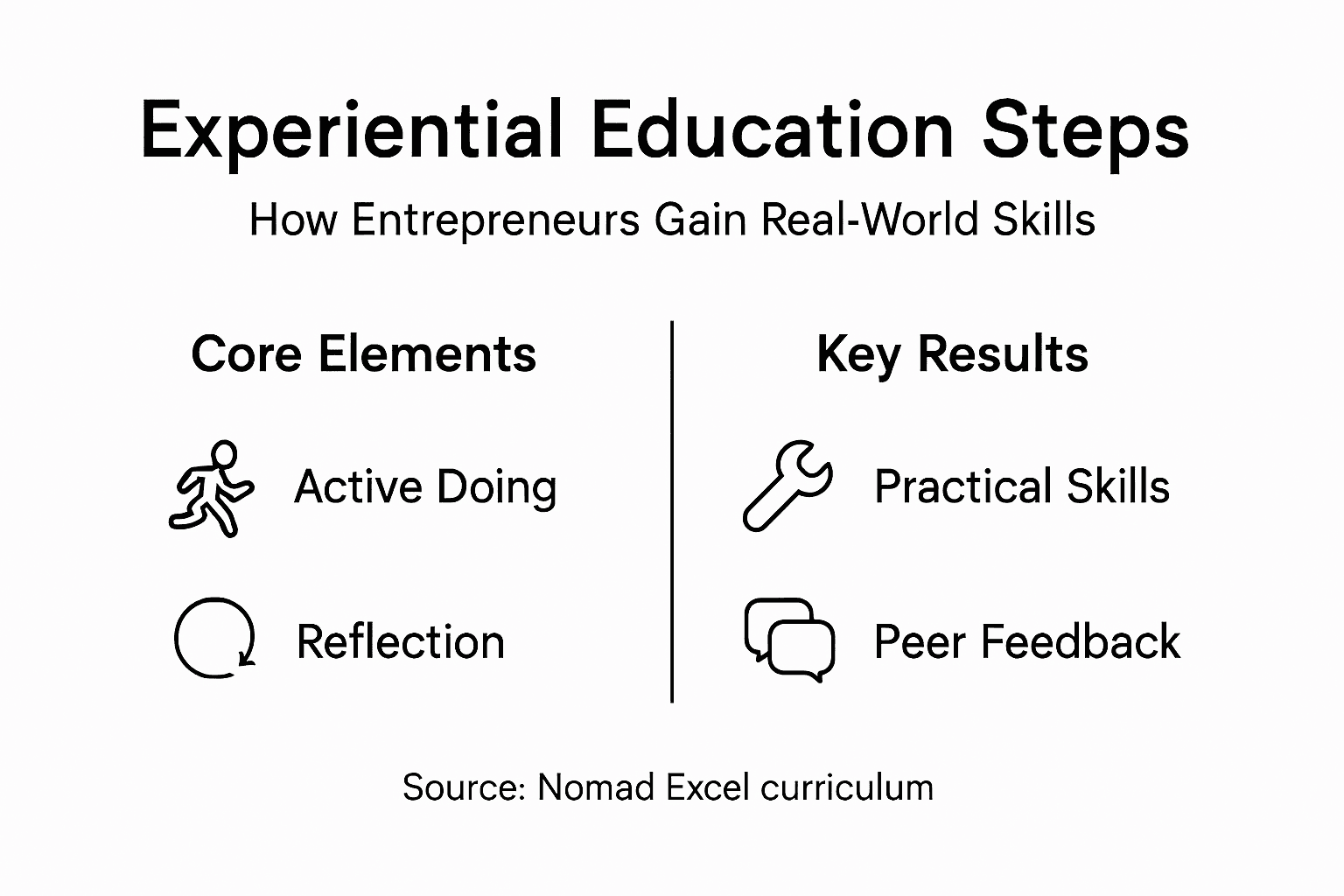
Experiential learning processes represent a dynamic approach to education that transforms traditional learning paradigms. Unlike passive instructional methods, these processes engage learners through a holistic, integrated framework that activates intellectual, emotional, and practical dimensions of understanding.
The core characteristics of experiential education include:
- Learner-centered design: Placing the individual at the center of the learning experience
- Active engagement: Requiring direct participation and personal investment
- Reflective practice: Encouraging continuous analysis and meaning-making
- Contextual application: Connecting theoretical concepts with real-world scenarios
Learning cycles play a critical role in these processes. Experiential learning theory typically involves a cyclical pattern of experiencing, reflecting, conceptualizing, and experimenting. This approach ensures that learning is not a linear transfer of information, but a dynamic, iterative journey of personal discovery.
Experiential education transforms learners from passive recipients of knowledge to active creators of understanding.
Key stages in the experiential learning process include:
- Concrete experience (direct involvement)
- Reflective observation (analyzing the experience)
- Abstract conceptualization (deriving insights)
- Active experimentation (testing new understanding)
The facilitator’s role shifts from traditional instructor to learning guide, creating environments that foster inquiry, challenge assumptions, and support personal growth. By designing experiences that are intentionally complex and meaningful, educators can help learners develop deeper, more resilient understanding.
Pro tip: Design learning experiences that deliberately create cognitive friction, compelling learners to reconcile new information with existing mental frameworks.
Role of Mentorship, Reflection, and Peer Community
Mentorship and reflective practice form the critical backbone of transformative experiential education, creating powerful learning ecosystems that extend far beyond traditional instructional models. These interconnected elements work synergistically to support deep personal and professional growth for entrepreneurs and learners.
Key dimensions of mentorship and community engagement include:
- Strategic guidance: Experienced professionals providing targeted insights
- Emotional support: Creating safe spaces for vulnerability and growth
- Skill development: Accelerating learning through direct knowledge transfer
- Network expansion: Building meaningful professional connections
Peer mentoring plays a particularly significant role in developing holistic learning environments. Peer community dynamics create powerful platforms for mutual support, where individuals with similar challenges can share experiences, strategies, and emotional resources.
Effective mentorship transforms individual potential into collective achievement through collaborative learning and shared wisdom.
The most impactful mentorship and peer community models typically involve:
- Structured interaction frameworks
- Regular feedback mechanisms
- Mutual accountability systems
- Diverse perspective sharing
Successful programs recognize that learning is fundamentally a social process. By creating environments that encourage open dialogue, vulnerability, and continuous improvement, mentorship ecosystems enable entrepreneurs to develop resilience, expand their cognitive frameworks, and accelerate personal growth.
Here’s a summary of mentorship models supporting experiential entrepreneurship:
| Mentorship Model | Focus Area | Typical Benefits |
|---|---|---|
| One-on-one mentoring | Personalized guidance | Accelerated skill growth |
| Peer mentoring | Group collaboration | Enhanced problem-solving |
| Community-based networks | Broad connectivity | Access to diverse expertise |
Pro tip: Design your mentorship interactions with intentional reciprocity, ensuring that both mentor and mentee experience meaningful growth and learning.
Risks, Challenges, and How to Maximize Benefits
Experiential education challenges demand strategic approaches to transform potential obstacles into powerful learning opportunities. While these immersive learning models offer tremendous growth potential, they also require careful design and intentional facilitation to mitigate inherent risks and maximize educational outcomes.
Key challenges in experiential learning include:
- Safety management: Ensuring physical and psychological well-being
- Unpredictability: Navigating unexpected learning scenarios
- Diverse learner needs: Accommodating different learning styles and backgrounds
- Assessment complexity: Measuring intangible learning outcomes
Risk mitigation involves developing comprehensive strategies that address potential barriers. Learning program design must balance structured frameworks with flexibility, creating environments that support individual growth while maintaining clear educational objectives.
Effective experiential education transforms challenges into catalysts for personal and professional development.
Strategies for maximizing experiential learning benefits include:
- Establishing clear learning outcomes
- Providing robust support mechanisms
- Implementing reflective practice protocols
- Creating adaptive learning environments
Successful programs recognize that challenges are not obstacles but opportunities for deeper understanding. By approaching experiential learning with intentionality, flexibility, and a growth mindset, entrepreneurs can convert potential risks into transformative learning experiences that accelerate personal and professional development.
Pro tip: Design your experiential learning programs with built-in flexibility, allowing space for unexpected learning moments while maintaining a structured approach to skill development.
Transform Your Entrepreneurial Journey with Experiential Learning at Nomad Excel
The article highlights a key challenge for entrepreneurs: bridging the gap between theoretical knowledge and real-world business skills through purposeful reflection and immersive experiences. If you are seeking to accelerate your growth by moving beyond traditional learning and embracing hands-on engagement, mentorship, and a supportive community, Nomad Excel offers exactly what you need. Our entrepreneurship bootcamps embody the core principles of experiential education by combining active participation with structured reflection and direct application.
Take the next step to transform your ideas into actionable results with our Entrepreneurship Bootcamps. Join a curated group of driven founders for intensive learning, expert guidance, and lasting community connections. Whether you are launching or scaling, we provide the clarity, execution focus, and real-world frameworks essential to entrepreneurial success. Discover how you can embrace experiential learning today at Nomad Excel and build the skills and mindset needed to thrive in today’s complex business world.
Frequently Asked Questions
What is experiential education?
Experiential education is a teaching approach that emphasizes direct engagement with experiences followed by intentional reflection, transforming how knowledge is acquired and applied.
How does experiential education benefit entrepreneurs?
Experiential education helps entrepreneurs develop critical competencies such as creativity, resilience, communication, and strategic thinking through hands-on learning in real-world contexts.
What are the key components of experiential learning processes?
Key components include learner-centered design, active engagement, reflective practice, and contextual application, all contributing to a holistic learning experience.
How can mentorship enhance experiential education for entrepreneurs?
Mentorship provides strategic guidance, emotional support, and skill development, creating a powerful learning ecosystem that fosters personal and professional growth among entrepreneurs.
Recommended
- Why Invest in Business Education for Entrepreneurs
- The Essential Guide to the Future of Entrepreneurship Education – Nomad Excel – Your Entrepreneurial Adventure Starts Here
- The Essential Guide to Cultivating Entrepreneurial Independence
- The Essential Guide to Benefits of Entrepreneurial Mindset – Nomad Excel – Your Entrepreneurial Adventure Starts Here
- Cirkkle et l’Incubateur Afro : financer les projets entrepreneuriaux africains autrement – Cirkkle
Comments are closed.