
What makes a company innovative? 2026 guide for entrepreneurs
Only 13% of Fortune 500 companies sustain innovation beyond five years. Most entrepreneurs confuse innovation with breakthrough inventions, missing that systematic processes, culture, and incremental improvements drive lasting success. This guide clarifies what truly makes companies innovative and shows you how to build those capabilities into your startup from day one.
Table of Contents
- Understanding What Makes A Company Innovative
- The Role Of Culture And Leadership In Driving Innovation
- Operational Frameworks That Make Innovation Repeatable
- Common Misconceptions Entrepreneurs Have About Innovation
- Real-World Examples And Case Studies Of Innovative Companies
- How Early-Stage Entrepreneurs Can Build Innovation Into Their Ventures
- Embedding Innovation For Sustainable Growth
- Nomad Excel: Empowering Entrepreneurs Through Innovation Bootcamps
Key takeaways
| Point | Details |
|---|---|
| Innovation definition | Applying new ideas systematically to create measurable value, not random creativity. |
| Culture drives results | Psychological safety and diverse teams produce 19% higher innovation revenue. |
| Frameworks reduce risk | Stage-gate, design thinking, and lean startup increase success rates through structured processes. |
| Incremental matters most | Small, continuous improvements sustain growth more reliably than breakthrough bets. |
| Leadership accelerates impact | Committed leaders reduce innovation time-to-market by up to 30%. |
Understanding what makes a company innovative
Business innovation means applying new ideas to create measurable value for customers and the company. It’s not about random creativity or waiting for lightning to strike. Companies with systematic innovation processes generate 2.5 times more revenue growth than competitors.
Innovation happens in three distinct phases. Ideation generates diverse concepts through structured brainstorming and problem exploration. Experimentation tests ideas rapidly with minimum resources to validate assumptions. Scaling transforms validated concepts into full products or processes that deliver consistent value.
Consistent innovation cycles beat one-off events every time. Companies that foster innovation for team growth embed regular review points, resource allocation frameworks, and clear metrics. They treat innovation as an operational discipline, not an occasional workshop.
Systematic processes create repeatability. You need defined criteria for idea selection, testing protocols, and scaling decisions. Without structure, innovation efforts waste resources on pet projects that never deliver returns.
Key components of innovative companies:
- Clear innovation goals tied to business strategy
- Dedicated time and budget for experimentation
- Cross-functional collaboration mechanisms
- Metrics tracking both inputs and outcomes
- Regular review cycles to learn and adjust
The role of culture and leadership in driving innovation
Psychological safety determines whether teams share bold ideas or stay silent. Teams with high psychological safety produce 67% more ideas that reach implementation. People need to know failure during experimentation won’t damage their careers.
Leadership commitment accelerates everything. When executives champion innovation, time-to-market drops by 30% because teams get faster decisions and resources. Leaders must model risk-taking behavior and celebrate smart failures publicly.
Diversity drives better outcomes. Companies with diverse teams generate 19% higher innovation revenue because different perspectives spot opportunities others miss. Mix backgrounds, thinking styles, and experiences deliberately.

Pro Tip: Schedule monthly innovation showcases where anyone can pitch ideas in five minutes. Make attendance optional but celebrate every presenter, regardless of idea quality. This builds a culture where sharing beats perfection.
Culture elements that boost innovation:
- Transparent communication about strategy and priorities
- Recognition systems rewarding experimentation, not just wins
- Cross-departmental collaboration opportunities
- Time allocation for exploratory projects
- Open feedback loops without hierarchy barriers
Companies that foster innovation for team growth invest in leadership training focused on psychological safety. They teach managers how to respond to failures constructively and create space for divergent thinking. Team innovation for business growth happens when culture and leadership align to remove innovation blockers systematically.
Operational frameworks that make innovation repeatable
Stage-gate processes filter ideas through phased checkpoints. Each gate requires specific deliverables before moving forward. Companies using stage-gate methods improve success rates by 40% because they kill weak ideas early before wasting resources.
Design thinking centers on empathy and iteration. You understand user needs deeply, prototype quickly, and test assumptions before building. This human-centered approach reduces product failure rates because solutions address real problems, not imagined ones.
Lean startup’s build-measure-learn cycle minimizes waste. You create minimum viable products, gather data, and pivot based on evidence. Startups using lean methods reach product-market fit 50% faster than traditional approaches.
| Framework | Best For | Key Strength | Time Horizon |
|---|---|---|---|
| Stage-Gate | Complex products with high investment | Risk reduction through phased funding | 12-24 months |
| Design Thinking | Customer-facing innovations | Deep user empathy and rapid iteration | 3-6 months |
| Lean Startup | New ventures with uncertainty | Fast learning with minimum resources | 1-3 months |
Sequential steps to implement innovation frameworks:
- Define clear innovation objectives tied to business goals
- Select framework matching your resource constraints and timeline
- Train team members on chosen methodology basics
- Run small pilot project to practice framework mechanics
- Review results and refine process before scaling
- Establish regular cadence for new innovation cycles
Pro Tip: Don’t follow frameworks religiously. Take core principles from multiple approaches and customize them to your context. A hybrid combining lean startup’s speed with design thinking’s empathy often works best for early-stage ventures.
These powerful innovation strategies give you structure without bureaucracy. Proven innovation strategies for startups show how frameworks adapt across different venture stages and industries.
Common misconceptions entrepreneurs have about innovation
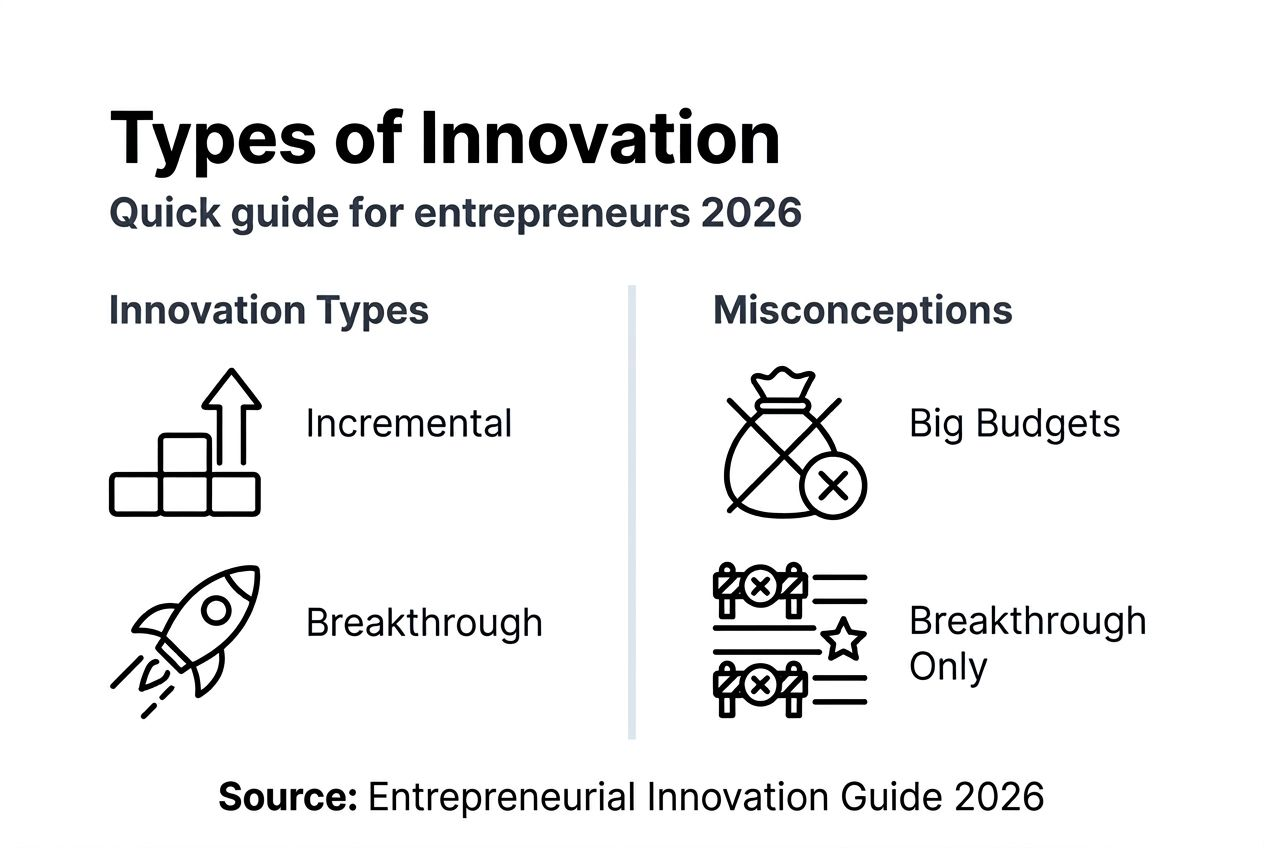
Many believe innovation requires massive R&D budgets. Reality? Bootstrap startups innovate effectively by focusing on business model creativity and customer experience improvements. Budget size matters far less than how deliberately you experiment.
The breakthrough myth blocks progress. Entrepreneurs chase game-changing inventions while ignoring incremental improvements. Incremental innovation delivers 85% of corporate value creation because small, consistent gains compound over time.
Innovation isn’t just about technology. Business model innovation, process improvements, and customer experience redesigns often generate bigger returns than new tech. Airbnb’s innovation was a marketplace model, not a technology breakthrough.
Misconceptions versus reality:
- Myth: Innovation needs dedicated R&D teams. Reality: Cross-functional collaboration often produces better results.
- Myth: Only breakthrough ideas matter. Reality: Incremental improvements drive sustainable growth.
- Myth: Innovation is expensive. Reality: Resourceful experimentation costs very little.
- Myth: More ideas equal more innovation. Reality: Execution quality beats idea quantity.
- Myth: Innovation is unpredictable. Reality: Systematic processes make outcomes reliable.
Resourceful experimentation beats big budgets. Use customer interviews instead of market research firms. Build landing pages before products. Test assumptions with small samples. Innovation strategies for startups show how constraint drives creative problem solving.
Real-world examples and case studies of innovative companies
Airbnb revolutionized hospitality through business model innovation, not technology. They created a two-sided marketplace connecting travelers and hosts, disrupting hotels without owning properties. The innovation was trust-building mechanisms and user experience design.
Tesla combines technological advancement with customer experience innovation. Their direct-to-consumer sales model eliminated dealerships. Over-the-air software updates keep cars improving after purchase. Manufacturing innovations reduced costs while maintaining quality.
Netflix shifted from DVD rental to streaming, then to content creation. Each pivot represented business model innovation responding to market changes. They invested heavily in data analytics to personalize recommendations and inform content decisions.
“Innovation isn’t just about new products. Business model innovation, customer experience redesign, and process improvements often create more sustainable competitive advantages than technology alone.”
Lessons from innovative companies:
- Start with customer problems, not solutions you want to build
- Test business model assumptions as rigorously as product features
- Invest in data infrastructure to inform decisions early
- Build feedback loops directly into product design
- Scale what works rather than over-engineering upfront
These companies succeeded by combining multiple innovation types. Technology enabled their models, but customer-centric thinking and business model creativity drove breakthrough results. Mentorship programs for startups connect you with founders who’ve navigated similar innovation journeys.
How early-stage entrepreneurs can build innovation into their ventures
Lean startup and design thinking offer accessible frameworks requiring minimal resources. Start with customer discovery interviews to validate problems before building solutions. Create low-fidelity prototypes using slides or mockups to test concepts cheaply.
Peer mentorship accelerates learning through shared experiences. Entrepreneur mentorship programs connect you with founders ahead in the journey. You avoid common mistakes and access proven playbooks without expensive consultants.
Bootstrap experimentation tactics work with tight budgets. Use free tools for landing pages and surveys. Offer manual services before automating. Pre-sell concepts to validate demand before building. These approaches test assumptions without significant capital.
Steps to implement innovation systematically:
- Schedule weekly innovation hours for team exploration
- Create simple idea submission process anyone can use
- Define clear criteria for selecting ideas to test
- Allocate small budget for monthly experiments
- Review results transparently and share learnings
- Scale successful experiments with dedicated resources
Pro Tip: Immersive bootcamps compress months of learning into weeks through intensive, hands-on practice. You work on your actual business while learning frameworks, getting expert feedback, and building a peer network that supports ongoing innovation.
Benefits of collaborative learning for innovation:
- Diverse perspectives challenge your assumptions constructively
- Peer accountability keeps experimentation consistent
- Shared resources reduce individual costs
- Real-time feedback shortens learning cycles
- Network effects create opportunities beyond your venture
These innovation strategies list approaches help you embed systematic innovation from the start. You don’t need to wait until you have more resources or team members.
Embedding innovation for sustainable growth
Sustainable innovation combines culture, leadership commitment, and structured frameworks into daily operations. Companies that treat innovation as a discipline rather than an event maintain competitive advantages long-term. Smart growth strategies for startups integrate innovation into planning cycles naturally.
Structured processes reduce risk by filtering ideas systematically. You invest resources in validated concepts rather than gut feelings. This disciplined approach increases success rates significantly while lowering overall innovation costs.
Balance your innovation portfolio between incremental improvements and bigger bets. Allocate 70% to core enhancements, 20% to adjacent opportunities, and 10% to transformational ideas. This mix maintains steady progress while exploring breakthrough potential.
Final actionable recommendations:
- Establish regular innovation review meetings with clear metrics
- Train team members in at least one innovation framework
- Create psychological safety through leadership modeling
- Track both innovation inputs and outcome measures
- Celebrate smart failures as learning opportunities publicly
- Build diverse teams intentionally for better perspective
- Start small and scale successful experiments systematically
Innovation becomes sustainable when embedded in how you work daily, not treated as separate from operations. The frameworks, culture elements, and leadership behaviors described here work together to create lasting innovation capabilities that fuel growth.
Nomad Excel: empowering entrepreneurs through innovation bootcamps
Ready to turn innovation theory into practice? Nomad Excel’s online entrepreneurship bootcamp provides immersive learning where you apply frameworks directly to your venture. Work alongside driven founders while expert mentors guide your progress.
Our mentorship program guide connects you with experienced entrepreneurs who’ve scaled innovative businesses. Get personalized feedback on your innovation strategy and avoid costly mistakes through their lived experience.
Learn more about our entrepreneurship program designed specifically for early-stage founders. We combine structured learning with hands-on execution, helping you build innovation capabilities while making real progress on your business. Join a community that accelerates growth through action, collaboration, and expert guidance.
FAQ
What is the difference between incremental and breakthrough innovation?
Incremental innovation involves small, continuous improvements to existing products, processes, or services. Breakthrough innovation represents radical, game-changing ideas that create new markets or disrupt existing ones. Both types are valuable and often work together for sustained growth, with incremental innovations providing steady progress while breakthrough attempts offer transformational potential.
How can a startup build a culture that supports innovation?
Encourage open communication where team members share ideas without fear of negative consequences for failures. Bring diverse perspectives into decision making and celebrate experimentation regardless of outcomes. Foster innovation culture by dedicating time for exploration, recognizing creative efforts publicly, and ensuring leadership models risk-taking behavior consistently.
What frameworks are best for resource-constrained startups to innovate?
Lean startup focuses on build-measure-learn cycles that enable fast learning with minimum resources. Design thinking emphasizes user empathy and iterative testing to validate assumptions before major investments. Both innovation strategies for startups work well with limited budgets because they prioritize learning speed over perfect execution.
Why is leadership commitment crucial for innovation?
Leadership sets the tone and allocates resources that determine whether innovation efforts succeed or stall. Committed leaders make faster decisions, remove organizational barriers, and signal that innovation matters through their actions. This commitment accelerates time-to-market significantly and increases the likelihood teams will take calculated risks necessary for breakthrough results.
Recommended
- 7 Powerful Innovation Strategies List for Entrepreneurs
- Innovation in Entrepreneurship: 30% Higher Growth Explained
- 7 Proven Innovation Strategies for Startups to Succeed – Nomad Excel – Your Entrepreneurial Adventure Starts Here
- Complete Guide to Entrepreneurial Thinking – Nomad Excel – Your Entrepreneurial Adventure Starts Here
Comments are closed.