
Business Innovation Trends 2025: What Leaders Must Know
TL;DR:
- Business leaders are shifting focus from AI experimentation and tool acquisition to workflow transformation and long-term strategic priorities. Investment in supply chains and sustainability is rising, with organizations integrating environmental goals into growth and operational resilience. To succeed, companies must redesign workflows, develop governance frameworks, and foster ecosystem collaboration rather than relying solely on pilot projects.
The hype around AI has made it easy to confuse motion with progress. Yet the real story behind business innovation trends 2025 is more grounded and more demanding than the headlines suggest. Strategic leaders are shifting from tool acquisition to workflow transformation, from sustainability as a compliance checkbox to a genuine growth driver, and from AI experimentation to measurable operational value. This guide unpacks where investment is actually flowing, what the emerging trends in business tell us about long-term priorities, and how you can position your organization to act on what matters.
Table of Contents
- Key takeaways
- Supply chain and sustainability: the new strategic priorities
- Enterprise AI adoption: moving beyond experimentation
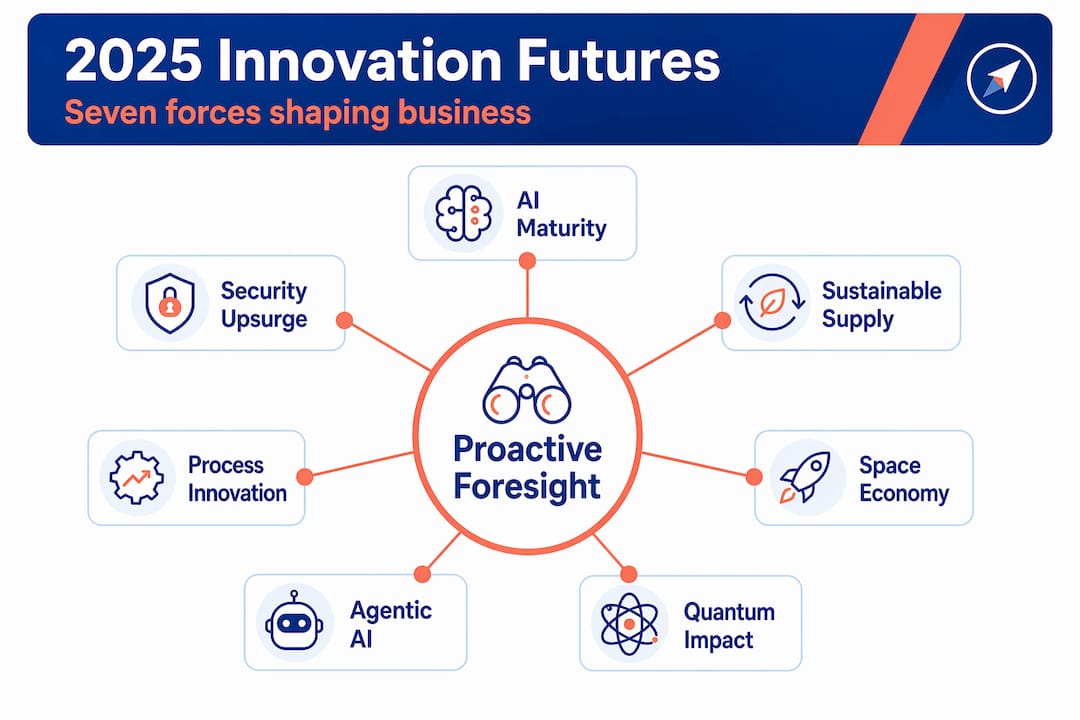
- Seven innovation futures reshaping business strategy
- Breaking out of the pilot loop: transformation strategies that work
- Applying these trends in practice
- My honest take on AI adoption and innovation maturity
- How Nomadexcel helps you lead through change
- FAQ
Key takeaways
| Point | Details |
|---|---|
| Supply chain investment is surging | 63% of business leaders plan to increase supply chain spending in 2025, up 15 points from 2024. |
| Sustainability is now a growth lever | Over 62% of organizations are increasing sustainability investments, targeting climate tech and product design. |
| Most AI is still stuck in pilot mode | Only about 23% of organizations have scaled AI agents into business functions, leaving most at the experimentation stage. |
| Workflow redesign separates leaders from laggards | Organizations that redesign roles and governance around AI consistently outperform those that simply add tools. |
| Seven innovation futures demand proactive planning | KPMG outlines domains from quantum computing to the space economy that will reshape business strategy in the years ahead. |
Supply chain and sustainability: the new strategic priorities
For years, supply chain resilience was treated as an operational concern rather than a strategic one. That changed decisively in 2025. Supply chain investment is rising among 63% of business leaders, a 15-point jump from the previous year, reflecting a fundamental reassessment of where competitive advantage is built. Geopolitical uncertainty, trade disruptions, and regulatory pressure have pushed leaders to treat supply chain architecture as a long-term differentiator rather than a cost center.
Nearshoring and “friendshoring” are reshaping partner ecosystems. Companies are deliberately shrinking the geographic distance between suppliers and production, reducing exposure to geopolitical shocks while building more agile and transparent networks. This is not merely defensive. It opens commercial opportunities with regional partners, accelerates delivery timelines, and strengthens relationships that generate mutual growth.
Sustainability is moving in lockstep with supply chain transformation. 62% of organizations plan to increase sustainability spending in 2025, with focus areas that include climate technologies, sustainable product design, biodiversity preservation, and water efficiency. These investments respond simultaneously to regulatory pressure and genuine market demand. Customers and institutional investors increasingly factor environmental performance into purchasing and funding decisions. Treating sustainability as a competitive advantage rather than a compliance burden is one of the most practical business transformation strategies available right now.
- Climate tech integration: Embedding renewable energy and carbon tracking directly into operations reduces both cost exposure and reporting complexity.
- Sustainable product design: Rethinking materials and end-of-life processes creates differentiation while meeting evolving regulations.
- Biodiversity and water commitments: These are emerging as measurable ESG indicators that affect financing terms and partner selection.
- Regulatory preparedness: Leaders who invest now build institutional capacity that lags take years to replicate.
Pro Tip: Do not treat your sustainability roadmap as separate from your supply chain strategy. The organizations seeing the strongest ROI in 2025 are those that mapped both together, identifying where resilience investments yield both environmental and operational returns simultaneously.
Enterprise AI adoption: moving beyond experimentation
The enterprise AI story in 2025 is not one of adoption. It is one of maturity. 78% of organizations used AI in at least one business function in 2025, which sounds impressive until you consider that only about 23% have scaled AI agents across their operations. Most organizations are stuck running isolated pilots that demonstrate potential but never generate enterprise-wide value.
Agentic AI is the concept attracting the most budget attention right now. Unlike conventional AI tools that respond to individual prompts, agentic AI systems execute multi-step tasks, make decisions within defined parameters, and coordinate across workflows without constant human intervention. 67% of organizations consider agentic AI a core part of their AI transformation plans, though few have the governance frameworks in place to deploy it safely. Designing for agentic AI requires business-architecture decisions that go far beyond technology procurement, encompassing end-to-end processes and KPI structures from the start.
The path from pilot to scale requires a deliberate sequence of steps that most organizations skip in their rush to show early results.
- Audit your workflows first. Identify where AI can reduce decision latency, not just automate repetitive tasks. The highest-value targets are complex, information-dense processes where humans currently act as bottlenecks.
- Redesign roles alongside tools. Organizational plasticity including workflow restructuring, governance updates, and role redesign is the critical success factor that separates AI leaders from those stuck in pilot mode.
- Build measurement into deployment. Define what success looks like in business terms before a single model goes live. Cycle time, error rates, and cost per transaction are more useful than model accuracy scores alone.
- Address data readiness before governance. AI maturity depends on combining data readiness, governance frameworks, and role redesign as integrated decisions, not sequential ones.
- Treat governance as a growth enabler. Organizations that establish clear accountability structures for AI decisions move faster in the long run because they avoid the costly course corrections that ungoverned deployments trigger.
Pro Tip: If your AI initiative has been in “pilot phase” for more than six months without a defined scaling plan, it is not a technology problem. It is a process engineering problem. Bring in your operations and HR leads before your data scientists.
Seven innovation futures reshaping business strategy
KPMG frames 2025 as a shift from reactive disruption responses to proactive foresight, and their framework of seven pivotal innovation futures gives business leaders a practical lens for long-range planning. These are the domains where investment decisions made today will compound into advantage or vulnerability over the next decade.
| Innovation Future | Core Opportunity | Key Business Implication |
|---|---|---|
| Artificial Superintelligence and agentic AI | AI as orchestration layer across enterprise workflows | Redesign operations for human-AI collaboration now |
| Computing infrastructure | Energy-efficient, multi-cloud, modular data centers | Evaluate infrastructure costs and carbon footprint together |
| Quantum computing | Quantum threats to encryption and new optimization capabilities | Audit cryptographic exposure and begin post-quantum planning |
| Space economy | Commercial satellites, earth observation, logistics | Explore data and connectivity services for supply chain use |
| Digital assets and blockchain | Tokenization and institutional finance integration | Assess impact on payments, contracts, and asset management |
| Environmental resilience | Climate-informed infrastructure and operations planning | Incorporate climate risk into capital allocation decisions |
| Advanced manufacturing | Reshoring with AI-augmented processes | Evaluate nearshoring economics with AI cost models |
The space economy and quantum computing represent what KPMG describes as growing commercial and security implications that most mid-market businesses are not yet tracking. Quantum computing is still a few years from widespread commercial application, but its threat to current encryption standards is real and urgent. Organizations handling sensitive data or financial transactions need to begin post-quantum security planning now, not when the capability becomes mainstream.
Breaking out of the pilot loop: transformation strategies that work
Business process innovation is more prevalent than product innovation, with roughly 38% of enterprises innovating in processes compared to 26% in products. The implication is significant: the organizations generating the most durable value from 2025 innovation technologies are not necessarily the ones building new products. They are the ones fundamentally rethinking how they deliver existing ones.
Understanding how to innovate in business at this level requires confronting some organizational realities that are often left out of the innovation conversation. AI failure is rarely a model problem. It is almost always a process and culture problem. Bolt a tool onto a broken workflow and you get a faster, more expensive broken workflow. Redesigning the workflow first, then selecting the tool that fits, consistently produces better outcomes.
Several practices distinguish leaders from laggards in this area:
- Process engineering as a core competency. The companies scaling AI fastest are investing in internal capability to map, redesign, and measure workflows before technology choices are finalized.
- Change management at the same budget level as technology. Every dollar spent on a new platform should have a corresponding investment in adoption, training, and role transition.
- Talent development for hybrid collaboration. Innovation-active enterprises employ higher shares of tertiary-educated workers, and the most effective organizations in 2025 are building teams that combine technical fluency with business judgment.
- Governance frameworks that move fast safely. Rather than waiting for perfect policy, leading innovators establish minimum viable governance: clear decision rights, audit trails, and escalation paths that allow experimentation without unchecked risk.
Pro Tip: Map your three most critical business processes before your next technology investment conversation. You will almost certainly find that the constraint is not the tool. It is the handoff, the data quality, or the accountability gap in between.
Applying these trends in practice
Knowing the trends is only useful if you act on them with intention. For business professionals and entrepreneurs navigating future business innovations, the translation from insight to execution comes down to five disciplines.
- Balance cost reduction with growth investment. The leaders seeing the best results in 2025 are not cutting their way to efficiency. They are investing in supply chain and AI with clear growth mandates tied to each initiative.
- Embed sustainability as a strategic differentiator. Rather than reporting on ESG separately, integrate sustainability targets into product roadmaps, partner selection, and capital planning.
- Concentrate AI efforts on workflow value. Pick two or three workflows where AI can deliver measurable impact within 90 days. Scale those before expanding scope.
- Build geopolitical and regulatory agility. Develop scenario plans for at least two regulatory or trade disruptions relevant to your sector. The organizations that do this today avoid reactive cost spikes later.
- Activate your partner ecosystem. The most resilient businesses in 2025 are not operating in isolation. Collaborative innovation through supplier networks, technology partners, and even cross-industry alliances is generating ideas and capabilities that no single organization could build alone. Explore business model innovation frameworks that incorporate ecosystem thinking from the start.
My honest take on AI adoption and innovation maturity
I have watched a lot of organizations spend real money on AI in 2025 and walk away with dashboards, not results. Here is what I have actually learned from that pattern.

The organizations that win are not the ones that moved fastest. They are the ones that asked “which workflow breaks first if we change nothing?” and started there. In my experience, that question alone surfaces more useful innovation priorities than any technology assessment framework.
The uncomfortable truth about pilot loops is that they feel like progress. Weekly demos, stakeholder updates, a growing library of use cases. But a pilot that has not killed any existing process is not scaling. It is decorating. The willingness to accept operational disruption as the price of real transformation is what separates serious innovators from optimistic ones.
Sustainability is similar. The leaders I respect most are not treating it as a messaging exercise. They are making capital allocation decisions based on climate risk models and regulatory trajectory. That takes discipline and it takes a team that understands both the financial and operational dimensions simultaneously.
The gap between AI enthusiasm and AI maturity comes down to human readiness, not hardware or model quality. Entrepreneurship education is evolving precisely because the skills that create durable value in 2025 are judgment, synthesis, and process thinking. Those are human skills that AI amplifies rather than replaces.
— Amichai
How Nomadexcel helps you lead through change
Understanding the trends is one thing. Building the skills and community to act on them is another. Nomadexcel designs programs specifically for entrepreneurs and business professionals who want to move faster through exactly the kind of transformation this article describes.
The online entrepreneurship bootcamp is built around execution, not theory. You will work through real frameworks for validating ideas, embedding AI in your workflows, and building systems that scale. Mentorship from experienced operators means you get direct guidance from people who have navigated the same challenges you are facing in 2025.
For teams, Nomadexcel’s company retreats combine strategic alignment with hands-on skill-building, helping organizations move from scattered pilots to coordinated innovation strategies. If you want to understand why joining a structured bootcamp accelerates results that self-directed learning rarely matches, the evidence is in the outcomes participants achieve. Growth happens faster in community.
FAQ
What are the top business innovation trends for 2025?
The leading trends include supply chain transformation, sustainability as a growth driver, enterprise AI maturity beyond pilots, and agentic AI adoption. KPMG identifies seven pivotal futures including quantum computing and the space economy as strategic planning domains.
How can organizations scale AI beyond pilot programs?
Scaling requires redesigning workflows and governance structures before selecting tools. McKinsey identifies organizational plasticity including role redesign and data readiness as the key differentiator between AI leaders and those stuck in experimentation.
Why is sustainability considered a business innovation strategy in 2025?
Sustainability investments in climate tech, product design, and supply chain resilience create competitive advantage through regulatory preparedness and market differentiation. Organizations treating sustainability as a strategic priority rather than a compliance function report stronger long-term growth positioning.
What is agentic AI and why does it matter for business?
Agentic AI refers to systems that execute multi-step tasks and make decisions within defined parameters without constant human input. It matters because it functions as an orchestration layer across enterprise workflows, but it requires business-architecture decisions around end-to-end processes and KPIs, not just technology procurement.
How do I prioritize innovation investments with limited resources?
Focus AI efforts on two or three workflows where measurable improvement is possible within 90 days, integrate sustainability into existing capital decisions rather than treating it separately, and use partner ecosystems to access capabilities you cannot build alone. Balancing cost reduction with growth mandates is the discipline that separates sustainable innovators from reactive ones.
Comments are closed.