
Startup Launch Step by Step: Your 2026 Founder Guide
TL;DR:
- Most startup launches fail due to chaotic processes rather than bad ideas, so following a clear, step-by-step approach is essential. Validating demand early with customer interviews and landing pages prevents costly mistakes, while focusing on a minimal MVP tests riskiest assumptions efficiently. Preparing your audience and assets weeks in advance, executing with intention on launch day, and leveraging post-launch feedback are key to sustainable growth.
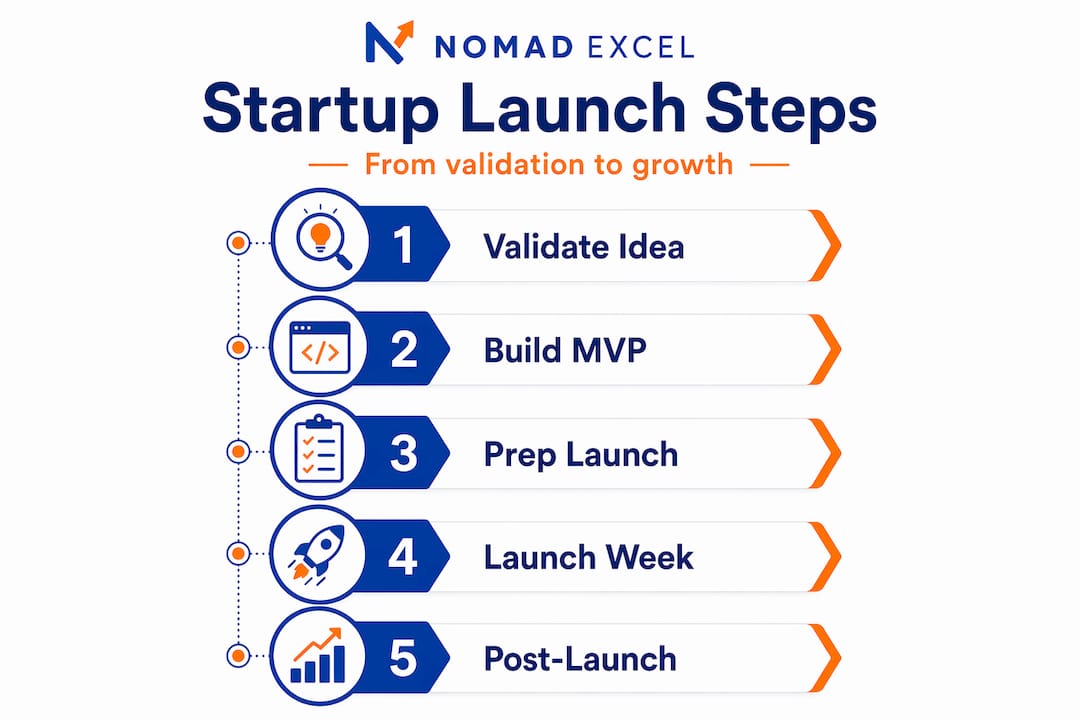
Most startup launches fail not because the idea was bad, but because the process was chaotic. Following a clear startup launch step by step approach is the single most reliable way to close the gap between a promising concept and a business that actually gains traction. This guide covers every critical phase: validating demand before you build, creating a focused MVP, preparing your operations, executing launch day with intention, and converting early momentum into sustainable growth. Whether you are pre-revenue or already talking to your first potential customers, this is the map you need.
Table of Contents
- Key takeaways
- Startup launch step by step: validating before you build
- Building an MVP that teaches you, not impresses you
- Preparing for launch: audience, assets, and operations
- Executing launch day and the week that follows
- Post-launch growth: retention, referrals, and learning
- My take on what actually separates good launches from great ones
- Ready to launch faster with expert support?
- FAQ
Key takeaways
| Point | Details |
|---|---|
| Validate before you build | Talk to real customers and test demand with a landing page before writing a single line of code. |
| Build narrow MVPs | Focus your MVP on your riskiest assumption only, not a full feature set. |
| Start audience building early | Begin growing your email list and community presence at least four weeks before launch. |
| Launch is a window, not a day | Plan your launch as a multi-week effort and monitor signals in week two for true conversion data. |
| Post-launch learning drives growth | The 30 days after launch are your highest-leverage window for retention, referrals, and iteration. |
Startup launch step by step: validating before you build
The most expensive mistake a founder can make is building a product nobody wants. Skipping validation leads to building the wrong product and forces costly late changes that could have been avoided with a few weeks of upfront research. Validation is not about proving yourself right. It is about finding out where you are wrong before it costs you six months and your savings.
Validation starts with a clear problem statement. Write down exactly who is suffering, what they are suffering from, and why existing solutions fall short. Then get in front of real people.
Here is how to run a practical validation sprint:
- Identify 10 real potential customers from your target segment, not friends or family who will tell you what you want to hear.
- Conduct structured interviews focused on their current behavior, pain points, and what they have already tried to solve the problem.
- Build a simple landing page describing your solution and include a sign-up or pre-order button to test genuine interest and willingness to pay.
- Drive traffic to the page through Reddit threads, niche Facebook groups, LinkedIn posts, or a small paid ad budget.
- Track the conversion rate on your landing page as a proxy for real demand.
A two-week validation sprint involving customer interviews and landing page sign-ups gives you enough signal to decide whether to build, pivot, or stop. That is far less painful than a two-month build cycle.
Common validation pitfalls include asking leading questions (“Would you use an app that does X?” gets you yes every time), treating compliments as validation, and skipping the willingness-to-pay test entirely. If someone won’t give you their email address or ten dollars to join a waitlist, they probably won’t pay later either.
Pro Tip: Check your startup idea validation checklist before launching into build mode. It takes an hour and can save you months of wasted effort.
Building an MVP that teaches you, not impresses you
Most founders build too much. The concept of a minimum viable product gets corrupted the moment founders start adding features “just to make it more polished.” The real purpose of an MVP is to test your riskiest assumption with the smallest possible build. That is it. Nothing more.

Start by mapping your assumptions. What must be true for your startup to succeed? Rank them by risk and by how quickly you can test them. The highest-risk, fastest-to-test assumption becomes your MVP’s focus.
Here is a sprint-based approach to MVP development:
- Write a one-sentence hypothesis. “We believe [customer type] will [take this action] because [this reason].” This forces clarity before coding starts.
- Scope the minimum build. What is the smallest possible version of the product that tests the hypothesis? This could be a Notion page, a Typeform, or a Zapier automation before writing custom code.
- Build in 8 to 12 week sprints with weekly reviews against your hypothesis, not a feature checklist. Analytics instrumentation should be wired in before you release to any beta users.
- Release to a small beta group of 20 to 50 users who match your validated customer profile, not just anyone willing to try it.
- Measure activated behavior, not sign-ups. Are users completing the core action your product is built around? That is your signal.
- Decide: persevere or pivot. Experienced founders treat MVPs as learning tools tied to retention metrics, not vanity sign-up numbers.
Two major traps to avoid: feature creep and ignoring technical debt. Feature creep kills focus. Technical debt accumulated in early sprints becomes a paralyzing problem at scale. Build lean and refactor regularly.
Pro Tip: If you can test your riskiest assumption with a spreadsheet and a Zoom call instead of a coded product, do that first. Save the engineering time for assumptions you have already validated.
Preparing for launch: audience, assets, and operations
Preparation is where most startups either set themselves up for a strong launch or guarantee a quiet one. The best practice for startups is to treat launch preparation as a phased timeline, not a to-do list you knock out in the final week.
A well-structured launch prep timeline looks like this:
| Phase | Timing before launch | Key activities |
|---|---|---|
| Idea validation | 6+ weeks out | Customer interviews, landing page testing, demand confirmation |
| Audience building | 4 weeks out | Email list growth, community engagement, social presence |
| Asset creation | 2 to 3 weeks out | Landing page, demo video, press kit, FAQ, social content |
| Operations setup | 2 weeks out | Licenses, permits, business banking, developer accounts |
| Launch week prep | 1 week out | Finalize messaging, brief partners, schedule posts |
Building your email list before launch is not optional. It is the difference between shouting into a void on day one and having 500 people ready to receive your message. Engage authentically in communities where your customers already spend time. Offer value first, whether that is a free resource, a useful thread, or honest answers to common questions. Deep niche community engagement before launch consistently produces stronger early adopters than last-minute broad promotions.
On the operational side, do not let paperwork derail your launch. Licenses and permits vary by industry and location and take time to process. Open a dedicated business bank account before you start accepting any payments. If you are launching a mobile app, note that Apple charges $99/year and Google Play charges a $25 one-time fee for developer accounts, and app review rejections are common, so build that timeline buffer in early.
Your launch assets should include a clear, conversion-focused landing page, a short demo video or product walkthrough, platform-specific social content (what works on LinkedIn rarely works on X or Instagram), and a thorough FAQ that proactively addresses objections. Tailoring your message to each platform is not extra work. It is what separates launches that generate press from ones that generate silence.
Executing launch day and the week that follows
Launch day feels like the finish line. It is actually the starting gun. Having a clear timeline keeps you from spending the morning panicking and the afternoon firefighting.
Here is how to approach launch day with intention:
- The night before: Do a final check on all links, landing pages, email sequences, and social posts. Queue everything you can. Brief any collaborators or community moderators on timing.
- Early morning post: Publish your primary platform launch post first thing. Post on your primary platform early, then email your waitlist, and then move to secondary platforms in sequence.
- Engage in real time: Reply to every comment. Thank every supporter publicly. Share your story, not just your features. People back people before they back products.
- Monitor metrics live: Watch your analytics dashboard for traffic sources, conversion rates, and drop-off points. If a specific community is sending high-quality traffic, double down on engagement there immediately.
- Handle support fast: Someone will encounter a bug or a confusing flow. Responding within minutes on launch day builds trust that no marketing budget can replicate.
The strongest conversion signals from your launch rarely appear on day one. Launch day spikes can be misleading — the real data you need to make decisions about retention and product direction tends to surface in the second week.
The post-launch week is where your entrepreneurship launch checklist should shift from broadcasting to listening. Schedule at least five user interviews within the first seven days. Fix any critical bugs within 24 hours. Send a launch recap email to your list that shares what you learned and what is coming next. Transparency at this stage builds loyalty that scales.
Post-launch growth: retention, referrals, and learning
The first 30 days after launch are your highest-leverage window as a founder. This is when your activation, retention, and NPS metrics paint the clearest picture of whether your product actually delivers on its promise, and where to focus next.
Here are the growth levers worth pulling immediately after launch:
- Build a referral loop. Happy early users are your best acquisition channel. A simple “invite a friend” mechanism with a meaningful incentive can compound your user base without ad spend.
- Start content marketing early. SEO takes time, but articles, tutorials, and case studies written in the first 30 days begin building organic authority that pays dividends for months.
- List on discovery platforms. Platforms like G2 and AlternativeTo generate sustained traffic well beyond launch day spikes. Submit your product to every relevant directory in your first week.
- Pursue partnerships and outreach. Identify adjacent tools, newsletters, and communities your users already trust. A single partnership with the right newsletter can outperform weeks of paid advertising.
- Run weekly iteration cycles. Use your NPS data and user interview notes to prioritize fixes and features. Ship fast, communicate changes openly, and watch retention metrics respond.
For deeper post-launch growth strategies, the pattern is consistent: founders who stay close to their users in the first month build better products than those who go heads-down on features. The feedback is the roadmap.
My take on what actually separates good launches from great ones
I have worked with hundreds of founders across bootcamps, retreats, and direct mentorship, and the pattern is remarkably consistent. The founders who launch well are almost never the ones who moved the fastest. They are the ones who were the most disciplined about sequence.
Validation before build. Build before broadcast. Broadcast before scale. When founders skip steps, they always pay for it later with either a pivot that costs months or a launch that lands in silence.
The mistake I see most often is treating launch day as the culmination of the work rather than the beginning of the learning. Founders pour everything into the launch post and then emotionally collapse when day-one numbers don’t match their expectations. But day one is not where startups win or lose. The second and third weeks, when you are doing unglamorous things like personally calling users who churned or rewriting your onboarding based on three pieces of feedback, that is where the real work happens.
One more thing: your early audience is not just a marketing channel. The people who sign up before you have social proof, before you have a polished product, before you have a single press mention, those people are telling you something about your idea that no market research report can replicate. Treat them accordingly.
Launch is not a moment. It is a posture you hold for months.
— Amichai
Ready to launch faster with expert support?
Following a startup launch guide on your own takes discipline, and the learning curve is steep when you are doing it solo. Nomadexcel’s online entrepreneurship bootcamp is built specifically for aspiring founders who want to compress that curve. The program walks you through validation, MVP development, launch prep, and early growth inside a structured, mentor-led environment alongside a community of driven peers. Rather than piecing together advice from articles and forums, you get a proven sequence delivered with accountability and real-time feedback. If you are serious about turning your idea into a real business, explore why joining a bootcamp might be the most efficient step you can take right now.
FAQ
What is the first step in launching a startup?
Validation comes first. Before building anything, test your core assumption by interviewing potential customers and measuring interest with a landing page sign-up or pre-order to confirm genuine demand.
How long does a startup launch take to prepare?
A well-structured launch typically requires six or more weeks of preparation, beginning with validation, followed by audience building starting four weeks out, and operational setup in the final two weeks before launch day.
What should a startup MVP include?
An MVP should include only what is needed to test your single riskiest assumption. That could be one core feature, a manual process wrapped in a simple interface, or even a landing page with a booking form before any product is built.
How do you measure startup launch success?
Focus on activated user behavior rather than total sign-ups. Metrics like activation rate, week-two retention, and Net Promoter Score (NPS) give you far more reliable signals than raw traffic or day-one downloads.
When should you start building your launch audience?
Begin building your email list and engaging in relevant communities at least four weeks before your planned launch date. Early community participation produces higher-quality early adopters than any last-minute promotion push.
Comments are closed.