
What Is Innovation Mindset and How to Develop It
TL;DR:
- An innovation mindset involves a personal drive toward learning, resilience, and creative problem-solving, rather than just a supportive culture. Research shows that individuals with a growth-oriented learning goal focus are more likely to engage fully in all stages of innovation. Developing this mindset requires continuous structural practices that reduce psychological costs of failure and foster ongoing reflection and collaboration.
Most people assume innovation comes from the right leadership, the right culture, or the right office environment. The research tells a different story. What is innovation mindset? At its core, it’s a personal orientation toward learning, challenge, and creative problem-solving that drives real innovation behavior. Not the ping-pong-table version of “innovation culture,” but the internal drive that determines whether someone generates ideas, pushes them forward, and sees them through. This article breaks down the science behind it, what it looks like in practice, and how you can build it within yourself and your team.
Table of Contents
- Key Takeaways
- What the innovation mindset actually means
- Why learning goal orientation is the real driver
- How team mindsets shape collective innovation
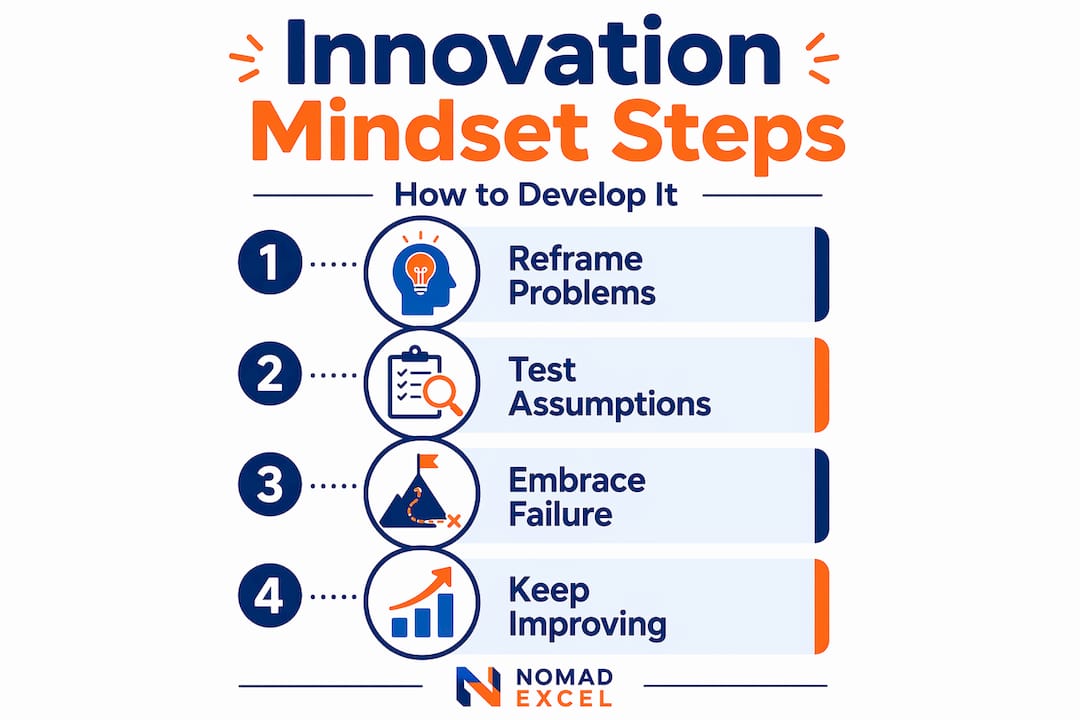
- How to develop an innovation mindset that sticks
- Common misconceptions that undermine mindset development
- My take: the mindset shift that changes everything
- Build your innovation mindset with Nomadexcel
- FAQ
Key Takeaways
| Point | Details |
|---|---|
| Mindset precedes innovation | Learning goal orientation predicts innovation behavior more reliably than leadership style or workplace culture. |
| It’s a bundle of behaviors | The definition of innovation mindset includes curiosity, resilience, adaptive thinking, and persistence through uncertainty. |
| Teams hold mindsets too | Shared team beliefs about learning and failure directly shape collective creativity and problem-solving performance. |
| Development requires structure | Shifting from competence-proving to mastery-focused evaluation is the most effective way to cultivate innovation mindset at scale. |
| Reframing problems matters | Regularly questioning whether you’re solving the right problem is as critical as generating new solutions. |
What the innovation mindset actually means
The definition of innovation mindset goes well beyond “thinking creatively.” It’s the capacity to view challenges as opportunities, adapt to change, and persist through uncertainty while maintaining a drive toward creative problem-solving. That last part matters. Persistence through uncertainty separates genuine innovation mindset from simple curiosity or enthusiasm for new ideas.
Psychologist Carol Dweck’s growth mindset concept laid foundational groundwork here. People who believe their abilities can be developed through effort approach obstacles very differently from those who see capability as fixed. The innovation mindset builds on that foundation, adding domain-specific behaviors tied to real work: identifying problems worth solving, generating solutions, and championing those solutions through organizational friction.
The characteristics of innovative thinkers tend to cluster around a few consistent traits:
- Curiosity without judgment. They ask “what if” before they ask “why not.”
- Resilience under ambiguity. Uncertainty doesn’t paralyze them; it activates them.
- Opportunity framing. Problems are starting points, not stopping points.
- Systems thinking. They see how parts connect, not just how individual components work.
- Adaptive problem-solving. They use frameworks like TRIZ (a structured method for inventive problem-solving) to challenge assumptions rather than default to familiar solutions.
Notice what’s missing from that list: raw intelligence, seniority, or access to resources. Innovation mindset is not a privilege of the experienced or the well-funded. It’s trainable, and that’s the most empowering part.
Pro Tip: When you encounter a problem this week, spend two minutes writing down what you’re assuming about the problem before you start solving it. Challenging those assumptions is where innovation mindset begins.
Why learning goal orientation is the real driver
Here’s where the research gets genuinely surprising. Most organizations spend enormous energy improving leadership quality, building psychological safety, and redesigning culture. Those things matter, but learning goal orientation is a stronger predictor of innovation outcomes than either of them.

Learning goal orientation means you’re motivated by mastery. You work hard because you want to get better at something, not because you want to prove you’re already good. Employees who carry this orientation engage more consistently in all three stages of innovation: idea generation, promotion, and implementation. That full-cycle engagement is rare and valuable.
Compare that to the other two common orientations:
| Goal Orientation | What Drives It | Impact on Innovation |
|---|---|---|
| Learning | Desire to master and grow skills | High across all innovation stages |
| Performance-approach | Desire to outperform others | Moderate, mostly at idea generation |
| Performance-avoidance | Desire to avoid looking incompetent | Low to negative; inhibits idea sharing |
The performance-avoidance orientation is particularly damaging. When people fear looking incompetent, they stop sharing half-formed ideas, they stop experimenting, and they stop failing forward. That’s the opposite of what innovation requires.
“The findings suggest that organizations would benefit from shifting their focus from managing innovation to fostering the right individual mindset orientations among employees.” — NTU Singapore Research
The practical implication is direct: if you want teams that innovate, you need to reduce the cost of failure and increase the reward for learning. That’s not a culture poster. It’s a structural change in how performance is evaluated and recognized.
How team mindsets shape collective innovation
Innovation mindset doesn’t stop at the individual. Teams develop their own shared beliefs about learning, failure, and collaboration, and those collective beliefs shape how the group behaves under pressure.
Team mindsets are measurable. Researchers have validated a Team Mindset Scale that captures shared beliefs about whether ability is fixed or developable at the group level. Teams that score high on growth-oriented dimensions approach setbacks as data. They debrief failures without blame and share knowledge across traditional silos. Teams that score low tend to protect information, avoid experiments, and interpret errors as evidence of collective incompetence.
The innovation mindset in business context gets complicated here because individual and team mindsets don’t always align. You can have a highly learning-oriented individual on a team that collectively punishes failure. The result is usually that person either suppresses their ideas or leaves.
| Team mindset dimension | Low expression | High expression |
|---|---|---|
| Learning from failure | Blame-focused debriefs | Data-focused retrospectives |
| Knowledge collaboration | Siloed expertise | Active cross-functional sharing |
| Challenge interpretation | Threats to avoid | Problems to solve together |
| Growth belief | Fixed team capability | Developable collective skills |
Inclusive leadership plays a meaningful role in this dynamic. Teams led inclusively show better innovation performance, largely because inclusive leaders create the conditions for team learning from failures to actually happen. Interestingly, that effect is moderated by career calling: team members who see their work as personally meaningful respond most strongly to inclusive leadership in terms of innovation behavior.
The takeaway for team leaders is this: your job isn’t to generate the best ideas. Your job is to build the conditions where learning from failure is normal, and where knowledge flows freely across the team. That’s what fostering an innovation mindset at the team level actually looks like.
Pro Tip: Run a “failure retrospective” after your next project. Ask only two questions: What did we learn? What would we do differently? Remove any language about who was responsible. You’ll see your team’s innovation mindset begin to shift within a few sessions.
How to develop an innovation mindset that sticks
Understanding what the innovation mindset is and actually building it are two different challenges. Here are the practices that research and real application support most strongly.
Shift the evaluation frame. Move from competence proving to mastery and learning in how you assess yourself and your team. Replace “Did you succeed?” with “What did you learn and what will you try next?” That single shift changes what behavior gets reinforced.
Build reflective habits into your work rhythm. Weekly reflection on what you tried, what surprised you, and what you’re still uncertain about builds the metacognitive muscle that innovation requires. Five minutes at the end of each Friday is enough to start.
Use collaboration as a creativity multiplier. Research confirms that knowledge collaboration mediates the relationship between learning orientation and creative output. The act of explaining your thinking to someone else sharpens it. Pair or small-group work isn’t just good for morale; it’s mechanically linked to better ideas.
Challenge your problem definition regularly. This one tends to get skipped. Retest your problem frame at least annually, and do lighter checks more frequently. Teams that never question whether they’re solving the right problem end up generating increasingly polished answers to the wrong question.
Practice and encourage experimental behavior explicitly. Set aside time for low-stakes experiments. Innovation mindset training works best when people have space to try things that might not work, without that outcome affecting their standing or reputation. You can explore specific team creativity exercises to start building this habit.
The thread connecting all five of these is the same: they all reduce the psychological cost of being wrong, and they all increase the perceived value of learning. That’s the operating system that an innovation mindset runs on.
Common misconceptions that undermine mindset development
A few persistent misunderstandings tend to derail even well-intentioned innovation mindset efforts. Getting clear on them saves significant time and frustration.
- Innovation mindset is not just ideation. Generating ideas is one phase. People with genuine innovation mindset behaviors also promote those ideas through skepticism and implement them through obstacles. The mindset has to carry you through all three stages.
- Leadership and culture are not substitutes for mindset. Great leaders and psychologically safe cultures create conditions where innovation mindset can flourish, but they don’t replace it. The NTU research is clear: individual mindset orientation is a more powerful predictor of innovation behavior than leadership quality on its own.
- Praise alone doesn’t build innovation mindset. Simply telling someone they have a “growth mindset” or praising effort without structure produces the superficial version. The mindset has to be operationalized through how work is actually evaluated and rewarded.
- Scale is a real challenge. Measuring and developing mindsets across a large organization is genuinely difficult. Team-level measurement tools help, but they require consistent application and leadership commitment to mean anything.
“Sustainable innovation requires continuously questioning problem definitions, not just creating ideas under stale frames.” — MIT Sloan Management Review
The organizations that get this right treat mindset development as an ongoing practice rather than a workshop. It shows up in how they hire, how they run meetings, how they debrief projects, and how they recognize contribution.
My take: the mindset shift that changes everything
I’ve worked with founders and teams across many different industries, and the pattern that surprises people most is this: the organizations with the most resources don’t innovate the most consistently. The ones that do have something quieter in common. They’ve built environments where being wrong early is treated as progress, not failure.
What the NTU research confirmed for me is something I’d observed for years before seeing the data. When you change what people are optimizing for, from “look competent” to “learn and improve,” everything else follows. The ideas get braver. The feedback gets more honest. The experiments get more interesting.
What I caution teams against is mistaking mindset training for a one-time event. A two-day workshop won’t do it. The mindset has to live in the systems: how you conduct reviews, how you celebrate learning, how you frame setbacks in all-hands meetings. I’ve seen teams transform their entrepreneurial resilience not through dramatic culture overhauls, but through small, consistent practices that made learning feel safer than hiding.
If you take one thing from this: don’t wait for better leadership or a more psychologically safe culture before you start building your own innovation mindset. Start with what you can control, your own orientation toward learning, and let that compound.
— Amichai
Build your innovation mindset with Nomadexcel
Understanding what innovation mindset means is the first step. Putting it into practice, with the right structure, community, and real-world pressure, is where growth actually happens. Nomadexcel designs immersive programs specifically for entrepreneurs and teams who want to translate mindset into results.
The Online Entrepreneurship Bootcamp at Nomadexcel brings together driven founders for hands-on learning, expert mentorship, and a community built around execution and creative problem-solving. Every program is designed to push participants through the full innovation cycle: generating ideas, testing them, and building systems to implement them at scale.
For teams, the inspiring business retreats Nomadexcel facilitates are built around exactly the kind of shared learning experiences that shift team mindsets from performance-avoidance to genuine growth orientation. If you’re ready to stop theorizing and start building, this is where that shift happens.
FAQ
What is an innovation mindset in simple terms?
An innovation mindset is the combination of attitudes and behaviors that leads a person to view challenges as opportunities, persist through uncertainty, and continuously seek better ways to solve problems. It goes beyond idea generation to include promoting and implementing ideas through real obstacles.
How does learning goal orientation relate to innovation?
Learning goal orientation, the motivation to develop skills and master new challenges, is a stronger predictor of innovation behavior than leadership style or workplace culture, according to NTU Singapore research. It drives engagement across all stages of innovation from ideation through implementation.
Can teams develop a collective innovation mindset?
Yes. Research from BMC Psychology confirms that teams hold shared beliefs about ability and learning that function like an organizational mindset. Teams that score high on growth-oriented dimensions collaborate more freely, learn from failures constructively, and consistently out-innovate more fixed-minded groups.
How often should teams revisit their problem framing?
MIT Sloan Management Review recommends testing your problem frame at least once a year, with lighter check-ins more frequently. Teams that never question whether they’re solving the right problem tend to produce solutions that address symptoms rather than causes.
What is the biggest mistake in innovation mindset training?
The most common mistake is treating innovation mindset development as a single event, like a workshop, rather than embedding it in ongoing evaluation systems, team rituals, and leadership behavior. Mindset shifts require structural reinforcement, not just exposure to new ideas.
Comments are closed.