
The Step by Step Mentorship Process That Works
TL;DR:
- Effective mentorship requires structured goal-setting, consistent communication, and regular progress assessments to prevent relationship stagnation. Preparing specific objectives, mapping a clear process, and tracking skill development ensure measurable results and mutual accountability. The primary success indicator is when the mentee becomes independent and no longer requires direct guidance, signifying a well-rounded mentorship journey.
Mentorship sounds simple until you are actually in it. You have a mentor lined up, good intentions on both sides, and then the relationship quietly loses momentum after a few meetings. The step by step mentorship process exists to prevent exactly that. When both parties follow a clear mentorship process outline, progress becomes visible, expectations stay aligned, and the relationship produces real results instead of vague encouragement. This guide walks you through every stage, from initial preparation through final evaluation, with the kind of detail most overviews skip entirely.
Table of Contents
- Key takeaways
- What you need before starting mentorship
- The step by step mentorship process outline
- Common challenges in mentorship and how to avoid them
- Measuring success in your mentorship journey
- My take on what actually makes mentorship work
- Ready to put this process into action?
- FAQ
Key takeaways
| Point | Details |
|---|---|
| Preparation determines outcomes | Clarifying your goals and gathering tools like skill matrices before starting shapes the entire mentorship trajectory. |
| Structure beats goodwill | A stepwise mentoring approach with milestones outperforms informal check-ins every time. |
| Feedback requires a system | Regular, documented feedback at defined intervals keeps progress measurable and momentum alive. |
| Challenges are predictable | Misaligned expectations and inconsistent meetings are the most common pitfalls, and both are preventable. |
| Graduation is a planned event | Knowing when and how to conclude or evolve the relationship is just as important as how you begin it. |
What you need before starting mentorship
Most people skip preparation entirely and then wonder why the relationship feels unfocused after six weeks. The foundation you build before the first real session either sets you up for acceleration or keeps you circling the same conversations indefinitely.
Start by getting specific about what you actually want. Personal development mentoring works best when the mentee brings a clear, focused challenge rather than a broad aspiration. Research confirms that a specific, time-bound ask creates far greater commitment from the mentor than a generic “I’d love your guidance” request. “Help me get promoted in 12 months” is weaker than “Help me build the stakeholder communication skills that are blocking my path to a senior role.”
Beyond goal clarity, you need to understand the roles involved in mentoring relationships explained properly. The mentor provides direction, frameworks, feedback, and sometimes connections. The mentee brings effort, honesty, and follow-through. Neither role is passive. If you treat mentorship as something that happens to you, you will walk away frustrated.
Practical preparation steps to complete before session one:
- Write a one-paragraph summary of your current situation and where you want to be in 6 to 12 months
- Identify two or three specific skill gaps using a simple self-assessment or skill matrix scored from 1 to 5
- Research your mentor’s background so you can ask targeted questions, not generic ones
- Decide on your preferred meeting cadence and be ready to propose it
- Set up a simple progress tracking document, whether a shared Google Doc, a Notion page, or a structured journal
Pro Tip: Consider building what some advisors call a “Personal Board of Directors.” Research suggests that 4 to 7 mentors with distinct roles such as a Challenger, a Connector, or a Technical Expert, creates more diversified support than relying on one person for everything.
The step by step mentorship process outline
This is where structure becomes the difference between a relationship that transforms you and one that just takes up calendar space. The following stages represent a tested mentorship process outline, drawn from real frameworks used in professional development contexts.
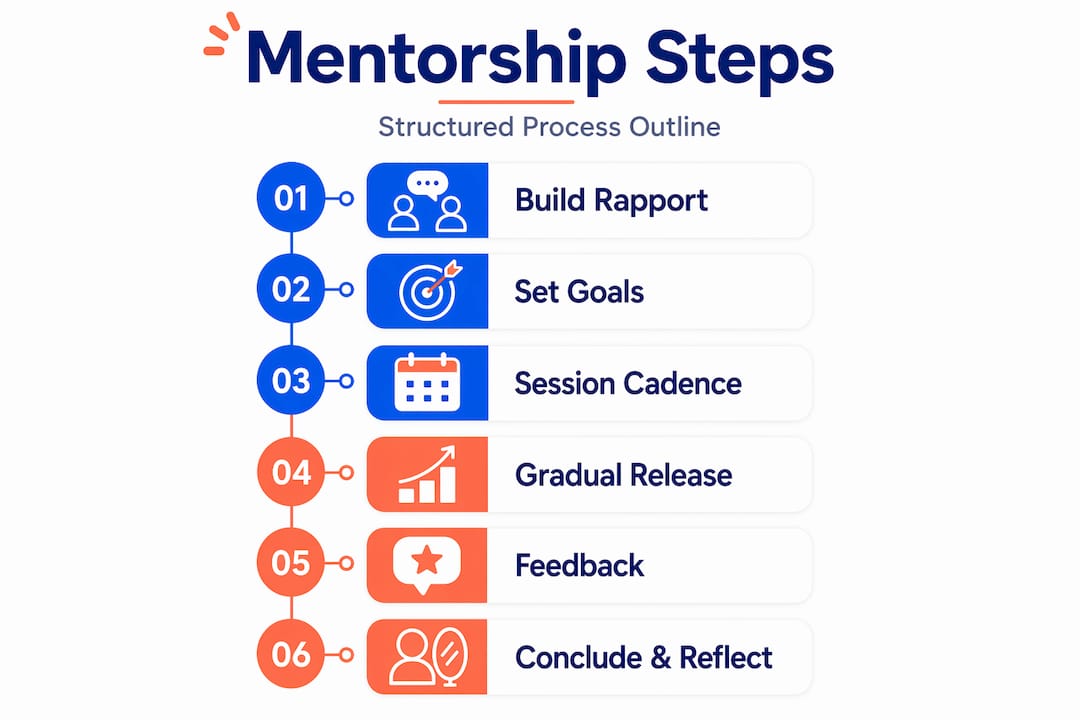
1. Build rapport and establish psychological safety
Your first one or two sessions are not about solving problems. They are about creating enough trust that the real problems get shared. Ask your mentor about their own pivotal challenges and failures. Share yours. A relationship where the mentee only shows polished progress is a relationship where the mentor cannot actually help.
2. Set collaborative, time-bound goals
Once rapport is established, co-create your goals rather than presenting a finished list. Goals that the mentor helped shape receive more genuine attention. Mentorship success hinges on clarity from the start, including defining what success looks like and how milestones will be tracked.
3. Map a session cadence and accountability system
Decide how often you will meet, how long each session will last, and who owns the agenda. The mentee should own the agenda. Research indicates that a minimum of 6 hours of interaction over 12 months, with a formal midpoint check at 5 to 6 months, maintains the momentum that most relationships lose after the initial enthusiasm wears off.
4. Execute with gradual release of responsibility
This stage borrows from a well-validated framework in adult learning. The progression moves from demonstration to guided practice to independent execution. The research on gradual release of responsibility shows it is highly effective, but requires the mentor to revisit earlier stages when the mentee hits complex new territory. Do not treat it as a rigid ladder. Treat it as a flexible progression.
5. Hold structured feedback sessions
Feedback should follow a format, not a mood. A simple structure: what went well, what specifically needs to change, one concrete next action. Unstructured feedback loops are where most mentoring relationships lose their edge. The mentee starts hearing general encouragement instead of targeted direction.
6. Conclude and reflect with intention
The final stage of the personal development mentoring cycle is often handled carelessly. A strong conclusion includes a formal reflection session where both parties review the original goals, document what was achieved, and discuss what comes next. This is not just closure. It is a knowledge capture exercise that informs the mentee’s next development phase.
| Stage | Key activity | Marker of completion |
|---|---|---|
| Rapport building | Mutual sharing and trust exercises | Both parties feel comfortable with honest dialogue |
| Goal setting | Collaborative milestone mapping | Written goals with timelines agreed upon |
| Cadence planning | Meeting schedule and accountability setup | Calendar invites sent and agenda ownership assigned |
| Skill execution | Gradual release practice with feedback | Mentee completing tasks with decreasing supervision |
| Feedback loops | Structured bi-weekly or monthly reviews | Progress documented and goals adjusted as needed |
| Conclusion | Reflection session and transition planning | Final review completed, next steps defined |
Pro Tip: Many programs with a stepwise mentoring approach build in a sensitization and role-play stage before real-world practice begins. This dramatically reduces the anxiety that often freezes mentees at the execution phase.
Common challenges in mentorship and how to avoid them
Even the best-matched pairs hit friction. Knowing where mentoring relationships typically break down gives you the ability to course-correct before real damage is done.
The most damaging pattern is misaligned expectations. One person expects structured technical coaching while the other provides motivational conversation. Research is direct on this: mentoring is primarily structured technical work, not emotional support. The relationship follows from achieving real milestones together, not from enjoying the conversations.
Other common failure points include:
- Inconsistent meeting frequency: When sessions are cancelled repeatedly and rescheduled without urgency, both parties unconsciously signal that the relationship is not a priority. Protect the meeting time fiercely.
- Agenda drift: Sessions that lack a written agenda tend to become venting sessions. The mentee leaves feeling heard but not moved forward.
- One-sided effort: If the mentor is doing most of the thinking and the mentee is mostly listening, the dynamic is broken. The mentee must arrive prepared with updates, questions, and attempted solutions.
- Avoiding hard feedback: Mentors who only validate keep the mentee comfortable but stuck. This is one of the clearest signs a relationship needs a reset conversation.
“The relationship between mentor and mentee should feel like a professional partnership with a shared destination, not a support group with open-ended membership.” Nomad Excel
The best practices for mentorship treat difficult conversations as part of the program, not exceptions to it. If something feels off, name it early and specifically.
Measuring success in your mentorship journey
Knowing when you have actually achieved your mentorship goals requires more than a feeling. It requires a system. This is where most mentees underinvest, and where the mentoring steps for success become genuinely measurable.

Skill matrices are one of the most practical tools available. When both mentor and mentee independently score competencies on a 1 to 5 scale and then compare results, the gaps that surface become immediate teaching moments. Skill matrices scored independently by both parties create far more objective and useful conversations than asking “how do you think you are doing?”
Beyond skill scoring, here is a simple framework for tracking mentorship effectiveness over time:
| Evaluation tool | When to use | What it measures |
|---|---|---|
| Skill matrix comparison | Start and every 6 weeks | Competency growth across defined skill areas |
| Midpoint survey | Month 5 or 6 | Relationship quality, goal alignment, and satisfaction |
| Goal progress scorecard | Every session | Weekly action completion and milestone advancement |
| Final reflection survey | Last session | Overall outcome achievement and readiness for next phase |
| Independence audit | End of program | Ability to execute without mentor direction |
Recognizing readiness for independence is itself a skill. When a mentee begins arriving at sessions with their own solutions and is primarily looking for validation rather than direction, that is a positive signal. It means the structured program has worked. The next step is either concluding the relationship gracefully or evolving it into a peer advisory dynamic where the role of mentorship networks continues to serve long-term development.
Pro Tip: Run a brief personal scorecard at the end of every session. Rate three things on a scale of 1 to 10: clarity of direction, energy level after the session, and confidence in your next step. If scores consistently drop below 6, bring it up in your next meeting before it becomes a pattern.
My take on what actually makes mentorship work
I have seen mentorship described as a transformational relationship, a vital lifeline, and a career accelerator. All of that can be true. But in my experience, the version that actually changes people’s trajectories has one quality that most descriptions miss: it is boring in the best possible way.
What I mean is that the mentorship relationships I have witnessed produce real results when they look like disciplined work. The mentor and mentee show up with agendas. They track numbers. They revisit the same skill gap four sessions in a row without apologizing for the repetition. There is no magic moment. There is just consistent, structured effort applied in the right direction.
The most common mistake I see is mentees who want a mentor to give them energy and inspiration. That is not wrong, but it is the wrong primary goal. The right primary goal is to use the mentor’s experience to compress your learning curve on a specific challenge. Everything else, the connection, the motivation, the community, tends to follow naturally when the technical work is rigorous.
I also think the “when to end” question is underrated. In my view, a mentorship relationship that never graduates the mentee has failed at one of its core jobs. The goal of a good mentor is to become unnecessary. When the mentee can articulate their own gaps, design their own plan, and execute with confidence, that is the outcome worth celebrating.
— Amichai
Ready to put this process into action?
Understanding the step by step mentorship process is one thing. Having a structured program that builds it in from day one is another. Nomadexcel’s online entrepreneurship bootcamp is built around exactly the kind of structured mentorship, daily accountability, and expert guidance this article describes. If you are an entrepreneur ready to move from theory to execution with real mentors and a community that holds you to your goals, the entrepreneur mentorship guide is your natural next step. Nomadexcel brings the framework. You bring the commitment.
FAQ
What is a step by step mentorship process?
A step by step mentorship process is a structured series of stages that guide both mentor and mentee from initial goal-setting through skill development to a planned conclusion. It includes rapport building, collaborative goal setting, accountability systems, feedback loops, and a formal evaluation phase.
How long should a mentorship process take?
Most effective mentorship programs run for 6 to 12 months. Research recommends a minimum of 6 hours of meaningful interaction over that period, with a formal midpoint check at months 5 or 6 to maintain direction and energy.
What are the best practices for mentorship?
The core best practices for mentorship include defining specific goals before the first session, maintaining a consistent meeting cadence, using skill matrices to track progress objectively, and treating feedback as a structured process rather than an informal conversation.
How do you measure success in a mentorship relationship?
Use a combination of skill matrix comparisons at regular intervals, midpoint and final surveys, and a personal scorecard after each session. When the mentee consistently arrives with their own solutions and requires less direction, that signals the program has achieved its goal.
What is the most common reason mentorships fail?
Misaligned expectations are the leading cause. When one party expects structured technical guidance and the other provides only general encouragement, progress stalls. Establishing a clear mentorship process outline at the start prevents this almost entirely.
Comments are closed.