
Business Growth Strategies: 30% Faster Startup Success 2026
Despite ambitious plans, only 1 in 8 companies achieve sustained profitable growth even though most leaders prioritize it. The gap between intention and execution reveals a critical truth: growth demands structured, evidence-backed strategies. This guide delivers actionable frameworks combining data-driven insights, market tactics, and customer-centric approaches to help aspiring entrepreneurs and early-stage startups build scalable success.
Table of Contents
- Understanding Business Growth Fundamentals
- Data-Driven Decision Making for Scalable Growth
- Market Penetration and Revenue Diversification
- Customer-Centric Growth Approaches
- Growth Mindset and Execution Discipline
- Mentorship and Community in Growth Execution
- Common Misconceptions About Business Growth
- Actionable Frameworks and Next Steps for Entrepreneurs
- Accelerate Your Startup Success with Nomad Excel
Key Takeaways
| Point | Details |
|---|---|
| Strategic Discipline | Growth requires intentional execution and resource prioritization, not just ambition. |
| Data-Driven Insights | Analytics reduce risk and improve decision-making for sustainable scaling. |
| Market and Revenue Tactics | Penetration strategies and diversification create stable, scalable income streams. |
| Customer-Centric Focus | Retention-focused approaches boost profitability by up to 25%. |
| Mentorship Acceleration | Community and guidance increase startup success rates by up to 30%. |
Understanding Business Growth Fundamentals
Growth isn’t automatic. It’s a strategic, intentional process requiring the right mindset, clear strategy, and dedicated resources.
Most founders treat growth as a byproduct of a good product. That’s a mistake. Sustained scaling demands discipline in execution, resource allocation, and continuous learning. Entrepreneurship bootcamps and mentorship drive faster learning and application critical for startup growth.
Think of growth as a muscle. You build it through consistent training, not occasional bursts. Building a growth mindset establishes the foundation. Strategic frameworks provide the structure. Mentorship programs accelerate the timeline.
Here’s what matters for early-stage founders:
- Align your team around clear, measurable growth objectives
- Commit resources intentionally to high-impact initiatives
- Build systems for execution discipline and accountability
- Invest in learning from experienced operators who’ve scaled before
Understanding business growth fundamentals means recognizing that strategy without execution fails. Execution without strategy wastes resources.
Pro Tip: Start each quarter by identifying your single most important growth lever. Allocate 70% of your resources there. This focused approach beats spreading effort across multiple initiatives.
Data-Driven Decision Making for Scalable Growth
You can’t scale what you don’t measure. Analytics transform guesswork into informed action.
Data-driven decision making and advanced analytics improve resource allocation and help anticipate market demand. Real-time dashboards let you spot trends before competitors. Customer behavior data reveals what drives conversions and retention.
Consider a SaaS startup tracking user engagement. They notice 80% of churn happens within the first 30 days. Armed with this insight, they build an onboarding sequence that cuts early churn by 40%. That’s the power of data.
Effective startups use analytics to:
- Identify which customer segments deliver highest lifetime value
- Forecast demand patterns to optimize inventory and staffing
- Test pricing strategies with precision and measure impact
- Validate product features before committing development resources
The key is choosing metrics that matter. Vanity metrics like social media followers feel good but don’t drive revenue. Focus on conversion rates, customer acquisition cost, lifetime value, and retention.
Growth frameworks integrate data at every decision point. They create repeatable systems for testing, learning, and optimizing. This approach to data-driven growth reduces risk as you scale.
Pro Tip: Set up weekly metric reviews with your team. Choose five core metrics. Track trends, not just absolute numbers. This rhythm builds data literacy across your organization.
Insight: Companies using advanced analytics to guide resource allocation see 15-20% improvement in ROI compared to those relying on intuition alone.
Market Penetration and Revenue Diversification
Expanding market share and stabilizing income streams requires tactical precision.

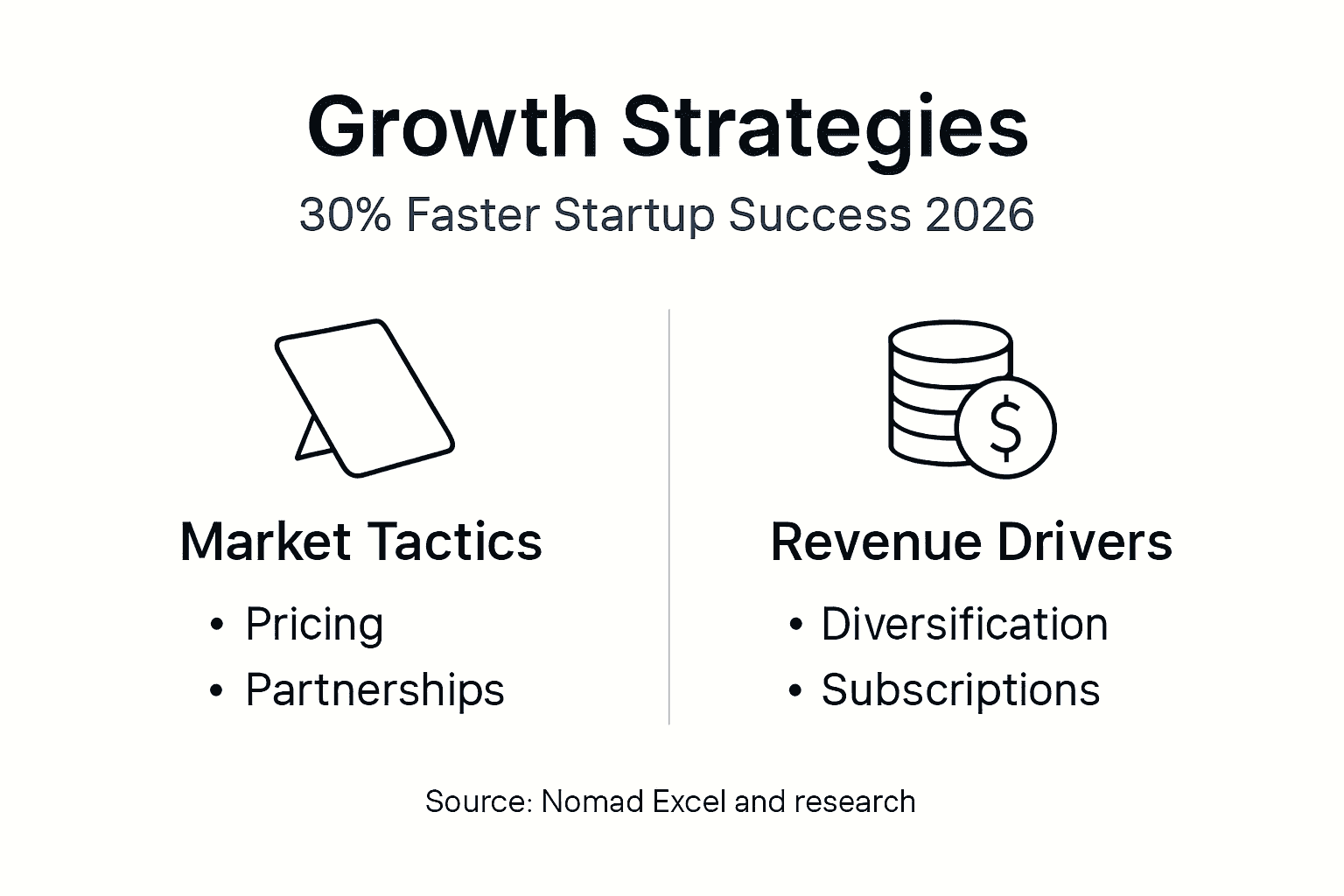
Competitive pricing and promotions boost revenue by up to 15% in one year. Strategic partnerships amplify this impact. Forging partnerships can increase revenue growth by 20-30% and expand market reach by 70%.
Market penetration starts with understanding your competitive position. Price aggressively in underserved segments. Run targeted promotions to convert price-sensitive customers. Build brand awareness through consistent presence where your customers spend time.
Revenue diversification protects against market volatility. Diversifying with complementary products and subscription models improves revenue stability by 10-20%. Think recurring revenue, upsells, and new customer segments.
| Strategy | Primary Benefit | Implementation Timeline |
|---|---|---|
| Competitive Pricing | 10-15% revenue increase | 1-3 months |
| Strategic Partnerships | 20-30% growth acceleration | 3-6 months |
| Product Diversification | 10-20% stability improvement | 6-12 months |
| Subscription Models | Predictable recurring revenue | 4-8 months |
Combining penetration with diversification creates balanced growth. Strategic partnerships give you immediate market access. Product expansion builds long-term resilience.
Here’s how to execute:
- Research competitor pricing and position yourself strategically
- Identify partnership opportunities with complementary businesses
- Test new revenue streams with minimal viable offerings
- Build subscription options that deliver ongoing value
The startups that master practical growth strategies in market penetration and revenue diversification build defensible positions. They’re not dependent on one product, one customer segment, or one revenue model.
Customer-Centric Growth Approaches
Retaining customers drives profitability faster than constantly chasing new ones.
Customer-centric strategies using CRM tools increase profitability by up to 25%. The math is simple: keeping existing customers costs 5-7 times less than acquiring new ones. Happy customers buy more, refer others, and provide valuable feedback.
Personalization makes the difference. Generic email blasts get ignored. Tailored recommendations based on purchase history drive action. CRM platforms help you track customer interactions, preferences, and pain points across every touchpoint.
Think about subscription box companies. They analyze what customers keep versus return. They adjust future shipments based on preferences. This personalization boosts retention rates by 30-40%.
Focus on these customer-centric tactics:
- Implement CRM systems to track customer journey and engagement
- Personalize communications based on behavior and preferences
- Build feedback loops to continuously improve your offering
- Create loyalty programs that reward repeat business
The best startups obsess over customer experience. They respond quickly to support requests. They proactively solve problems before customers complain. They treat every interaction as an opportunity to build loyalty.
Customer engagement and accountability structures ensure your team delivers consistent value. Regular check-ins, satisfaction surveys, and usage monitoring keep you connected to customer needs.
Pro Tip: Map your customer journey from first contact to repeat purchase. Identify friction points where customers drop off. Fix one friction point per quarter. This systematic approach compounds over time.
Prioritizing customer-centric approaches transforms your startup from product-focused to value-focused. That shift drives sustainable, profitable growth.
Growth Mindset and Execution Discipline
Strategy fails without execution. Most startups stumble here.
Only 22% of business leaders have effective team and resource allocation for growth despite 72% prioritizing it. This execution gap kills more startups than bad ideas.
Cultivating a growth mindset starts with leadership. You must model boldness, embrace failure as learning, and stay relentlessly focused on customer value. Your team mirrors your approach.
Execution discipline means doing what you said you’d do. It’s weekly progress reviews, clear accountability, and removing obstacles fast. It’s saying no to distractions that don’t serve your growth priorities.
Consider two startups with identical strategies. One has weekly accountability check-ins, clear ownership of initiatives, and rapid iteration cycles. The other has monthly meetings and vague responsibilities. The first scales. The second stalls.
Build execution discipline through:
- Clear ownership assignments for every growth initiative
- Weekly progress reviews with specific metrics
- Rapid iteration cycles that test and learn quickly
- Resource commitment that matches stated priorities
The entrepreneurial mindset shift from employee to owner thinking drives execution. Employees wait for direction. Owners solve problems proactively. Developing a strong founder mindset means taking responsibility for outcomes, not just activities.
Building a growth mindset also requires viewing challenges as opportunities. When growth slows, ask what you can learn and improve. Don’t blame external factors you can’t control.
Reality Check: About 80% of startup failures stem from execution gaps, not idea quality. The difference between success and failure is consistent, disciplined action on the right priorities.
Most startup failures due to execution problems could be prevented with better systems and accountability.
Mentorship and Community in Growth Execution
You don’t have to figure everything out alone. Smart founders seek guidance.
Mentorship increases startup success rates by up to 30%, while community fosters ongoing collaboration and support. Experienced mentors help you avoid costly mistakes. They’ve navigated challenges you’re facing for the first time.
Entrepreneurship communities provide peer learning, accountability, and motivation during tough stretches. When you’re struggling with pricing strategy, someone in your community has likely solved it. When you’re questioning your direction, peers offer perspective.
Bootcamp-style programs blend structured learning with practical application. You learn frameworks in the morning, apply them to your business in the afternoon. This hands-on approach accelerates results compared to passive learning.
Here’s what effective mentorship delivers:
- Pattern recognition from someone who’s scaled businesses before
- Honest feedback on blind spots and weak assumptions
- Connections to resources, partners, and potential customers
- Accountability that keeps you executing on commitments
The mentorship program guide approach transforms how quickly you implement growth strategies. Instead of trial and error over years, you compress learning into months.
Community creates sustained momentum. Weekly check-ins with peers who understand your challenges maintain focus. Shared wins inspire continued effort. Collaborative problem-solving generates solutions faster than solo work.
Accountability in growth structures prevents the common pattern of starting strong then fading. When you commit publicly to goals, you’re more likely to follow through.
Mentorship and community support create a multiplier effect on everything else you’re doing. Better decisions, faster execution, and sustained motivation compound over time.
Common Misconceptions About Business Growth
Let’s clear up myths that hold founders back.
Myth: A great idea guarantees growth. Reality: About 80% of startups fail due to poor execution despite having good ideas. Execution matters more than the initial concept.
Myth: Growth happens automatically after product launch. Reality: Launch is just the beginning. Sustained growth requires ongoing strategy, resource allocation, and optimization. Most successful products gained traction through deliberate growth tactics, not organic virality.
Myth: Customer acquisition is more important than retention. Reality: Retention drives profitability. A 5% increase in retention can boost profits by 25-95%. Focus equal energy on keeping customers as getting new ones.
Myth: You should scale as fast as possible. Reality: Premature scaling kills startups. Growing faster than your operations, cash flow, or team can handle leads to quality problems, customer churn, and burnout.
Key misconceptions to avoid:
- Believing you can outwork poor strategy through sheer effort
- Thinking all growth metrics matter equally
- Assuming competitors’ success means they’re doing everything right
- Expecting linear progress instead of the reality of plateaus and breakthroughs
Understanding growth mindset misconceptions helps you focus on what actually drives results. The execution failure statistic should motivate you to prioritize systems and discipline over clever ideas.
Growth requires balancing multiple priorities simultaneously. Product development, customer acquisition, retention, team building, and financial management all need attention. The art is knowing which lever to pull when.
Actionable Frameworks and Next Steps for Entrepreneurs
Now let’s translate everything into a concrete action plan.
Structured growth frameworks integrating market, customer, and resource strategies enable clear prioritization and sustained execution. Here’s your six-step implementation roadmap:
Identify and validate opportunities using data analytics. Set up dashboards tracking customer acquisition cost, lifetime value, conversion rates, retention, and revenue per customer. Analyze which segments and channels perform best. Validate assumptions with small tests before scaling.
Execute market penetration and diversify revenue. Research competitor pricing and position strategically. Launch targeted promotions in high-potential segments. Identify three potential strategic partners. Test one new revenue stream as a minimal viable offering.
Boost retention through personalized engagement. Implement a CRM system if you don’t have one. Segment customers by behavior and preferences. Create personalized communication flows. Build a loyalty program that rewards repeat business.
Cultivate growth mindset and enforce execution discipline. Set clear quarterly objectives with specific metrics. Assign ownership for each initiative. Schedule weekly progress reviews. Remove obstacles and reallocate resources as needed.
Engage with mentorship and community for accountability. Find a mentor who’s scaled a business in your industry. Join an entrepreneur community or bootcamp program. Commit to weekly check-ins with peers or advisors.
Continuously evaluate and adjust based on performance data. Review metrics weekly. Run monthly strategy sessions to assess what’s working. Pivot quickly when tactics aren’t delivering expected results. Double down on what’s driving growth.
| Framework Component | Key Actions | Expected Outcome |
|---|---|---|
| Data Analysis | Set up dashboards, validate assumptions | Informed decision-making |
| Market Tactics | Penetration pricing, partnerships | 15-30% revenue growth |
| Customer Focus | CRM implementation, personalization | 25% profitability increase |
| Execution Systems | Weekly reviews, clear ownership | Consistent progress |
| Mentorship Support | Regular guidance, accountability | 30% higher success rate |
Your growth framework guide provides detailed templates for each step. Accountability for growth structures keep you on track. Mentorship programs accelerate implementation.
Start with step one this week. Complete steps two and three over the next 30 days. Build steps four through six into your ongoing operations. This phased approach prevents overwhelm while maintaining momentum.
Accelerate Your Startup Success with Nomad Excel
Ready to transform these strategies into tangible results?
Nomad Excel’s Online Entrepreneurship Bootcamp delivers hands-on training in the exact frameworks covered here. You’ll work directly on your business with guidance from experienced entrepreneurs who’ve scaled ventures successfully. Our Mentorship Program Guide connects you with operators who provide personalized feedback and accountability. You’ll join a community of driven founders who support each other through challenges and celebrate wins together. Stop struggling alone with execution gaps. Accelerate your path to scalable growth through proven systems, expert mentorship, and a community that keeps you accountable. Explore programs at Nomad Excel and start building the business you envision.
Frequently Asked Questions
How do I validate my startup growth ideas before investing significant resources?
Start with small-scale tests measuring specific customer behaviors. Run a landing page experiment, limited beta launch, or pilot program with 20-50 users. Track conversion, engagement, and willingness to pay. Validated learning costs far less than building the wrong thing at scale.
What role does mentorship play in accelerating business growth?
Experienced mentorship programs compress years of trial and error into months of guided execution. Mentors help you avoid costly mistakes, make better strategic decisions, and stay accountable to commitments. Their pattern recognition from scaling businesses gives you shortcuts you can’t find in books.
How can startups balance customer acquisition with retention effectively?
Allocate resources based on customer lifetime value and acquisition cost ratios. If your LTV:CAC ratio exceeds 3:1, invest more in acquisition. Below 3:1, focus on retention and increasing customer value. Most early-stage startups should spend 60% on acquisition, 40% on retention until product-market fit is proven.
What are initial steps for applying growth strategies without large budgets?
Start with free analytics tools to understand current performance. Implement one customer retention tactic like personalized email sequences. Test one market penetration strategy such as strategic partnerships requiring time but not money. Build execution discipline through weekly self-reviews. Join free entrepreneur communities for peer learning. Comprehensive growth frameworks scale with your budget.
How long does it typically take to see results from growth strategies?
Quick wins from pricing tests or promotions appear in 30-60 days. Customer retention improvements show impact in 90-120 days. Strategic partnerships and product diversification take 6-12 months. Execution discipline and mindset shifts compound over 12-24 months. Expect early momentum within the first quarter, with compounding effects building over the first year.
Comments are closed.